
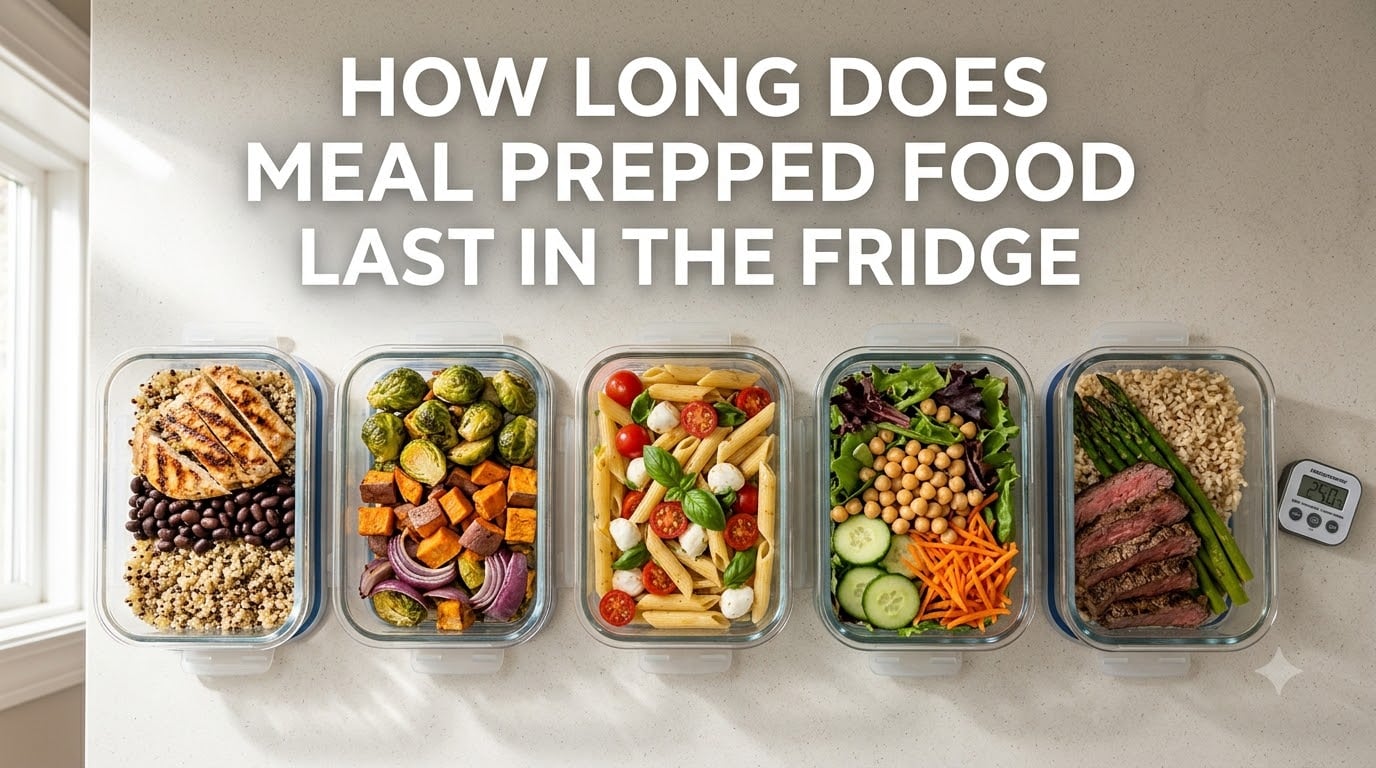
Most meal prepped food lasts 3 to 4 days in the fridge when stored at 40 degrees Fahrenheit or below, following USDA food safety guidelines. That single line is the answer most people need when Sunday afternoon batch-cooking wraps up and the work week looms ahead.
I used to panic every Sunday night, staring at five identical glass containers and wondering which one was still safe to eat on Friday. After a year of testing, talking to food safety experts, and reading USDA guidance line by line, I have the answer locked in. This guide gives you the quick rule, the food-by-food breakdown, the 3-3-3 rule that finally makes meal planning simple, and the warning signs that mean it is time to toss a container.
Table of Contents
How Long Does Meal Prepped Food Last in the Fridge
The general rule is 3 to 4 days for most cooked meal prep stored in the fridge at 40 degrees Fahrenheit or below. Some foods hold up for 5 or even 6 days, but 4 days is the safe planning window if you batch cook on Sunday and eat through Friday.
The General 3 to 4 Day Rule
USDA, the CDC, and most state health departments agree on this window. Cooked food kept in the fridge should be eaten within 3 to 4 days for the best balance of safety and quality. Past day 4, the risk of bacterial growth climbs even if the food still looks fine.
Reddit’s r/MealPrepSunday community runs a daily thread where members share their own timelines. The strongest consensus is “3-4 days in the fridge, 3-4 months in the freezer.” That phrase shows up so often it has become the unofficial motto of the sub.
Why Most Meal Prep Lasts Only 3 to 4 Days
Bacteria like Listeria, Salmonella, and Staphylococcus aureus all grow in the “danger zone” between 40 degrees Fahrenheit and 140 degrees Fahrenheit. Your fridge should hold food below 40 degrees F, but bacteria still multiply slowly even at safe temperatures. Over 3 to 4 days, the count can climb high enough to make you sick, especially in moisture-rich foods like rice, chicken, and cooked vegetables.
Texture and taste also decline. Chicken dries out, pasta turns mushy, and leafy greens wilt past the point of rescue. Day 4 is usually when flavor drops off a cliff.
Meal Prep Shelf Life by Food Type
Different foods break down at different speeds. Below is the breakdown I use when planning a Sunday prep session, based on USDA guidelines and what meal preppers actually report in practice.
| Food Category | Fridge Life (at 40F or below) | Freezer Life |
|---|---|---|
| Cooked chicken and poultry | 3 to 4 days | 2 to 6 months |
| Beef, pork, and lamb | 3 to 4 days | 2 to 6 months |
| Seafood and fish | 3 to 4 days | 2 to 3 months |
| Rice and grain bowls | 3 to 4 days | 1 to 2 months |
| Pasta and noodle dishes | 3 to 5 days | 1 to 2 months |
| Soups, stews, and chili | 4 to 6 days | 4 to 6 months |
| Cooked beans and legumes | 3 to 4 days | 2 to 3 months |
| Leafy green salads | 1 to 3 days | Not recommended |
| Roasted vegetables | 3 to 4 days | 2 to 3 months |
| Baked goods (muffins, breads) | 5 to 7 days | 2 to 3 months |
Cooked Chicken and Poultry
Cooked chicken, turkey, and duck last 3 to 4 days in the fridge. Chicken is high-risk because Salmonella and Campylobacter thrive on it. Store it in shallow airtight containers so it cools quickly and chills evenly.
Beef, Pork, and Lamb
Cooked red meat keeps for 3 to 4 days. Slice or portion it before storing so you only reheat what you actually eat. Reheating the same container three times pushes it past the safe window faster.
Seafood and Fish
Cooked fish lasts 3 to 4 days. Lean fish like cod and tilapia dry out fast, so eat those first. Fatty fish like salmon holds moisture slightly better but still follows the same window. If your meal prep includes shrimp, scallops, or other shellfish, target day 3 for the best texture.
Rice and Other Grains
Cooked rice keeps 3 to 4 days, but rice has a special warning: Bacillus cereus spores survive cooking and can produce toxins if rice sits at room temperature too long. Cool rice within 2 hours of cooking and refrigerate immediately.
Quinoa, farro, and other whole grains follow the same 3 to 4 day rule. Store them separately from saucy proteins to keep textures intact.
Pasta and Noodle Dishes
Cooked pasta lasts 3 to 5 days in the fridge. Tomato-based sauces tend to keep pasta moister than cream or oil-based ones. If you are prepping mac and cheese or a creamy pasta, plan to eat it by day 3 for the best texture.
Soups, Stews, and Chili
Soups and stews are the champions of fridge life. They keep 4 to 6 days because the liquid creates a more uniform cold temperature. Chili, in particular, often tastes better on day 3 once the spices have melded. Cool soup in shallow containers before refrigerating to avoid keeping the center warm too long.
Salads and Vegetables
Leafy green salads last only 1 to 3 days. The dressing wilts the greens, and by day 2 most prepped salads are mushy. Store dressing on the side in a small container and toss it in right before eating. Roasted vegetables last longer, around 3 to 4 days.
Beans and Legumes
Cooked beans last 3 to 4 days in the fridge. They freeze beautifully and work well as a base for multiple meals during the week.
Baked Goods and Treats
Muffins, quick breads, and most baked goods last 5 to 7 days in the fridge. They actually freeze very well for up to 3 months. Bring them to room temperature or warm them in a toaster oven before eating.
Understanding the 3-3-3 Rule for Meal Prep
The 3-3-3 rule is a meal-planning framework that simplifies the entire question of how long meal prep lasts. It says: eat your meal prep within 3 days of cooking, plan around 3 meals per prep session, and freeze anything you will not eat in 3 days. The “3” repeats because the system works when all three numbers line up.
Where the 3-3-3 Rule Comes From
The 3-3-3 rule emerged from meal prep communities as a practical shortcut that matches USDA safety guidance. The fridge window is 3 days because that is where food safety, taste, and texture all overlap. The “3 meals” piece keeps your Sunday prep realistic. The “3 days freezer” line covers anything you want to push past the fresh window.
When I started using 3-3-3, my weekly prep dropped from 8 stressed-out containers to 6 focused ones. The leftover 2 go straight into the freezer for the following week.
How to Use 3-3-3 in Practice
Cook on Sunday. Eat on Monday, Tuesday, and Wednesday (3 meals). On Wednesday evening, pull anything you have not eaten and freeze it. That keeps the fridge clean, your safety margin solid, and your food budget in line. If you need 5 days of lunches, freeze half on Sunday and thaw it Wednesday night for Thursday and Friday.
How to Store Meal Prep Properly in the Fridge
Storage technique matters as much as the food type. Even the safest dish will spoil early if you store it wrong. These are the steps that keep my meal prep fresh through day 4.
Cool Food Before You Refrigerate
Putting hot food straight in the fridge is one of the most common meal prep mistakes. Hot food raises the temperature inside your fridge, putting everything else at risk. The USDA 2-hour rule says food should move from 140 degrees F to 70 degrees F within 2 hours, then from 70 degrees F to 40 degrees F within 4 more hours.
I cool food on the counter for no more than 30 minutes, then transfer to shallow containers (no deeper than 3 inches) and into the fridge. Shallow containers chill food much faster than deep pots.
Use Airtight Containers
Airtight containers are the single biggest upgrade for meal preppers. Glass containers with snap-lock lids outperform plastic for both safety and taste. They do not absorb odors, stains, or flavors, and they microwave safely. Plastic containers work too but check for BPA-free labeling and replace them when they stain or crack.
Vacuum-sealed bags extend fridge life by another 1 to 2 days for many foods, but they require a vacuum sealer and are overkill for everyday prep.
Label Everything with Dates
Label every container with the cook date. A small piece of masking tape and a Sharpie takes 3 seconds per container and removes all guesswork later. When in doubt, check the label, not the calendar in your head.
Fridge Temperature Zones You Should Know
Not every shelf in your fridge is the same temperature. The back of the bottom shelf is the coldest spot and is where you should store raw proteins and anything you want to keep longest. The door is the warmest area and should hold condiments, not cooked meal prep. The front of the middle shelf is fine for ready-to-eat leftovers.
Air vents in most fridges sit at the top and back, so the top shelf near the back tends to run coldest. Store your most perishable meal prep there. I learned this the hard way after losing a full week of prep to inconsistent temperatures on the middle shelf.
Keep the Fridge at 40 Degrees F or Below
USDA guidelines require your fridge to stay at 40 degrees Fahrenheit or below. Buy a basic fridge thermometer and check it weekly. Many fridges run a few degrees warm without anyone noticing, especially older models or fridges packed tight with groceries.
Do not overload your fridge. Air needs to circulate to keep temperatures even, and a packed fridge creates warm pockets that breed bacteria.
Signs Your Meal Prep Has Gone Bad
Sometimes meal prep goes bad before its time. Knowing the warning signs protects you from foodborne illness, which the CDC estimates affects 48 million Americans every year.
Smell and Sight Tests
Off smell is the easiest warning sign. Fresh meal prep smells like the ingredients you cooked with. Spoiled meal prep smells sour, musty, yeasty, or “off” in a way you cannot quite place. If something smells wrong, trust your nose and throw it out.
Visual cues include mold (fuzzy white, green, or black spots), discoloration on meat (gray or green patches), and slimy film on vegetables or rice. Any of these means the food is no longer safe.
Texture Changes That Signal Spoilage
Slimy chicken, sticky rice, or vegetables that have turned into mush are all red flags. Some texture change is normal in cooked food after 3 to 4 days, but a slimy or sticky surface is not normal. Bacterial growth creates those textures even before the food smells bad.
Liquid pooling at the bottom of a container in unusual amounts can also signal early spoilage, especially if the liquid looks cloudy or off-color.
When in Doubt, Throw It Out
USDA’s rule is simple: when in doubt, throw it out. A 6 dollar container of chicken is not worth a 24-hour stomach bug. If your meal prep has been in the fridge more than 4 days, smells off, looks off, or has been sitting out at room temperature for more than 2 hours, the safe call is the trash.
Freezing Meal Prep to Make It Last Longer
Freezing is the answer when 4 days is not enough. It stops bacterial growth almost completely and preserves most of the flavor and nutrition.
How Long Frozen Meal Prep Lasts
Most frozen meal prep stays good for 2 to 4 months. Soups, stews, and chili can last 4 to 6 months. After that, freezer burn and texture changes degrade the quality even though the food is technically still safe to eat.
Best Foods to Freeze
Soups, stews, chili, cooked grains, beans, braised meats, and baked goods all freeze very well. Cucumber, raw lettuce, raw potatoes, and cream-based sauces do not freeze well and are better kept in the fridge for the 3 to 4 day window.
Cooked pasta holds up reasonably well if slightly undercooked before freezing. Overcooking it before freezing leads to mushy texture after thawing.
Safe Thawing Methods
Thaw frozen meal prep in the fridge overnight. It is the slowest method but the safest. For faster thawing, use the cold water method (submerge sealed bag in cold water, change water every 30 minutes) or the microwave defrost setting if you plan to cook the food immediately.
Never thaw meal prep on the counter at room temperature. The outer layers warm up into the danger zone while the center stays frozen, creating perfect conditions for bacterial growth.
Reheating Without Losing Quality
Reheat meal prep to 165 degrees F internal temperature, which kills any bacteria that may have grown during thawing. Use a food thermometer to check. Microwave on medium power with a splash of water and a loose lid to keep food from drying out. Stovetop reheating works better for soups and stir-fries.
Common Meal Prep Mistakes That Shorten Shelf Life
After running Sunday prep for years and talking to dozens of meal preppers, I keep seeing the same mistakes show up. Avoiding them stretches your food from 3 days to a full 5 in some cases.
Putting Hot Food Straight in the Fridge
This is the most common mistake. Hot food raises your fridge’s internal temperature and pushes other food into the danger zone. Always cool to room temperature (no more than 30 minutes on the counter) before refrigerating, or use an ice bath to cool it faster.
Using the Wrong Containers
Thin, flimsy plastic deli containers leak air and absorb smells. Cheap containers also crack after a few dishwasher cycles. Invest in a set of glass containers with locking lids. They last for years, keep food fresher, and work in the microwave, oven, and freezer.
Cross-Contamination Risks
Use separate cutting boards for raw meat and vegetables. Wash your hands between handling raw and cooked food. Store raw meat on the bottom shelf of the fridge so juices cannot drip onto cooked meal prep below.
Reusing Containers Without Washing
Refilling a container without washing it properly is a shortcut to early spoilage. Old food residue, even invisible, feeds bacteria. Wash every container in hot soapy water or the dishwasher before refilling.
Frequently Asked Questions
Can meal preps last 7 days?
Meal prep does not safely last 7 full days in the fridge. Most cooked foods stay safe for 3 to 4 days at 40 degrees Fahrenheit or below. For meals you want to eat on day 5 through 7, freeze them on day 1 and thaw in the fridge overnight.
What is the 3-3-3 rule for meal prep?
The 3-3-3 rule says: eat your meal prep within 3 days of cooking, plan around 3 meals per prep session, and freeze anything you will not eat within 3 days. It is a simple framework that matches USDA food safety guidance and removes the guesswork from weekly meal planning.
Is it safe to meal prep for 2 weeks?
You cannot safely meal prep for 2 full weeks using only the fridge. Refrigerated cooked food stays safe for 3 to 4 days. For a 2-week plan, prep half on day 1 and freeze it, then thaw portions in the fridge the night before each meal. Frozen meal prep stays good for 2 to 4 months.
Is it safe to eat meal prep for 5 days?
Day 5 meal prep is risky in the fridge. Most cooked foods pass their safe window at day 4. If you cooked on Sunday, eating on Friday means 5 days in the fridge, which puts you past USDA guidance. Freeze on Wednesday if you want Friday’s portion, or stick to 4 days max in the fridge.
How long will a prepped meal last in the fridge?
A prepped meal lasts 3 to 4 days in the fridge when stored in airtight containers at 40 degrees Fahrenheit or below. Soups and stews can stretch to 5 to 6 days. Leafy green salads only last 1 to 3 days. For longer storage, freeze for 2 to 4 months.
How long does meal prepped chicken last in the fridge?
Cooked chicken and poultry last 3 to 4 days in the fridge at 40 degrees Fahrenheit or below. Chicken is high-risk for Salmonella and Campylobacter, so cool it within 2 hours of cooking, store it in shallow airtight containers, and reheat to 165 degrees F before eating.
Final Thoughts on Meal Prep Shelf Life
So how long does meal prepped food last in the fridge in real life? Stick to the 3 to 4 day window for most cooked foods, 4 to 6 days for soups and stews, and freeze anything you want to keep past day 4. Cool food before refrigerating, store in airtight containers at 40 degrees F or below, label everything, and trust your nose when in doubt.
Your next step: pick up a fridge thermometer if you do not have one, set your Sunday prep around the 3-3-3 rule, and label every container with the cook date. The difference between guessing and knowing is exactly the difference between an empty fridge Friday and a wasted 50 dollars of groceries in the trash.