
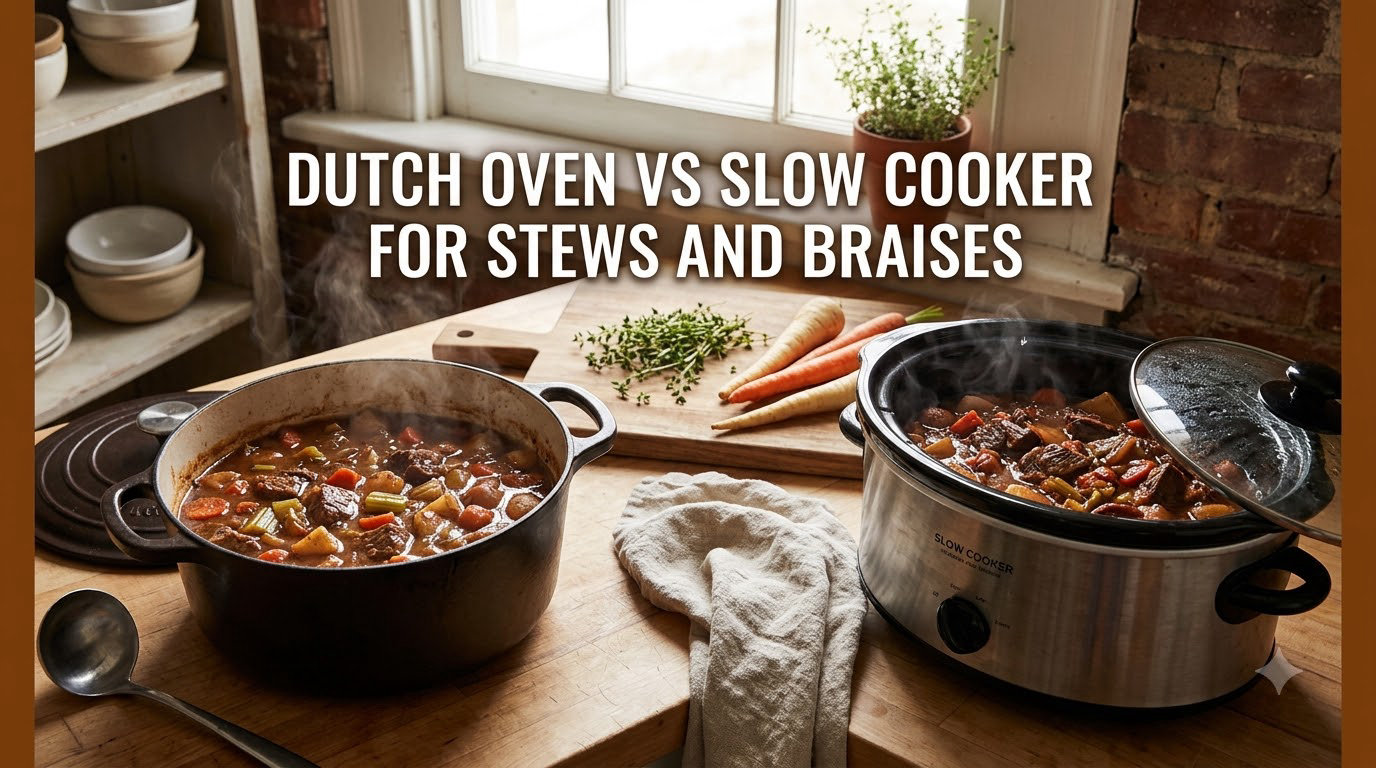
For stews and braises, a Dutch oven wins on flavor and versatility, and a slow cooker wins on convenience and hands-off cooking. Dutch ovens reach stovetop and oven heat so you can sear meat, trigger the Maillard reaction, and reduce the sauce into something glossy. Slow cookers run much cooler and trap moisture, so they tenderize tough cuts without babysitting but cannot brown or thicken on their own. If you want the deepest flavor, choose a Dutch oven. If you want a set-and-forget weeknight pot roast, choose a slow cooker. Most home cooks end up using both.
I have been testing both vessels side by side in my own kitchen for years, braising chuck roast in one and simmering beef stew in the other on the same Saturday. This guide walks you through how each one actually cooks, where each one wins, how to convert recipes between them, and which cuts of meat belong in which pot. By the end you will know exactly which pot to grab for your specific dish.
Table of Contents
Quick Answer: Dutch Oven vs Slow Cooker for Stews and Braises
The Dutch oven produces deeper flavor because it lets you sear first and then reduce the sauce at oven heat. The slow cooker produces reliably tender meat because it holds a steady low temperature for hours with no monitoring. Pick a Dutch oven if flavor and one-pot versatility matter most. Pick a slow cooker if you want to walk out the door and come home to dinner. For pure beef stew, the Dutch oven wins on taste. For an unattended pot roast on a workday, the slow cooker wins on practicality.
Here is how they stack up at a glance:
| Feature | Dutch Oven | Slow Cooker |
|---|---|---|
| Heat source | Stovetop and oven (up to 450F+) | Electric, low ~200F, high ~300F |
| Can sear meat? | Yes, on the burner | No |
| Hands-on time | 15 to 20 minutes active | 5 to 10 minutes |
| Total cook time | 2 to 3 hours | 6 to 8 hours on low |
| Moisture behavior | Some evaporation, sauce reduces | Very little evaporation, sauce stays loose |
| Flavor depth | High (Maillard, fond, reduction) | Mild, one-note without finishing steps |
| Versatility | Sear, braise, stew, fry, bake bread | Mostly low-and-slow cooks |
| Best for | Beef stew, short ribs, osso buco, chili | Pulled pork, chuck roast, chicken, beans |
| Kitchen heat | Adds significant heat (oven and stove) | Minimal extra heat |
| Footprint | Heavy, needs storage | Takes counter space |
What Is a Dutch Oven and How Does It Cook?
A Dutch oven is a heavy, thick-walled pot, most often enameled cast iron, with a tight-fitting lid. The heavy bottom and walls store heat and release it slowly, so the temperature inside stays steady even when you add cold ingredients. Most Dutch ovens are oven-safe to 450F or higher, which means the same pot can sear meat on a burner, slide into a hot oven to braise, and finish the dish in one vessel without dirtying a second pan.
That ability to move from stovetop to oven is what makes the Dutch oven a braising powerhouse. You brown the beef in the open pot, pour in stock and aromatics, clamp the lid on, and slide it into a 300 to 325F oven. Conduction heat from the walls and lid cooks the meat gently, while the heavy lid keeps most of the moisture inside. Because the Dutch oven does not seal as tightly as a slow cooker, a small amount of steam escapes, which concentrates the sauce over time. By the end of a 2.5-hour braise you have deeply browned meat and a glossy, reduced pan sauce.
Cheaper bare cast iron Dutch ovens do the same cooking but require seasoning and a little more care. Enameled versions cost more but skip the seasoning step and resist sticking. Either way, the cooking physics are the same: high heat capacity, even conduction, and a heavy lid that traps most steam while letting a little escape.
What Is a Slow Cooker and How Does It Cook?
A slow cooker, the brand name Crock-Pot being the most famous, is an electric countertop appliance with a ceramic or metal crock insert surrounded by a heating element. You set it to low or high and walk away. Most slow cookers hold low at around 200F and high at around 300F, so they cook at roughly the same temperatures as a low oven braise, but without ever exceeding that ceiling. That temperature gap is the real differentiator between slow cooking and braising.
The lid on a slow cooker is designed to seal tightly so almost no steam escapes during the cook. That trapped moisture keeps the meat bathed in liquid and prevents drying out, which is why even tough cuts like chuck roast and pork shoulder turn spoon-tender after 8 hours on low. The flip side is that nothing evaporates, so the sauce stays loose and can end up thin and watery if you add too much liquid at the start. Many slow cooker recipes finish with a step where you ladle out the cooking liquid, boil it down on the stove, and pour it back over the meat to thicken the dish.
Because the temperature never climbs above about 300F, a slow cooker cannot sear or trigger the Maillard reaction. Any browning you want has to happen before the meat goes in, either in a separate skillet or under the broiler at the very end. That is the trade-off you accept for the convenience of walking out the door at 8 a.m. and coming home to a fully cooked pot roast at 6 p.m.
Dutch Oven vs Slow Cooker: Side-by-Side Comparison
Both vessels cook with moist heat over a long time, but the way they deliver that heat is fundamentally different. The Dutch oven runs hotter, lets steam escape, and rewards you with deeper flavor. The slow cooker runs cooler, traps steam, and rewards you with reliable tenderness and total hands-off convenience.
Heat Source and Temperature Range
The Dutch oven pulls heat from your stove and oven, so it can hit 400F for a hard sear or settle at 300F for a steady braise. The slow cooker generates its own heat from a wall element and tops out around 300F on high, with low running closer to 200F. Neither gets hot enough to deep-fry, but the Dutch oven can comfortably go from a hard sear to a slow braise in the same pot. The slow cooker cannot.
Cooking Speed
A Dutch oven braise finishes in 2 to 3 hours. A slow cooker braise needs 6 to 8 hours on low or 4 to 5 on high. Neither is wrong, but they fit different rhythms. The Dutch oven suits a lazy Saturday. The slow cooker suits a workday where you need dinner ready by the time you walk in the door.
Flavor Development
Flavor is where the Dutch oven pulls clearly ahead. The high stovetop heat creates a browned crust on the meat and leaves fond on the bottom of the pot. When you deglaze with wine or stock, those browned bits dissolve into the liquid and become the backbone of the sauce. A slow cooker never gets hot enough to create that crust, so the flavor profile stays milder unless you sear in a separate pan first.
Hands-On vs Hands-Off
A Dutch oven recipe asks you to be present for the first 15 to 20 minutes, then it cooks largely on its own in the oven. A slow cooker recipe asks for 5 to 10 minutes of prep in the morning and zero attention after that. For weeknight cooks, parents, and anyone who works outside the home, that set-and-forget quality is the deciding factor.
Moisture Retention
The slow cooker wins here. Its nearly airtight lid keeps liquid in the pot, so even very lean cuts like chicken breast stay moist if you do not overcook them. The Dutch oven loses a small but steady amount of steam through the lid, which is great for sauce but means you need a little more liquid at the start and you cannot leave it uncovered for hours without drying the dish out.
Pros and Cons of a Dutch Oven for Stews and Braises
Pros of using a Dutch oven for stews and braises:
- You can sear meat and build fond on the stovetop in the same pot, which adds deep, roasted flavor
- The sauce reduces naturally as it cooks, so you end up with a thicker, glossier finish
- It moves seamlessly from burner to oven to table, so you dirty one pot
- The same vessel bakes bread, fries chicken, simmers chili, and roasts a whole chicken
- Enameled cast iron holds heat so well that hot spots and cold spots barely exist
Cons of using a Dutch oven for stews and braises:
- It is heavy, often 12 to 16 pounds for a 6-quart model, which can be tough for smaller cooks to lift
- It needs active cooking at the start and you have to be home to put it in the oven
- It heats up the kitchen, which is the wrong tool for a hot August weeknight
- Bare cast iron requires seasoning and cannot go in the dishwasher
- It is more expensive than most slow cookers, especially enameled brands like Le Creuset and Staub
Pros and Cons of a Slow Cooker for Stews and Braises
Pros of using a slow cooker for stews and braises:
- True set-and-forget cooking, perfect for workdays and busy weeknights
- Trapped moisture keeps even lean meats tender if you do not overcook them
- It adds almost no heat to the kitchen, which matters in summer
- The crock insert is usually dishwasher safe and easy to clean
- It is inexpensive and simple to replace if the insert cracks
Cons of using a slow cooker for stews and braises:
- The low temperature prevents browning, so flavor stays flat without a separate sear step
- The tight lid traps all the moisture, which leaves the sauce thin and watery if you add too much liquid
- Large cuts of meat can dry out around the edges even when the center is tender
- It cannot brown, fry, bake, or reduce a sauce on its own
- It takes up permanent counter space or a chunk of cabinet real estate
Which Is Better for Which Dishes?
Some dishes lean Dutch oven. Others lean slow cooker. A few work well in either. Here is how I think about it dish by dish.
Beef Stew
The Dutch oven wins for beef stew because the dish depends on a deeply browned crust and a thick, glossy sauce. You want fond on the bottom of the pot and you want the liquid to reduce into something that clings to the meat. A slow cooker can produce tender beef but the sauce will look and taste thin unless you sear first and finish by reducing the liquid on the stove.
Pot Roast
The slow cooker wins for pot roast because the cut is large and benefits from a long, gentle, unattended cook. Chuck roast stays juicy in the trapped steam and shreds with a fork after 8 hours on low. A Dutch oven pot roast tastes better but requires an hour of attention on the stove first.
Short Ribs and Osso Buco
The Dutch oven wins for short ribs and osso buco because both dishes are defined by a thick, reduced pan sauce that you ladle over the meat. You need Maillard browning on the outside and you need evaporation at the end to concentrate the braising liquid into something silky. A slow cooker version is tender but the sauce is thin and one-note.
Pulled Pork
The slow cooker wins for pulled pork because the cut is enormous and forgiving, and the long, moist cook breaks down connective tissue without drying out the leaner outer edges. The Dutch oven can do it but you have to baste or flip the roast to keep the top from drying out. A home cook on Reddit’s r/cookingforbeginners put it bluntly: they wanted melt-in-mouth texture and that is what a slow cooker reliably delivers.
Chili
The Dutch oven wins for chili. You want fond from the beef, you want the beans and tomatoes to reduce into something thick, and you want the spices to toast in oil at the start. A slow cooker chili tastes watered down unless you reduce the final product on the stove.
Chicken Stews and Soups
Either works well for chicken stews and soups. Chicken thighs benefit from the low, steady heat of a slow cooker and turn tender after 4 hours on low. The Dutch oven version gives a slightly richer broth but takes more attention. Pick based on your schedule.
Best Cuts of Meat for Each Method
Different cuts behave differently in each vessel. Here is the cheat sheet I wish I had ten years ago.
Best Cuts for Dutch Oven Braising
- Chuck roast: the classic braise. The marbling melts into the sauce and the fibers break down at oven temperatures.
- Beef short ribs: thick, rich, and forgiving. The high oven heat renders fat and concentrates the braising liquid.
- Veal shanks for osso buco: need the high heat to soften the marrow and to reduce the sauce around them.
- Brisket: the dry heat of the oven concentrates flavor better than the moist, sealed environment of a slow cooker.
- Lamb shanks: behave like short ribs and benefit from the same reduction step.
Best Cuts for Slow Cooker
- Pork shoulder and pork butt: huge, fatty, and forgiving. The slow cooker’s trapped moisture keeps the lean edges from drying out.
- Whole chicken or chicken thighs: the gentle low heat produces juicy, shreddable meat with almost no effort.
- Chuck roast when you want set-and-forget: the slow cooker produces a less complex sauce but a more reliable result.
- Beans and legumes: long, low, moist heat is exactly what dried beans need to soften without splitting.
- Beef stew meat, when you are short on time: tender after 8 hours on low, even if the sauce is thin.
How to Convert Recipes Between Dutch Oven and Slow Cooker
The most common question home cooks ask is whether they can use one vessel in place of the other. The short answer is yes, but you have to adjust time, temperature, and liquid. Use this cheat sheet every time you swap.
Step-by-Step: Convert a Dutch Oven Recipe to a Slow Cooker
- Brown the meat and aromatics in a skillet on the stovetop first. Do not skip this step, because the slow cooker cannot sear.
- Transfer the seared meat and vegetables into the slow cooker crock.
- Reduce the liquid by about 25 percent compared to the Dutch oven recipe. The slow cooker lid traps moisture, so the original amount would leave the sauce too thin.
- Cook on low for 7 to 8 hours or on high for 4 to 5 hours, depending on the size of the cut.
- At the end, ladle the cooking liquid into a small pot and simmer on the stove for 10 to 15 minutes to thicken the sauce, then pour it back over the meat.
Step-by-Step: Convert a Slow Cooker Recipe to a Dutch Oven
- Preheat the oven to 325F while you brown the meat and aromatics directly in the Dutch oven on the stovetop.
- Add the remaining ingredients, using the full amount of liquid the slow cooker recipe called for, since the Dutch oven loses some to evaporation.
- Bring the pot to a simmer on the burner, then clamp the lid on and slide it into the oven.
- Cook for about 2 to 2.5 hours for a stew or 3 hours for a pot roast, checking at the halfway point.
- Remove the lid for the final 30 minutes if you want the sauce to thicken, or finish by ladling the liquid into a saucepan and reducing it on the stove.
Time and Temperature Cheat Sheet
| Dutch Oven (325F oven) | Slow Cooker (low) | Slow Cooker (high) |
|---|---|---|
| 1.5 hours | 4 hours | 2.5 hours |
| 2 hours | 6 hours | 4 hours |
| 2.5 hours | 7 to 8 hours | 5 hours |
| 3 hours | 8 to 9 hours | 6 hours |
Cleaning, Storage, and Care
The two vessels ask for very different care routines. A Dutch oven, especially bare cast iron, needs hand washing, drying on the stove, and a thin coat of oil after every use to maintain the seasoning. Enameled cast iron skips the seasoning step but still cannot go in the dishwasher, because harsh detergents dull the enamel over time. Either way, the pot is heavy and needs a sturdy shelf or a hanging rack.
A slow cooker is the opposite. The crock insert lifts out and goes straight into the dishwasher in most models. The electric base wipes down with a damp cloth. There is no seasoning to worry about and no special storage routine beyond keeping the lid nearby. The trade-off is that the crock can chip or crack if dropped, and replacement crocks cost nearly as much as a whole new slow cooker.
For kitchen footprint, the Dutch oven nests inside other pots if you have deep cabinets, while a slow cooker takes a permanent spot on the counter for most people. If counter space is tight, store the slow cooker in a cabinet and accept the small daily annoyance of pulling it out.
Frequently Asked Questions
Is beef stew better in a Dutch oven or slow cooker?
Beef stew is generally better in a Dutch oven because the dish depends on a browned crust and a reduced, glossy sauce. The Dutch oven reaches oven heat so you can sear the meat first and reduce the braising liquid into a thick sauce. A slow cooker makes tender beef but the sauce often ends up thin unless you reduce it on the stove at the end.
Can I use a Dutch oven instead of a slow cooker?
Yes, you can use a Dutch oven instead of a slow cooker for almost any stew or braise. Brown the meat and aromatics on the stovetop, add the remaining ingredients, bring to a simmer, cover, and cook in a 325F oven for 2 to 3 hours instead of 6 to 8 hours on slow cooker low. You may want to add slightly more liquid because the Dutch oven loses some to evaporation.
Can you braise in a Dutch oven?
Yes, the Dutch oven is one of the best vessels for braising. Its heavy walls and tight-fitting lid trap heat and moisture while allowing a small amount of steam to escape, which concentrates the sauce. It is oven-safe to at least 400F in most models, so you can move it from stovetop sear to oven braise without changing pots.
Is pulled pork better in a Dutch oven or crock pot?
Pulled pork is generally better in a crock pot or slow cooker because the cut is large and benefits from long, gentle, unattended cooking in trapped moisture. The slow cooker keeps the lean outer edges from drying out over the 8 to 10 hours needed to break down the shoulder. A Dutch oven can do it but requires basting and produces a slightly less tender result.
What is the difference between a slow cooker and braising?
Braising is a cooking method that uses low, moist heat over a long time in a covered pot, usually in a 300 to 325F oven. A slow cooker is one specific appliance that cooks at roughly the same temperatures using its own electric heating element and a tightly sealed lid. The slow cooker runs a bit cooler on low and traps more moisture than an oven braise.
Is a Dutch oven good for stews?
Yes, a Dutch oven is excellent for stews. It browns the meat on the stovetop, builds fond on the bottom of the pot, and then braises everything in the oven so the sauce reduces into a thick, glossy finish. It is the traditional vessel for French-style beef stews like boeuf bourguignon.
Why is my slow cooker stew watery?
Your slow cooker stew is watery because the lid traps almost all moisture during the cook, so no liquid evaporates and the sauce stays loose. Fix it by ladling the cooking liquid into a saucepan after the meat is done, simmering it on the stove for 10 to 15 minutes to reduce and thicken, then pouring it back over the meat. You can also reduce the original liquid by 25 percent next time you make the recipe.
What are the disadvantages of braising?
The disadvantages of braising are the long cook time, the need to be home to put the pot in the oven, the heat the oven adds to the kitchen, and the fact that tough cuts of meat with plenty of connective tissue are required for the best results. Lean tender cuts will dry out before the connective tissue breaks down.
Final Verdict
For stews and braises, the Dutch oven wins on flavor and the slow cooker wins on convenience. If you cook mostly on weekends and care about the deepest flavor, a Dutch oven is the better single investment. If you work full-time and need dinner ready when you walk in the door, a slow cooker will change your weeknights. Most home cooks I know end up using both, and after this guide you should know exactly which one to grab for your next pot of stew.