
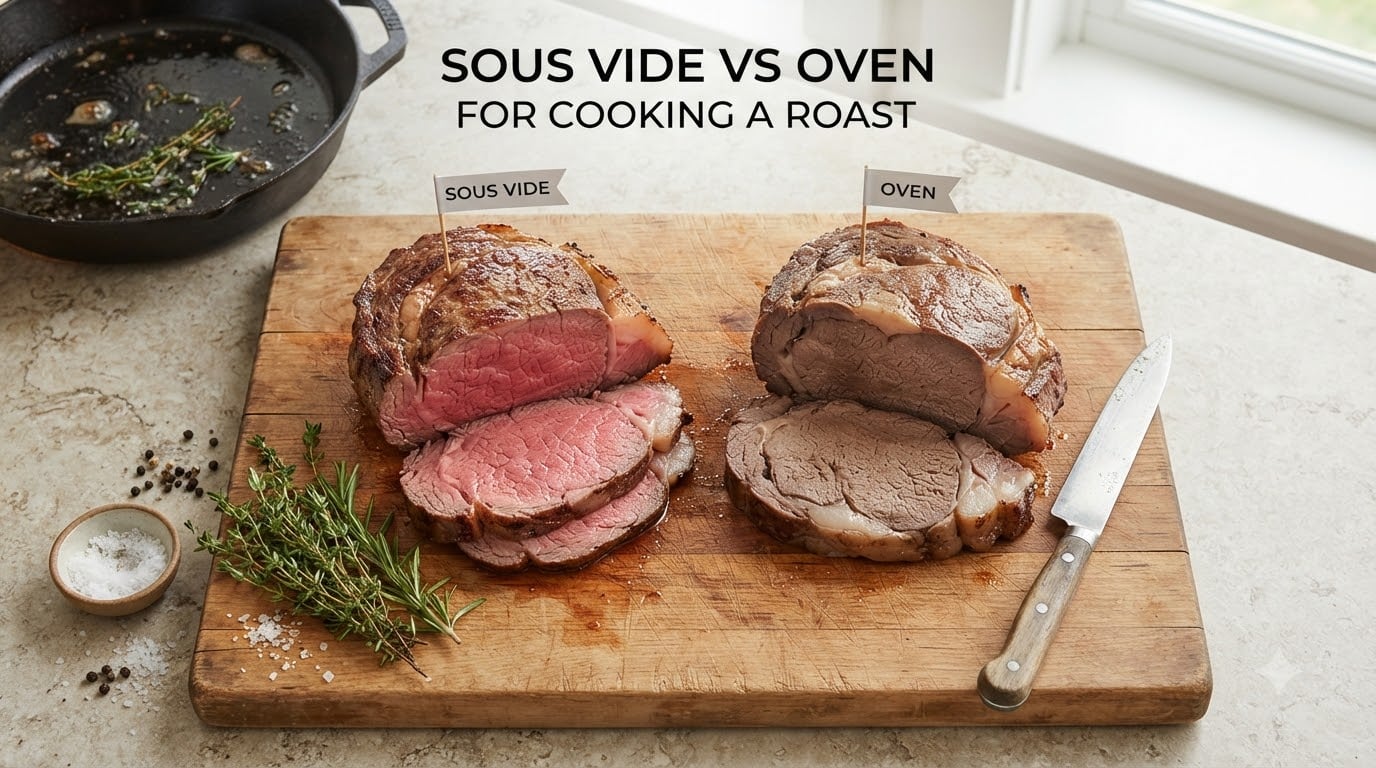
You pull your roast out of the oven, slice into it, and find a perfect pink center — surrounded by a gray, overcooked outer ring. That temperature gradient is the single biggest frustration home cooks face with roasts. Sous vide eliminates it entirely, but it comes with trade-offs of its own.
In this guide, I’ll break down sous vide vs oven for cooking a roast with real data, practical timelines, and honest comparisons. You’ll learn exactly when each method wins, which cuts favor which technique, and how to avoid the most common mistakes that ruin a good roast.
Table of Contents
Sous Vide vs Oven Roast: The Quick Verdict
Sous vide produces perfectly even doneness from edge to edge with almost no moisture loss, while oven roasting delivers a superior natural crust with less planning and no extra equipment. The right choice depends on your cut, your timeline, and how much you value precision versus convenience.
| Factor | Sous Vide | Oven Roasting |
|---|---|---|
| Doneness uniformity | Edge-to-edge, no gradient | Gradient: pink center, gray edges |
| Juiciness / moisture loss | Minimal (1-3% loss) | Moderate (10-20% loss) |
| Crust quality | Needs a separate sear step | Natural Maillard crust develops |
| Temperature control | Precise to ±0.1°F | ±10-15°F; carryover adds 5-10°F |
| Active effort | Low once sealed | Moderate: monitor temp, manage rest |
| Total time | 1-48 hours depending on cut | 1-5 hours |
| Equipment needed | Immersion circulator, vacuum sealer | Oven, thermometer |
| Best for | Tough cuts, large roasts, precision | Prime rib, holiday roasts, convenience |
How Sous Vide Works for a Roast
Sous vide uses an immersion circulator to heat a water bath to an exact target temperature. You vacuum-seal the roast (or use the water displacement method with a zip-top bag), submerge it, and let it cook for an extended period — typically 1 to 48 hours depending on the cut.
Because water transfers heat roughly 25 times more efficiently than air, the meat reaches your target temperature evenly from surface to center. There is no gradient. A roast set to 131°F (55°C) for medium-rare will be 131°F at every point, producing the signature edge-to-edge pink that sous vide is known for.
Time and temperature vary significantly by cut:
Prime rib or tenderloin: 131°F for 3-6 hours — these tender cuts need only enough time to reach target temperature.
Chuck roast: 133°F for 24-48 hours — the extended cook breaks down collagen into gelatin, transforming a tough cut into something fork-tender.
Top round or eye of round: 131°F for 8-24 hours — lean cuts benefit from longer times but can turn mealy if the temperature is too high.
Pork loin: 140°F for 3-6 hours — slightly higher target for food safety and texture.
After the water bath, you’ll need a finishing sear — a ripping-hot cast iron skillet or a kitchen torch for 60-90 seconds per side. This step is non-negotiable; without it, sous vide meat has a gray, unappetizing surface.
How Oven Roasting Works for a Roast
Oven roasting is the traditional method most of us grew up with. You season the meat, place it on a rack in a roasting pan, and cook it in dry heat — typically between 250°F and 450°F depending on your approach.
The challenge with oven roasting is the temperature gradient. Heat enters from the surface and conducts slowly inward, meaning the outside of the roast is always hotter than the center. America’s Test Kitchen measured a 3-5°F difference between the surface and center of oven-roasted pork at 275°F — and that gap widens at higher oven temperatures.
Carryover cooking makes this worse. When you pull a roast from the oven, residual heat continues to raise the internal temperature by 5-10°F during the rest period. If you pull at your target doneness, you’ll overshoot it by the time you slice. The fix is simple: pull the roast 5-10°F below your target and let carryover bring it the rest of the way.
For a low-and-slow oven approach (250°F), expect roughly 30-40 minutes per pound for medium-rare. A high-heat blast at 450°F for the first 15 minutes develops a crust before you drop the temperature. Either way, an instant-read thermometer is your best friend — guessing is how roasts get ruined.
Texture, Juiciness, and Doneness: The Core Differences
This is where sous vide pulls ahead. A medium-rare sous vide roast is medium-rare at every single point — no gray band, no gradient, no compromise. An oven-roasted roast at the same target center temperature will have a well-done outer inch, a medium transition zone, and a medium-rare core.
The moisture difference is dramatic too. Stefan Gourmet’s side-by-side test on 800g top round roasts showed the oven-cooked piece “leaked a lot of juices” when sliced, while the sous vide piece “hardly leaked juices” and maintained its structure. In practical terms, sous vide roasts lose 1-3% of their weight during cooking, while oven roasts can lose 10-20%.
That moisture loss translates directly to texture. A sous vide chuck roast cooked at 133°F for 36 hours comes out with a texture that multiple forum users describe as “prime-rib-level tenderness.” The same cut oven-roasted would need to reach 200°F+ internal to achieve comparable tenderness — at which point it’s well-done throughout.
For tender cuts like prime rib or tenderloin, the difference is less dramatic. You can achieve excellent results with either method, and honest testers have admitted the gap can be “just slight” for premium cuts. The real advantage of sous vide shows up with tough, collagen-rich cuts and large roasts where the gradient problem is amplified.
Crust and Browning: The Maillard Reaction
This is where oven roasting wins outright. The Maillard reaction — the chemical process that creates browned, caramelized flavors — kicks in at 280-330°F. An oven naturally hits those temperatures on the roast’s surface, building a deeply flavored crust throughout the cooking process.
Sous vide never gets close to Maillard temperatures because the water bath stays at 130-160°F. The result is a pale, soft exterior that most people find unappetizing. That’s why a finishing sear is mandatory — you need 60-90 seconds per side in a smoking-hot cast iron pan with high-smoke-point oil, or a pass with a kitchen torch.
The trade-off: a finishing sear adds surface browning but doesn’t develop the same depth of crust that 2-3 hours of oven roasting produces. Some cooks compensate with a pre-sear (before the bag) plus a post-sear (after the bath) for maximum flavor development. Others argue that a single aggressive sear is sufficient — the debate is ongoing in every sous vide forum.
Time, Effort, and Convenience
Oven roasting is simpler for a one-day cook. Season, thermometer in, oven on, monitor, rest, slice. The entire process can be done in 2-4 hours for most roasts, with maybe 20 minutes of active involvement.
Sous vide requires more planning. A chuck roast needs 24-48 hours in the water bath — you’re thinking about dinner two days ahead. The hands-on time is actually lower (seal, drop in water, forget about it), but the total timeline is much longer. For weeknight cooking, this is a dealbreaker for many home cooks.
There’s also the equipment factor. Sous vide requires an immersion circulator and either a vacuum sealer or quality zip-top bags. That’s a real investment in both money and storage space. The oven is already in your kitchen.
One advantage of sous vide that rarely gets mentioned: it doesn’t heat your kitchen the way an oven does. During summer months or in warm climates, running a water bath is far more comfortable than a 450°F oven for three hours. If you’ve ever roasted a prime rib in July, you know exactly what I mean.
Which Method to Choose by Cut
Not every roast benefits equally from sous vide. Here’s a practical decision matrix based on what I’ve tested and what the cooking community consistently reports:
Chuck roast — Choose sous vide. This is where sous vide truly shines. The 24-48 hour cook at 131-135°F transforms collagen into gelatin without pushing the meat past medium-rare. Oven-roasted chuck needs to hit 195-205°F internal to become tender, which means it’s well-done throughout. Multiple sous vide forums describe the result as “prime-rib-level tenderness” from a budget cut.
Prime rib — Either method works. A prime rib is already tender; you’re mainly chasing even doneness and a good crust. Sous vide guarantees edge-to-edge perfection, but a reverse-seared oven prime rib (low-temp finish at 250°F with a high-heat sear) comes remarkably close. Choose based on your timeline and equipment.
Beef tenderloin — Either method works, with a slight edge to sous vide. Tenderloin is lean and cooks quickly, so the gradient problem is less severe. But sous vide removes the risk entirely, and for a cut this expensive, precision matters.
Top round / eye of round — Choose sous vide for tenderness, oven for convenience. These lean, tough cuts benefit from the extended tenderizing time sous vide offers (8-24 hours at 131°F). Oven-roasted, they tend to be chewy unless sliced paper-thin for sandwiches.
Pork loin — Choose oven low-temp. Pork responds well to moderate oven temperatures (325°F to 145°F internal), and the natural browning adds flavor. Sous vide works too but offers less of an advantage since pork loin is already relatively tender.
The Hybrid Approach: Reverse Sear
The reverse sear is a popular third option that borrows from both methods. You cook the roast in a low oven (200-250°F) until it’s 10-15°F below your target, then finish with a blast of high heat — either a 500°F oven or a hot skillet.
This approach minimizes the temperature gradient (because the low oven cooks gently) while still developing a Maillard crust from the high-heat finish. It’s faster than sous vide (2-4 hours vs 4-48 hours) and doesn’t require any special equipment beyond a thermometer.
For cooks who want better-than-traditional results without committing to sous vide equipment, the reverse sear is an excellent middle ground. Reddit users in r/AskCulinary frequently cite it as their preferred method when they “don’t see the benefits of using a sous vide vs just an oven.” The results are noticeably more even than a traditional high-heat roast, though not quite as uniform as true sous vide.
Common Mistakes to Avoid
Pulling an oven roast at exact target temperature. Carryover cooking will push it 5-10°F higher during the rest. Always pull 5-10°F below your target doneness.
Skipping the sear on sous vide. The water bath produces perfectly cooked but unappetizingly pale meat. A 60-90 second sear per side in a smoking-hot pan is mandatory — not optional.
Using too much oil in the bag. A small amount of butter or oil is fine for flavor, but too much can interfere with the vacuum seal and cause bags to float unevenly in the water bath.
Overcooking lean cuts with long sous vide times. Eye of round at 135°F for 24 hours can turn mealy. Lean cuts do better at 131°F with shorter times (8-12 hours). Tough, collagen-rich cuts are the ones that benefit from marathon cooks.
Not accounting for thickness. Sous vide time depends on thickness, not weight. A thick 4-pound roast needs much more time than a flat 4-pound roast. When in doubt, use a meat thermometer even with sous vide — it’s the only way to confirm the center has reached target.
Frequently Asked Questions
Is sous vide worth the effort for chuck roast?
Yes — chuck roast is arguably the best case for sous vide. Cooking at 133°F for 24-48 hours breaks down tough collagen into gelatin while keeping the meat at medium-rare doneness. The result is fork-tender meat from a budget cut that would be chewy or well-done if oven-roasted. Multiple experienced cooks describe sous vide chuck roast as having prime-rib-level tenderness.
What is the downside of sous vide?
The main downsides are time commitment (4-48 hours depending on cut), equipment cost (immersion circulator plus vacuum sealer), the need for a separate searing step to develop a crust, and the fact that the finished meat looks pale without that sear. Bag management and cleanup add minor friction compared to simply putting a roast in the oven.
Is sous vide in an oven worth it?
Some modern precision ovens and steam ovens can hold temperatures low enough to mimic sous vide without a water bath. If you already own one, it eliminates the need for an immersion circulator. However, most standard ovens cannot maintain the ±1°F precision that makes sous vide work — temperature swings of 10-15°F are common in regular ovens.
How long should you sous vide a roast?
It depends on the cut and thickness. Tender cuts like prime rib or tenderloin need 3-6 hours at 131°F. Tough cuts like chuck roast need 24-48 hours at 133°F to break down collagen. Lean tough cuts like top round fall in between at 8-24 hours at 131°F. The key factor is thickness — thicker roasts need more time for heat to reach the center.
How does America’s Test Kitchen sous vide chuck roast?
America’s Test Kitchen has tested sous vide extensively and found that the method produces precise, edge-to-edge doneness. In their low-oven-versus-sous-vide comparison, the sous vide pork tenderloin registered exactly 140°F at all three measurement points, while the oven version showed higher temperatures near the surface. Their approach emphasizes precise temperature control and adequate cooking time.
Do fancy steakhouses use sous vide?
Many high-end restaurants use sous vide for consistency and timing flexibility. It allows them to hold steaks and roasts at perfect doneness during service without overcooking. However, most still finish with a high-heat sear or grill for crust and presentation. Sous vide is a prep tool in professional kitchens, not the final cooking step.
How long is too long to sous vide a roast?
For tender cuts, anything past 6 hours starts to degrade texture — the meat can become mushy. For tough collagen-rich cuts like chuck, the sweet spot is 24-48 hours; beyond 48 hours, even well-marbled cuts can turn mealy. Lean cuts like eye of round should stay under 24 hours. When in doubt, check texture at the minimum recommended time and extend if needed.
Is sous vide full of microplastics?
This is a growing concern among home cooks. Most sous vide bags are made from food-grade polyethylene or nylon, which are considered safe at sous vide temperatures (below 160°F). However, research on microplastic leaching at cooking temperatures is still evolving. If you are concerned, use silicone bags or the water displacement method with BPA-free zip-top bags as alternatives to traditional vacuum seal bags.
Conclusion
Sous vide vs oven for cooking a roast comes down to what you value most. If edge-to-edge doneness, maximum juiciness, and the ability to transform tough cuts into tender roasts matter to you, sous vide is worth the investment. If you prefer simplicity, a natural crust, and a method that works with equipment you already own, oven roasting remains an excellent choice. For many home cooks, the best answer is owning both techniques and picking the right one for each roast.