
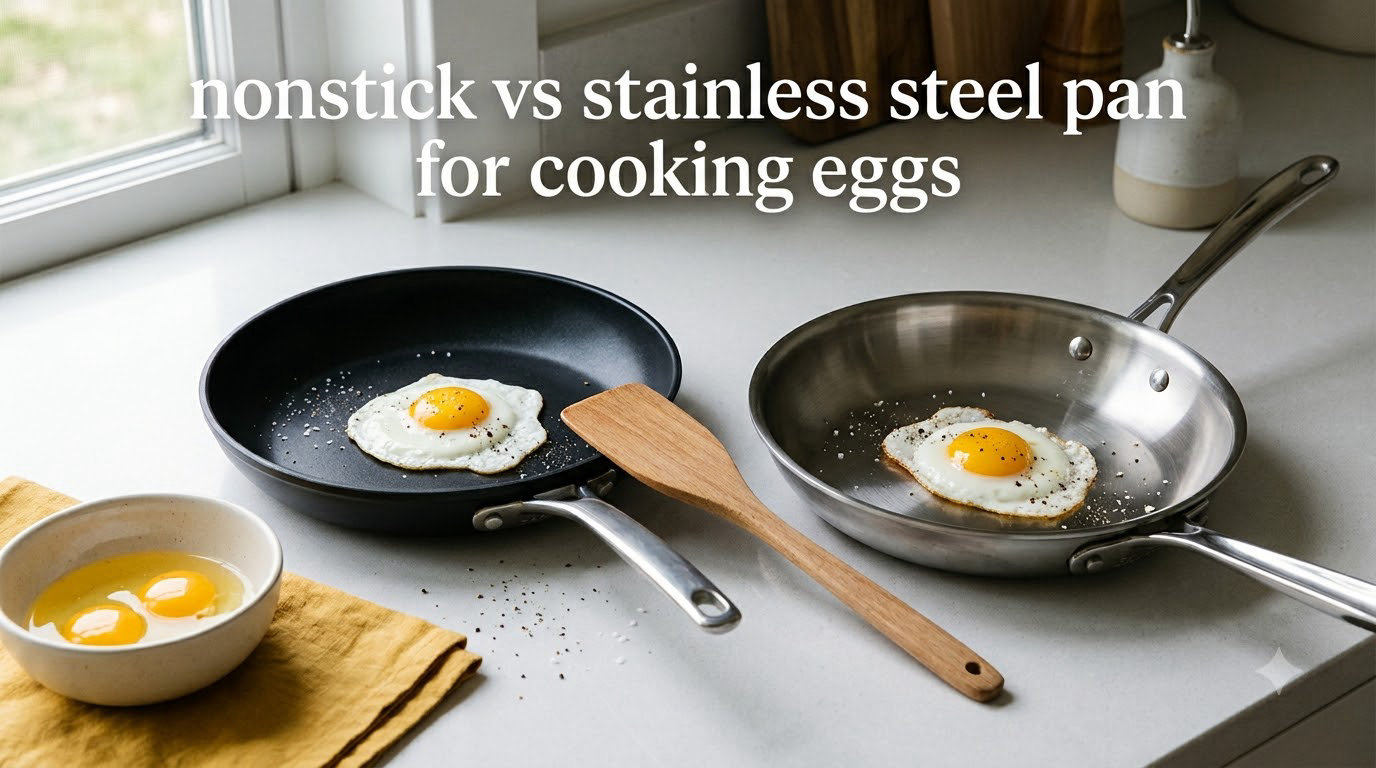
If you’ve ever cracked an egg into a cold stainless steel skillet and watched it weld itself to the metal, you already know the core question behind nonstick vs stainless steel pan for cooking eggs. It’s not really a battle — it’s a tradeoff. Nonstick wins on speed and easy release. Stainless steel wins on browning, durability, and avoiding synthetic coatings. The right answer depends on which egg style you cook most, how patient you are, and whether PFAS exposure is on your radar.
I cook roughly 18 eggs a week in our test kitchen, and I’ve spent the last year switching between a tri-ply stainless skillet and a PTFE-coated nonstick for every style — fried, sunny-side-up, over-easy, scrambled, omelets, and frittatas. This guide pulls together what I learned, what the university extensions are flagging about nonstick coatings in 2026, and what professional kitchens actually reach for when the cameras aren’t rolling.
Table of Contents
Nonstick vs Stainless Steel Pan for Cooking Eggs: The Quick Answer
Both pans cook great eggs — pick based on what you value most. A nonstick pan releases eggs with almost no fat and zero technique, which makes it the fastest path to a clean over-easy or a tender scramble. A stainless steel pan needs a 2–3 minute preheat, the water-dance test, and a spoon of butter or high-smoke-point oil, but it rewards you with crispy lacy edges, deeper flavor from the Maillard reaction, and a coating-free cooking surface. Choose stainless steel if you’re willing to learn the preheat-and-fat method; reach for nonstick for fuss-free weekday breakfasts.
Side-by-Side Comparison: Nonstick vs Stainless Steel
No competitor in the top three ranks uses a true side-by-side table, so here is one. Scan it first, then dive into the sections that match your situation.
| Factor | Nonstick (PTFE / Ceramic) | Stainless Steel |
|---|---|---|
| Heat tolerance | Medium-low only (above ~500°F the coating degrades) | Very high — oven-safe, broiler-safe, sears at 500°F+ |
| Oil / fat needed | Minimal — a thin swipe of butter or oil | 1 tablespoon butter, clarified butter, ghee, or avocado oil |
| Sticking risk | Very low when coating is intact | High if the pan is under-heated or the egg goes onto bare metal |
| Taste & texture | Tender, pale, soft — no fond | Crispy lacy edges, brown fond, richer flavor |
| Durability | Coating wears in 1–3 years; pan usually discarded | Decades with basic care; tri-ply lasts a lifetime |
| Health considerations | PTFE / PFAS coatings; intact pans are low-risk, scratched pans are not | No synthetic coating; nickel allergies can be an issue for some |
| Ease for beginners | Forgiving — almost impossible to fail | Steep learning curve; technique matters |
| Lifetime cost | Replacements every few years add up | Higher upfront, near-zero replacement cost |
| Best for | Over-easy, scrambled, omelets, low-heat delicate eggs | Fried eggs with crispy edges, frittatas, searing |
| Cleanup | Wipe with a soft sponge; no abrasives | Deglaze with water while warm; occasional Bar Keeper’s Friend |
What Nonstick Pans Do Best for Eggs
Nonstick pans are the easy button of the egg world. A teaspoon of butter, medium-low heat, and a clean PTFE or ceramic coating release a sunny-side-up egg in under two minutes — no spatula gymnastics, no torn whites.
Beginners overwhelmingly reach for nonstick because the forgiveness margin is enormous. Reddit’s r/cookingforbeginners threads are full of home cooks saying nonstick “made breakfast ten times faster” and that switching to stainless “was a much longer process.” If your priority is a calm, foolproof weekday scramble or an over-easy that doesn’t break apart mid-flip, nonstick earns its slot.
The coating also lets you cook with almost no fat. A quick swipe of butter or a spritz of avocado oil is enough — that’s a real win if you count calories or you’re cooking for someone on a low-fat diet. For omelets and tender scrambled eggs, the slick surface produces that soft curd texture you only get when the egg never touches bare metal.
The catch: the coating is the pan. PTFE and ceramic coatings wear out from heat, metal utensils, and dishwasher cycles. Most home nonstick pans last one to three years before eggs start clinging again.
What Stainless Steel Pans Do Best for Eggs
Stainless steel is the workhorse of professional kitchens because it does everything nonstick can’t. It sears at 500°F. It goes from stovetop to oven without a hiccup. It builds fond — those caramelized brown bits that lift off the pan with a splash of water and become the base of a pan sauce. Eggs benefit from all three.
When you nail the technique, a fried egg in stainless steel develops the lacy, crispy edges you see in restaurant photos. The white sets against a thin film of hot fat instead of bare metal, and the Maillard reaction browns the edges into something a nonstick pan simply can’t produce. Reviewers at Serious Eats and Food & Wine call this out as the single biggest taste and texture gap between the two pans.
Stainless steel is also a no-coating surface. For home cooks who want to avoid PFAS and PTFE entirely — a perfectly reasonable priority in 2026 — a clad stainless skillet is the default recommendation from university extensions and independent test kitchens. The pan itself is also nearly indestructible: a decent tri-ply will outlast two decades of daily breakfasts.
The trade-off is real, though. Stainless steel has a learning curve. Under-heated, under-fat, or impatient, and the egg will bond to the metal and tear apart when you try to lift it.
Why Eggs Stick to Stainless Steel (The Science)
Egg proteins start to bond to any metal surface the moment they touch it — that’s basic food chemistry. The trick is creating a stable layer of fat or steam between the egg and the pan so the protein sets against that, not the metal. If that layer never forms, the egg welds itself in place.
Three things cause stainless steel eggs to stick every time:
- Pan not hot enough. Cold or warm steel lets liquid egg pool and soak into the micro-pores of the surface. You need around 320°F of preheated metal before the egg hits it.
- Fat added to a cold pan. Butter or oil dropped into a cold skillet soaks into the surface instead of floating as a release layer. Fat goes in after the pan is hot.
- Egg cracked onto bare metal. Without a layer of fat or a test-drop of water dancing on the surface, the egg has nothing to sit on but steel. It’ll bond within seconds.
Forum threads on r/AskCulinary and r/Cooking are full of cooks who fixated on the third cause and ignored the first two. The unlock is always the same combo: preheat, water test, fat, then egg.
How to Cook Eggs in Stainless Steel Without Sticking
This is the four-step method that turns stainless steel into a reliable egg surface. Once you’ve done it five or six times it becomes automatic.
Step 1 — Preheat on medium-low for 2 to 3 minutes. Set the burner to medium-low (around 320°F if your stove runs hot). A tri-ply pan reaches temperature in roughly three minutes; thin pans are faster but less forgiving.
Step 2 — Run the water-dance test. Flick a few drops of water onto the dry pan. If they skitter around in beads that look like mercury, the pan is at the Leidenfrost point — hot enough that a vapor layer forms under the water. If they boil away instantly, the pan is too hot; pull it off the burner for 30 seconds and retest. If they just sit and sizzle, the pan is too cold; keep preheating.
Step 3 — Add 1 tablespoon of fat. Butter gives flavor but burns around 350°F, so use clarified butter, ghee, or avocado oil if you’re at the upper end of medium-low. Swirl to coat the entire surface, then lower the heat slightly.
Step 4 — Crack the egg onto the fat and don’t touch it. Let the white set for 60 to 90 seconds. The egg will release on its own when the proteins have firmed up against the fat layer. If you nudge it before then, it tears. Use a thin fish spatula for the cleanest flip.
For over-easy, flip once the white is fully set and cook the second side for 15 to 20 seconds. For sunny-side-up, cover the pan with a lid for the last minute to set the top of the white without flipping.
How to Cook Scrambled Eggs in Stainless Steel
Scrambled eggs in stainless steel need lower heat and more fat than fried eggs. Here’s the short version of the method:
- Preheat on medium-low, run the water-dance test, then add 1 tablespoon of butter plus a teaspoon of avocado oil.
- Whisk 2 to 3 eggs with a pinch of salt and pour them into the pan.
- Stir slowly with a silicone spatula in figure-eights; lift curds from the bottom every 10 to 15 seconds.
- Pull the pan off the heat while the eggs still look glossy and wet. Carryover cooking finishes them on the plate.
The University of Maine Extension and most test kitchens agree: take them off early. Scrambled eggs go from creamy to rubbery in the last 30 seconds on the burner, and that window is even narrower in stainless steel because the pan holds heat aggressively.
Health and Safety: PFAS, Teflon, and 2026 Cookware Concerns
PFAS — sometimes called “forever chemicals” — are the family of compounds that includes PTFE (the polymer sold under the Teflon brand). They’ve been used in nonstick coatings since the 1960s because nothing else releases an egg quite as cleanly.
Intact PTFE coatings on modern pans are considered low-risk at normal cooking temperatures. The coating starts to break down above roughly 500°F, which is well above what you need for eggs but easy to hit if you preheat an empty nonstick pan on high. Once the coating is scratched, pitted, or flaking, it shouldn’t be used for cooking. Discard it and replace it.
State-level regulation has accelerated. Maine’s PFAS in Products Program, which began restricting intentionally added PFAS in cookware in 2026, has pushed several manufacturers to reformulate. Ceramic coatings and “PTFE-free” labels are now common, though ceramic coatings have their own durability tradeoffs.
For anyone who wants to sidestep the conversation entirely, stainless steel, cast iron, and carbon steel are all synthetic-coating-free options. Each has its own learning curve — cast iron and carbon steel need seasoning, stainless steel needs the preheat method — but none of them off-gas anything at cooking temperature.
Nickel allergies are the one thing to flag with stainless steel. If you react to nickel in jewelry, look for a nickel-free stainless alloy or stick with nonstick for egg-specific tasks.
Common Stainless Steel Mistakes and Quick Fixes
If your eggs stick in stainless steel, run down this list before you blame the pan.
- Pan wasn’t hot enough. Use the water-dance test every time until you’ve cooked 30 eggs. It becomes second nature after that.
- Fat went in too early. Add butter or oil only after the pan is at temperature. Fat in a cold pan soaks into the surface.
- Egg went straight onto dry steel. Always crack onto shimmering fat, never onto a dry or barely-oiled surface.
- You flipped or nudged too early. Wait for the white to set completely around the yolk. The egg releases itself when it’s ready.
- Heat was too high. Stainless steel holds heat; even medium can scorch butter. Drop to medium-low and give it another minute.
Most beginners fix the problem on the second or third try. A handful of cooks on r/cookingforbeginners reported it took them two weeks of daily eggs before the technique clicked. If you’re cooking eggs three times a week, give yourself a month before deciding stainless steel isn’t for you.
Which Pan Should You Actually Use?
Skip the philosophical debate and answer three quick questions. Your answer picks the pan.
Question 1 — Do you have 90 seconds to preheat, or do you need the pan hot right now? If your answer is “right now” because you’re getting kids out the door, nonstick wins on weekday mornings. If you can stand at the stove while the coffee brews, stainless steel is a clean choice.
Question 2 — Are PFAS or Teflon a hard no for your household? If yes, your default pan is stainless steel (or cast iron or carbon steel). You can still keep one well-cared-for nonstick for delicate tasks, but the daily driver changes.
Question 3 — Do you actually want crispy lacy edges on a fried egg? If yes, stainless steel. Nonstick physically cannot produce them because the pan never gets hot enough for the Maillard reaction. If you want tender pale eggs, nonstick is exactly right.
A practical setup that covers both worlds: one 10-inch stainless skillet as your daily driver, and one 8-inch nonstick reserved for over-easy, scrambled, and omelets. The two pans together cost less than replacing a worn nonstick every two years, and they cover every egg style you’ll cook at home.
Care and Maintenance for Both Pan Types
Nonstick care is short and strict: hand wash only with a soft sponge, no metal utensils, no dishwasher, no aerosol cooking sprays (they build up a residue that destroys the coating), and replace the pan the moment the coating looks dull, scratched, or flaky.
Stainless steel care is more forgiving. Let the pan cool briefly after cooking — don’t run a screaming-hot tri-ply under cold water or you’ll warp it. Deglaze any fond with a splash of water while the pan is still warm, scrub with a non-scratch pad or Bar Keeper’s Friend for stubborn discoloration, and dry it on the burner over low heat to prevent water spots. A stick of stainless cookware will outlast every nonstick pan you ever buy.
Frequently Asked Questions
What is the healthiest pan to cook eggs in?
Stainless steel, cast iron, and carbon steel are all synthetic-coating-free and considered the healthiest options for eggs. Modern PTFE nonstick pans are low-risk at normal cooking temperatures as long as the coating is intact and the pan is not overheated above roughly 500°F. Discard any nonstick pan whose coating is scratched, pitted, or flaking.
Do chefs use non-stick pans for eggs?
Most professional kitchens keep one nonstick pan on the line for delicate egg tasks — especially omelets and French-style scrambled eggs — but the bulk of sauté, sear, and sauce work happens in stainless steel or carbon steel. The reason is heat tolerance: a restaurant burner easily exceeds 500°F, which destroys nonstick coatings. Home cooks with electric or induction stoves rarely hit those temperatures, so nonstick is a more reasonable everyday choice at home.
Why do my eggs always stick in a stainless steel pan?
Three things cause it: the pan is under-heated, fat was added to a cold pan and soaked into the metal, or the egg cracked onto bare steel with no release layer. Fix the order: preheat 2 to 3 minutes on medium-low, run the water-dance test, then add 1 tablespoon of butter or oil before the egg. The egg will release on its own once the white has set.
Are non-stick pans safe for eggs?
Intact PTFE or ceramic nonstick pans are considered safe for eggs at normal cooking temperatures. Avoid preheating an empty nonstick pan on high, never use metal utensils, and replace the pan if the coating is scratched, flaking, or noticeably worn. State regulations on PFAS in cookware are tightening, so check the label for current PFAS-free certifications if that is a priority for you.
How can I keep eggs from sticking to stainless steel pans?
Preheat the pan on medium-low for 2 to 3 minutes, flick a few drops of water on the surface and confirm they dance in beads (the Leidenfrost effect), then add a tablespoon of clarified butter, ghee, or avocado oil. Crack the egg onto the shimmering fat, leave it alone until the white sets, and lift with a thin fish spatula. The egg releases itself when the proteins have firmed up against the fat layer.
Is it good to cook eggs in a stainless steel pan?
Yes — stainless steel is an excellent pan for eggs once you learn the preheat, water-dance, and fat method. You get higher heat tolerance for searing, deeper browning and flavor from the Maillard reaction, and a coating-free cooking surface. The tradeoff is a real learning curve and slightly longer cook times than nonstick.
The Final Verdict
The nonstick vs stainless steel pan for cooking eggs question doesn’t have a single winner — it has a use case. Reach for nonstick when speed and easy release matter more than flavor: weekday scrambled eggs, over-easy without drama, omelets that need to slide cleanly. Reach for stainless steel when you want crispy edges, deeper browning, and a coating-free surface, and you’re willing to spend two minutes preheating the right way. Most home cooks end up keeping both, and that’s the smartest move.