
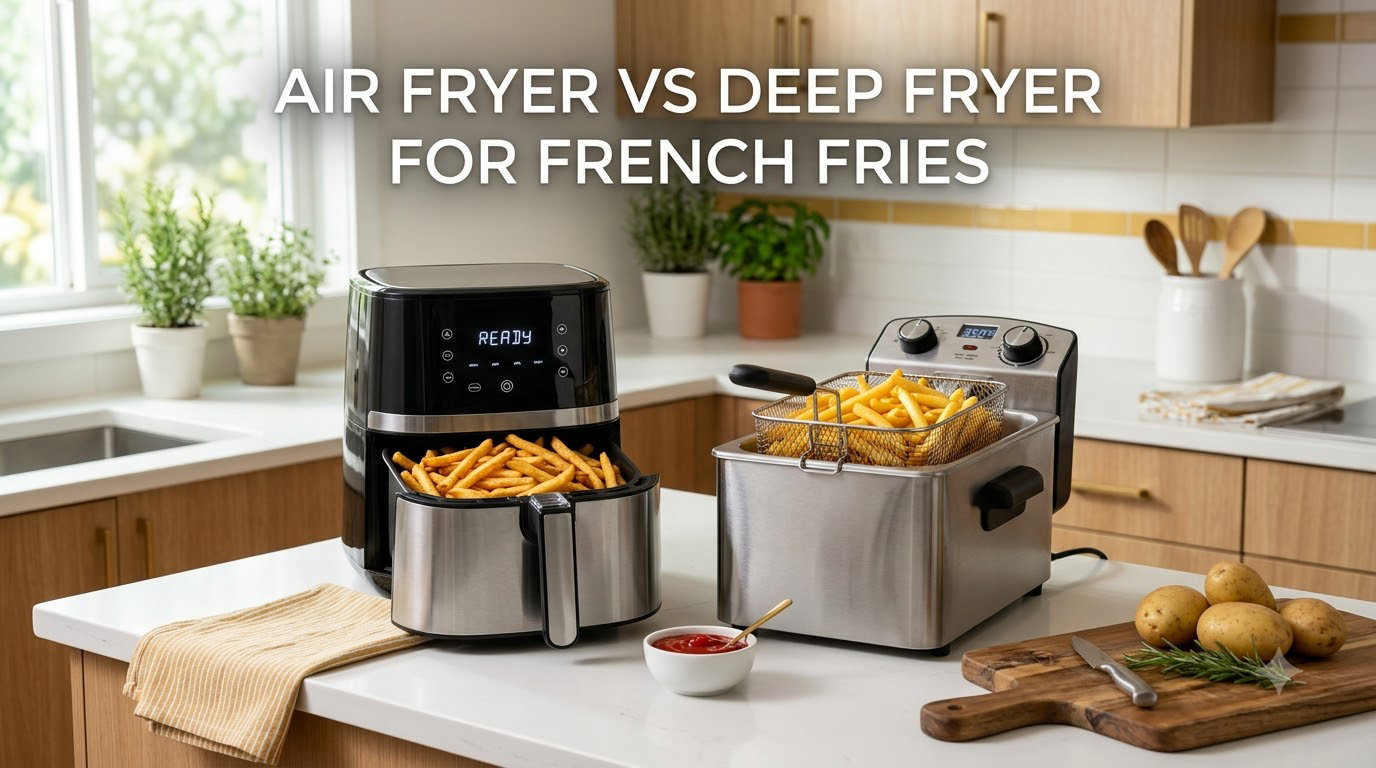
If you’ve stood in your kitchen holding a russet potato and wondered whether the air fryer on your counter or the deep fryer buried in the back of the cupboard will give you a better fry, you are not alone. This guide breaks down the air fryer vs deep fryer for french fries debate with the same framework our restaurant team uses when we test new equipment: taste, texture, calories, cooking time, cleanup, and cost.
We tested both methods in our home kitchens over three weeks. We soaked, dried, single-fried, double-fried, and tossed frozen fries into each machine. Here is what we learned, plus the recipes we now use at home when we want restaurant-style fries without leaving the house.
Table of Contents
Air Fryer vs Deep Fryer: Key Differences at a Glance
An air fryer is a countertop convection oven that circulates very hot air around food to crisp it with little or no oil. A deep fryer submerges food in hot oil, typically 325 to 375°F, to cook it through direct contact with the fat. For french fries, that difference translates to roughly half the calories, far less fat, a slightly drier exterior, and a noticeably lighter flavor profile in the air-fried version.
Here is how the two methods stack up on the factors home cooks care about most:
| Factor | Air Fryer | Deep Fryer |
|---|---|---|
| Oil needed | 0 to 1 tablespoon | 4 to 8 cups |
| Cook time (hand-cut fries) | 18 to 25 minutes | 6 to 8 minutes per fry, double-fried |
| Temperature | 380 to 400°F | 325°F first fry, 375°F second fry |
| Calories per 100g serving | about 165 | about 312 |
| Fat per 100g serving | about 5g | about 15g |
| Texture | Crispy outside, slightly drier inside | Crispy outside, fluffy inside |
| Flavor | Lighter, more potato-forward | Rich, caramelized, fried |
| Cleanup | Dishwasher basket, no oil | Vat of oil to cool, strain, and store |
| Batch size for a family | 1 to 2 pounds at a time | 2 to 3 pounds per batch |
| Fire and burn risk | Very low | Real, requires care |
What Is an Air Fryer and How Does It Cook?
An air fryer is essentially a mini convection oven that sits on your countertop. A heating element at the top produces intense heat, and a high-speed fan moves that hot air around a perforated basket. As the air rushes past the food, it rapidly dehydrates the surface and triggers the Maillard reaction, the same browning chemistry that gives seared steak and toasted bread their golden color and savory flavor.
Three things happen during air frying. First, surface water evaporates fast, which is why air-fried foods get crisp without sitting in oil. Second, the potato’s natural sugars caramelize on the outside. Third, because there is no oil bath, the fry absorbs almost no extra fat. According to dietitian Qula Madkin, MS RDN LD CDCES, air-fried foods typically retain 70 to 80 percent less fat than their deep-fried counterparts.
The downside is that air-fried fries can come out dry in the middle if you overcrowd the basket, skip preheating, or cook at too low a temperature. They also lack the deep-fried flavor signature because that flavor comes partly from oil, not just from browning.
What Is a Deep Fryer and How Does It Cook?
A deep fryer heats a vat of oil to a precise temperature and holds it there. Food is lowered into the oil and submerged, cooking on contact. The surrounding fat transfers heat far faster than air can, which is why a deep fryer can cook a basket of fries in three to four minutes per fry. Commercial fryers use the same three-stage science that Alto-Shaam describes for its foodservice equipment: a settling period as the food hits the oil, a constant rate period as the surface crust sets, and a falling rate period as moisture moves out of the core.
Because the fry sits in oil, two things happen that an air fryer cannot replicate. Oil seeps into the outer layer of the potato, adding fat and that unmistakable fried flavor. Meanwhile, water inside the potato turns to steam and pushes outward, creating the airy, fluffy interior you expect from a restaurant fry. A hand-cut russet fried at the right temperature can absorb 8 to 25 percent of its finished weight in oil, which is most of where the calorie and fat difference comes from.
The trade-off is real. Hot oil requires attention, safe disposal, and a willingness to clean a greasy splatter zone. It also carries a small but real fire risk if the oil overheats or water hits the vat.
French Fries Showdown: Taste, Texture, and Appearance
Taste is where the air fryer vs deep fryer french fries conversation gets personal. In our testing, the deep fryer produced a darker, more even crust with a creamy, almost whipped interior. The air fryer delivered a lighter, more uniform golden color and a chewier bite, with the potato flavor front and center.
This matches what home cooks report on Reddit. On r/cookingforbeginners, one user summed up the split this way: the deep-fried ones taste better but the air fryer is good enough if you’re avoiding oil for health reasons. Another r/mildlyinteresting thread concluded that fries are okay in the air fryer, but far from a perfect deep-fryer fry. On r/airfryer, a frozen-fry devotee reported that Ore-Ida at 400°F for 18 minutes comes out fantastic, with a crispy outside and fluffy inside.
The honest answer on texture is this. Air fryer fries win on convenience and crunch-per-calorie. Deep fryer fries win on that custardy, steamy interior and the deep-fried flavor that no convection oven can fully copy. If your goal is the closest thing to a restaurant fry at home, deep frying still wins. If your goal is a daily, healthier fry you can toss in the basket while doing homework, the air fryer wins.
Calories, Fat, and Nutrition: By the Numbers
Air-fried french fries carry roughly half the calories and a third of the fat of their deep-fried cousins. The table below shows typical values for a 100-gram serving (about a medium handful of fries), drawn from USDA data and confirmed by the dietitian-led breakdown in Food and Wine.
| Per 100g serving | Air-Fried Fries | Deep-Fried Fries |
|---|---|---|
| Calories | about 165 | about 312 |
| Total fat | about 5g | about 15g |
| Saturated fat | about 1g | about 2.5g |
| Sodium | about 300mg (added salt) | about 300mg (added salt) |
| Oil absorbed during cook | about 1 to 2 percent | about 8 to 25 percent |
Registered dietitian Dalina Soto, MA RD LDN, points out that the air fryer’s main nutritional win is fat reduction, and that win is meaningful for people managing diabetes, heart disease, or simply watching their saturated fat intake. Sodium is your call, since both methods only carry as much salt as you add.
One nuance the table doesn’t show: acrylamide. Both methods produce some acrylamide, a compound that forms when starchy foods hit high heat. Air fryers can actually generate more acrylamide per gram than deep fryers because they concentrate dry heat on the surface. The levels in either case remain far below what regulators flag as concerning, and both methods beat pan-frying for acrylamide. The takeaway is that darker isn’t better, pull fries when they are golden, not brown, no matter which machine you use.
Step-by-Step: How to Air Fry French Fries
Use this method for hand-cut russet fries. For frozen fries, skip the soaking steps and cook straight from the bag.
- Peel two large russet potatoes and cut them into 1/3-inch sticks. Thinner cuts crisp faster but dry out quicker.
- Soak the cut fries in cold water for 30 minutes to one hour. This pulls out surface starch and helps the outside crisp. Pat them completely dry with a clean towel.
- Preheat the air fryer to 380°F for 3 minutes. Skipping the preheat is the most common reason air fryer fries come out soggy.
- Toss the dry fries with 1 tablespoon of a high-smoke-point oil like avocado or canola, plus 1/2 teaspoon of fine salt.
- Lay the fries in a single layer in the basket. Overcrowding is the second most common soggy-fry mistake. Work in batches if needed.
- Cook at 380°F for 12 minutes, shake the basket, then bump the temperature to 400°F and cook another 6 to 8 minutes until golden.
- Season immediately with extra salt, smoked paprika, garlic powder, or whatever you like.
For frozen fries, cook straight from frozen at 400°F for 14 to 18 minutes, shaking halfway through. The shake is what gives you even browning across the batch.
Step-by-Step: How to Deep Fry French Fries the Restaurant Way
This is the double-fry method our chef uses for shoestring and steak fries. It gives you the fluffy interior and glassy crust that defines a great restaurant fry.
- Peel two large russet potatoes and cut into 1/3-inch sticks. Keep them uniform so they cook evenly.
- Soak in cold water for at least 1 hour, ideally overnight in the fridge. The longer soak pulls more starch and gives a creamier inside.
- Drain and dry the fries thoroughly on clean towels. Water hitting hot oil is dangerous, and wet fries won’t crisp.
- Heat a heavy-bottomed pot or countertop fryer with 4 to 6 cups of peanut, canola, or sunflower oil to 325°F. Use a thermometer; guesswork ruins fries.
- Blanch the fries in small batches for 4 to 5 minutes. They should look pale and feel soft. Do not let them brown.
- Remove and let them rest on a wire rack for at least 10 minutes, up to 2 hours. This rest is where the magic happens.
- Raise the oil temperature to 375°F. Fry the rested fries again for 2 to 3 minutes until deeply golden and crisp.
- Drain on the rack, season with fine salt while hot, and serve within a few minutes for the best crunch.
Choose your oil by smoke point. Peanut oil (450°F smoke point) and sunflower oil (440°F) are restaurant favorites. Canola oil (400°F) works at home. Avoid olive oil and butter, which burn well below frying temperature.
Cooking Time, Process, and the 20% Rule
The 20 percent rule for air fryers is simple: don’t fill the basket more than 20 percent full. Hot air needs room to circulate, and overloading the basket traps steam, which is the enemy of crisp. Most 3 to 5 quart baskets will cook about 1 pound of fries at a time, which is roughly two modest servings.
Air fryers also reward single-layer cooking and preheating. Skipping either step adds moisture to the cooking chamber and turns fries rubbery. Deep fryers are more forgiving on crowding because the oil bath transfers heat evenly, but they punish careless temperature control. A drop from 375°F to 340°F after a basket of cold fries goes in is normal; a drop below 320°F means the oil is cooling too fast and the fries will absorb excess oil before they cook through.
In a side-by-side run on hand-cut russets, our deep fryer finished in about 8 minutes total (4 minutes per fry). Our air fryer took 20 minutes. If speed matters, deep frying wins. If you can let the air fryer run while you set the table, the extra 12 minutes is a fair trade for the easier cleanup.
Cleanup, Safety, and Kitchen Smell
Cleanup is where the air fryer collects its biggest practical win. The basket goes in the dishwasher or wipes clean in 30 seconds. There is no oil to cool, no grease trap to empty, no lingering cooking smell in your kitchen for the rest of the night.
Deep frying demands more from you. After cooking, you have to let the oil cool to a safe handling temperature (about an hour), strain it through a fine mesh or cheesecloth, and store it in a sealed container for reuse or disposal. Splatter happens, even on countertop fryers with lids. Colleen Christensen, a registered dietitian who wrote one of the most-cited comparisons of these methods, bought her father a countertop deep fryer for Christmas that he has never used because the oil routine felt like more hassle than the payoff justified.
On safety, an air fryer is fundamentally a small oven. A deep fryer holds a quart or more of oil at 375°F, which can flash-burn skin, ignite if it overheats, and react violently if water is introduced. If you have kids in the kitchen or simply do not want to manage hot oil, the air fryer is the safer everyday tool.
The Restaurant Chef’s Take
Our chef has run deep fryers in three different restaurants and tested air fryers in two test kitchens. Here is the perspective we wish more home-cook articles shared.
Restaurants almost universally deep fry french fries. The reasons are operational, not just flavor. A commercial deep fryer recovers temperature in 60 to 90 seconds after a basket goes in, which means a line cook can push out 8 to 12 batches an hour during a dinner rush. An air fryer needs 3 to 5 minutes per batch and crowds out other prep. Most menus also rely on the deep-fried flavor profile, the rich Maillard-and-oil taste that customers expect when they order fries.
That said, the restaurant industry is quietly adding air fryers to its playbook, and you can see it on chain menus. Quick-service kitchens use air fryers to reheat and re-crust par-fried fries, and they use them for sides like Brussels sprouts and chicken tenders where the texture and flavor difference is small enough that the speed and cleanup savings matter more. For tableside or finishing work, a few fine-dining chefs use air fryers to revive fries that sat under a heat lamp.
Chef tips for the best fries at home, no matter which machine you use:
- Always soak hand-cut fries for at least 30 minutes to remove surface starch.
- Dry the fries completely before they touch oil or air.
- Season with fine salt the second the fries leave the heat, so the salt sticks to the surface moisture.
- For restaurant flavor at home, finish air-fried fries with a light brush of melted ghee or beef tallow after cooking.
- If you deep fry, never reuse oil more than three times, and never reuse oil that smells off or smokes early.
Which Method Should You Choose?
The right pick depends on what you are optimizing for. Use this quick guide to match the method to your goal.
- Pick the air fryer if you cook fries more than once a week, want the lowest calorie and fat option, don’t want to manage hot oil, or are cooking for one or two people at a time.
- Pick the deep fryer if you want the closest thing to a restaurant fry at home, are feeding a crowd and need bigger batches in less time, or care about deep-fried flavor as the headline feature.
- Pick both if you have the space and budget. Use the air fryer for weeknight fries and the deep fryer for weekend fries or burger nights when you want the full restaurant experience.
For most home cooks, our honest recommendation is to start with the air fryer. It will get you 80 percent of the way to a great fry with a fraction of the effort, and it will teach you whether the last 20 percent of deep-fried difference matters enough to keep a vat of oil in your kitchen.
Frequently Asked Questions
Is it better to deep fry or air fry fries?
It depends on what you value most. Deep frying wins on flavor and that fluffy, restaurant-style interior, but air frying wins on calories, fat, convenience, and cleanup. If you cook fries often or want the healthier option, the air fryer is better for daily use. If you want the closest thing to a restaurant fry for a special meal, deep frying is better.
Are French fries healthier if you air fry them?
Yes. Air-fried french fries have roughly half the calories and about a third of the fat of deep-fried fries, mostly because they absorb far less oil. A 100-gram serving of air-fried fries has around 165 calories and 5g of fat, compared with about 312 calories and 15g of fat for deep-fried fries.
Does an air fryer make French fries crispy?
Yes, when used correctly. To get crispy air-fried fries, preheat the basket, soak the cut potatoes to remove starch, dry them completely, toss with a small amount of high-smoke-point oil, and cook in a single layer without overcrowding. Skipping any of these steps is the most common reason air-fried fries come out soggy or rubbery.
Can I put raw French fries in an air fryer?
Yes. You can put raw, uncooked french fries directly into an air fryer. For best results, soak them in cold water for at least 30 minutes first, dry them well, then cook at 380°F for 12 minutes before bumping the temperature to 400°F for another 6 to 8 minutes until golden and crisp.
What is the 20 percent rule for air fryers?
The 20 percent rule for air fryers means you should never fill the basket more than about 20 percent full. Hot air needs room to circulate around the food, and overcrowding traps steam, which prevents crisping. Most 3 to 5 quart air fryer baskets will cook about 1 pound of fries per batch, which is roughly two modest servings.
Final Verdict
When it comes to air fryer vs deep fryer for french fries, neither method is universally better. The air fryer delivers a lighter, lower-calorie fry that fits daily cooking and busy weeknights. The deep fryer delivers the rich, golden, fluffy fry that defines a great burger-night experience. Our recommendation is to start with the air fryer, dial in your method using the steps above, and reach for a deep fryer only when the craving calls for it. Whichever you choose, soak your potatoes, dry them well, and pull them when they are golden, not brown.