
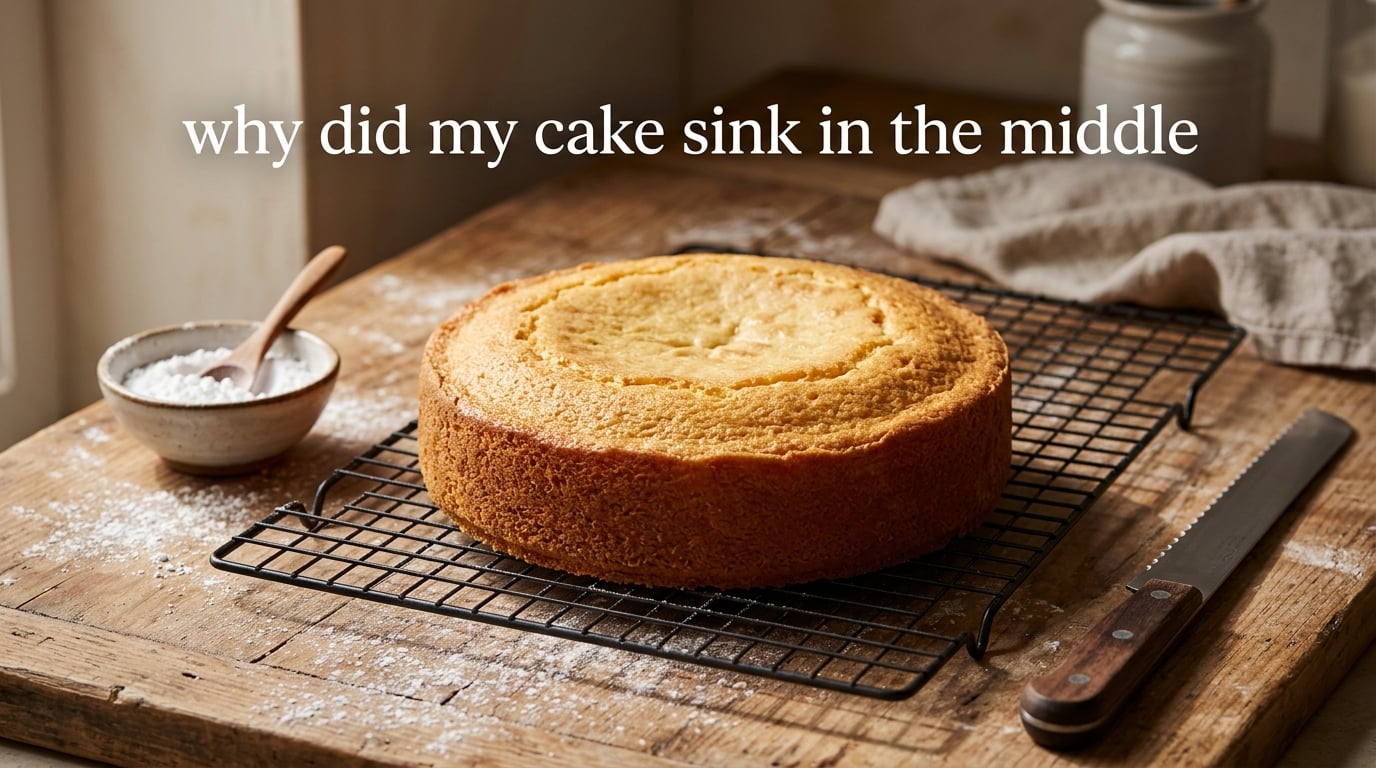
If you’ve ever pulled a cake out of the oven looking golden and perfect, set it on the counter, and watched the middle sink in before your eyes – you’re not alone. Why did my cake sink in the middle is the question I hear most often from home bakers, and the short answer is almost always the same: the cake’s internal structure hadn’t fully set before it had to support the weight above it. That single structural failure shows up as a crater, a dent, a sunken middle, or a cake that peaked dramatically in the oven and then collapsed on the counter.
There are six common causes, and in our kitchen we walk through them in this order – underbaking, too much leavening, oven temperature that’s off, the wrong pan size or shape, opening the oven too early, and mixing the batter too much or too little. In this guide I’ll explain the science behind each one, show you how to tell which cause is yours, and give you a three-step rescue for the cake you have cooling on the counter right now.
Table of Contents
What Makes a Cake Sink in the Middle (Quick Diagnosis)
When a cake’s middle collapses, it’s a sign that the gas from baking powder or baking soda inflated the batter faster than the gluten and egg proteins could firm up around it. The structure rises, looks dramatic, then caves in once the gas escapes or the cake cools. Six things cause that timing mismatch:
- Underbaking – the center never finished cooking before the gas escaped.
- Too much baking powder or baking soda – the cake over-rises faster than the proteins can set.
- Oven temperature off – too hot sets the outside before the inside cooks; too cold lets the batter rise and then fall.
- Wrong size or shape pan – too much batter in a small pan means the center can’t bake through.
- Opening the oven door too soon – a cold-air slump collapses air pockets before they firm up.
- Overmixing or undermixing the batter – either weak structure or trapped air that bursts and deflates the cake.
Each of these has a different fix, and once you know which one hit you, the same cake almost never sinks twice.
1. Underbaking: The Center Never Finished Setting
Underbaking is the single biggest cause of a sunken middle, and it’s the one that frustrates bakers the most because the toothpick test often lies to you. A clean tester tells you the batter isn’t gooey. It does not tell you that the proteins and gluten have finished doing their thing and are fully set. Reddit bakers call this out constantly – a cake can pass the toothpick test, look done in the oven, then collapse while cooling because the crumb structure was still wet in the very center.
The King Arthur bakers prefer the pat test for exactly this reason. Gently press the center of the cake with a fingertip. If it springs back fully and the surface feels firm, the proteins have set. If your finger leaves a dent or the cake wobbles, it needs more time even if a toothpick comes out clean.
If you’re worried about overbaking the edges while you finish the center, drop the oven temperature by 15 degrees and tent a ring of foil around the outside of the pan after the first 30 minutes. That gentler heat lets the center catch up without burning the crust.
2. Too Much Baking Powder or Baking Soda
Leavening sounds like it should always mean more lift, but too much creates more gas than the batter’s protein structure can hold. The cake rises dramatically, the bubbles collide and merge into big pockets, and once the gas escapes the structure collapses into itself. A good rule of thumb is one to one and a quarter teaspoons of baking powder per cup of flour, or one quarter teaspoon of baking soda per cup of flour when the recipe uses an acidic ingredient like buttermilk or cocoa.
Also check whether your leavening is still active. Baking powder loses potency about six months after opening, and baking soda fades after about three. To test baking powder, drop a teaspoon into a half cup of hot water – it should fizz immediately and aggressively. To test baking soda, add a splash of vinegar to a spoonful – it should bubble up right away. No reaction means toss the container and start fresh.
3. Oven Temperature Is Off (Too Hot or Too Cold)
Most home ovens run 15 to 25 degrees off their dial setting, and some swing wildly from one side of the cavity to the other. An oven thermometer is the cheapest fix in baking – a $5 hanging thermometer in the door has saved more of my cakes than any new pan. Hang it in the middle of the rack where the cake actually bakes, not near the heating element.
An oven that’s too hot sets the outside crust before the center has a chance to set. The cake looks tall and golden, but the wet middle can’t support the weight above it, so the cake falls as it cools. An oven that’s too cold lets the batter keep rising on weak gas pressure, then the structure sags once the gas dissipates. Both look identical – a cake that peaked, then sank.
If you’re using a convection or fan-forced oven, drop the recipe’s temperature by about 15 degrees C or 25 degrees F. The fan moves heat faster than a conventional oven, so what works at 350°F conventional will overbake at the same temperature convection.
4. The Wrong Size or Shape Cake Pan
The recipe writer tested the cake in a specific pan, and the baking time only works in that exact pan. A 9-inch round holds a different amount of batter than an 8-inch round, and a Bundt pan has a center column that doesn’t bake the same way as a tube pan. If you fill any pan more than about two-thirds full, the center stays too deep for the heat to reach before the edges set.
If you only have a different size pan, scale the batter rather than just pouring and hoping. As a rough guide, a 9-inch round, 8-inch square, and a loaf pan roughly 9×5 inches all hold similar volumes. Two 8-inch rounds hold slightly less than one 9×13 sheet pan. When in doubt, fill the pans you have, then bake any leftover batter in a cupcake tin so you can compare cooking times side by side.
5. Opening the Oven Door Too Soon
The first 20 minutes of baking are when the cake is most vulnerable. The leavening is actively releasing gas, the proteins are setting, and the cake’s structure is still soft enough that a rush of cold air will collapse the air pockets in the crumb. Once those pockets collapse, the cake can’t rise again – the structure is broken.
Wait until at least three-quarters of the bake time before you even peek. If you’re using a glass door, you can usually see the top without opening. If you do open the door, do it slowly and only a crack – never swing it wide. A cake that has finished setting will hold its shape even with the door open; a cake that hasn’t will sink in front of you.
6. Overmixing or Undermixing the Batter
Mixing problems sit on opposite ends of the same spectrum, which is why they cause the same symptom.
Overmixing develops too much gluten. The cake rises high in the pan – often higher than the rim – then collapses as the tight, tough crumb can’t hold its own weight. Overmixing also forces large pockets of air into the batter that expand, merge, and burst during baking. The cake looks dramatic in the oven and tragic on the counter.
Undermixing leaves flour pockets and pockets of fat that the leavening can’t reach. The cake rises unevenly, and where the structure is weak, it sinks. You’ll often see tunnels and streaks of flour in the crumb.
To tell which happened, slice a cooled piece and look at the inside. Tight, even, fine crumbs with a slightly domed top and a thin pale ring just under the crust is a well-mixed cake. Large holes, tunnels, or streaks of flour mean undermixing. A gummy, dense texture with a tough top means overmixing.
Mix on low speed just until the last streak of flour disappears. For butter cakes, cream the butter and sugar until pale before adding eggs one at a time. For sponge cakes, fold gently by hand. Stop the mixer the moment the batter looks uniform.
Why Sponge, Chocolate, and Pound Cakes Sink Differently
Bakers often ask why their chocolate cake keeps sinking while their vanilla pound cake bakes perfectly every time. The answer is in the ratios.
Sponge cakes rely entirely on whipped eggs for lift, with very little or no chemical leavening. If you under-whip the eggs, the structure is too weak to support the batter as it rises and the cake collapses. Over-whipping creates air pockets that burst in the oven. Sponge cakes also have a higher liquid-to-flour ratio than butter cakes, so they’re more sensitive to oven temperature and pan size.
Chocolate cakes use cocoa, which is acidic and reacts with baking soda for extra lift. If you swap baking powder for baking soda without rebalancing, the leavening goes flat. Cocoa also absorbs liquid differently than flour, so a chocolate batter can look thinner than a vanilla batter and tempt you to add more flour – which then throws off the ratio and causes sinking.
Pound cakes are the most structurally sound because they have a high ratio of butter, sugar, and eggs to flour. They rarely sink unless something extreme happened – expired leavening, an oven that runs 50+ degrees off, or a pan that is dramatically too small. If your pound cake sank, suspect the oven first.
How to Fix a Sunken Cake: A 3-Step Rescue
A sunken cake is rarely a lost cause. Most sunken cakes bake into perfectly good eating once you trim, fill, and frost them. Here’s the rescue method our team uses for every sunken layer cake that comes out of our test kitchen.
Step 1 – Cool completely, then level. Let the cake cool in the pan for 10 minutes, then turn it out onto a rack and cool fully – at least two hours. Wrap the still-warm cake in plastic and chill it in the fridge for an hour before trimming; a cold cake sheds far fewer crumbs. Use a serrated knife or a cake leveler to slice off the domed and sunken top so you have a flat, even layer. Save the trimmings – they make excellent cake pops, truffles, or a batch of “cake crumble” to sprinkle over ice cream.
Step 2 – Fill the crater. If the sink is small, a thick layer of frosting spread across the top will hide it. If the sink is deep, fill it with a complementary filling – pastry cream, lemon curd, ganache, jam, or a stabilized whipped cream. Build the layer with the crater facing up, then top with another leveled cake layer. The filling gives the cake height and turns the structural flaw into a design feature.
Step 3 – Frost and decorate. Crumb-coat the whole cake with a thin layer of frosting and chill for 20 minutes. Then apply the final coat. The crumb coat traps loose crumbs so the final coat looks clean. From here, decorate as usual – fresh flowers, piped borders, or a simple dusting of powdered sugar.
If the cake is too far gone to rescue as a layer cake, crumble it and roll it into cake pops or truffles, or layer it into a trifle. A sunken cake is rarely wasted – it’s just a different dessert now.
Cake Diagnosis: Symptom to Cause to Fix
Use this quick decision table to identify which cause hit your cake and what to change next time.
- Sunken in the middle, wet center, golden edges – cause: underbaking. Fix: lower oven 15 degrees, tent edges with foil, use the pat test, extend bake time.
- Peaked high then collapsed into a crater – cause: too much leavening or oven too hot. Fix: measure leavening carefully, test freshness, drop oven 15 degrees.
- Sank while still in the oven – cause: opened door too soon, oven too cold, or pan too small. Fix: wait until 75 percent of bake time, verify with an oven thermometer, scale batter to the pan.
- Sank while cooling on the counter – cause: underbaked center, expired leavening, or over-aerated batter. Fix: bake longer at a lower temp, replace leavening, mix on low just until combined.
- Edges set, raw middle, toothpick clean – cause: proteins not yet set even though no wet batter. Fix: switch to pat test, extend bake by 5-minute increments.
- Tunnels and streaks of flour inside – cause: undermixing. Fix: scrape the bowl often, mix until just combined, fold in dry ingredients by hand.
- Tight, gummy, tough crumb with a tall dome – cause: overmixing. Fix: mix on low, stop the moment flour disappears, use the folding technique for delicate batters.
High-Altitude and Oven-Change Adjustments
If you’ve recently moved to a higher elevation, switched apartments, or bought a new oven, expect to recalibrate. At altitudes above 3,000 feet, lower air pressure makes leavening expand more aggressively and causes cakes to rise too fast and collapse. Reduce baking powder by about one-eighth to one-quarter teaspoon per teaspoon, increase oven temperature by 15 to 25 degrees to set the structure faster, and reduce sugar slightly to keep the batter from being too wet.
A new oven is the same kind of recalibration problem. Every oven has its own personality – some run hot, some run cold, some have hot spots on one side. Before you blame your recipe, run a test bake with a thermometer in the oven and bake a simple batch of cupcakes or a pound cake to learn how the new oven behaves. Two test bakes will save you ten ruined layer cakes.
Frequently Asked Questions
Is a cake still good if it sinks in the middle?
Yes, if the cake was actually baked through. A sunken cake with a fully set, springy center is safe to eat – just trim, fill, and frost it. If the center is wet, gummy, or smells of raw batter, it isn’t safe and should go back in the oven for a few more minutes, or be discarded and re-baked.
How to fix a cake that sinks in the middle?
Cool the cake fully, then level the top with a serrated knife so you have a flat layer. Fill the crater with frosting, jam, ganache, or pastry cream. Crumb-coat the cake with a thin layer of frosting, chill it for 20 minutes, then apply the final coat. The sunken middle becomes a hidden filling rather than a flaw.
Will a sunken cake rise again?
No – once a cake’s structure has collapsed, it cannot rise again in the oven. The protein and gluten network has already broken. What you can do is rebake the batter in a fresh pan, or rescue the sunken cake by trimming and filling it so the sink becomes invisible.
How to tell if you’ve overmixed cake batter?
Overmixed batter looks glossy, thick, and slightly ribbon-like as it falls off the beater. The cake itself will bake with a tight, tough crumb, a tall peaked top, and tunnels inside. If the batter looks heavy and the flour has fully hydrated, you’ve likely overmixed. Stop the moment the last streak of flour disappears.
What could cause a cake to sink in the middle?
The six most common causes are underbaking, too much baking powder or baking soda, an oven that runs too hot or too cold, the wrong size or shape pan, opening the oven door too soon, and overmixing or undermixing the batter. Almost every sunken cake traces back to one of these six timing or ratio mismatches.
Why is my cake sinking in the middle while baking?
A cake that sinks while still in the oven usually means the oven is too cold, the door was opened too early, or the pan is too small for the amount of batter. The structure rose on gas pressure but never finished setting before the gas escaped, so the cake fell while still baking. Verify your oven with a thermometer and never open the door before 75 percent of the bake time.
Why would a sponge cake sink in the middle?
Sponge cakes rely on whipped eggs for lift rather than chemical leavening, so they are extra sensitive to under- or over-whipping the eggs and to oven temperature swings. Under-whipped eggs make a weak structure that can’t support the rise. Over-whipped eggs trap large air pockets that burst in the oven. Fold gently by hand and bake at the recipe’s exact temperature.
Can you put a sunken cake back in the oven?
Only if the cake is still wet in the center. Return it to a 325 degree F oven for 5 to 10 minutes and check with the pat test rather than the toothpick. If the cake is fully baked but still sunken, putting it back will dry out the edges without fixing the structure – trim and fill it instead.
Final Thoughts on Why Your Cake Sank
If you walked through this guide with a sunken cake cooling on your counter, you almost certainly know which of the six causes hit you. Why did my cake sink in the middle becomes a much easier question once you match the symptom – peaked then collapsed, sank while cooling, raw center with golden edges – to the cause underneath. For most home bakers, the fix is an oven thermometer, an accurate teaspoon measure, and the patience to wait until 75 percent of the bake time before opening the door.
Next step: try the recipe again with the single change that targets your specific cause. Use the pat test for doneness instead of the toothpick. Trim, fill, and frost the cake you have now, and turn today’s baking heartbreak into tomorrow’s perfect layer cake.