
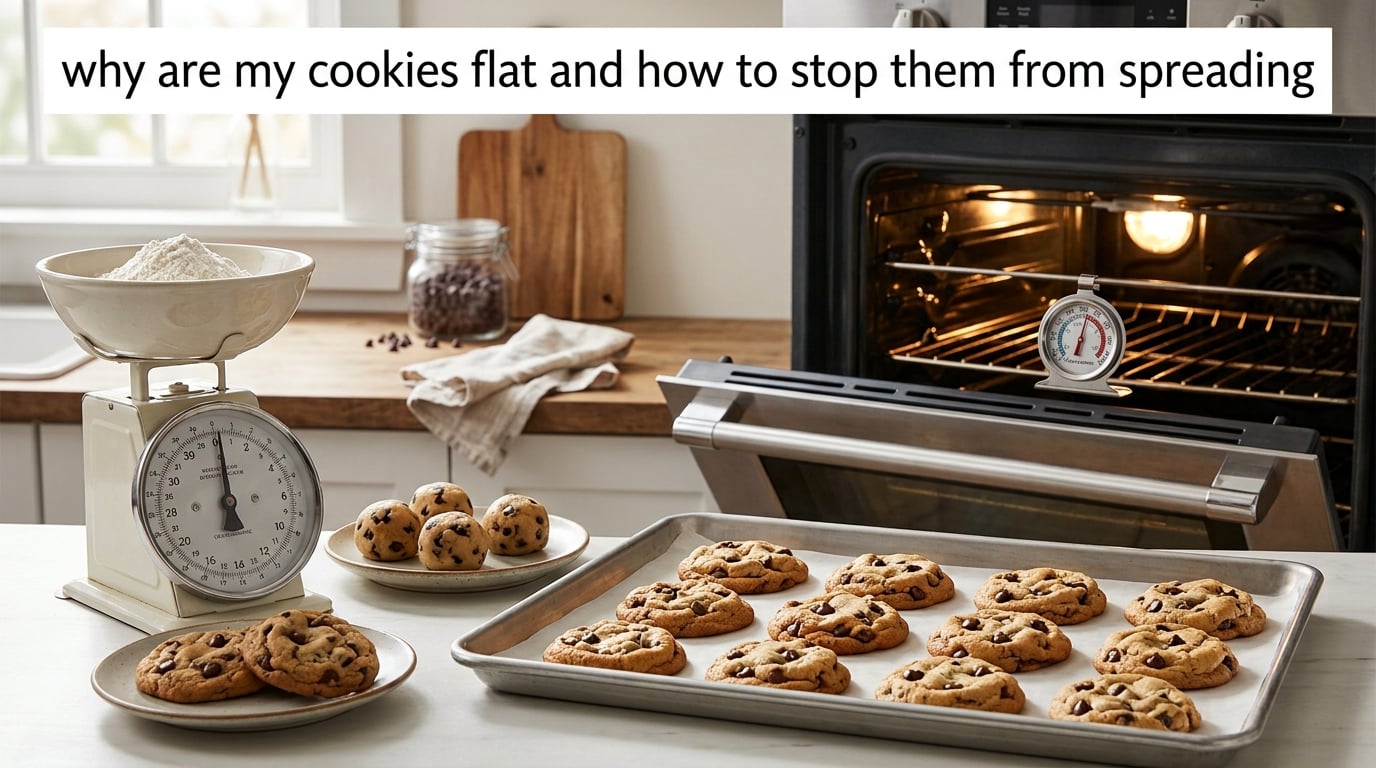
We’ve all been there. You pull a tray of chocolate chip cookies out of the oven expecting thick, bakery-style rounds, and instead you get thin, greasy pancakes. If you’ve ever wondered “why are my cookies flat?” the answer almost always traces back to a handful of fixable mistakes in temperature, timing, or technique.
In our test kitchen, we’ve baked hundreds of batches over the years — and we’ve made every flat-cookie mistake in the book. This guide pulls together the ten most common causes of flat cookies, with the exact fix for each. Whether your cookies spread too much, came out flat and greasy, or turned out flat and crispy when you wanted soft, you’ll find a clear answer here.
Table of Contents
Quick Diagnosis: What Your Flat Cookies Are Telling You
Before you start tweaking, match your symptom to the most likely culprit. Different flat-cookie problems point to different root causes.
| If your cookies are flat and… | The most likely cause is… |
|---|---|
| Greasy or oily on top | Butter was too warm, or there is too much butter in the recipe |
| Chewy in the middle but very thin | Not enough flour, or the dough was over-handled |
| Cakey and pale, no browning | Expired baking soda or baking powder, or too little sugar |
| Crispy and lacy at the edges | Too much sugar (especially white sugar) or oven too hot |
| Flat on the bottom, puffy on top | Hot baking sheet from a previous batch |
| Flat at high altitude | Air pressure and dry air pull moisture out fast — adjust flour and leavening |
This quick-read table comes from years of reader emails and our own failed batches. The next sections walk through every cause in detail.
Why Are My Cookies Flat? 10 Common Causes and Quick Fixes
Most flat cookies come from one of ten causes. We’ve listed them in the order we usually troubleshoot, with a one-line fix for each. If you fix these one at a time and re-test a small batch between changes, you will find your culprit.
1. Your butter was too warm
The single most common reason cookies turn out flat is butter that was too soft when you mixed the dough. Butter should be cool but pliable — about 65 to 68°F (18 to 20°C).
Press a clean finger into the butter. It should yield slightly but still hold its shape and feel cool to the touch. If your finger slides in easily or the butter looks shiny and greasy, it is too warm. Put it back in the fridge for 10 to 15 minutes and retest.
Quick fix: Aim for butter that bends without snapping. If it melts at room contact, it is too soft for cookies.
2. You skipped chilling the dough
Chilling cookie dough is not optional if you want thick cookies. Cold dough means cold butter, and cold butter melts more slowly in the oven — giving the flour-and-egg structure time to set before the fat runs out.
A minimum 30-minute chill helps with spread. A 2-hour chill is better. A 24 to 72-hour chill is what many bakeries do for the deepest flavor and the tallest cookies.
Quick fix: Scoop the dough into balls first, then chill the balls on a parchment-lined plate. Bake straight from the fridge.
3. You measured flour wrong
This one causes more flat cookies than any other ingredient error. Flour is the structure of the cookie, and a quarter-cup too little will leave you with thin, greasy rounds.
Never scoop the measuring cup directly into the bag — that compacts the flour and adds up to 20% more than the recipe calls for. Either fluff the flour with a spoon, spoon it into the cup, and level it off with a knife, or — better — weigh the flour. Most cookie recipes call for 120 grams of flour per cup.
Quick fix: Use a kitchen scale. We promise the $15 it costs will change every cookie you bake.
4. Your baking soda or baking powder is expired
Leavening agents are what give cookies their lift. Without active baking soda or baking powder, dough spreads instead of rising, and you end up with flat, dense, pale rounds.
Baking soda loses potency about 6 months after opening. Baking powder loses potency about 9 to 12 months after opening. Test by stirring a teaspoon into a half-cup of hot water — it should bubble vigorously. No bubbles means it is dead.
Quick fix: Replace the leavening. Also double-check that the recipe actually calls for it — some shortbread-style doughs skip leavening on purpose and will always be flat.
5. Your oven temperature is off
Ovens lie. Most run 10 to 25°F hotter or cooler than the dial says. A too-hot oven causes cookies to spread before they set; a too-cool oven gives them time to spread before browning.
Invest in an oven thermometer that hangs from a rack. Preheat for at least 20 minutes. If your oven runs hot, drop the recipe’s temperature by 25°F and bake a few minutes longer.
Quick fix: Check actual oven temp with a thermometer and adjust accordingly.
6. You are using a bad recipe (too much sugar, butter, or too little flour)
Some viral cookie recipes are simply imbalanced. Food52’s testing found that recipes with a wacky ratio of sugar, butter, and fat — too much sugar, too much butter, or too little flour — produce cookies that “are on the run” before they bake.
A reliable drop-cookie ratio is roughly 2 parts flour to 1 part fat to 1 part sugar (by weight), plus one egg and a teaspoon of leavening per cup of butter. If your recipe departs wildly from this, consider switching.
Quick fix: Use a tested recipe from a cookbook author or bakery you trust. The internet is full of untested “secret” cookie recipes that will never give you the texture you want.
7. You overmixed the dough
Overmixing develops gluten, which sounds like a good thing for structure — but in cookies, too much gluten turns the dough tough and elastic, and it also warms the fat in your hands and from the mixer. Warm fat melts faster in the oven. The result: flat cookies.
Mix dry ingredients into wet just until you stop seeing streaks of flour. A few flour pockets are fine; they will hydrate during the chill.
Quick fix: Mix until just combined. Stop the mixer the moment the flour disappears.
8. Your baking sheet is too hot
If you reused a baking sheet straight from the dishwasher or one fresh out of a previous bake, the bottom of your cookies cooks immediately on contact and they spread as the fat melts.
Always bake on a cool sheet. Run it under cold water and dry it between batches, or keep two sheets in rotation so one can cool while the other bakes.
Quick fix: Cool baking sheets fully between batches.
9. You over-greased the pan
A non-stick or parchment-lined baking sheet needs no extra grease. Adding butter or cooking spray to a sheet that is already slick makes a cookie slide outward as soon as the fat in the dough melts.
Use parchment paper or a silicone baking mat (Silpat) for almost every cookie recipe. Skip the butter and oil unless a recipe specifically calls for it.
Quick fix: Use parchment paper or a silicone mat — not greased foil or bare dark metal sheets.
10. Your kitchen is too warm
If you bake in a hot kitchen in summer, your butter softens faster than the recipe assumes and your dough spreads more between scoop and oven. Reddit and baking-forum threads show this is a top cause of “my recipe used to work” complaints.
If the kitchen is over 75°F, work quickly, chill your mixing bowl, and put scooped dough back in the fridge between batches. Climate and altitude both play a real role in spread.
Quick fix: Chill the mixing bowl and dough balls. At high altitude (above 3,500 feet), reduce baking powder by 1/4 teaspoon and increase flour by 1 to 2 tablespoons.
How to Stop Cookies From Spreading: A Step-by-Step Technique
If you have time to read one section, read this one. These are the seven moves our bakers make every single time, in order, when cookies start going flat.
- Weigh the flour. 120 grams per cup. Use a kitchen scale.
- Check the butter temperature. 65 to 68°F. Cool but pliable. Use the finger-press test.
- Test the leavening. A teaspoon in hot water should fizz hard.
- Scoop the dough into balls on a parchment-lined plate and chill for at least 30 minutes — 2 hours is better, 24 hours is best.
- Preheat the oven for 20 minutes with an oven thermometer inside. Confirm the actual temperature before baking.
- Line a cool baking sheet with parchment paper or a silicone mat. Do not grease.
- Bake one tray at a time on the middle rack, leaving 2 inches between dough balls. Cool the sheet fully between batches.
Following those seven steps fixes roughly 90% of the flat-cookie problems we see in our test kitchen and from readers.
The Science: Why Cookies Spread in the Oven
Understanding the science makes every fix above easier to remember. Cookies spread for three big reasons that all happen in the first half of baking:
Fat melts before structure sets. Butter melts around 90 to 95°F. Cookie dough goes into a 350°F oven — so the fat liquefies almost immediately, and the dough “runs” outward across the sheet. If the fat is already warm before the oven, this happens even faster. The flour proteins and egg proteins need heat plus time to firm up. Chilling the dough and keeping the butter cool slows the melt just long enough for structure to form.
Steam pushes the dough outward. As the butter melts and water in the dough heats up, steam escapes. The cookie is essentially puffed on a cushion of steam until the structure sets and the steam leaks out the sides. Too much steam (often from a too-wet dough or a too-cool oven) gives flat, dense cookies.
Sugar liquefies early. White sugar melts at a lower temperature than brown sugar. Recipes heavy on white sugar spread more before the dough can set. Brown sugar’s molasses content holds moisture and adds chewiness — which is why cookies with more brown sugar are typically puffier.
Together, these three forces explain nearly every flat-cookie problem. The fixes all reduce fat temperature, slow the melt, and give structure time to set.
Chill Time Guide: How Long to Chill Cookie Dough
| Chill time | Effect on cookies | Best for |
|---|---|---|
| 20 to 30 minutes | Reduces spread noticeably | Quick weeknight batches |
| 2 hours | Noticeably thicker, less spread | Most home bakers — minimum recommended |
| 24 hours | Deeper flavor, taller cookies, slightly darker color | Weekend bakers, dinner-party batches |
| 48 to 72 hours | Bakery-level flavor and structure | Holiday baking, when time allows |
Always chill scooped dough balls, not the whole bulk of dough. Scooped balls re-chill faster and bake more evenly.
Flat Cookie Rescue: What to Do If the Dough Is Already Flat
You’ve scooped the dough, and it is already spreading on the plate. Don’t bake it. Try these rescue moves:
- Freeze the dough balls on the parchment-lined plate for 15 to 20 minutes before baking.
- Roll each ball more tightly, pressing out any air pockets that will expand in the oven.
- Add 1 to 2 tablespoons of flour to the dough if it looks greasy or slack, then chill again.
- Bake at 325°F instead of 350°F — a lower oven temperature slows the fat melt and gives the structure time to set.
The freezer trick is especially good when your kitchen is warm or you forgot to chill. A 15-minute freeze is enough to firm up the butter and reduce spread dramatically.
Frequently Asked Questions
How do I keep my cookies from being flat?
Weigh your flour with a kitchen scale (120 grams per cup), chill the dough for at least 30 minutes before baking, keep butter at 65 to 68°F, and bake on a parchment-lined cool sheet. These four changes fix about 90 percent of flat-cookie problems in our test kitchen.
What makes cookies fluffy instead of flat?
Active leavening (baking soda or baking powder), cold butter, properly measured flour, and a chilled dough. Steam trapped inside the dough puffs cookies up; fat melting too fast flattens them. Slow the fat melt and you get fluffy cookies.
What to do with cookies that are flat?
Freeze the dough balls for 15 minutes before baking, roll them more tightly to remove air pockets, add a tablespoon or two of flour if they look greasy, and bake at 325°F instead of 350°F. These rescue moves often turn a flat batch into a usable one.
How to get cookies to rise more?
Check your baking soda and baking powder for freshness — a teaspoon in hot water should fizz hard. Old leavening will not lift the dough. Also bake from a chilled state, not room temperature, so the structure sets before the fat melts.
Does overmixing cause flat cookies?
Yes. Overmixing develops gluten and warms the butter from the friction. Warm butter melts faster in the oven, and the dough spreads before the flour structure sets. Mix dry ingredients into wet just until the flour streaks disappear.
Why do my cookies never bake flat?
Some cookie styles are meant to be flat — tuiles, lace cookies, and certain shortbreads are thin by design. If your recipe is a drop cookie (chocolate chip, oatmeal, snickerdoodle), flat means too much spread, and the same fixes apply: chill the dough, weigh the flour, and check your oven temperature.
The Bottom Line: A Flat-Cookie Checklist
Before any batch of cookies goes in the oven, run through this list. It sums up everything in this guide.
- Butter at 65 to 68°F (firm but pliable).
- Flour weighed at 120 grams per cup — not scooped.
- Baking soda and baking powder less than 6 months old.
- Dough scooped into balls and chilled at least 30 minutes.
- Oven preheated 20 minutes, verified with an oven thermometer.
- Cool baking sheet lined with parchment or a silicone mat.
- 2 inches of space between dough balls.
- One tray on the middle rack, sheet cooled between batches.
Run through that checklist twice and your next batch should look more like the cookies you want and less like a pancake. If a few still come out flat — that’s baking. Tweak one variable at a time and you’ll crack it.