
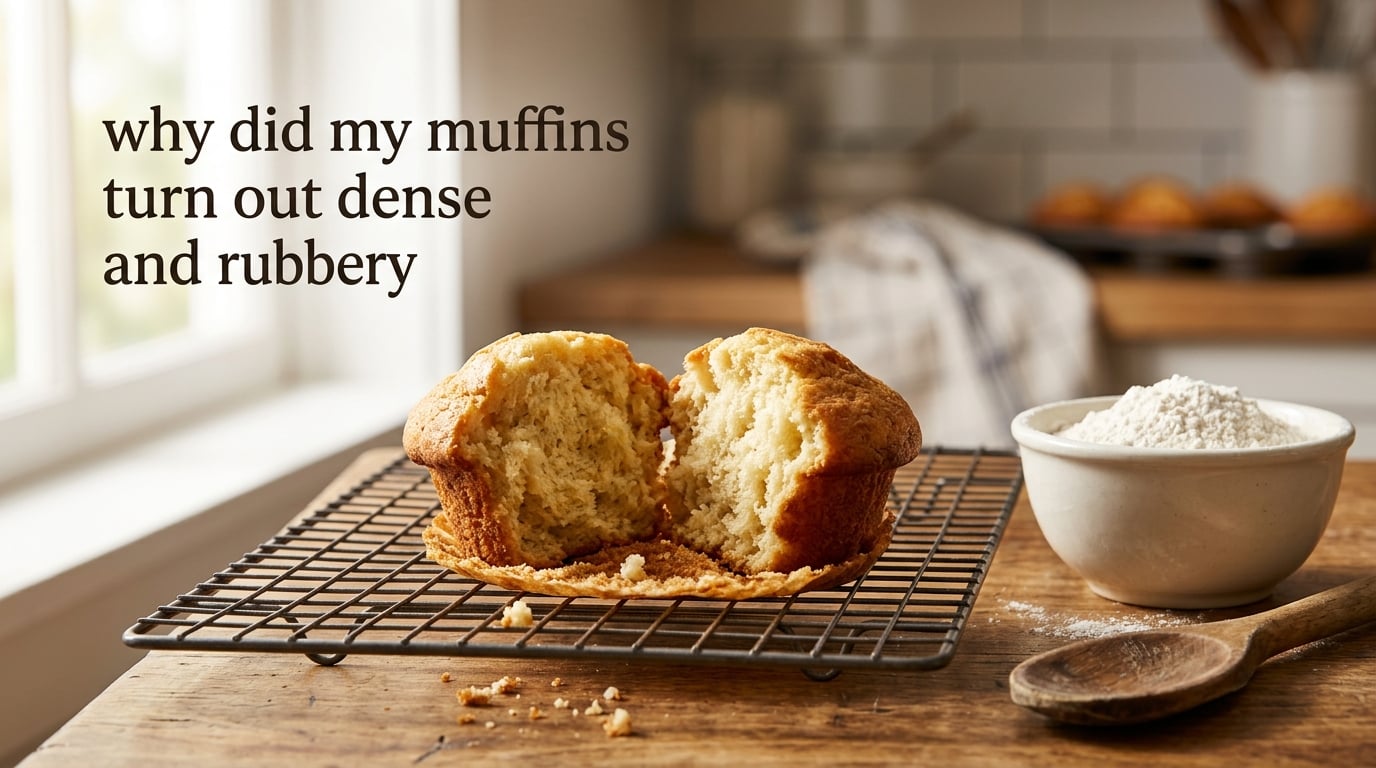
If you just pulled a tray of dense, rubbery muffins out of the oven, you’re not alone. This is one of the most common home-baking frustrations, and the good news is that the fix is almost always simpler than you think.
You followed the recipe, preheated the oven, and waited patiently. Yet the muffins came out heavy in the middle, tough on the outside, or both at once. So the real question is: why did my muffins turn out dense and rubbery, and which exact mistake caused it?
Before we dig in, here’s the short answer: dense muffins and rubbery muffins are actually two different problems with overlapping causes. Most of the time, the culprit is overmixing the batter, which develops too much gluten and produces a tough, chewy crumb instead of a tender, fluffy one. But flour measurement, old baking powder, wet add-ins, oven temperature, and pan choice all play a role too.
In this guide, I will walk you through the six most common causes of dense and rubbery muffins, show you how to diagnose your specific batch, and give you the exact fixes that work. By the end, you will know exactly what went wrong and how to get fluffy, tender muffins next time.
Table of Contents
Quick Answer: The 6 Most Common Causes
If you only have thirty seconds, this is the shortlist of why muffins turn out dense or rubbery, and the one-line fix for each:
- Overmixing the batter — develops gluten. Fix: stop stirring the moment the flour disappears; lumps are fine.
- Too much flour — throws off the ratio. Fix: weigh flour on a scale (125 g per cup) or spoon-and-level.
- Old or weak baking powder — muffins can’t rise. Fix: replace baking powder every 6-12 months and test it in hot water.
- Too much liquid or juicy add-ins — batter is wet and heavy. Fix: blot fruit, measure milk carefully, fold gently.
- Wrong oven temperature — underbakes the center or toughens the outside. Fix: use an oven thermometer and preheat fully.
- Skipping the batter rest — flour doesn’t hydrate. Fix: rest the batter 10-15 minutes before scooping.
Now let me show you how to figure out which one caused your muffins.
Dense vs Rubbery: Two Different Problems With Overlapping Causes
Most bakers use “dense” and “rubbery” interchangeably, but they describe different texture failures, and the cause is usually different too.
A dense muffin is heavy in the middle, sinks a little, and has a tight crumb. It often tastes fine, but the texture is closer to a cupcake that forgot to rise. The main suspects are weak leavening, too much flour, or overmixing.
A rubbery muffin has a chewy, almost bouncy texture, sometimes only on the outside, sometimes all the way through. The most common culprit is overdeveloped gluten, which comes from overmixing. A hot oven in a dark pan can also produce a rubbery, tough crust.
Quick self-check:
- Heavy and flat? Lean toward leavening or flour issues.
- Chewing like bread? Lean toward overmixing or too much flour.
- Tough crust, soft middle? Lean toward oven temperature or pan color.
- Sinking in the middle? Lean toward underbaking or old baking powder.
Once you identify which failure you actually have, the rest of this guide will feel much more useful.
Cause #1: Overmixing and Gluten Development
If I had to pick a single reason home bakers end up with dense, rubbery muffins, this is it. Overmixing is the #1 cause across every recipe forum and troubleshooting guide, including the bakers I trust most.
Here is what happens. Flour contains two proteins, glutenin and gliadin. When they meet liquid and are stirred, they link into an elastic network called gluten. In yeast breads, you want this. In muffins, you absolutely do not.
Muffins are a type of quick bread: they rise from chemical leavening (baking powder or baking soda), not from yeast and time. The crumb is supposed to be tender, with small, even air pockets. Every extra stroke of the spatula cross-links more gluten strands, tightening the network, trapping less gas, and producing a muffin that is dense, chewy, and rubbery instead of light and fluffy.
How to tell if you overmixed:
- Your muffin has a smooth, elastic top that springs back when pressed.
- The interior has tight tunnels instead of small, even holes.
- The crumb is bouncy when you bite into it.
- The muffin tears into tough strips rather than breaking softly.
The fix is straightforward:
- Mix by hand with a fork or spatula. Stand mixers and hand mixers develop gluten very fast in muffin batter.
- Stop the moment the flour disappears. Lumps are not your enemy. A lumpy batter means you mixed just enough.
- Use the “fold and rest” method. Pour wet into dry, fold gently a few times, and walk away. The resting batter (covered below) will smooth out without further mixing.
- Time yourself. Most muffin batters need only 10-15 seconds of mixing once wet and dry meet.
Across forums like r/Baking and r/AskBaking, the consensus is clear. As multiple experienced bakers point out, weighing flour and mixing by hand are the two upgrades that fix more muffin batches than any other change. If you only fix one thing today, fix overmixing.
Cause #2: Measuring Flour Wrong – Too Much Flour in the Cup
This one is sneaky because you can follow a recipe exactly and still end up with way more flour than the recipe calls for. A cup of flour can vary by 30-50 grams depending on how it is packed.
More flour means more gluten, more structure, and less liquid to hydrate it. The result is a muffin that is tall, dry, and dense in the middle. Too much flour is also one of the most common reasons muffins sink in the middle or feel bready rather than cake-like.
The fix:
- Weigh your flour. 125 grams per cup of all-purpose flour is the standard. A kitchen scale costs less than a takeout dinner and changes everything.
- Spoon and level if you do not have a scale. Fluff the flour with a spoon, spoon it into the measuring cup, then level with a knife. Never scoop directly with the cup.
- Use the spoon-and-level method for cocoa powder too, since cocoa compacts the same way.
Recipe tip: if a recipe calls for “1 cup of flour” and your muffins always come out dry and dense, that recipe may be written for a lighter hand. Drop to 110-115 grams per cup and see what happens.
Cause #3: Old or Weak Leavening
Baking powder and baking soda are the engines that make muffins rise. If they are old, weak, or measured wrong, your muffins simply do not have the gas to climb. They bake dense, sometimes with sunken tops, sometimes with a raw-looking center.
Baking powder has a shelf life of about 6-12 months once opened. Heat, humidity, and a damp spoon all shorten its life. Baking soda lasts a bit longer but loses potency once opened.
How to test your baking powder:
- Drop a teaspoon into a cup of hot water.
- If it fizzes vigorously, it is alive and well.
- If it barely bubbles, replace it.
Other leavening pitfalls:
- Baking soda needs acid. If a recipe uses baking soda, it must have buttermilk, yogurt, sour cream, or another acid. No acid means no rise, and a metallic, bitter aftertaste.
- Double-acting baking powder activates once when wet and once when heated. Single-acting bakes differently and can leave you with a flat, dense muffin.
- Mixing leavening too early in wet ingredients can exhaust it before the oven. Always combine dry ingredients right before mixing the batter.
If your muffins always come out flat or dense even when the texture is fine, leavening is the first place to look.
Cause #4: Too Much Liquid or Wet Add-ins
Muffin batter is a careful balance. If the liquid side gets out of proportion, the muffins turn out gummy in the middle, dense, or underdone. This is one of the most common complaints I see in baking forums, especially for banana and blueberry muffins.
Common liquid culprits:
- Overripe banana can release a lot of liquid. Mash and measure, and reduce the milk by a tablespoon if the mash looks soupy.
- Frozen fruit (blueberries, raspberries) thaws into the batter during mixing and dumps extra water. Toss frozen fruit straight from the freezer in a tablespoon of flour, and reduce other liquid by 1-2 tablespoons.
- Yogurt or buttermilk are great for tenderness, but they vary widely by brand. Greek yogurt is much thicker than regular, and buttermilk ranges from thin to thick.
- Eggs should be at room temperature so they emulsify into the batter. Cold eggs can also cause a curdled look and uneven texture.
The simplest diagnostic: scoop your finished batter. It should fall in thick ribbons from the spoon, not pour like pancake batter. If it is runny, you have too much liquid for the flour you used.
Cause #5: Wrong Oven Temperature
An oven that runs hot or cold can turn perfectly good muffin batter into a tough, dense, or underbaked batch.
If your oven runs hot, the outside of the muffin sets before the inside has time to rise. You get a tall, peaked top and a gummy, undercooked center. The crust can also brown so fast it turns rubbery, especially in dark pans.
If your oven runs cold, the muffins bake too slowly. The leavening runs out before the structure sets, and the muffins sink in the middle and feel dense.
How to fix oven temperature:
- Use an oven thermometer. Most ovens are off by 25°F (15°C) or more. The dial setting is a wish, not a measurement.
- Preheat for at least 20 minutes. Muffins need full heat from the start.
- Avoid opening the door in the first 15 minutes of baking. The heat drop is dramatic and can collapse rising muffins.
- Rotate the pan once at the halfway mark if your oven has hot spots.
A good target is 375-400°F (190-200°C) for most muffin recipes. Some bakers start at 425°F (220°C) for 5 minutes, then drop to 375°F (190°C) for tall, bakery-style tops. Both work, but both depend on your oven actually being at the temperature the recipe says.
Cause #6: Skipping the Batter Rest
This is the quiet fix that more experienced bakers swear by, and one of the easiest upgrades you can make. Resting the batter for 10-15 minutes before scooping lets the flour fully hydrate and the gluten relax.
Why it matters:
- Hydrated flour traps gas more efficiently, so muffins rise taller.
- Relaxed gluten produces a more tender, less chewy crumb.
- The batter thickens slightly, which helps you get those tall, bakery-style tops.
How to rest batter:
- Mix your batter as directed, but stop a touch early. It should look slightly undermixed.
- Cover the bowl and let it sit at room temperature for 10-15 minutes.
- After resting, give it a single, gentle fold. Do not stir. Then scoop and bake.
Do not rest longer than 30 minutes. Beyond that, the baking powder exhausts itself, and your muffins will turn out flat. The sweet spot is 10-15 minutes.
Pan Color, Fill Levels, and Other Easy Fixes
Beyond the six main causes, a few smaller choices have an outsized effect on texture.
Pan color matters. Dark pans absorb more heat and produce a thicker, browner, sometimes rubbery crust. Light or aluminum pans bake more gently and give a softer crumb. If you are switching to dark pans, drop the oven temperature by 25°F (15°C).
Fill levels change density. Muffin cups should be filled about two-thirds to three-quarters full for a domed top. Overfilling creates muffin tops that spill over and dry out the sides. Underfilling produces short, squat muffins with a denser body.
Coat add-ins in flour. Toss blueberries, chocolate chips, or nuts in a tablespoon of flour before folding them in. This stops them from sinking to the bottom, where they release moisture and make the base gummy.
Cool on a wire rack. Leave muffins in the pan for 5 minutes, then move them to a wire rack. Trapped steam in the pan softens the sides and makes them feel rubbery even when they are baked through.
Room-temperature ingredients. Cold milk, eggs, or butter do not emulsify well into the batter, leaving pockets of fat that produce uneven, dense patches. Set everything out 30-60 minutes before you start.
Symptom-to-Fix Diagnosis Table
Here is a quick reference for the four most common muffin failures and what to change on your next batch.
| Symptom | Likely Cause | Fix for Next Time |
|---|---|---|
| Dense, heavy center; small or no rise | Old baking powder or weak leavening | Replace baking powder; test in hot water; check acid balance |
| Rubbery, chewy texture all the way through | Overmixing developed gluten | Mix by hand; stop when flour disappears; rest 10-15 minutes |
| Tough, dark crust; gummy middle | Hot oven or dark pan | Use oven thermometer; switch to light pan; lower temp 25°F |
| Muffins sink in the middle after baking | Underbaking or exhausted leavening | Test doneness with toothpick; check internal temp 200°F (95°C) |
| Tall, peaked top but raw center | Oven too hot | Drop temperature 25°F; move rack to middle |
| Dry, crumbly texture | Too much flour or overbaked | Weigh flour at 125 g/cup; shorten bake time by 2-3 minutes |
| Gummy bottom layer | Wet fruit sank, or too much liquid | Coat add-ins in flour; blot fruit; reduce milk slightly |
How to Tell When Muffins Are Done
The toothpick test is the classic check for a reason. Insert a wooden toothpick into the center of a muffin. If it comes out clean or with a few moist crumbs, the muffin is done. If wet batter clings to it, give it another 2-3 minutes.
For more certainty, use an instant-read thermometer. The internal temperature of a fully baked muffin should be 200-205°F (93-96°C). Below 195°F (90°C), the center is likely still gummy.
Other cues:
- The top springs back lightly when pressed.
- The edges have just begun to pull away from the liner.
- The muffin feels light in your hand for its size.
Pulling muffins too early is one of the most common reasons for a gummy center. When in doubt, give them another minute. A slightly overbaked muffin is far better than an underbaked one.
Adjustments for High Altitude, Humid Climates, and Gluten-Free Baking
If you live above 3,000 feet (900 meters), your muffins will rise faster and then collapse, leaving a dry, dense crumb. To compensate, reduce baking powder by about 1/4 teaspoon per teaspoon, increase oven temperature by 15-25°F (8-15°C), and slightly reduce sugar.
In humid climates, flour absorbs moisture from the air. Reduce the milk or liquid by 1-2 tablespoons, and store flour in an airtight container.
For gluten-free muffins, the texture problem is the opposite. Without gluten, you get less structure and a crumblier muffin. Use a 1-to-1 gluten-free flour blend that includes xanthan gum, and let the batter rest 15-20 minutes so the binders can activate.
Frequently Asked Questions
Why did my muffins turn out dense?
Dense muffins are usually caused by weak or old baking powder, too much flour, or overmixing the batter. The fix is to replace your baking powder, weigh flour at 125 grams per cup, and stop mixing the moment the flour disappears. A properly mixed muffin batter should look lumpy, not smooth.
Why did my muffins turn out rubbery?
Rubbery muffins are almost always caused by overmixing, which develops too much gluten and creates a tough, chewy crumb. Mix the batter by hand, stop as soon as the flour disappears, and rest the batter for 10-15 minutes before scooping. A dark pan or oven that runs hot can also create a rubbery crust.
How can I make my muffins lighter and fluffier?
Mix the batter by hand and stop the moment the flour is incorporated. Use fresh baking powder, weigh your flour, and rest the batter for 10-15 minutes before baking. Fill muffin cups two-thirds to three-quarters full and bake at 375-400°F (190-200°C) until a toothpick comes out clean.
How do I tell if I overmixed the muffin batter?
Overmixed batter looks smooth and glossy rather than lumpy. The finished muffin will have a tight crumb with tunnels, spring back firmly when pressed, and chew like bread instead of crumbling softly. Lumpy batter is the goal – lumps mean you stopped mixing before gluten developed.
What is the fastest way to fix dense muffins?
If your muffins are already baked and dense, you cannot undo the texture, but you can repurpose them. Cube them for bread pudding, split and toast them, or crumble them as a topping for yogurt or ice cream. For the next batch, weigh your flour, replace the baking powder, and mix only until the flour disappears.
What are the most common muffin baking mistakes?
The most common mistakes are overmixing the batter, measuring flour by packing it into the cup, using old baking powder, adding too many wet add-ins like frozen fruit, skipping the preheat, and overbaking. Avoid these and your muffins will be noticeably more tender.
Should muffin batter be lumpy?
Yes. Lumpy batter is the correct texture for muffins. The lumps are pockets of flour that have not fully hydrated yet, and they will smooth out during the 10-15 minute rest. A perfectly smooth batter means gluten has developed and the muffins will be dense or rubbery.
Final Thoughts: A Quick Checklist for Tender Muffins Every Time
So, to answer the original question – why did my muffins turn out dense and rubbery – the most likely cause is overmixing, with too much flour and old baking powder close behind. The good news is that none of these are hard to fix.
Before your next batch, run through this short checklist:
- Use fresh baking powder (test it in hot water).
- Weigh flour at 125 grams per cup, or spoon and level.
- Mix by hand, and stop the moment the flour disappears.
- Rest the batter for 10-15 minutes before scooping.
- Preheat the oven fully and confirm with a thermometer.
- Fill cups two-thirds to three-quarters full in a light pan.
- Cool on a wire rack within 5 minutes of leaving the oven.
Muffins are forgiving once you understand what they need: tender mixing, accurate flour, and lively leavening. Make those three changes and you will go from dense, rubbery muffins to the light, fluffy, domed tops you have been chasing. Happy baking.