
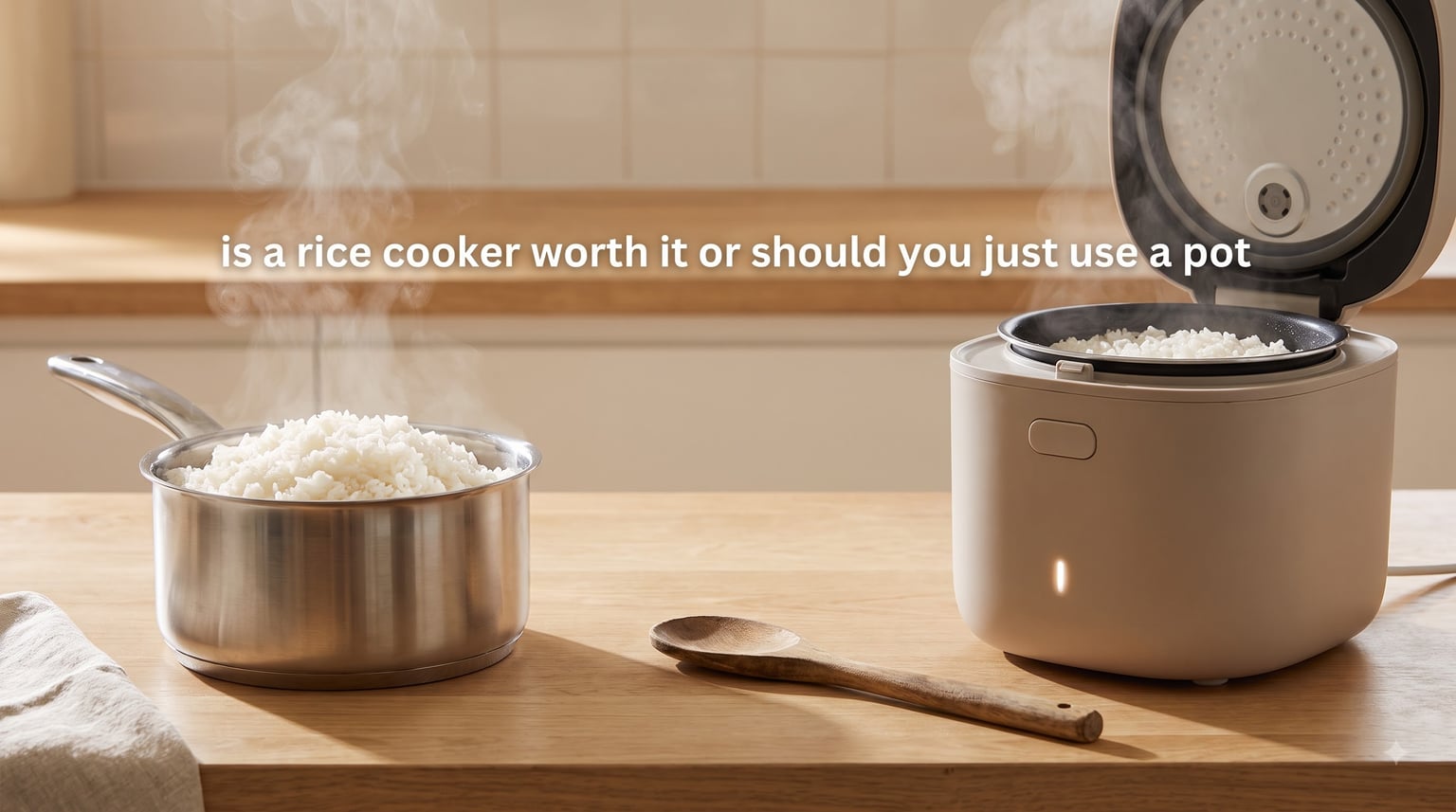
Is a rice cooker worth it or should you just use a pot? The honest answer is: it depends on how often you cook rice, how much counter space you have, and whether you value hands-off consistency or stovetop control. If rice is on your plate two or more times a week, a basic rice cooker earns its spot within a month. If you cook rice once a month and already own a heavy pot with a tight lid, save your money.
I’ve been switching between a $35 basic rice cooker and a stainless steel pot on the stove for the better part of a decade, and the honest answer surprised me. Both methods make excellent rice. The real question isn’t which one is “better”, it’s which one fits the way you actually cook.
In this guide, our team walks through how a rice cooker works, the real pros and cons of both methods, a side-by-side comparison table, a practical stovetop technique that rivals any appliance, and a clear decision framework so you can stop second-guessing and start cooking.
Table of Contents
How Does a Rice Cooker Actually Work?
A rice cooker automates the absorption method – the same boiling-and-steaming process you’d do by hand on the stove. There is no magic. What you’re paying for is precision and timing.
Inside every rice cooker, a heating plate warms an inner pot of water and rice until the mixture hits 212°F (the boiling point of water). A thermostat at the bottom of the pot tracks the temperature. As long as liquid water is still present, the temperature stays pinned at boiling. The moment the rice absorbs the last of the water, the temperature inside the pot suddenly jumps above boiling. The thermostat senses that jump and clicks the cooker from “cook” mode to “keep warm” mode.
That’s the whole trick. The cooker doesn’t know rice from porridge – it just knows “water present” versus “water gone”. The result is a tight steam environment where starch gelatinizes evenly, and a controlled rest that prevents a scorched bottom.
The absorption method (the science behind both methods)
When rice hits hot water, starch granules on the surface absorb water and swell, then burst. This is starch gelatinization, and it’s what turns dry, crunchy grains into tender rice. Both a rice cooker and a stovetop pot rely on this same reaction. The difference is who (or what) is in charge of the temperature curve.
Fuzzy logic (and when it matters)
Basic rice cookers use the simple “water gone, switch to warm” logic above. Mid-range and premium models add fuzzy logic – a small chip that makes continuous micro-adjustments to time and temperature based on the type of rice, the volume, and even humidity. For everyday long-grain or jasmine rice, fuzzy logic is overkill. For short-grain sushi rice, brown rice, or mixed grains, fuzzy logic genuinely improves texture. If you only eat white rice, skip the upgrade.
What Are the Real Benefits of a Rice Cooker?
A rice cooker pays off in seven concrete ways. None of them are about “taste” per se – both methods can produce great rice – but they add up.
- Hands-off, truly set-it-and-forget-it. Add rice, add water, press the button. Walk away. This is the single biggest reason daily rice eaters own one.
- Consistent results every time. The thermostat removes the “did I overshoot the simmer?” guesswork. Reviewers in r/Cooking consistently call out this reliability.
- Frees up a burner. While the rice cooker hums along, you can sauté vegetables, fry an egg, or simmer a curry on the stovetop. Multi-dish dinners get noticeably easier.
- Keep-warm mode for hours. Useful for families with staggered meal times, or for anyone who’s been burned (literally) by rice that sat on a warm burner too long.
- Safer than a stovetop pot. No boil-overs, no flame under a pot of starch, no scorching risk if you get distracted by a child or a work call.
- Excellent for meal prep and batch cooking. Cook a big batch on Sunday, hit warm, scoop portions through the week.
- Cultural fit for daily rice traditions. In Asian, West African, Latin American, and Caribbean households where rice is a daily side, the rice cooker isn’t a gadget – it’s a foundational tool.
What Are the Downsides of Using a Rice Cooker?
A rice cooker is not a free win. Here are the seven honest drawbacks.
- Counter space. A standard 5-cup rice cooker takes about 9×11 inches of counter, plus clearance for the lid to swing open. In a dorm, studio, or RV, that footprint matters more than price.
- Single-purpose appliance. Yes, you can cook oats, quinoa, lentils, and steam vegetables in a rice cooker, but it still can’t sear, sauté, or reduce a sauce. A pot can do all of those things.
- Upfront cost and replacement cycles. Basic models run cheap, but nonstick inner coatings scratch and degrade within a few years of regular use. Replacement inner pots can cost as much as a new basic cooker.
- Slower than a stovetop pot, not faster. A common misconception. A rice cooker typically takes 25-35 minutes for white rice; a stovetop pot with the right ratio finishes in about 18-20 minutes. The cooker buys you freedom, not speed.
- No crispy bottom. A rice cooker cannot make tahdig (the Persian golden crust) or socarrat (the Spanish paella base). Those textures require direct bottom heat and a dry final phase that the thermostat specifically prevents.
- Learning curve for fuzzy-logic models. Multiple modes, delay timers, and “quick cook” buttons confuse beginners. A basic one-button cooker is the friendlier entry point.
- Cleaning. You still need to wash the inner pot, the lid, and the steam vent. Some users report it feels like more dishes than just rinsing a single pot.
Why a Pot on the Stove Is Still a Great Choice
A heavy-bottomed pot with a tight-fitting lid can absolutely produce restaurant-quality rice. The trade-off is attention, but the upside is real.
- Versatility. The same pot makes rice, soups, stocks, pasta, boiled vegetables, and one-pot meals. One tool, dozens of uses.
- No extra equipment, no extra clutter. You already own it. There’s nothing to plug in, store, or replace.
- Texture control. You control the heat curve minute by minute. You can pull the rice a touch early for al dente, push it longer for softer grains, or crank the heat at the end for tahdig.
- Crispy bottom rice. Tahdig, socarrat, and the coveted golden crust at the bottom of a Persian or Spanish rice dish are only possible in a stovetop pot. If you love that texture, a rice cooker simply cannot deliver it.
- Cheaper and faster for small batches. One cup of rice for one person takes 18 minutes on the stove and barely dirties a dish. A rice cooker for one cup feels like overkill.
- Works during a power outage. No electricity required. A real plus during storms or in older kitchens.
When Cooking Rice in a Pot Goes Wrong
The pot method has a learning curve, and most failures fall into a few predictable patterns.
- Burnt or scorched bottom. The most common complaint. Usually caused by heat that’s too high once the water reaches a boil, or by leaving the pot on a hot burner after all the water has been absorbed.
- Mushy, overcooked rice. Too much water, or a lid that lets steam escape. Long-grain rice forgives extra water better than short-grain.
- Underdone, crunchy rice. Not enough water, or lifting the lid too often (each peek releases steam and drops the pot temperature).
- Boil-overs. High starch content plus a too-vigorous boil equals starchy foam spilling over the rim. A heavy lid and a quick reduction to low heat prevents this.
- Inconsistent batches. Without a thermostat, every batch depends on your stove, your pot, and your attention. Some cooks nail it every time; others struggle for months.
The good news: every one of these problems is fixable with the right technique. We’ve covered that step by step below.
Rice Cooker vs Pot: Side-by-Side Comparison
| Factor | Rice Cooker | Stovetop Pot |
|---|---|---|
| Ease of use | One-button, fully hands-off | Active monitoring for 18-20 minutes |
| Typical cook time (white rice) | 25-35 minutes | 18-20 minutes |
| Consistency | Very high (thermostat-controlled) | Depends on the cook |
| Versatility | Rice, oats, quinoa, steamed veg | Rice, soups, pasta, sauces, one-pot meals |
| Counter space | 9×11 inches plus clearance | None extra (you already own a pot) |
| Energy use | 300-700W, steady draw | Single burner, 5-15 minutes active |
| Cleanup | Inner pot, lid, steam vent | One pot, one lid |
| Crispy bottom (tahdig) | Not possible | Easy with a dry final phase |
| Upfront cost | Basic to mid-range covers most cooks | Zero (already in your kitchen) |
| Power outage friendly | No | Yes |
How to Cook Perfect Rice in a Pot on the Stove
This is the section most competing guides skip, and it’s the one that matters most if you’re leaning toward the pot. Follow these six steps and your stovetop rice will match a rice cooker every time.
Step 1: Rinse the rice
Place the rice in a bowl, cover with cool water, swirl, and drain. Repeat two or three times until the water runs mostly clear. Rinsing removes surface starch, which is the main cause of gummy or sticky rice. This step matters more than any other.
Step 2: Use the right water-to-rice ratio
For most long-grain white rice (jasmine, basmati), use 1.5 cups of water per 1 cup of rice. For short-grain or sushi rice, use 1.25 cups of water. For brown rice, bump to 2 cups. These ratios assume a tight-fitting lid; if your lid is loose, add an extra two tablespoons of water.
Step 3: Bring to a boil, then drop to a bare simmer
Cover the pot, set the burner to high, and bring the water to a full boil. The moment you see vigorous bubbles around the edge, drop the heat to the lowest possible setting. The goal is a gentle, barely-visible simmer – if you can hear the rice bubbling, the heat is still too high.
Step 4: Set a timer for 18 minutes and leave the lid on
Do not lift the lid. Do not stir. Each peek releases steam and stretches the cook time. Set a kitchen timer for 18 minutes and walk away. This is the closest a pot method gets to “set it and forget it”.
Step 5: Kill the heat and let it rest for 10 minutes
After 18 minutes, turn off the burner completely but leave the lid on. Let the rice rest for 10 minutes. This final steaming phase finishes the absorption and lets the grains firm up so they don’t turn to mush when you fluff.
Step 6: Fluff with a fork and serve
Remove the lid, run a fork gently through the rice to separate the grains, and serve. Never use a spoon – it compresses the grains. If you want tahdig, skip the lid rest and instead crank the heat up for the last 90 seconds until you hear a faint sizzle and smell toasted rice.
That six-step method is the entire technique. Once you’ve done it two or three times, it becomes muscle memory, and you’ll never look at a rice cooker the same way again.
So, Is a Rice Cooker Worth It or Should You Just Use a Pot?
The honest, conditional verdict: a rice cooker is worth it if you cook rice two or more times a week, you live in a household where rice is a daily staple, or you specifically value hands-off, consistent results. A pot on the stove is the right call if you cook rice occasionally, you live in a small kitchen where counter space is precious, you love crispy bottom rice, or you want to keep your kitchen tools to a minimum.
Here’s the audience-by-audience breakdown that makes the decision easier.
Choose a rice cooker if you are…
- A daily or near-daily rice eater. Two to three times a week or more is the threshold where the convenience starts to pay for itself in saved attention.
- Cooking for a family. Keep-warm mode is a lifesaver when kids eat at different times, and batch cooking in a 5- or 10-cup cooker is genuinely easier than managing a giant pot on the stove.
- A beginner cook. The thermostat removes the most common stovetop mistakes. If you’ve burned rice three times in a row, a basic rice cooker will save your dinner.
- A meal-prepper. Cook once, keep warm for hours, scoop portions into containers – the rice cooker is built for this workflow.
- Short on attention, not space. If your bottleneck is “I forgot about the rice”, a rice cooker fixes that. If your bottleneck is “I have no counter space”, see the pot section below.
Choose a pot if you are…
- An occasional rice eater. Once a week or less, a pot is plenty.
- In a dorm, studio, RV, or tiny kitchen. Counter space is a finite resource, and a pot you already own wins on real estate.
- A minimalist. One pot, ten uses. A rice cooker does one thing well and a few other things adequately.
- A tahdig or paella lover. That crispy bottom is impossible in a rice cooker. Period.
- A confident stovetop cook. If you’ve nailed the simmer-and-rest technique, you don’t need an appliance to do it for you.
Best method by rice variety
Different grains behave differently, and the right method depends on what you’re cooking.
- Long-grain white (jasmine, basmati). Both methods work beautifully. Stovetop is slightly faster; rice cooker is slightly more consistent.
- Short-grain (sushi, arborio). Rice cooker, especially with fuzzy logic. Short-grain is sticky and unforgiving, and the thermostat helps prevent overcooking.
- Brown rice. Rice cooker wins. The longer cook time and the steady low-temperature phase are tricky on the stove, and brown rice scorches easily.
- Wild rice or rice blends. Pot on the stove gives you more control over the variable hydration times across different grains.
- Risotto. Pot only. Risotto requires the slow addition of liquid and constant stirring, which neither a rice cooker nor a basic pot of simmering rice can replicate.
Frequently Asked Questions
Is it better to cook rice in a pot or rice cooker?
Both methods make excellent rice. A rice cooker is better for hands-off, consistent results if you cook rice two or more times a week or want the keep-warm feature. A heavy-bottomed pot on the stove is better for occasional batches, small kitchens, anyone who loves crispy bottom rice (tahdig), and cooks who want maximum versatility from a single tool.
What are the downsides of using a rice cooker?
The main downsides are counter space (about 9×11 inches plus lid clearance), the upfront cost, single-purpose use, the nonstick coating wearing out over time, slower cook times than a stovetop pot, no crispy bottom rice, and the fact that cleaning the inner pot and lid is more steps than washing one pot.
Do I actually need a rice cooker?
You need a rice cooker only if you cook rice frequently (two or more times a week), you want hands-off convenience, or you cook rice for a family where staggered meal times matter. If you cook rice once a week or less and you already own a heavy pot with a tight lid, you can make perfectly good rice without one.
Is it worth spending money on a rice cooker?
A basic rice cooker is worth it for frequent rice eaters. Premium models with fuzzy logic are worth the upgrade only if you regularly cook short-grain sushi rice, brown rice, or mixed grains that benefit from the micro-adjustments. For everyday white rice, a basic one-button cooker produces results that are essentially identical to a premium model.
What are common problems with rice cookers?
The most common problems are nonstick inner pot coating scratching and degrading over time, lid seals wearing out on premium models, boil-overs if you overfill the pot, the keep-warm function drying out rice if left for many hours, and a learning curve for fuzzy-logic models with multiple cooking modes. Basic one-button models avoid most of these issues.
What is the disadvantage of a rice cooker?
The biggest disadvantages are counter space, the appliance being essentially single-purpose, and the inability to make crispy bottom rice (tahdig or socarrat). A rice cooker also cannot sear, sauté, or reduce sauces the way a stovetop pot can, so for cooks who want to minimize kitchen tools, a pot covers more ground.
The Bottom Line
A rice cooker is worth it if rice is a daily or near-daily habit in your household, if you want hands-off cooking, or if you cook for a family where staggered meals and keep-warm mode matter. A pot on the stove is the right choice if you cook rice occasionally, work in a small kitchen, love the crispy tahdig layer, or simply want to keep your kitchen tools to a minimum. Either method can produce excellent rice – the real choice is about your kitchen, your habits, and what you’re optimizing for.
Pick the method that fits your week, learn the technique, and stop worrying about the appliance debate. Great rice is closer than you think.