
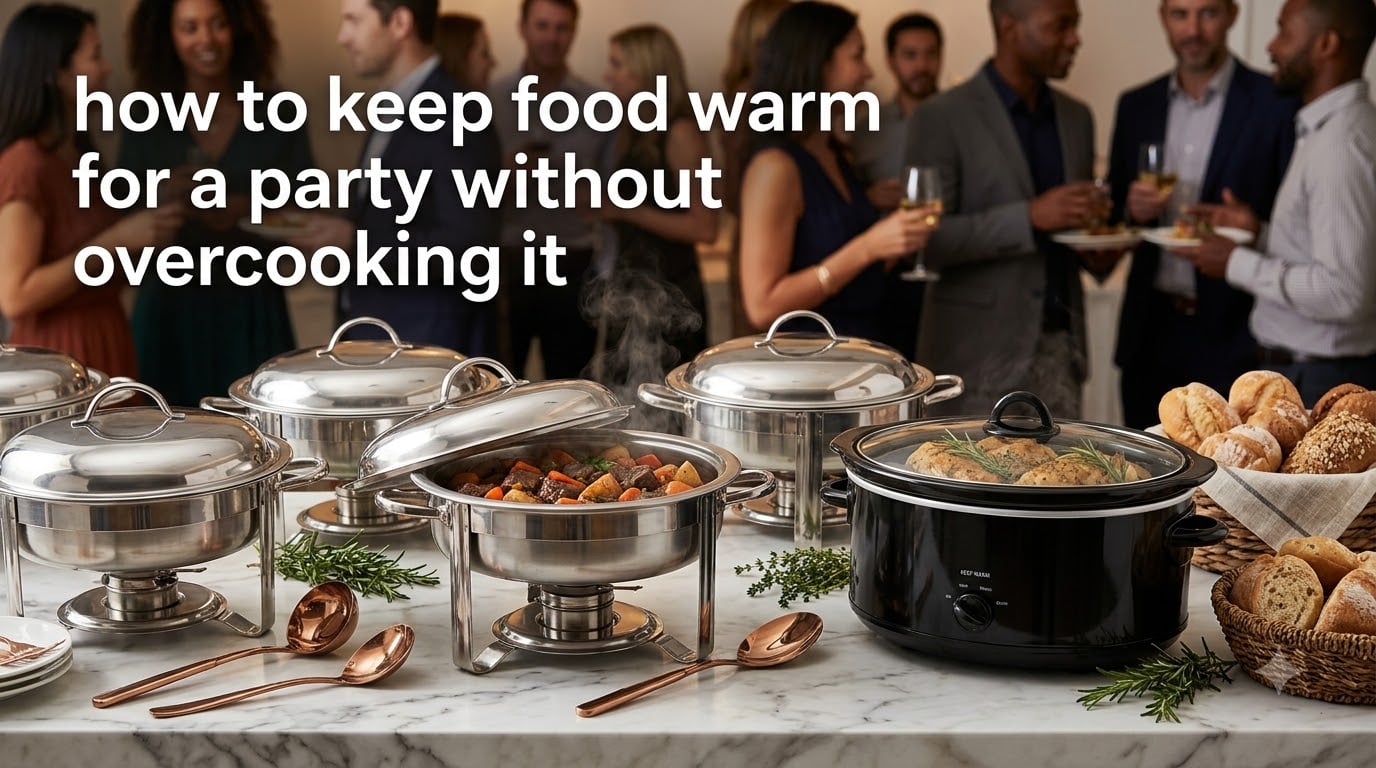
After fifteen years of hosting dinner parties, holiday buffets, and restaurant prep shifts, I can tell you one truth: the gap between “piping hot” and “sad, dried-out leftovers” is measured in minutes and degrees, not hours. When you know how to keep food warm for a party without overcooking it, you stop babysitting the stove and start enjoying your own event. The secret is choosing low, gentle heat sources that hold food above the USDA-recommended 140°F danger zone without pushing it further into cooking temperatures. Below are the ten methods our team uses for everything from Thanksgiving turkey to a backyard birthday buffet, plus the food-safety rules that keep guests safe and the techniques that prevent rubbery chicken and gluey mashed potatoes.
If you only have sixty seconds, here is the quick answer: pick one active low-heat tool (a slow cooker on warm, a chafing dish, an oven at 170°F to 200°F, or a warming tray), keep the food covered to trap moisture, and hold everything above 140°F. Skip the microwave for anything that needs to stay warm longer than fifteen minutes, and wrap transport dishes in towels inside a cooler for off-site parties. The full playbook follows.
Table of Contents
How to Keep Food Warm for a Party Without Overcooking It: 10 Methods That Actually Work
Each method below includes the specific temperature, the best food types, and the rough holding time. Pick the one that fits your menu and your venue.
- Use a slow cooker on the warm setting (170°F to 200°F) for saucy dishes, dips, and shredded meats. Heat the food first, then switch to warm; do not start with cold food on warm.
- Set up a chafing dish with sterno fuel for buffet-style service. The water bath keeps heat gentle and the food steamy for two to three hours.
- Hold food in a 170°F to 200°F oven, covered with foil, for roasts, casseroles, and vegetables. Add a pan of water on the rack below for moisture.
- Plug in a warming tray or hot plate for passed appetizers and small plates. Ideal for flatbreads, meatballs, and buns.
- Wrap dishes in foil and towels inside an insulated cooler (DIY hot box) for transport. Holds 140°F+ for one to two hours, no electricity needed.
- Pour boiling water into a thermal cooker or pre-warmed thermos for rice, grains, and soups. Five hours of safe holding is realistic with a quality vacuum flask.
- Use a sous vide bath at the food’s serving temperature for steak, fish, and tender cuts. It cannot overcook; it can only hold.
- Set up an indirect-heat zone on a grill for outdoor parties and BBQ menus. Roughly 200°F on the cool side mimics an oven.
- Use a warming drawer or toaster oven on its lowest setting for plated proteins and sides. Concentrated, gentle heat in small batches.
- Use the keep-warm function on an Instant Pot or rice cooker for stews, congee, and beans. Holds 145°F to 155°F indefinitely.
Food Safety First: The 140°F Danger Zone and the 2-Hour Rule
Before we dig into equipment, the food-safety foundation matters more than any gadget. The USDA defines the bacterial “danger zone” as 40°F to 140°F. Bacteria multiply fastest in that range, doubling in number every twenty minutes. Food held between those temperatures for more than two hours (or one hour if the room is above 90°F) should be discarded.
- Safe cold holding: below 40°F
- Safe hot holding: above 140°F
- The danger zone: 40°F to 140°F
- Discard rule: more than 2 hours in the danger zone (1 hour above 90°F)
- Reheat rule: bring leftovers to 165°F within 2 hours of taking them out of the fridge
The 140°F threshold is the number to memorize. Every method below targets that floor or higher, because holding food above 140°F is what separates a safe buffet from a food-poisoning call. When in doubt, slide an instant-read thermometer into the thickest part of the dish every thirty minutes. The thermometer is the single most useful tool any host can own for this job.
One more food-safety detail that often gets overlooked: hot food cools fastest between 140°F and 70°F, which is exactly the band you want to clear quickly. When you reheat leftovers for a party, push them through that range in under an hour, not by leaving the pot on the counter while you set the table. The same logic applies to cooked food you intend to hold for guests; if it drops below 140°F, you have a food-safety problem, not a quality problem.
Method-by-Method Breakdown
The list above gives you the headline. This section adds the temperatures, the holding times, and the food types that each method actually suits.
Slow Cooker on Warm Setting (170°F to 200°F)
A slow cooker on warm keeps food at roughly 170°F to 200°F depending on the brand, which is well above the 140°F safety floor and well below the simmering range. It is my go-to for pulled pork, meatballs in sauce, queso, chili, mulled cider, and anything saucy that can sit covered for hours.
Two habits make the difference between tender and overcooked. First, heat the food fully on high or low before switching to warm; dropping room-temperature food straight onto warm can leave it sitting in the bacterial-growth window for too long. Second, lift the lid only when you need to stir; every peek drops the internal temperature by 10°F to 20°F.
Reddit’s r/cookingforbeginners community reinforces this: preheat the food, then warm. The slow cooker is for holding, not for finishing the cook. For dry items like chicken breasts, add a half-cup of broth or water to the pot first, and you will not get that dreaded rubbery texture.
Chafing Dishes with Sterno Fuel
Chafing dishes are the workhorse of the catering world for good reason. A sterno can burns for roughly two hours, and the water pan underneath turns that flame into gentle, even steam. The food sits above the water in a hotel pan, so direct flame never touches the dish.
For best results, use hot water (not boiling, not cold) in the water pan so the food starts holding temperature the moment it lands. Sterno cans are cheap and widely available, but they also make any outdoor table look instantly professional, which is half the battle at a self-serve buffet. Keep extra cans on hand because a forgotten fuel change is the number-one reason chafing-dish food goes cold mid-party.
Oven at 170°F to 200°F with Foil Cover
The oven is the most underrated holding tool in a home kitchen. Set it to its lowest setting (most home ovens bottom out around 170°F to 200°F) and you have a giant warming drawer that can hold three or four dishes at once. Cover each dish with foil to trap steam, and slide a sheet pan of water onto the lower rack to keep the air moist.
This is where most home cooks go wrong: they set the oven to 350°F “to keep things warm.” That temperature will continue to cook anything you put in. Treat the warm setting as a target, not a starting point, and your turkey, stuffing, and roasted vegetables will hold beautifully for ninety minutes while you finish the rest of the meal. Check your oven’s actual temperature with an oven thermometer; many home ovens run 25°F hotter or cooler than the dial claims.
Warming Tray or Hot Plate for Buffets
A warming tray is a flat electric surface that holds platters at 140°F to 160°F. They are perfect for passed appetizers, flatbreads, buns, and anything that wants a dry, gentle warmth without steam.
Place a heat-safe towel under the dishes for a softer hold, or run them bare if you want a slight crust on the bottom (great for samosas, empanadas, and mini quiches). Warming trays do not add moisture, so add a small bowl of water beside the tray or spritz proteins lightly with broth before service. Two Kooks In The Kitchen uses this trick for everything from carved roasts to grilled flatbreads.
Insulated Containers, Coolers, and Thermal Cookers
For transport and outdoor venues without power, insulation is your best friend. A Cambro hot box, a Yeti-style cooler, or even a soft-sided insulated bag will hold food above 140°F for ninety minutes to three hours, depending on the starting temperature and the quality of the insulation.
The hot-brick method is the most underrated hack in this whole guide. Line the cooler with towels, pour a kettle of boiling water in to preheat it for ten minutes, dump the water, wrap your food containers in fresh towels, and tuck two or three heated brick-wrapped-in-foil “heat packs” in beside them. Reddit’s r/Cooking users confirm this trick holds 160°F meat loaves for two-hour drives to potlucks. It is genuinely magical.
Sous Vide for Precise Holding
If you already own a sous vide circulator, you have the most precise holding tool on the planet. Set the bath to your target serving temperature (130°F for medium-rare steak, 140°F for pork, 165°F for chicken breast), drop the bagged food in, and walk away. It cannot overshoot because the bath thermostat physically cannot exceed its setpoint.
This is the only method that is genuinely zero-risk for overcooking. Two Kooks In The Kitchen uses it for everything from holiday prime rib to a six-hour braised short rib. The downside is the up-front equipment cost, but if you cook for crowds regularly, a sous vide setup pays for itself in stress reduction alone.
Indirect Grill Heat for Outdoor Parties
A gas or charcoal grill with a cool zone is essentially an outdoor convection oven. Light the burners (or charcoal) on one side only, set the other side to roughly 200°F, and place your food in disposable aluminum pans on the cool side with the lid closed.
This method is unbeatable for smoke-flavored foods (brisket, ribs, pulled pork, grilled vegetables) and for parties where the kitchen is full. Add a pan of water over the heat source to keep the air humid, and your pulled pork will hold for three hours without drying out. It also frees up the indoor oven, which is a logistics win for Thanksgiving.
Warming Drawer and Toaster Oven
Many newer ranges ship with a warming drawer (usually 90°F to 200°F). Treat it as a small-batch oven: ideal for rolls, tortillas, pancakes, and small pans of vegetables. A toaster oven on its lowest setting plays the same role for hosts without a warming drawer.
Concentrated, dry heat means you want to add moisture somewhere. A small dish of water inside the drawer, a quick spritz of broth on the food, or a brush of butter on top of bread will keep surfaces from going leathery. Use this method when you need a focused holding spot, not a buffet solution.
Instant Pot and Rice Cooker Warm Modes
The “keep warm” function on an electric pressure cooker or rice cooker sits at roughly 145°F to 155°F, which is perfect for stews, beans, congee, dal, and chilis. They will hold all day without scorching, and the sealed lid means flavors stay concentrated.
Two practical notes. First, the cycle can click on and off, so stir occasionally if the dish is thick; this prevents a skin from forming on the top. Second, do not trust warm mode to heat food from cold; it can only hold already-hot food safely. Heat on sauté or pressure-cook first, then switch.
DIY Hot Box with Towels and Hot Water
If you have a clean cooler, a stack of dish towels, and a kettle, you can build a hot box that rivals a professional Cambro. Pour a kettle of boiling water into the cooler, close the lid, and let it sit for ten minutes. Dump the water, line the cooler with a thick towel, place your foil-wrapped hot food inside, pack more towels around and on top, and close the lid.
This method holds 150°F+ for ninety minutes and 140°F+ for two hours, easily enough for a potluck drive. ChefTalk forum users confirm this exact technique for transporting multiple trays to events. It is the cheapest professional-grade trick in this entire guide.
Food-Specific Holding Guide: What Works Best for Each Dish
Different foods overcook at different rates. Use this quick picker when you are deciding which method goes with which dish.
Rice and Grains
Rice dries out fast and turns crunchy when held uncovered. The best method is a thermal cooker or pre-warmed thermos: pour in freshly cooked rice, close the lid, and it stays steaming for four to five hours. A slow cooker on warm with a splash of water works for buffet service, but stir every thirty minutes to prevent a crust from forming on the bottom.
Roasts, Turkey, and Large Cuts of Meat
Large roasts hold beautifully at 140°F to 160°F for one to two hours with no quality loss. Cover with foil, rest in a 170°F oven or warming drawer, and pour collected juices over the top every twenty minutes. For turkey specifically, the FDA recommends holding above 140°F; we aim for 150°F to 160°F to keep the breast meat juicy.
Mashed Potatoes and Sauces
Mashed potatoes become gluey when stirred aggressively on heat. The fix is a slow cooker on warm with a half-cup of milk or cream added before holding; the gentle ambient heat and the fat keep them loose. Sauces and gravies do well in a thermos or small slow cooker on warm; whisk in a splash of liquid if they tighten up.
Vegetables and Sides
Roasted vegetables hold well in a covered dish in a 200°F oven for sixty to ninety minutes. Add a tablespoon of butter or olive oil before covering to keep them glossy. Steamed vegetables are the trickiest because they keep cooking from residual heat; shock them in cold water, then reheat briefly in a buttered pan just before service for the best texture.
Soups, Stews, and Casseroles
Liquid-heavy dishes are the easiest to hold. A slow cooker, Instant Pot on warm, or thermal cooker will keep soup above 140°F indefinitely. Cover with a tight lid, stir occasionally, and taste for salt adjustment at the two-hour mark; long holds can concentrate flavors and need a splash of water or stock to rebalance.
Common Overcooking Mistakes to Avoid
After watching countless home cooks (and a few line cooks) ruin beautiful food at the holding stage, I keep a mental checklist of the errors that show up again and again.
Using high heat “to keep it warm.” If your oven is set above 200°F, you are baking or roasting, not holding. Drop the temperature and cover the dish.
Putting room-temperature food directly on warm. Slow cookers and chafing dishes hold food; they do not safely heat it from cold. Heat the food first, then transfer.
Lifting the lid every few minutes. Every lid lift drops the temperature by 10°F to 20°F and adds five to ten minutes of recovery time. Trust the process and check once every thirty minutes at most.
Microwaving proteins to “freshen them up.” Microwaves heat unevenly and turn proteins rubbery in minutes. Use the oven, stovetop, or a covered skillet with a splash of broth instead.
Holding without a thermometer. “It feels hot” is not a measurement. An inexpensive instant-read thermometer saves pounds of wasted food and prevents food-safety incidents at every party.
Letting sauces and gravies reduce too far. Long holds concentrate liquids. Add a little water, stock, or wine every hour to keep textures silky.
Skipping the warm plate step. Cold plates suck the heat out of hot food in under a minute. Stack plates in the oven at 150°F or run them through the dishwasher right before dinner; Reddit users swear by the dishwasher method.
A French Bistro Chef’s Perspective on Holding Food
At our restaurant, the pass is the final kitchen, and we treat holding the same way we treat plating: with intention. Sauces go into a bain-marie over a pilot light. Proteins rest on a wire rack set over a sheet pan in a 150°F holding cabinet. Vegetables sit in a hotel pan with a tight lid and a wet towel on top. None of this is fancy equipment; it is just disciplined technique.
The home cook can borrow three things from that approach. First, lift food off the bottom of the pan whenever possible; a wire rack or a folded towel under the hotel pan prevents the underside from overcooking. Second, separate moist and dry heat; do not put bread in the same enclosed space as braised meat unless you want the bread soggy. Third, finish with a flourish; a last-minute sear, a fresh herb sprinkle, or a pour of hot sauce takes ten seconds and resets the dish after a long hold.
That last habit is the one most home cooks skip. Holding is not the same as forgetting. A tiny bit of attention at the end of the hold separates restaurant-quality results from lukewarm leftovers.
Frequently Asked Questions
How do you keep food warm while serving at a party?
The fastest approach is to use active low-heat tools that hold food above 140°F: a slow cooker on the warm setting, a chafing dish with sterno fuel, an oven set to 170°F to 200°F with foil covers, or a warming tray for buffets. For transport or outdoor venues without power, wrap hot food in towels inside a preheated cooler (a DIY hot box) for up to two hours of safe holding.
How do you keep food warm for 2 hours?
For a two-hour hold, preheat an oven to 170°F to 200°F, cover dishes with foil, and add a pan of water on the lower rack for moisture. A slow cooker on warm or a chafing dish with two sterno cans also holds food above 140°F for the full two hours. For transport, a preheated cooler packed with towels holds 150°F+ for the entire window.
How can I keep food warm for a long time?
Thermal cookers and quality vacuum flasks can hold rice, grains, and soups at safe temperatures for four to five hours. A slow cooker on warm extends holding time for saucy dishes to six hours or more. For proteins, sous vide at the target serving temperature holds food indefinitely without any quality loss, because the bath cannot exceed its setpoint.
How do caterers keep food warm?
Caterers rely on chafing dishes with sterno fuel, Cambro hot boxes for transport, steam tables for buffet service, and heat lamps over carving stations. They also preheat every holding vessel before food goes in, so the temperature never drops below 140°F even for a moment. The combination of active heat and insulation is the professional standard.
What is the cheapest way to keep food warm for a party?
The cheapest reliable method is a 170°F to 200°F oven with foil-covered dishes and a pan of water on the lower rack; it costs nothing extra and holds food for hours. A DIY hot box using a clean cooler, dish towels, and boiling water is essentially free and holds 140°F+ for two hours, perfect for potlucks and transport.
Bringing It All Together
Learning how to keep food warm for a party without overcooking it comes down to two habits: pick the right low-heat tool for each dish, and trust an instant-read thermometer over guesswork. Start with the slow cooker or chafing dish for saucy dishes, the 170°F oven for roasts and sides, and a preheated cooler for transport. Hold everything above 140°F, cover with foil or lids, and resist the urge to peek. Your guests will get hot, safe, restaurant-quality food, and you will actually enjoy the party you worked so hard to host.