
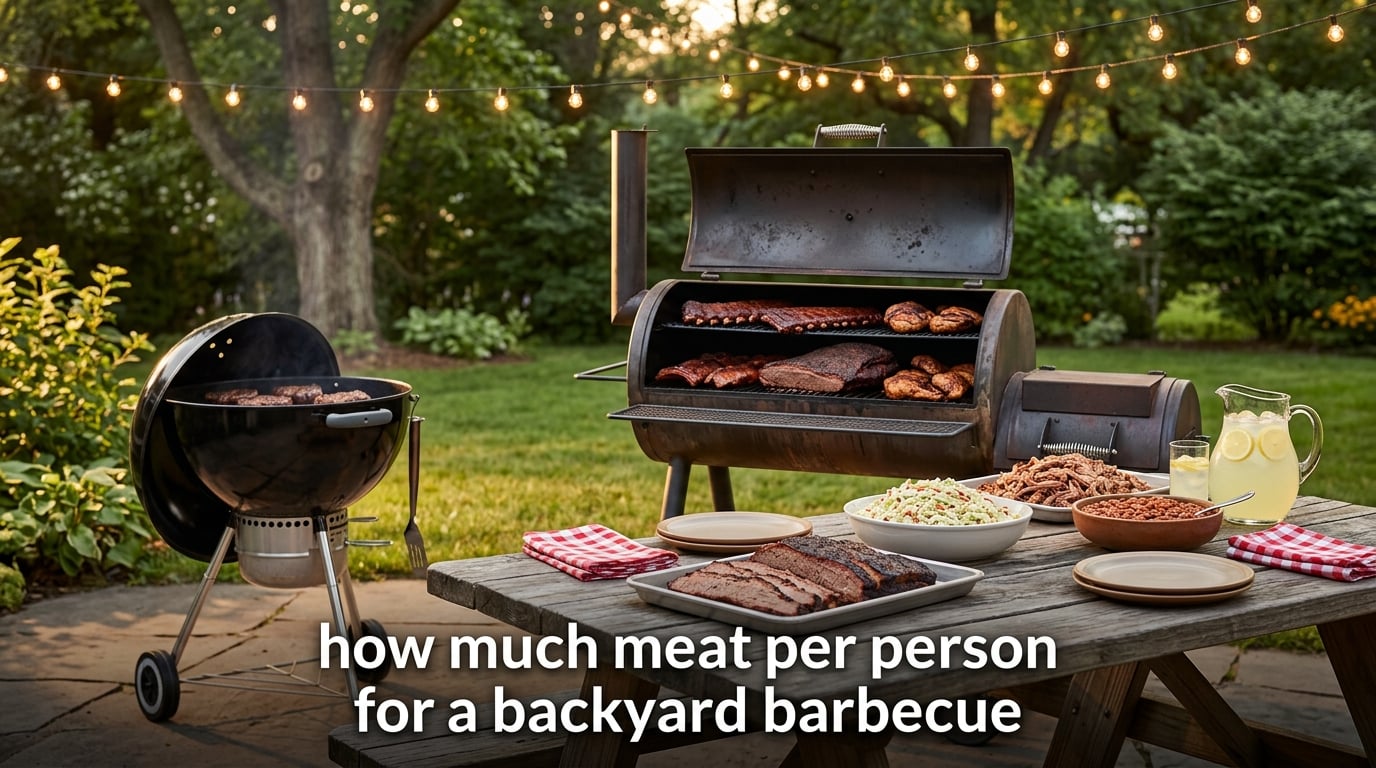
Last summer our team cooked for a 40-guest Fourth of July cookout. We bought 28 pounds of raw meat and came back with barely a pound of leftover brisket. That single cook taught me that figuring out how much meat per person for a backyard barbecue is more art than guesswork. Get it wrong and you either run out by halftime or eat pulled pork sandwiches for a week straight.
This guide breaks down exact portion sizes by meat type, party size, and serving style. I will show you how to calculate raw versus cooked weight, adjust for kids and big eaters, and avoid the most common backyard hosting mistakes. Whether you are grilling for 10 friends or smoking for 75 neighbors, the same math applies.
Table of Contents
Quick Answer: How Much Meat Per Person for a Backyard Barbecue
Plan for 1/2 pound of cooked meat per adult guest, which translates to roughly 3/4 to 1 pound of raw meat per adult depending on the cut. For a backyard barbecue with sides, that gives most people enough for a full meal plus a small second helping. Kids eat about half an adult portion, so figure 1/4 pound cooked meat per child.
Here is the rule of thumb our team uses after dozens of backyard events: 1/3 pound cooked meat per adult when serving three or more side dishes, 1/2 pound when serving only one or two sides, and 3/4 pound for an all-male group of big eaters. Multiply by 1.5 to 2 to convert cooked weight to raw weight, since most BBQ cuts lose 30 to 40 percent of their weight during cooking from moisture and fat rendering.
For a typical party of 20 adults with three sides, buy 7 to 8 pounds of raw meat total. That gives you roughly 4 to 5 pounds of cooked meat to serve, plus a comfortable safety margin.
BBQ Meat Portion Chart by Type
Different meats shrink at different rates and behave differently on the grill or smoker. Pulled pork loses more moisture than ribs, and boneless cuts yield more edible meat than bone-in. Use this chart as your starting point, then adjust based on your guest list and serving style.
| Meat Type | Raw Per Adult | Cooked Per Adult | Shrinkage | Notes |
|---|---|---|---|---|
| Pulled Pork (pork shoulder) | 2/3 to 1 lb | 1/3 to 1/2 lb | 40 percent | Most popular, budget-friendly |
| Brisket | 3/4 to 1 lb | 1/3 to 1/2 lb | 35 to 45 percent | Trim fat before weighing raw |
| Beef Ribs | 1 to 1.5 lb | 1/2 to 3/4 lb | 30 to 40 percent | Bone-in, count 4 to 6 bones per guest |
| Pork Ribs (St. Louis) | 1 to 1.25 lb | 1/2 to 3/4 lb | 30 to 40 percent | Count 4 to 6 bones per guest |
| Smoked Chicken (whole or half) | 3/4 to 1 lb | 1/2 lb | 30 percent | 1 whole chicken feeds 3 to 4 |
| Chicken Wings | 1 to 1.5 lb | 3/4 to 1 lb | 25 to 30 percent | Count 6 to 8 wings per adult |
| Sausage Links | 1/3 to 1/2 lb | 1/4 to 1/3 lb | 20 to 25 percent | Plan 2 to 3 links per adult |
| Hamburgers | 1/3 lb patty each | 1/4 lb patty | 25 percent | 1 patty plus a bun per adult |
| Hot Dogs | 2 dogs per adult | 2 dogs | Minimal | Standard 1/4 lb dogs |
| Tri-Tip | 1/2 to 3/4 lb | 1/3 to 1/2 lb | 30 to 35 percent | Trim before weighing |
When you serve two or three meat types, divide the total cooked target across them rather than serving the full portion of each. For a group of 20 with pulled pork and brisket, plan on roughly 3 pounds cooked pulled pork and 3 pounds cooked brisket, not 10 pounds of each.
Raw vs Cooked Weight: The Shrinkage Math
Every backyard cook needs to understand one simple fact: meat shrinks during cooking. Fat renders out, moisture evaporates, and bones lose weight during long smokes. If you buy 10 pounds of raw pork shoulder, you will pull about 6 pounds of finished pulled pork off the pit. Plan accordingly.
The standard shrinkage rates are: pulled pork shrinks 40 percent on average, brisket shrinks 35 to 45 percent, ribs lose 30 to 40 percent, and chicken drops about 30 percent. Sausage and hot dogs barely shrink at all, which is why they are popular for feeding a crowd on a budget.
Bone-in cuts also waste more on the plate. A guest eats the meat between the bones and leaves the rest. For pork ribs, the edible yield is roughly 50 to 60 percent of raw weight after you remove the bones. For brisket point and flat, the edible yield runs 55 to 65 percent once you trim the deckle fat.
How to Calculate Raw Weight from Cooked Target
Use this three-step formula our team uses for every event:
- Decide how many pounds of cooked meat each adult guest will eat (1/3 to 1/2 lb is standard).
- Multiply that number by your guest count to get total cooked weight needed.
- Divide by the inverse of your shrinkage rate (0.6 for 40 percent shrinkage, 0.65 for 35 percent) to get total raw weight.
For example, feeding 30 adults at 1/2 pound cooked meat each means 15 pounds of cooked target. Divided by 0.6 (pulled pork shrinkage) means 25 pounds of raw pork shoulder on the smoker.
Party Size Calculator: How Much Meat to Buy
Below is a reference table covering the most common backyard barbecue sizes. We used the standard 1/2 pound cooked meat per adult with three sides. Add 25 percent for big-eater groups or reduce by 20 percent if you are serving heavy appetizers or a fourth side.
| Guests (Adults) | Cooked Meat Needed | Raw Pulled Pork | Raw Brisket | Raw Ribs | Raw Chicken |
|---|---|---|---|---|---|
| 10 | 5 lb | 8 to 9 lb | 8 to 9 lb | 8 to 10 lb | 7 to 8 lb |
| 20 | 10 lb | 16 to 18 lb | 16 to 18 lb | 16 to 20 lb | 14 to 16 lb |
| 30 | 15 lb | 24 to 27 lb | 24 to 27 lb | 24 to 30 lb | 21 to 24 lb |
| 50 | 25 lb | 40 to 45 lb | 40 to 45 lb | 40 to 50 lb | 35 to 40 lb |
| 75 | 37.5 lb | 60 to 67 lb | 60 to 67 lb | 60 to 75 lb | 52 to 60 lb |
| 100 | 50 lb | 80 to 90 lb | 80 to 90 lb | 80 to 100 lb | 70 to 80 lb |
For mixed groups with kids, count two children as one adult for meat calculations. A family of four with two adults and two kids counts as three adult portions. Most children under 10 eat about 1/4 pound of cooked meat, so plan 1/4 pound per kid and 1/2 pound per adult when the group is evenly split.
When cooking for very large groups, our team found that running two proteins plus a sausage option gives you the best balance of variety and predictable yield. A 60-person party with 25 pounds of pulled pork, 20 pounds of brisket, and 8 pounds of sausage will satisfy most appetites without breaking the smoker.
Adjusting for Kids, Adults, and Big Eaters
Not every guest eats the same amount. Teenage boys can put away more than two adult men, while a six-year-old might pick at a single chicken wing. Use these adjustments to fine-tune your total.
- Light eaters (older adults, small women): 1/4 pound cooked meat per person
- Average adults: 1/3 to 1/2 pound cooked meat per person
- Big eaters (athletes, teenage boys, manual laborers): 3/4 to 1 pound cooked meat per person
- Kids ages 5 to 10: 1/4 pound cooked meat per person
- Kids under 5: 1/8 pound or just share from a parent’s plate
For an all-male crowd (a tailgate, a work crew, a fantasy football party), our team recommends 3/4 pound cooked meat per guest. For a mixed brunch or a retirement party with mostly older guests, drop to 1/3 pound per adult. The type of event matters as much as the head count.
Buffet vs Plated Dinner Portions
How you serve the food changes how much meat you need. Buffet-style service encourages guests to come back for seconds, which can push your consumption up by 25 to 50 percent. Plated dinners give you tighter control because each plate is portioned at the kitchen.
For buffet service, plan 1/2 to 3/4 pound cooked meat per adult. Guests serve themselves generously, and the visual appeal of a full spread encourages extra trips. For plated service, 1/3 to 1/2 pound cooked meat per adult is plenty, with a small buffer of about 10 percent for seconds and unexpected guests.
Sandwich-style service (pulled pork sliders, brisket sandwiches) sits in the middle. A standard sandwich uses about 1/4 to 1/3 pound of meat, so plan 1.5 to 2 sandwiches per adult. A slider counts as a half portion, so plan 3 sliders per adult if you go that route.
Backyard-Specific Tips for Grilling and Smoking
Most portion guides assume a commercial kitchen and unlimited grill space. A backyard cook has tighter constraints. Standard home grills run 400 to 600 square inches of cooking surface, and a typical bullet smoker fits two medium pork butts or one brisket plus a few racks of ribs per cook.
Plan your cook in batches if your grill cannot fit everything at once. A 30-person party with pulled pork, brisket, and ribs requires roughly 24 pounds of raw meat. On a standard home grill, that means at least two cook sessions: one overnight smoke for the brisket and pork, then a same-day grill session for the ribs and sausage.
Time your cook so the longest item rests for at least 30 minutes before serving. Pork shoulder and brisket benefit from a 1 to 2 hour rest in a dry cooler wrapped in towels. Ribs need only a brief 10 minute rest. Chicken should rest 5 to 10 minutes before pulling or slicing.
Keep cooked meat hot (140 degrees Fahrenheit or above) until service. In summer heat, move cooked meats to a cooler with hot water bottles or keep them in foil-wrapped pans in a warm oven set to 200 degrees. Food left in the danger zone (40 to 140 degrees) for more than 2 hours should be discarded.
Sides, Drinks, and Dessert Portions
Meat is half the meal. Plan sides at about 1 to 1.5 cups per adult across three to four side dishes. A standard 9 by 13 inch pan holds roughly 12 cups, so one pan feeds 8 to 12 guests. Two pans of each side covers a party of 20 with comfortable leftovers.
| Side Dish | Per Adult | Party of 20 |
|---|---|---|
| BBQ Beans | 1/2 cup | 2.5 quarts |
| Coleslaw | 1/2 cup | 2.5 quarts |
| Potato Salad | 1/2 cup | 2.5 quarts |
| Mac and Cheese | 3/4 cup | 3.5 quarts |
| Cornbread | 1 piece | 20 pieces (2 skillets) |
| Buns/Slider Rolls | 1.5 per adult | 30 rolls |
For drinks, plan 2 to 3 beverages per adult for the first hour and 1 per hour after that. A 4-hour party for 20 adults needs roughly 80 drinks, split between water, soda, and beer. Ice runs about 1.5 pounds per adult for a hot day.
Plan one dessert serving per adult if you offer a single option like brownies or cobbler. For ice cream, plan 1.5 scoops per adult since most people take two scoops when given the chance.
Metric Conversions for International Cooks
If you measure in kilograms and grams, the same portions translate cleanly. The base rule stays the same: 225 grams (about 1/2 pound) of cooked meat per adult, or 115 grams per child.
| Guests | Cooked Meat (kg) | Raw Meat Target (kg) |
|---|---|---|
| 10 adults | 2.3 kg | 3.5 to 4 kg |
| 20 adults | 4.5 kg | 7 to 8 kg |
| 30 adults | 6.8 kg | 10.5 to 12 kg |
| 50 adults | 11.3 kg | 17.5 to 20 kg |
| 100 adults | 22.7 kg | 35 to 40 kg |
For individual cuts: 1 pound equals 454 grams, 1 kilogram equals 2.2 pounds. A typical pork shoulder weighs 3 to 5 kilograms raw. A whole chicken runs 1.5 to 2 kilograms. A rack of ribs weighs about 1 to 1.5 kilograms raw.
Frequently Asked Questions
How much meat do I need for 20 people’s barbecue?
Plan on 10 pounds of cooked meat for 20 adults, which translates to roughly 16 to 18 pounds of raw meat if you are cooking pulled pork, brisket, or ribs. If you serve three or four side dishes, this gives each adult about 1/2 pound cooked meat with a comfortable margin for seconds. Add 4 pounds of raw meat for every 10 kids in the group.
Is 10 lbs of meat enough for 30 people?
Only if the 10 pounds is cooked weight. Ten pounds of cooked meat feeds 20 average adults or 30 adults with three or more filling sides. If the 10 pounds is raw weight, it will yield roughly 6 pounds of cooked meat after shrinkage, which feeds about 12 adults. For 30 adults, plan 15 pounds cooked or 24 to 27 pounds raw.
How many will 2 lbs of barbecue feed?
Two pounds of cooked barbecue meat feeds about 4 to 6 average adults when served with sides. Two pounds of raw meat yields only 1.2 to 1.4 pounds of cooked meat, which feeds 3 adults. For sandwich-style service, 2 pounds of cooked meat makes 6 to 8 sandwiches.
What is the cheapest meat to feed a crowd?
Pork shoulder is the cheapest cut that feeds the most people. A whole pork butt costs less per pound than brisket and yields the same amount of edible meat after pulling. Chicken thighs and drumsticks are the second cheapest option, with sausage links rounding out the top three budget choices for backyard barbecues.
How much meat per person for BBQ sandwiches?
Plan 1/4 to 1/3 pound of cooked meat per sandwich. For a sandwich-only backyard barbecue, figure 1.5 to 2 sandwiches per adult, which means 1/2 pound of cooked meat per person. For sliders, count 3 per adult and 1/8 pound of meat per slider.
Is 7 pounds of meat enough for 10 people?
Seven pounds of cooked meat is more than enough for 10 adults with leftovers. Seven pounds of raw meat yields about 4 to 4.5 pounds cooked, which is borderline for 10 adults. Add another 3 to 4 pounds of raw meat if 7 pounds is your total before cooking.
Planning Your Backyard Barbecue
Figuring out how much meat per person for a backyard barbecue comes down to three numbers: your guest count, your average cooked portion per adult, and your shrinkage rate. Start with 1/2 pound cooked per adult, multiply by guest count, then divide by 0.6 for pulled pork or 0.65 for brisket to get your raw weight.
From there, adjust for kids (half portions), big eaters (1.5x portions), buffet service (25 percent more), and bone-in cuts (double the raw weight for ribs). Use the party size table above as a quick reference, and always round up by 10 to 15 percent so you are not the host who runs out of brisket at 6 PM. Better to send guests home with leftovers than to apologize for an empty serving tray.