
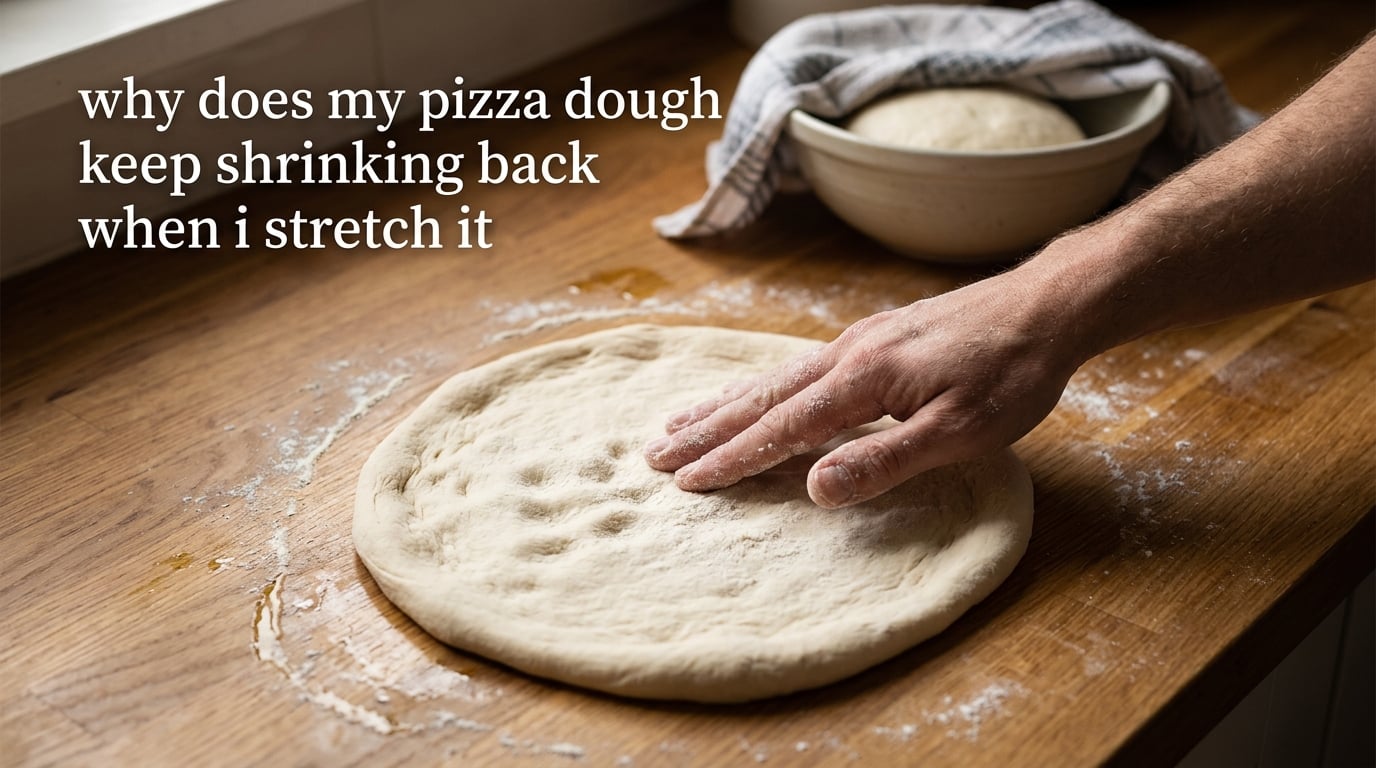
Pizza dough shrinks back when you stretch it because the gluten network inside is tight, cold, or under-rested. When you mix flour with water, two proteins — glutenin and gliadin — link into an elastic web. If that web has not had time to relax, stretching it triggers recoil: the dough snaps back like a rubber band. The fix is more rest, warmer dough, gentler hands, and matching your flour to your style. In the next few minutes I will show you exactly which cause fits your dough and how to get a thin, tender crust that holds its shape.
I have baked hundreds of pizzas at home over the last few years — Neapolitan, pan, Detroit, sourdough — and the spring-back problem has cost me more ruined bases than I want to admit. What I learned is that the dough is not fighting you. It is following the rules of gluten physics. Once you understand those rules, the fix is almost always the same: rest, warmth, and patience.
Table of Contents
Quick Diagnosis: What Is Causing Your Dough to Shrink Back
Before we dive into the science, let us pin down your cause. Match your symptom to the row below and you will save yourself hours of trial and error.
| Symptom | Most Likely Cause | Fastest Fix |
|---|---|---|
| Dough fights back the moment you stretch it, straight from the fridge | Cold gluten | Rest at room temperature for 60 to 90 minutes |
| Same-day dough, made within the last 2 hours, snaps back fast | Not enough bench rest | Cover and rest 20 to 30 minutes, then try again |
| Dough made yesterday or today keeps retracting between shapes | Under-fermented or under-rested in balls | Give the balls another 1 to 2 hours at room temp |
| Dough made with bread flour bounces back hard | Protein too high for your style | Switch to 00 flour or all-purpose next time |
| Dough feels stiff, dry, and snaps no matter what you do | Hydration too low | Wet your hands and try again, or use a higher-hydration recipe |
| Sourdough stretches a little but fights you the whole way | Acidic, under-rested gluten | Add 30 to 60 minutes of room-temp rest after balling |
| Store-bought dough, taken straight from the bag, refuses to budge | Compressed and cold, never rested | Leave out 2 to 4 hours before shaping |
| Dough tore last time, so you added more flour while stretching | Over-floured, tight surface | Switch to olive oil on the work surface |
One of these almost always fits. If you are not sure which one, the rest of this guide will walk you through every cause and its fix.
The Science: Why Pizza Dough Shrinks Back
When flour meets water and you start mixing, two insoluble proteins — glutenin and gliadin — begin to link. Glutenin gives dough its strength and elasticity, the ability to spring back. Gliadin gives dough its extensibility, the ability to stretch thin without tearing.
As you knead or do stretch-and-folds, you align these proteins into long, organized strands. Think of them as a bundle of tiny rubber bands sitting next to each other in the dough. When you stretch the dough, you stretch every one of those rubber bands. The instant you stop applying force, they pull back to their resting length. That is the snap-back you feel under your hands.
Time and fermentation relax those strands. Acids produced during fermentation weaken some of the bonds. Water lubricates the network. The dough slowly loses its memory of the balled-up shape and becomes a calm, extensible sheet that wants to be stretched. When the gluten is properly relaxed, the dough stays where you put it. That is the dough you are aiming for.
Elasticity vs. Extensibility: The Key Concept
Every pizza maker eventually meets this pair of words, and understanding the difference will save you years of frustration. Elasticity is the dough’s ability to return to its original shape after being stretched — that is what causes shrink-back. Extensibility is the dough’s ability to stretch without snapping back.
The goal is not zero elasticity. A pizza base needs some spring-back so it holds sauce and toppings without sagging through the oven rack. The goal is dough that is extensible enough to stretch thin without fighting you. A dough with too much elasticity and not enough extensibility is exactly what you are fighting right now.
Force never improves this balance. The harder you pull, the more the gluten strands tighten in response. Rest, hydration, fermentation, and gentle handling are the only reliable ways to push the balance toward extensibility.
The #1 Fix: Rest Your Dough (Bench Rest and Cold Ferment)
If you take only one thing from this guide, take this: rest fixes almost every case of pizza dough that shrinks back. There are two kinds of rest, and they do different jobs.
A bench rest is a short pause, usually 10 to 30 minutes, that you give the dough after mixing, kneading, or shaping. During a bench rest you cover the dough with a damp towel, an upside-down bowl, or plastic wrap so the surface does not dry out. The gluten strands relax in place. After 20 minutes under a towel, most same-day doughs will stretch with very little fight.
A cold ferment is the longer, slower rest in the refrigerator, usually 24 to 72 hours. Cold temperature slows yeast activity, but fermentation still happens — and acids and enzymes keep working on the gluten network. The result is dough that is far more extensible than anything you can get in a single day. Forum bakers who make dough on Wednesday for Friday pizza night are not doing it for the schedule. They are doing it because the dough behaves better.
Here is a quick reference for resting times by dough type.
| Dough Type | Bench Rest After Shaping | Cold Ferment (Recommended) |
|---|---|---|
| Same-day dough (mixed and used the same day) | 30 to 60 minutes | Not applicable |
| Next-day dough (24-hour cold ferment) | 60 to 90 minutes at room temp before stretching | 24 hours |
| Two- to three-day cold-fermented | 90 to 120 minutes at room temp | 48 to 72 hours |
| Store-bought, refrigerated | 2 to 4 hours at room temp | Already fermented |
| Sourdough pizza dough | 2 to 3 hours at room temp after balling | 24 to 48 hours |
Bring Dough to Room Temperature Before Stretching
Cold gluten is stiff gluten. Even well-fermented dough will fight you if you try to stretch it straight out of the fridge. Take the dough out 60 to 90 minutes before you plan to bake. Same-day dough needs less, cold-fermented dough needs more.
The dough is ready to test when it has lost its fridge chill and feels pliable when you press it. If your kitchen is cold, give it an extra 30 minutes. A room-temperature kitchen of 68 to 72°F is the sweet spot for dough relaxation. Do not microwave it to speed things up — that cooks the starches on the outside and ruins the texture.
Flour Type and Protein Content
Not all flours behave the same way. Protein content drives gluten strength, and stronger gluten means more snap-back.
- Bread flour (12 to 14% protein): The strongest gluten. Great for chew, terrible for easy stretching. If you have ever had dough that fights you like a tire tube, bread flour is the usual suspect.
- All-purpose flour (10 to 12% protein): The middle ground. Most home pizza recipes call for this for good reason — it stretches without excessive fight.
- Type 00 flour (11 to 12% protein, finely milled): The Neapolitan classic. Finely milled so the dough hydrates faster, slightly lower elasticity than bread flour. Many bakers report noticeably less snap-back after switching to 00.
If you are committed to bread flour for the chew, give the dough a longer cold ferment and a longer bench rest. The protein breakdown during fermentation is what makes even strong-flour doughs manageable.
Hydration Matters
Hydration — the ratio of water to flour by weight — is the second biggest lever you have after time. A 60% hydration dough (600g water per 1000g flour) is noticeably easier to stretch than a 55% dough. A 65% dough is easier still.
Wet doughs are stickier and harder to handle, which is why beginners shy away. That stickiness is actually your friend: water lubricates the gluten network and lets the strands slide past each other instead of locking up. A wetter dough is a more extensible dough.
If your dough feels stiff and dry, do not reach for the flour bag. Flour on the work surface tightens the outside of the dough and makes shrink-back worse. Instead, wet your hands with water or brush a thin layer of olive oil on the counter. Both reduce sticking without adding dry flour to the dough.
The Poke Test: How to Know Dough Is Ready
The poke test is the most reliable readiness indicator used by pizzaioli and home bakers alike. Flour a finger lightly and press it into the dough about half an inch deep.
- If the dough springs back fast, filling in the dent almost immediately, the gluten is still tight. Rest longer — another 15 to 30 minutes — and test again.
- If the dough springs back slowly, leaving a slight impression that relaxes over a few seconds, the dough is ready. Stretch now.
- If the dough does not spring back at all and your finger sinks in, the dough is over-proofed. Use it for pan pizza or foccacia, where it will work beautifully.
This single test replaces a lot of guesswork. Trust the poke, not the clock.
Step-by-Step: How to Stretch Pizza Dough Without It Shrinking Back
Now that your dough is rested, warm, and properly hydrated, here is the technique that minimizes shrink-back.
- Prep your surface with olive oil, not flour. A thin layer of olive oil keeps the dough from sticking without drying the surface.
- Press, do not pull. Use your fingertips to press the dough out from the center, leaving a slightly thicker edge for the crust. Never grab the dough and tug.
- Use gravity. Once the dough is wide enough, drape it over the back of your knuckles. Let it hang and rotate your hands. Gravity stretches the dough for you while the gluten stays relaxed.
- If it resists, rest again. Set the dough down, cover it with a damp towel, and wait 10 minutes. Then try once more. Multiple short rests beat one forced stretch every time.
- Finish on the peel. Lay the stretched dough on a floured or parchment-lined peel, dimple the surface gently to remove air, and dress immediately.
The trick to stretching pizza dough is not strength. It is patience and letting gravity do the work. Pulling harder always makes shrink-back worse.
Common Mistakes That Make Dough Shrink Back
If your dough keeps retracting, one of these is almost certainly the reason.
- Skipping the rest. The single most common mistake. Even good dough needs at least 20 minutes after shaping.
- Using a rolling pin. A rolling pin compresses the dough unevenly and tightens gluten in places, leading to uneven snap-back and a tough crust.
- Adding flour while stretching. Every dusting of flour makes the surface drier and tighter. Use olive oil or wet hands instead.
- Stretching cold dough. Cold gluten is rigid. Always warm the dough to room temperature first.
- Over-kneading. Ten minutes of intensive kneading in a stand mixer develops more gluten than most home pizzas need. Try stretch-and-folds or a no-knead approach for more extensible dough.
- Over-fermenting. Under-fermented dough snaps back. Over-fermented dough tears and sags. The poke test tells you which side you are on.
Special Cases: Pan Pizza, Sourdough, and Store-Bought Dough
Not every dough should be stretched the same way. A few special cases deserve their own notes.
Pan pizza. Detroit-style and Sicilian-style pizzas are pressed or stretched into an oiled pan and rested there. Many pan doughs benefit from an extra 30 minutes of rest in the pan before topping, which relaxes any final gluten tension. A rolling pin is more acceptable here because the pan sets the final shape.
Sourdough. Sourdough pizza dough is more acidic, and that acidity affects gluten in a specific way. It often feels extensible at first but tightens up during shaping. The fix is a longer final rest after balling — two to three hours at room temperature for dough that has already had a 24 to 48 hour cold ferment. Some sourdough bakers also find that adding a small percentage of olive oil to the dough noticeably improves extensibility.
Store-bought dough. That plastic-wrapped ball from the supermarket is usually compressed at the factory and never rested. Take it out of the fridge 2 to 4 hours before you plan to bake, unwrap it, lightly oil it, and let it sit in a bowl covered with a damp towel. This single change fixes store-bought dough for most home cooks.
When to Give Up on Stretching and Use a Pan Instead
Sometimes the dough is telling you something. If you have rested it twice, brought it to room temperature, and it still fights back hard, stop fighting. Press it into an oiled pan, dimple the surface, top it generously, and bake it as a pan pizza or focaccia-style base.
Pan pizza is not a compromise. It is one of the best pizza styles in the world. Detroit, Sicilian, and Roman pan pizzas use exactly this kind of dough to great effect. Knowing when to switch is part of becoming a better pizza maker.
Frequently Asked Questions
How long should pizza dough rest before being stretched?
At least 20 to 30 minutes for same-day dough after shaping. Cold-fermented dough needs 60 to 90 minutes at room temperature. Store-bought dough benefits from 2 to 4 hours out of the fridge. The poke test is the most reliable indicator: if the dough springs back slowly when pressed, it is ready to stretch.
How do you stop pizza dough from shrinking back?
Rest it longer, bring it to room temperature, switch to olive oil instead of flour on your work surface, and avoid pulling the dough — press it out from the center instead. Most shrink-back is caused by under-rested, cold, or over-floured dough, and all three are easy to fix with patience.
What are the most common mistakes when stretching pizza dough?
Using a rolling pin, dusting the dough with extra flour, skipping the bench rest, stretching cold dough straight from the fridge, and over-kneading the dough. Each of these tightens gluten further. Olive oil on the counter, gentle pressing, and multiple short rests solve almost every case.
What is the trick to stretching pizza dough without it snapping back?
Let gravity do the work. Once you have pressed the dough out to about 8 inches, drape it over the back of your knuckles and let it hang while you rotate your hands. Gravity stretches the dough while the gluten stays relaxed. If the dough resists at any point, set it down and rest for 10 more minutes.
Why is my pizza dough retracting and not stretching?
The gluten network is tight — usually because the dough is cold, under-rested, or made with very high-protein flour like bread flour. Fermentation, warmth, and time relax the gluten strands. Give the dough a longer bench rest, bring it fully to room temperature, and try pressing instead of pulling.
Why does cold pizza dough shrink when stretched?
Cold gluten is stiff and rigid, just like a cold rubber band. The proteins have lost the flexibility they have at room temperature. Take the dough out of the fridge 60 to 90 minutes before shaping so the gluten can warm up and relax. Do not microwave it — uneven heating ruins the texture.
The Fix Comes Down to Time, Warmth, and Gentle Hands
If your pizza dough keeps shrinking back when you stretch it, the gluten network is doing exactly what gluten does — recoiling when it is tight, cold, or under-rested. The fix is almost always the same combination: a longer bench rest, time at room temperature, gentler handling, and a flour that matches your style.
Next time you mix a batch of dough, plan an extra 30 to 60 minutes of rest before you bake. Give the poke test a try. Press instead of pull, and let gravity stretch the dough for you. Within a few bakes you will notice the difference, and pizza night will get a lot less frustrating.