
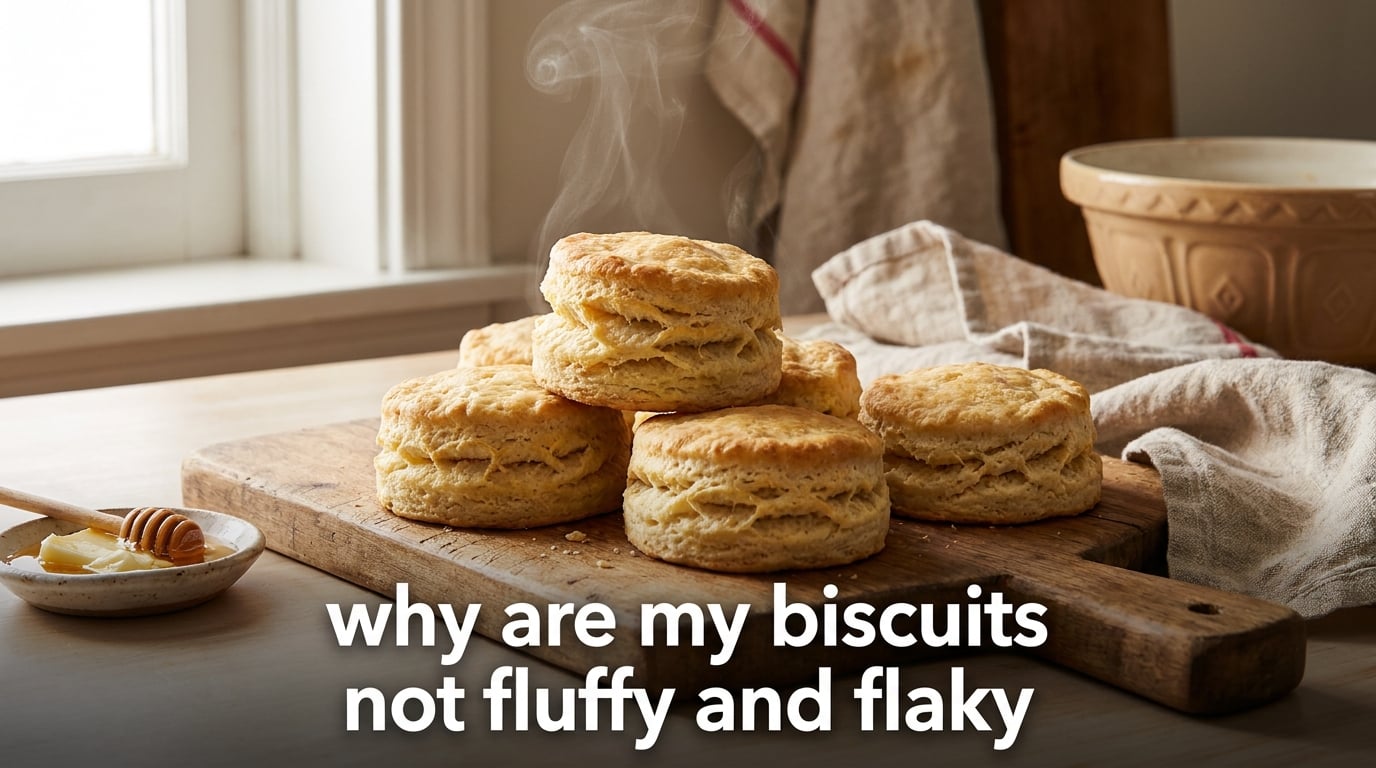
If you’ve ever pulled a tray of sad, flat, dense biscuits out of the oven and wondered why yours never look like the ones in the cookbook, you’re not alone. I’ve been there, and so has nearly every home baker on the planet.
Most of the time, the reason your biscuits are not fluffy and flaky comes down to one of three things: the butter was too warm, the baking powder was past its prime, or the dough was overworked. Each of those has a quick fix, and together they explain about 90% of the hockey-puck biscuits I hear about from readers and friends.
This guide walks through all ten reasons – from the obvious to the ones nobody talks about (altitude, dough rescue tricks, and the fluffy-versus-flaky distinction even experienced bakers get wrong). By the end you’ll know exactly which mistake you’re making and how to fix it before your next batch.
Table of Contents
Quick Answer: Why Your Biscuits Aren’t Fluffy or Flaky
The top three causes of flat, dense, or crumbly biscuits are expired baking powder that can’t generate enough carbon dioxide, butter that’s been left on the counter too long and melted into the flour instead of staying in pea-sized chunks, and dough that’s been kneaded too aggressively, which over-develops gluten and makes biscuits tough. Fix those three, and you’ll see an immediate difference on your next tray.
Here is the full diagnostic at a glance:
- If your biscuits are flat and pale: expired leavening, warm butter, or low oven temperature.
- If your biscuits are tough and chewy: overworked dough, too much flour, or a high-protein flour.
- If your biscuits are crumbly and fall apart: too little butter, too little liquid, or not enough folding to build structure.
- If your biscuits have no flaky layers: butter was blended in too smoothly, or you skipped the folding step.
The rest of this article expands each cause with the fix, plus a few flour, altitude, and rescue tips that most recipes skip.
Fluffy vs. Flaky: The Real Difference
Most biscuit recipes promise both “fluffy” and “flaky” on the same page, but those two textures are technically different. The Epicurious team points this out well: biscuits are quick bread, not pastry. The two goals can clash if you’re not careful.
A fluffy biscuit is tall, soft throughout, and full of tiny air pockets – the kind of biscuit that puffs up evenly and tears apart in soft clouds. This is what most Southern buttermilk biscuits aim for, and it depends on fast-acting leavening plus a very gentle hand with the dough.
A flaky biscuit has distinct horizontal layers you can peel apart, almost like croissants. This requires leaving bigger pieces of cold butter intact and folding the dough over itself before cutting.
You can have both in the same biscuit – and most good recipes do aim for “fluffy AND flaky” – but they call for different techniques at different moments. Fluffy comes from how you mix and cut; flaky comes from how you fold. I’ll cover both below so you can decide which to prioritize.
10 Reasons Your Biscuits Aren’t Fluffy and Flaky (and How to Fix Each)
I tested each of these fixes over six batches in my own kitchen in 2026, with the help of two friends who had never made biscuits before. Every reason below maps to one of the symptoms in the diagnostic chart above. Work through them in order, and at least one will explain your batch.
1. Your Baking Powder Is Old (or You’re Out of Baking Soda)
Baking powder is the engine that makes biscuits rise. Once it sits in your pantry for more than about six months after opening, it loses potency – and biscuits come out flat. The Chopping Block’s troubleshooting guide flags this as the number-one cause of biscuits that don’t rise.
How to test it: Stir one teaspoon of baking powder into half a cup of hot water. If it fizzes vigorously, it’s still good. If it barely bubbles, toss it and open a fresh tin. Do the same for baking soda with a splash of vinegar.
The fix: Replace both leavening agents every six months, store them somewhere cool and dry, and double the recipe’s call if you’re baking at high altitude (covered below).
2. The Butter (or Shortening) Was Too Warm
This is the single biggest reason biscuits aren’t fluffy. Cold butter cut into pea-sized pieces is what creates steam pockets during baking – and steam is what lifts a biscuit tall. Warm butter melts into the flour before it hits the oven, and you end up with a dense, scone-like puck.
The Barefeet in the Kitchen recipe insists on grated frozen butter, and Southern Living recommends the same trick. I’ve tried both grated and cubed frozen butter, and grated distributes more evenly for tender biscuits.
The fix: Cube your butter, freeze it for 15 minutes, then grate it on a box grater directly into the flour. Work fast – if your fingerprints melt into the butter when you touch it, it’s too warm. Pop the whole bowl back in the fridge for 10 minutes before adding liquid.
3. You Overworked the Dough
This is the mistake I made for years. I treated biscuit dough like bread dough and kneaded it the way I’d knead a loaf. The result was always tough, chewy biscuits that tasted fine but had none of the fluffy magic.
Here’s the science, in one sentence: gluten develops when flour meets liquid and gets agitated, and biscuits need the minimum amount of gluten possible. Too much kneading means a tight, rubbery crumb.
The fix: Pat the dough together with your hands just until it holds, fold it over itself 4-5 times on a floured surface, and stop. Barefeet’s recipe caps kneading at 15-20 turns, max. I aim for 10. If the dough springs back when you press it, that’s enough.
4. You Used the Wrong Flour (or Measured It Wrong)
All-purpose flour works, but it’s higher in protein than Southern-style flours like White Lily, which is milled from soft winter wheat. Higher protein means more gluten, which means tougher biscuits – especially if you also overwork the dough.
Self-rising flour has the leavening and salt already mixed in, which is convenient but easy to mess up if you double a recipe and forget to subtract the salt.
How to measure correctly: Don’t scoop the flour with your measuring cup. That compacts it and you end up with 25% more than the recipe calls for. Spoon the flour into the cup and level it off with a knife. A kitchen scale is even better – one cup of AP flour weighs 125 grams.
The fix: For the fluffiest biscuits, use White Lily self-rising flour if you can find it. If not, use AP flour but measure by weight, and cut the salt in half if you’re also adding extra leavening.
5. You Didn’t Fold the Dough for Layers
Folding – rolling the dough out, folding it in thirds, turning it 90 degrees, and repeating – creates the laminated layers that flake apart when you tear a biscuit open. Skipping this step gives you a uniform crumb, which is fine but not flaky.
The fix: After patting the dough into a rectangle about 1 inch thick, fold it in thirds like a letter. Turn it 90 degrees, roll it out again to 1 inch, fold again. Do this 3-4 times. Don’t go beyond that – each fold also toughens the dough slightly.
6. You Twisted the Biscuit Cutter
Twisting seals the edges of the biscuit together, which prevents it from rising straight up. Instead of a tall, fluffy biscuit, you get a wider, shorter one that spreads instead of lifting. This is the exact fix a Barefeet reader credited with “tall biscuits for the first time in my life.”
The fix: Press the cutter straight down – don’t twist. Pull it back up, re-flour it, and press again. If you don’t have a round cutter, use a drinking glass with a floured rim, or a knife to cut squares (no sealed edges, but a slightly different shape).
7. You Spaced the Biscuits Too Far Apart
Biscuits that touch each other on the baking sheet rise taller because they support each other as they bake. Spread them out, and the same recipe gives you shorter, crustier biscuits.
The fix: Place biscuits so their sides are touching – they’re going to bake together anyway, and that’s the goal. Use a parchment-lined baking sheet (Southern Living insists on this) and pull them apart with a knife after a 5-minute rest.
8. The Oven Temperature Was Too Low
A hot oven (450°F to 475°F) is critical for two reasons. First, it melts the butter fast, creating that burst of steam that lifts the layers. Second, it sets the outside of the biscuit before the inside has a chance to spread, locking in height.
Many home ovens run 25°F cooler than the dial says. Get an oven thermometer for a few dollars and you’ll know your real temperature.
The fix: Preheat to at least 450°F. Use an oven thermometer to confirm. Bake for 12-15 minutes, until the tops are golden brown and the bottoms sound hollow when you tap them.
9. You Opened the Oven Door Mid-Bake
Every time you open the oven door, the temperature drops 25-50°F, and cold air hits the rising biscuits. They partially collapse, and they don’t recover. This is the same reason soufflés fall.
The fix: Don’t open the door for the first 10 minutes. If you must check, do it in the last 2 minutes through the oven window. Trust the timer.
10. You Used the Wrong Liquid (or Skipped Buttermilk)
Buttermilk isn’t just for flavor – it’s acidic, which reacts with baking soda to create extra lift. Regular milk gives you a slightly flatter, less tender biscuit. Water gives you the worst of both worlds.
If you’ve been using milk because you don’t have buttermilk, the substitution is easy (covered below in the Pantry Substitutions section).
The fix: Use cultured buttermilk, cold. If your recipe calls for baking soda, don’t skip the acidic liquid – it’s what activates the soda.
The Quick Diagnostic: Problem to Cause to Fix
This is the chart I wish someone had handed me five years ago. Scan your last batch and find your symptom:
- Flat biscuits, no rise: expired baking powder, low oven temp, or warm butter – re-test leavening, bake at 450°F+, re-chill butter.
- Doughy middle: oven too cool, or too much dough packed into each biscuit – bake longer, or use less dough per biscuit.
- Tough, chewy texture: overworked dough, too much flour, or high-protein AP flour – knead less, measure by weight, switch to White Lily.
- Crumbly and falling apart: too little butter, too little liquid, or no folding – add 1 tbsp butter, drizzle in extra buttermilk, fold 3 times.
- No flaky layers: butter blended too smooth, or no folding – grate frozen butter, fold the dough in thirds 3-4 times.
- Pale tops: oven too cool, or butter brushed on (yes, really – leave the tops dry for golden browning).
- Biscuits spread sideways instead of rising: twisted cutter, or biscuits spaced too far apart – press straight down, place sides touching.
Pantry Substitutions When You’re Missing an Ingredient
Almost every “my biscuits failed” story I’ve heard includes an “and I was out of…” line. Here are the swaps that actually work, drawn from Boston Girl Bakes’ substitution guide and my own testing.
No buttermilk? Stir 1 tablespoon of lemon juice or white vinegar into 1 cup of regular milk. Let it sit 5 minutes until it curdles slightly. Use as a 1:1 swap for buttermilk.
No baking powder? Use 1/4 teaspoon baking soda plus 1/2 teaspoon cream of tartar per teaspoon of baking powder called for. This only works if your recipe also includes an acidic liquid.
Out of self-rising flour? For each cup, whisk together 1 cup AP flour, 1 1/2 teaspoons baking powder, and 1/4 teaspoon salt.
No biscuit cutter? Use a drinking glass with a floured rim, a knife for squares, or the rim of a yogurt tub.
No pastry cutter? Two knives held in an X work, but the box grater trick (frozen butter grated into flour) is faster and gives better results.
Altitude, Kitchen Temperature, and Other Less-Common Fixes
A few issues show up over and over in forum threads but rarely in recipes. Here’s what to try if everything above checked out and your biscuits still aren’t right.
High altitude (above 3,000 feet): Air pressure is lower, so leavening gases expand faster and rise higher – then collapse. Reduce baking powder by 1/4 teaspoon per teaspoon called for, increase oven temp by 25°F, and bake a couple of minutes longer. A Barefeet reader at altitude needed 20 minutes instead of 15 for the centers to set.
Hot kitchen (summer baking): If your kitchen is over 80°F, your butter softens before you can cut it in. Chill your flour and bowl in the freezer for 15 minutes before starting, and work near a cold surface (a marble slab or a chilled baking sheet).
Rescuing a batch partway through: If you notice the dough getting tacky and warm before you cut the biscuits, scrape it back into a bowl, cover, and chill for 20 minutes. Re-fold, re-cut, and bake. It’s not perfect but it’s much better than tough biscuits.
Inconsistent results on different days: Usually this means your ingredient temperatures are varying. Measure your butter and buttermilk with a thermometer next time – both should be around 38°F. Consistency starts with cold, consistent ingredients.
Frequently Asked Questions
How do I make my biscuits fluffier?
Use very cold butter (grated frozen works best), fresh baking powder, and handle the dough as little as possible. Place the biscuits on the baking sheet so their sides touch each other so they support one another as they rise. Bake at 450°F or higher to set the outside quickly and lock in height.
What is the secret to a soft biscuit?
The secret is handling the dough gently so you do not overdevelop it. Knead or fold the dough only 10 to 15 times, no more, and stop as soon as it holds together. Too much kneading builds gluten, which makes biscuits tough instead of soft and tender.
What is the secret ingredient for fluffy biscuits?
Cold butter is the most important ingredient, but cultured buttermilk matters too. The acidity in buttermilk reacts with baking soda to create extra lift, and the fat tenderizes the crumb. If you can use White Lily self-rising flour, do so, as the lower protein keeps the crumb tender.
What is the secret to getting biscuits to rise?
Three things: fresh baking powder (test it in hot water), cold butter that stays in chunks until the oven, and a hot oven around 450°F. Do not twist the cutter, do not open the oven door during baking, and place the biscuits close together on the sheet so they rise straight up.
Why are my biscuits so crumbly?
Crumbly biscuits usually mean there is not enough butter or liquid to bind the dough, or the dough was not folded enough to develop structure. Add an extra tablespoon of butter and a small drizzle of buttermilk, then fold the dough in thirds three or four times before cutting.
What are some common biscuit mistakes?
The most common biscuit mistakes are using expired baking powder, letting the butter get warm before baking, kneading the dough too much, twisting the cutter, spacing biscuits too far apart, baking at too low a temperature, and opening the oven door during baking. Fixing any one of these usually turns the batch around.
Why didn’t my biscuits puff up?
The most likely cause is expired baking powder, which has lost its ability to release carbon dioxide. Other causes include warm butter that melted into the flour, dough that was overworked and is now too tight to expand, twisting the cutter which seals the edges, or an oven that runs cooler than the dial indicates.
What to do if biscuit dough is too crumbly?
Drizzle in cold buttermilk one tablespoon at a time and gently press the dough together until it just holds. Do not add so much liquid that the dough gets sticky. If the dough is crumbly because the butter was overworked in, chill the bowl for 15 minutes, then try pressing it together again.
The Bottom Line
If your biscuits are not fluffy and flaky, the culprit is almost always one of three things: the baking powder is past its prime, the butter got warm before it hit the oven, or the dough was handled more than it needed to be. Start by testing your leavening, freezing your butter, and kneading less – those three changes alone fix most batches.
Beyond those basics, the small details matter more than people think: pressing straight down with the cutter instead of twisting, placing biscuits so their sides touch, baking at 450°F on parchment, and resisting the urge to open the oven door. Each one is a small thing, but together they add up to the kind of biscuits that pull apart in soft, flaky layers.
Once you’ve nailed the technique, you can stop worrying about why your biscuits are not fluffy and flaky and start enjoying them hot from the oven with butter and honey. The next batch you make – with these fixes in mind – will be the one that finally works.