
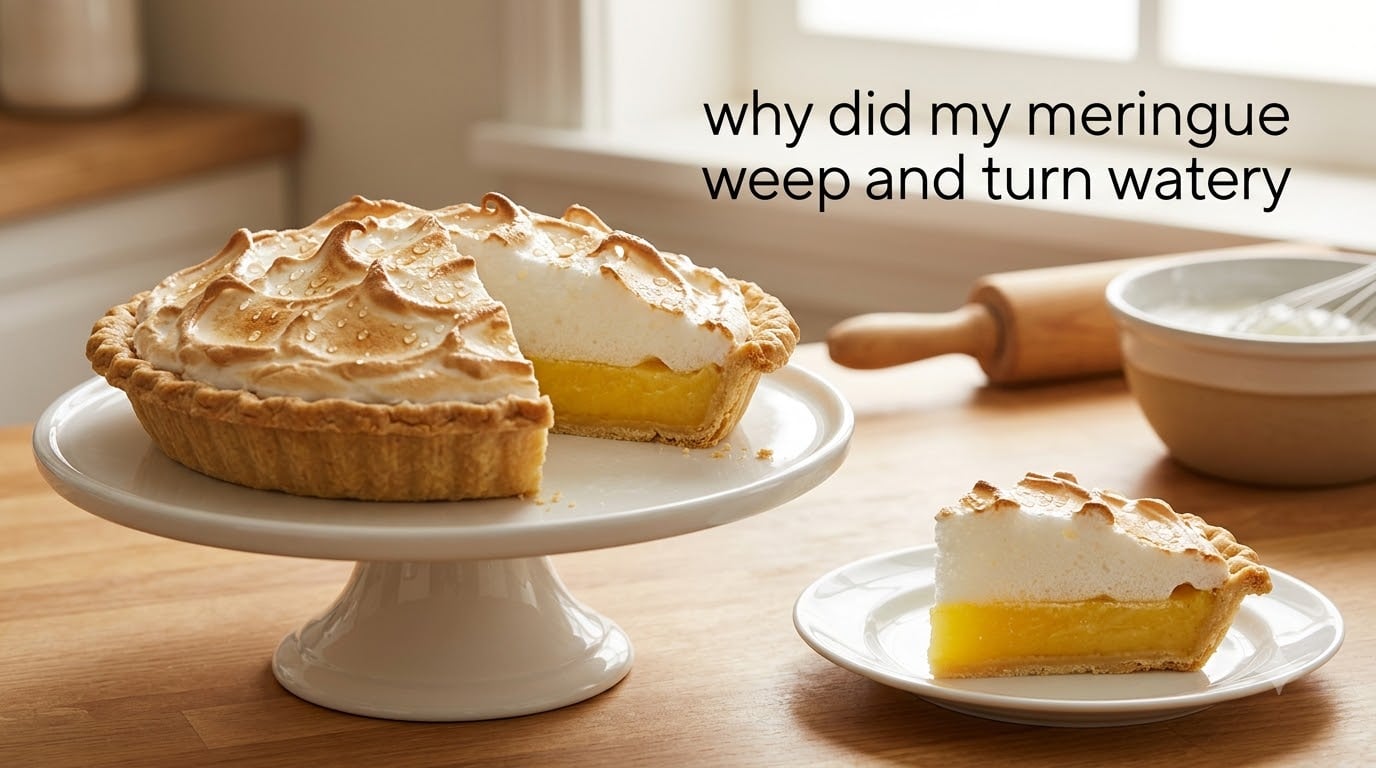
Why did my meringue weep and turn watery? In almost every case, the sugar in your meringue pulled moisture out of the foam (from underbaking, undissolved sugar, humid air, or a gap at the crust) and that moisture pooled as syrup on top, under, or around the meringue. Weeping is water separating from an unstable foam, and it shows up three ways: tiny clear beads on the surface (beading), a watery layer between meringue and filling (pooling), or the meringue sliding off the pie entirely (slipping).
I have baked meringue pies for friends, family, and recipe tests for years, and I have watched every version of weeping happen in my own kitchen. In this guide I will walk you through the six causes I see most often, the quick diagnosis trick that tells you which one you have, and the exact fixes that hold up for lemon, chocolate, coconut, key lime, and pumpkin meringue pies.
Table of Contents
Quick Diagnosis: What Your Meringue Is Telling You
Match what you see in the pan to the row below to identify the cause in under a minute. This is the fastest path to the right fix.
| What You See | Most Likely Cause | Fastest Fix |
|---|---|---|
| Clear droplets beading on top of the meringue | Underbaked interior + sugar drawing moisture out | Return to a 300 deg F oven for 10-15 minutes until the surface is dry and matte |
| Watery pool between meringue and filling when sliced | Meringue was not sealed to the crust edges (steam condensed under it) | Next time spread meringue all the way to the crust and bake on hot filling |
| Meringue shrunk away from the crust as it cooled | Overbeaten egg whites or oven too hot | Stop at true stiff peaks; bake at 325 deg F instead of 350 deg F |
| Meringue slides off the pie when you cut a slice | Meringue sat on cold filling, condensation pooled under it | Always spread meringue on hot filling and bake immediately |
| Gritty, syrupy meringue that never set | Sugar was not fully dissolved before baking | Use superfine sugar, add it gradually, or switch to Swiss meringue |
| Weeping only on humid summer days | Sugar is hygroscopic and absorbing moisture from the air | Run AC or a dehumidifier, postpone the bake, or stabilize with cornstarch |
If your meringue matches more than one row, treat the most visible symptom first and address the rest of the table before your next bake.
What Meringue Weeping Actually Is (and What It Looks Like)
Meringue is a foam of egg-white proteins wrapped around tiny air bubbles, with sugar holding the structure together. When that structure breaks down, water leaks out as syrup. That syrup is what bakers call weeping, and it shows up in three distinct forms.
Beading is the most common. You see small, clear, sticky droplets forming on the surface of the meringue, like dew on grass. Pooling happens underneath the meringue, where a thin watery layer sits between the meringue and the filling when you cut into the pie. Slipping is the dramatic version: the entire meringue top slides off the pie when you try to slice it.
A light, powdery dusting on top is not weeping, that is simply sugar that has dried on the surface. Real weeping is wet, glossy, and slightly sticky to the touch. Knowing which one you have determines whether you need to fix something or just admire the pie.
Cause 1: Sugar Was Not Fully Dissolved
Sugar is what keeps meringue stable. If the crystals have not fully melted into the egg whites before baking, they will absorb moisture during cooking and turn back into syrup on top of the pie. This is the single most cited cause of weeping in my own testing and in baker forums like Reddit’s r/AskBaking.
The quick test is simple. Pinch a bit of beaten meringue between your thumb and forefinger. If you feel any grit, the sugar is not dissolved and weeping is almost guaranteed.
Three fixes solve this problem. First, use superfine sugar instead of granulated, superfine dissolves in roughly half the time. Second, add the sugar one tablespoon at a time while the mixer runs, rather than dumping it all in at once. Third, switch to Swiss meringue, where you heat the egg whites and sugar together over a bain-marie until the sugar fully dissolves before whipping. Italian meringue works the same way: hot sugar syrup cooks the whites and dissolves the crystals for you.
Cause 2: The Meringue Was Underbaked
An underbaked meringue looks golden on the outside and stays raw, almost marshmallow-soft, in the middle. The center holds undissolved sugar and water that has not evaporated, and it leaks out as soon as the pie cools. Cook Til Delicious tested this in their kitchen and found that a thick, piled-on meringue needs a surprisingly long time to cook all the way through.
The target internal temperature for a fully set meringue is 160 deg F to 165 deg F, hot enough to pasteurize the eggs and to drive off enough water to stabilize the foam. If you do not want to use an instant-read thermometer, bake at 325 deg F for 18 to 25 minutes for a typical 9-inch pie, until the surface is dry and matte rather than glossy.
Two baking tricks help. Bake low and slow: 300 deg F for 25 to 30 minutes is gentler than 350 deg F and gives the center time to set before the outside overbrowns. And turn off the oven but leave the door closed with the pie inside for another 30 minutes. The residual heat finishes the cook and dries the surface, which is how you avoid both weeping and a scorched top.
Cause 3: Humidity and Weather Conditions
Sugar is hygroscopic, which is a fancy way of saying it pulls water out of the air. On a humid day, especially anything above 60 percent relative humidity, the sugar in your meringue will absorb moisture from your kitchen before it even gets to the oven. That moisture turns back into syrup during baking and weeps out.
The lab testing at Sunset Magazine confirmed that lower humidity, acid (cream of tartar), and cornstarch each independently reduce beading. Their takeaway: humidity matters more than most home bakers realize.
Three practical fixes. Run the air conditioner or a dehumidifier in the kitchen for an hour before you bake. Postpone the meringue pie if a thunderstorm is rolling in, since summer storms often push indoor humidity above 70 percent. If you cannot control the environment, stabilize the meringue with cornstarch (see the stabilizer section below), which absorbs moisture and keeps the foam intact.
Cause 4: Meringue Was Not Sealed to the Crust
If there is any gap between the meringue and the crust edge, steam from the hot filling escapes up through that gap, hits the cooler air above the pie, and condenses back into water under the meringue. That water pools between the meringue and the filling, which is the weeping you see when you cut the first slice.
The fix is mechanical. Spread the meringue all the way to the crust edge and press it firmly against the crust with the back of a spoon. Anchor it onto the crust, not onto the filling, so it grips the dry pastry wall. Make sure the meringue layer is at least 1 inch thick at the edges to create a real seal.
Cause 5: Meringue Was Spread on Cold Filling
A cold pie filling creates instant condensation under a warm meringue. That condensation pools as soon as the pie cools, even if you baked the meringue perfectly. This is the most common reason a “beautiful out of the oven” pie starts weeping within an hour.
Always spread the meringue on hot filling, ideally filling that has just finished cooking on the stovetop. Pour the meringue on within a minute or two of removing the filling from the heat, then transfer straight to the preheated oven. The hot filling partially cooks the underside of the meringue, which seals it and prevents steam from condensing underneath.
Cause 6: Egg White Issues (Yolk Grease, Cold Whites, Plastic Bowls)
Egg whites will not whip properly if anything interferes with the proteins unfolding. The three classic culprits are yolk contamination, cold whites, and plastic bowls.
Even a trace of yolk fat stops the whites from reaching stiff peaks. Separate eggs one at a time into a small bowl, then add each clean white to your mixing bowl, so a bad yolk does not ruin the whole batch. Use room-temperature whites, they whip to about double the volume of cold whites because the proteins are more relaxed and stretch more easily. And avoid plastic bowls unless you wipe them down with white vinegar first. Plastic holds onto a film of grease that plastic-wrap, butter, or previous baking projects leave behind, and that film blocks peaks just like yolk fat would.
Stabilizers That Prevent Weeping: Cream of Tartar, Cornstarch, Gelatin
Stabilizers are insurance policies against weeping. Each works differently, and you can combine them.
Cream of tartar is an acid. It slows protein coagulation just enough that the whites whip up taller and more stable. Use 1/8 teaspoon per egg white. It helps, but it does not stop weeping on its own in humid kitchens, and that is the myth I want to debunk right now: cream of tartar is not magic. It is one tool in a small kit.
Cornstarch absorbs moisture inside the meringue and keeps the foam from releasing water during baking. The classic method is to cook 1 tablespoon cornstarch with 1/3 cup sugar and 1/4 cup water into a slurry, cool it, then whip it into the beaten meringue. Use about 1 teaspoon cornstarch per egg white. My Own Sweet Thyme popularized this approach for home bakers, and it works well, just do not overcook the slurry. One commenter on that recipe cooked it too long and turned it into jelly, which made things worse, not better.
Gelatin gives structural integrity. Bloom 1/2 teaspoon gelatin in 1 tablespoon cold water, melt it gently, and stream it into the whites while they whip. This is the secret behind Swiss meringue’s 3 to 4 day refrigerator stability that food scientist J. Kenji López-Alt and the Cook Til Delicious team documented.
For a no-weep meringue on a lemon pie, my team uses all three: cream of tartar for acid stability, cornstarch for moisture absorption, and gelatin for structure. The combination is overkill for a dry climate and exactly enough for a humid one.
French vs Swiss vs Italian Meringue for Pies
The style of meringue you choose changes how weep-resistant the result is. Here is the comparison that matters for pies.
| Style | Technique | Stability on Pies | Best For |
|---|---|---|---|
| French | Whip raw whites, gradually add sugar | Lowest, weeping most likely | Pavlova, simple meringues where weeping is less of a concern |
| Swiss | Heat whites and sugar to 160 deg F, then whip | Medium-high, very stable when reinforced | Chocolate cream, coconut cream, banana cream pies |
| Italian | Pour hot sugar syrup into whipping whites | Highest, holds shape for days | Lemon meringue pie and any pie that needs long fridge time |
If weeping has been a recurring problem for you, switching from French to Italian is the single biggest upgrade you can make. Reddit’s r/Cooking thread on this topic converges on the same recommendation from multiple professional bakers.
How to Fix Already-Weeping Meringue (Salvage Workflow)
If your meringue has already wept, you have a few options depending on how bad it is.
For light beading on top: drain the droplets carefully with the corner of a paper towel, then return the pie to a 300 deg F oven for 10 to 15 minutes. The dry heat will reset the surface and stop further weeping.
For a watery pool underneath: cut a small slit in the meringue with a sharp knife, tip the pie slightly over the sink to drain the liquid, then rebake at 300 deg F for 10 minutes. This works once. Do not try it twice: re-baking caramelizes the sugar and makes the meringue tough.
For meringue that has slipped off entirely: there is no salvage. The foam has lost its structure. Strip the meringue off, rebake the filling briefly to drive off any extra water, then top with a fresh stabilized meringue.
And yes, weeping meringue is safe to eat. The sugar concentration is high enough that bacteria cannot grow, and the meringue itself is fully cooked by the time it has set on the pie. The texture is just less pleasant than it should be.
How to Prevent Weeping Next Time: The No-Weep Checklist
Work through this checklist before your next meringue-topped pie and weeping becomes rare.
Before you bake: separate eggs cleanly with no yolk, bring whites to room temperature for 30 minutes, wipe your bowl and whisk with white vinegar to remove grease, and measure your sugar by weight if you can. Humidity in your kitchen should be below 60 percent, run AC or a dehumidifier if it is not.
While you bake: add sugar one tablespoon at a time while the mixer runs, stop at true stiff peaks (the tip stands straight up without curling), and use 1/8 teaspoon cream of tartar per egg white. For lemon pie, switch to Italian meringue or reinforce Swiss with cornstarch and gelatin.
While you assemble: spread the meringue on hot filling within a minute or two of the filling leaving the stove, anchor it to the crust edge by pressing with the back of a spoon, and make the layer at least 1 inch thick at the edges.
While you bake the pie: set the oven to 325 deg F (not 350 deg F), bake for 18 to 25 minutes until the surface is dry and matte, then turn off the oven and leave the door closed for another 30 minutes so the residual heat finishes the inside.
While you store: refrigerate the pie within 2 hours of cooling, cover it loosely with foil rather than plastic wrap (plastic traps moisture and makes weeping worse), and eat within 3 days for the best texture.
Two myths to ignore. Cream of tartar alone will not save a meringue on a humid day, and you do not need a meringue powder or specialty product to stop weeping. Sugar, acid, starch, and gelatin do all the work.
Frequently Asked Questions
Can you fix weeping meringue?
Yes, in many cases. For light beading on top, drain the droplets with a paper towel and return the pie to a 300 deg F oven for 10 to 15 minutes. For a watery pool underneath, cut a small slit in the meringue, drain the liquid, and rebake briefly. If the meringue has slipped off the pie entirely, strip it off and replace with a fresh stabilized batch.
Is it safe to eat weeping meringue?
Yes. Weeping is sugar syrup that has separated from the foam, not spoilage. The high sugar concentration prevents bacterial growth, and the meringue is fully cooked by the time it sets on the pie. The texture is just less pleasant than a properly set meringue.
Does cream of tartar keep meringue from weeping?
Cream of tartar helps, but it does not stop weeping on its own. It is an acid that helps egg whites whip up taller and more stable. For real weep-proofing, combine cream of tartar with cornstarch (1 teaspoon per egg white) and spread the meringue on hot filling so it seals to the crust edges.
How to keep meringue from weeping overnight?
Refrigerate the pie within 2 hours of cooling, cover it loosely with foil rather than plastic wrap, and use Italian or stabilized Swiss meringue rather than plain French. The pie will keep for 3 days in the fridge. Avoid cutting into it until just before serving, since the exposed interior is what releases moisture into the meringue.
Why is my lemon meringue pie specifically weeping?
Lemon meringue pie is the most prone to weeping because lemon filling is high in water and acidic. Both factors stress a French meringue. Switch to Italian meringue (most stable), seal the meringue all the way to the crust edges, spread it on hot filling, and bake at 325 deg F for 20 minutes before cooling in the oven. These four changes fix lemon pie weeping in nearly every home kitchen.
What does weeping meringue look like?
Weeping shows up in three ways: small clear droplets beading on top of the meringue, a watery layer between the meringue and the filling when sliced, or the entire meringue top sliding off the pie when you cut a slice. A light powdery dusting on the surface is not weeping, that is simply dried sugar.
The Bottom Line on Weeping Meringue
Why did my meringue weep and turn watery? Because the foam lost water it was supposed to hold, usually from undissolved sugar, underbaking, humid air, or a gap at the crust edge. Match what you see in the pan to the diagnosis table, fix the visible symptom first, then run through the no-weep checklist before your next bake. Switch to Italian or stabilized Swiss meringue, seal it to a hot filling, bake at 325 deg F until the surface is dry and matte, and store the pie loosely covered in the fridge. Weeping is not permanent, and once you see it as a symptom rather than a failure, it becomes much easier to fix.