
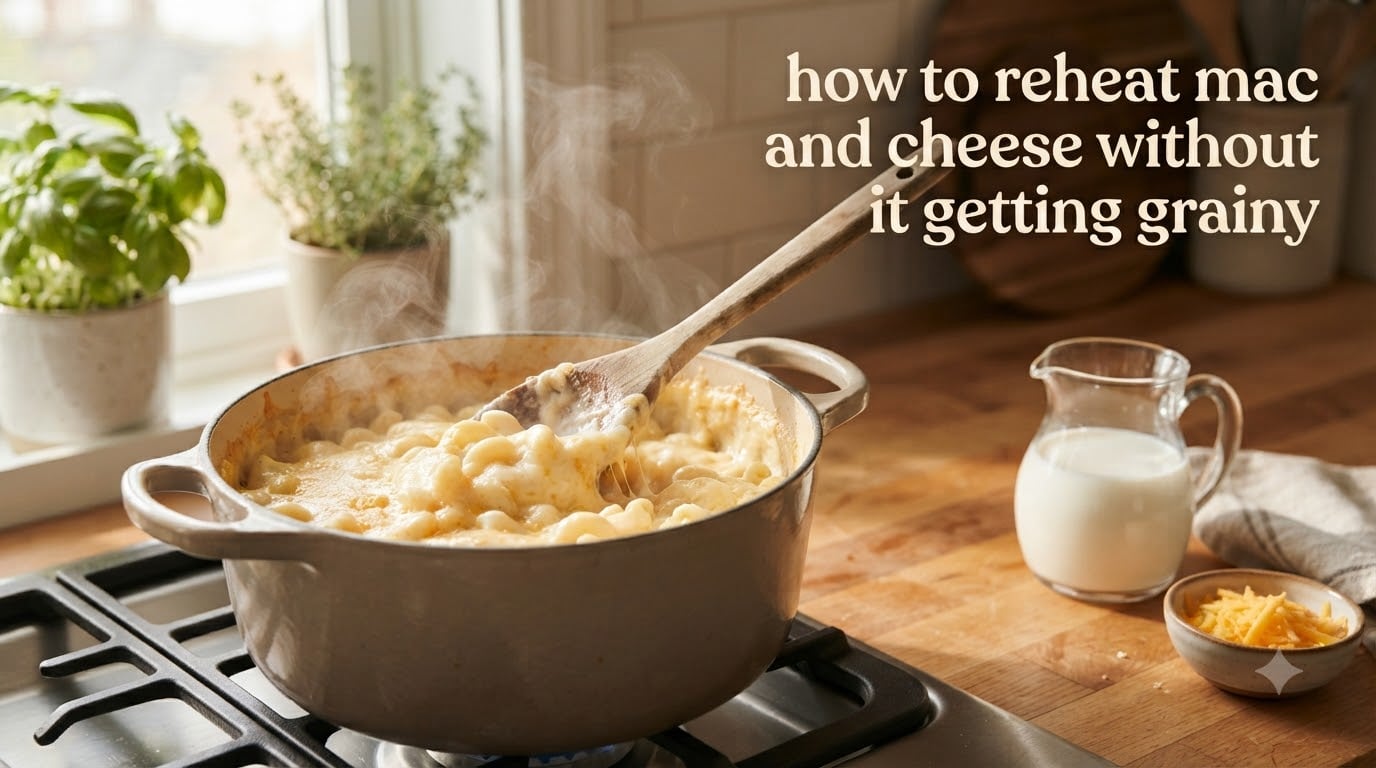
There is a particular kind of disappointment that hits the moment you reheat last night’s mac and cheese and find a bowl of stiff, oily pasta with little rubbery bits of cheese floating in it. I have thrown out more pans of “ruined” mac than I want to admit. The good news is that grainy leftover mac and cheese is not a life sentence. Once you understand why it happens and use low, gentle heat with a splash of liquid, you can bring that bowl back to something smooth and creamy almost every time.
In this guide I will walk you through exactly how to reheat mac and cheese without it getting grainy, using the stovetop, microwave, or oven. I will also explain the science behind the graininess, share the trick for rescuing mac that is already broken, and answer the most common questions home cooks ask on forums and Reddit threads about reheating mac and cheese.
Table of Contents
Why Does Mac and Cheese Get Grainy When Reheated?
The grainy texture you see in reheated mac and cheese is the cheese sauce breaking apart. Cheese sauce is an emulsion: fat, water, melted protein, and starch all suspended together in a stable mixture. When that mixture cools, the starches in the pasta soak up the surrounding liquid, and the fat begins to separate from the proteins.
Once you reheat, two things make it worse. High heat causes the cheese proteins to seize and clump, and overheating causes the suspended fat to leak out and pool on top. The result is a sauce that looks greasy in spots and gritty in others, with little chewy bits of protein instead of a smooth melt.
The pasta itself is also part of the problem. As it sits in the fridge overnight, starch retrogradation makes the noodles firm and dry. They essentially drink the sauce around them. So when you reheat, the sauce is already weakened before the heat ever hits it.
Understanding this is the key to preventing it. Your job during reheating is to add a small amount of liquid to rehydrate the starch, keep temperatures gentle so the proteins relax instead of seizing, and stir constantly so the fat stays suspended in the sauce.
The Best Way to Reheat Mac and Cheese
The best way to reheat mac and cheese is on the stovetop over low heat with a splash of milk, stirring constantly. This method gives you the most control, warms the pasta evenly, and lets you restore the sauce without overheating the cheese proteins.
Here is the quick version, which is the same method I use at home almost every week:
- Add the leftover mac and cheese to a small saucepan with 1 to 2 tablespoons of milk per cup of pasta.
- Place the pan over low heat.
- Stir gently and constantly with a wooden spoon or silicone spatula.
- Add a small knob of butter if you want extra richness.
- Once the sauce loosens and the cheese melts back in, taste and season with salt.
- Serve immediately while the sauce is glossy and smooth.
If you do not have a stovetop available, the microwave at 50 percent power in short bursts is the second-best option for single servings. The oven at 350 degrees F works best for baked or casserole-style mac and cheese. I cover each method in detail below.
How to Reheat Mac and Cheese on the Stove
The stovetop is my go-to for reheating mac and cheese because you can see and feel the sauce as it comes back together. It takes about 5 to 8 minutes and works for portions up to about 4 cups at a time.
You will need a small saucepan, a splash of milk (whole milk works best), and optionally a pat of butter or a splash of the pasta water you saved the night you made the dish. Pasta water is actually a secret weapon on forums like r/Cooking, because the extra starch helps the sauce cling again.
Step by step:
- Place the leftover mac and cheese in a small saucepan.
- Pour in 1 to 2 tablespoons of milk per cup of pasta. For very dry leftovers, use a little more.
- Add a small knob of butter, about half a teaspoon per cup, for richness.
- Set the burner to the lowest setting. Low heat is non-negotiable here.
- Stir slowly and constantly with a wooden spoon, scraping the bottom so nothing sticks and scorches.
- As the sauce loosens, keep stirring for 2 to 4 minutes until the cheese melts smoothly into the milk and coats the pasta again.
- Taste, adjust salt and pepper, and serve right away.
If the sauce still looks tight after a minute or two, add another small splash of milk. If it looks broken or oily, jump down to the “How to Fix Already-Grainy Mac and Cheese” section below. Do not be tempted to crank the heat to speed things up. That is exactly what causes grainy mac and cheese in the first place.
How to Reheat Mac and Cheese in the Microwave
The microwave is the fastest option for reheating mac and cheese, and it works fine for a single serving as long as you go slow and use 50 percent power. The microwave tends to heat unevenly, which is what causes those gritty hot edges and cold, dry centers, so you have to work with it, not against it.
What you need:
- A microwave-safe bowl with a microwave-safe lid or a plate to cover it
- 1 to 2 tablespoons of milk
- A fork for stirring between intervals
Step by step:
- Spoon the leftover mac and cheese into a microwave-safe bowl.
- Drizzle 1 to 2 tablespoons of milk over the top. Do not skip this step, since the pasta will drink the sauce during reheating without it.
- Cover loosely with a lid or a microwave-safe plate. The cover traps steam and keeps the top from drying out, which is one of the most common microwave mistakes people make.
- Microwave at 50 percent power for 1 minute.
- Remove, stir well with a fork, scraping the edges into the center.
- Return to the microwave at 50 percent power for another 30 seconds.
- Stir again, and repeat in 30-second bursts until the mac and cheese is hot all the way through and the sauce looks creamy.
- Total time is usually about 2 to 4 minutes for a single serving.
If the sauce looks tight or dry at any point, add another small splash of milk and keep going. If it looks split or oily, it overheated, so switch to the stovetop for any future reheats.
How to Reheat Mac and Cheese in the Oven
The oven is the right choice for baked mac and cheese or any casserole-style dish where you want to re-crisp the top. It is slower than the other two methods, but it preserves the texture of breadcrumb toppings and heats a whole dish evenly. Heat the oven to 350 degrees F and plan for 20 to 30 minutes total.
For a single-serve portion you can use a small baking dish. For a full casserole, use the original dish or a 9 by 13 inch pan. You will also need a splash of milk and a sheet of aluminum foil.
Step by step:
- Preheat the oven to 350 degrees F.
- Transfer the mac and cheese to an oven-safe dish if needed.
- Drizzle 2 to 4 tablespoons of milk over the top of the pasta. Spread it around so it soaks into dry spots.
- Dot the surface with a few small pieces of butter if you want a richer result.
- Cover the dish tightly with aluminum foil. This is critical to keep the steam in and prevent the top from drying out before the center is hot.
- Bake for 15 minutes.
- Remove the foil, stir the pasta gently, and bake uncovered for another 5 to 10 minutes until the sauce is bubbling and the top is lightly golden.
- Let it rest for 2 to 3 minutes before serving so the sauce settles.
Skip the oven if you are reheating a small portion, since it takes too long to be worth the energy. Stick to the stovetop or microwave for everyday reheating.
How to Fix Already-Grainy Mac and Cheese
If your mac and cheese is already grainy, you can usually rescue it. This is the situation I run into most often, and the trick is to treat the broken sauce gently and re-emulsify it with heat and liquid. The stovetop and the double boiler both work.
Stovetop rescue method:
- Transfer the grainy mac and cheese to a small saucepan.
- Add 2 to 3 tablespoons of warm milk per cup of pasta. Warm milk blends in better than cold, which can shock the proteins and make things worse.
- Set the burner to the lowest possible heat.
- Whisk gently and constantly with a small whisk or fork, pressing the grainy bits against the side of the pan to smooth them out.
- As the sauce loosens, the graininess should disappear within 3 to 5 minutes. If it does not, add another splash of warm milk and keep whisking.
Double boiler method for stubborn cases:
- Set up a double boiler by placing a heat-safe bowl over a pot of barely simmering water. The bowl should not touch the water.
- Add the grainy mac and cheese to the bowl along with a generous splash of warm milk.
- Stir gently and constantly. The indirect heat is gentle enough to re-emulsify the sauce without splitting it further.
- After 5 to 8 minutes the sauce should look glossy and smooth again.
If neither method works and the sauce is truly broken, the honest answer is to use it as a stovetop mac base and stir in 1 to 2 tablespoons of heavy cream and a little grated parmesan until it comes back together. It will not be exactly what you started with, but it will be creamy and good.
Storage Tips to Prevent Grainy Reheating
How you store leftover mac and cheese matters as much as how you reheat it. The right storage keeps the sauce from breaking down in the first place, which makes reheating almost foolproof. A few habits have saved me a lot of sad lunches.
- Cool the pasta quickly. Do not leave a hot pan of mac and cheese sitting out for more than 1 hour. Spread leftovers in a shallow container so they cool faster and evenly.
- Store in an airtight container. A tight lid keeps the sauce from forming a dry skin and prevents the pasta from absorbing the moisture in the container.
- Keep portions small. Divide leftovers into single-serve containers rather than one big tub. Smaller portions reheat faster and more evenly.
- Toss the pasta with a thin layer of milk or cream before storing if you know it will sit for a few days. The pasta drinks sauce overnight, so pre-hydrating it helps.
- Use within 3 to 4 days in the fridge. Mac and cheese holds its texture best within that window. After that, the sauce keeps breaking and reheating becomes harder.
- Freeze flat for the easiest thawing. If you plan to freeze, pour leftovers into a freezer bag, lay it flat, and freeze. Flat bags thaw much faster than round containers.
To reheat from frozen, thaw overnight in the fridge if possible, then use the stovetop method with extra milk. From a fully frozen state, go low and slow on the stovetop or use the oven covered at 325 degrees F for 30 to 40 minutes. Both work, but expect to add more liquid than usual.
Frequently Asked Questions
Why does my mac and cheese get grainy when I reheat it?
The graininess comes from the cheese sauce breaking apart. As mac and cheese cools, the starch in the pasta absorbs the sauce, and the fat separates from the proteins. Reheating at high heat makes the proteins seize and the fat leak out, leaving a gritty, oily texture. Low heat plus a splash of milk brings the sauce back together.
Can you reheat mac and cheese in the microwave?
Yes, use 50 percent power in 30-second bursts, stir between intervals, and cover the bowl loosely. Add 1 to 2 tablespoons of milk per serving before heating to keep the sauce from drying out. The microwave works best for single servings, not large batches.
How long should you reheat mac and cheese?
On the stovetop, 5 to 8 minutes over low heat. In the microwave, 2 to 4 minutes at 50 percent power in short bursts. In the oven, 20 to 30 minutes at 350 degrees F, covered with foil for the first 15 minutes. Exact times depend on portion size and starting temperature.
Can you add milk to mac and cheese when reheating?
Yes, and you almost always should. A splash of milk per cup of pasta rehydrates the starch and helps the cheese sauce re-emulsify. Whole milk works best, but cream, half-and-half, or even starchy pasta water will also bring back a smooth texture.
Can you reheat mac and cheese twice?
It is safe to reheat mac and cheese a second time if it has been stored properly in the fridge between reheats. Texture is the bigger issue: each reheating cycle breaks the sauce down a little more, so the second reheating is usually grainier than the first. For best results, only reheat what you plan to eat.
Final Tips for Reheating Mac and Cheese the Right Way
If you remember nothing else, remember this: low heat, a splash of liquid, and constant stirring. That trio fixes almost every bowl of leftover mac and cheese and keeps the sauce from breaking in the first place.
The stovetop is the most reliable method for everyday reheating, the microwave is fine for quick lunches at half power, and the oven is best for baked casseroles and large batches. Storing leftovers in shallow airtight containers, cooling them quickly, and adding a thin layer of milk before they go into the fridge all set you up for a smoother reheat tomorrow.
Now that you know how to reheat mac and cheese without it getting grainy, leftover mac is no longer something to dread. With a small saucepan, a splash of milk, and a few minutes of patience, you can bring almost any bowl of chilled mac and cheese back to a creamy, glossy, restaurant-style finish right at home in 2026.