
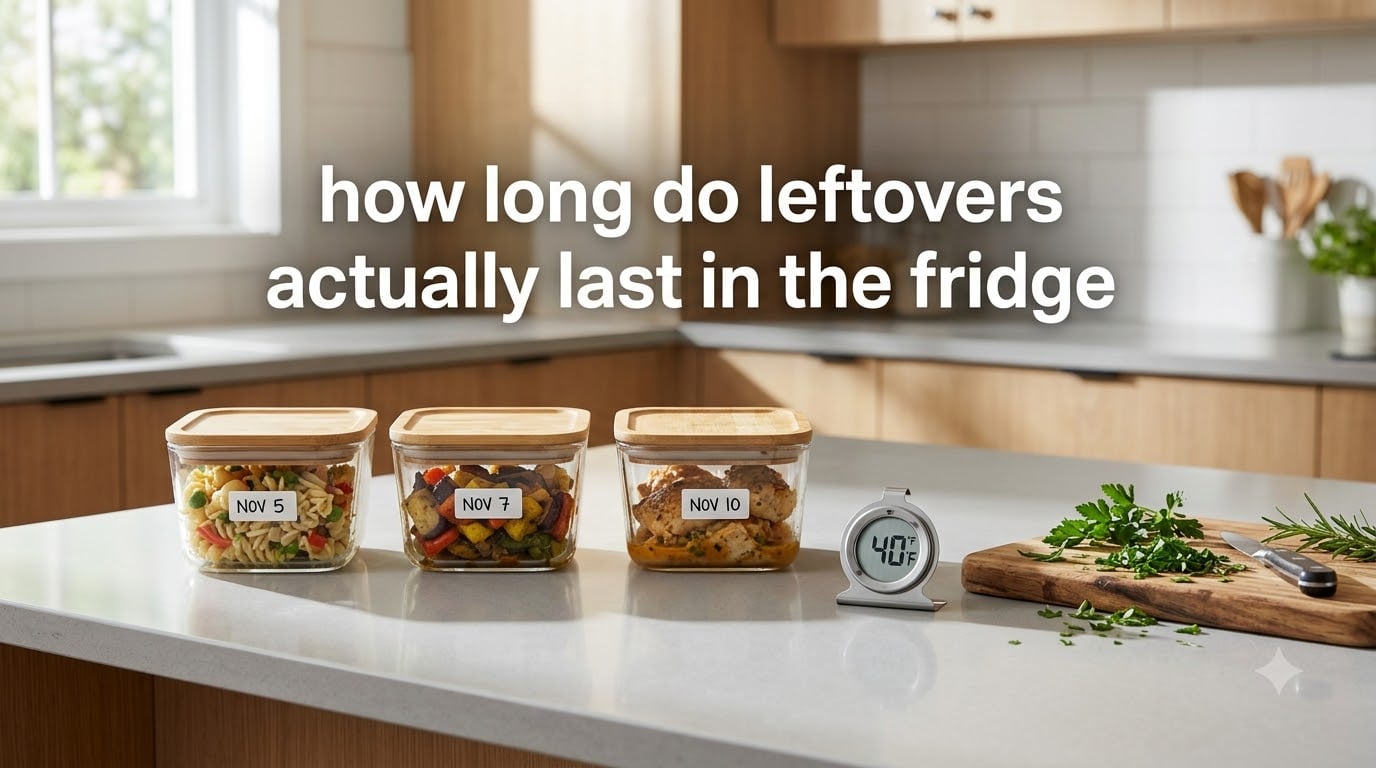
Most cooked leftovers stay safe in the refrigerator for 3 to 4 days when stored at 40°F (4°C) or below in airtight containers, per USDA and FDA guidelines. That window covers everything from last night’s roast chicken to a pot of soup to a slice of leftover pizza. Beyond day 4, the risk of foodborne illness rises even when the food looks and smells perfectly fine.
I know that sounds shorter than most of us have been taught. We’ve all scraped the “iffy” edge off something on day 6 or 7 and called it good. So in this guide I’ll walk through exactly how long how long do leftovers actually last in the fridge, why the rule exists, and the small storage habits that make those 3 to 4 days count.
Table of Contents
The 3-4 Day Rule in 4 Lines
Before we get into the details, here is the answer in plain language. This is the snippet you’ll want to remember next time you’re staring at a half-full pot of chili.
1. Cool fast. Refrigerate cooked food within 2 hours of cooking (1 hour if the room is above 90°F).
2. Store shallow. Split large pots into containers no deeper than 3 inches so they cool quickly.
3. Seal tight. Use airtight containers, label with the date, and keep your fridge at 40°F or below.
4. Eat within 4 days. After that, toss it. Smell and appearance don’t tell you whether leftovers are safe.
Why does the rule exist? Cooking kills most bacteria, but spores from organisms like Bacillus cereus and Clostridium perfringens survive the heat and start multiplying once the food cools into the danger zone. Refrigeration slows them down but doesn’t stop them.
How Long Each Type of Leftover Lasts
While the universal rule is 3 to 4 days, some foods deserve extra caution because of the bacteria they commonly harbor. Here is the breakdown the USDA and FDA rely on, and what our team uses at the restaurant when we send guests home with doggie bags.
Cooked meat and poultry (beef, pork, lamb, chicken, turkey): 3 to 4 days in the fridge. Slice large roasts before storing so they cool faster.
Cooked fish and shellfish: 3 to 4 days, but treat the high end with caution. Seafood spoils faster than other proteins and the risk of histamine and Listeria rises quickly.
Soups, stews, and chilis: 3 to 4 days. Cool to room temperature within 90 minutes before refrigerating.
Cooked rice and pasta: 3 to 4 days. Bacillus cereus spores in rice can survive cooking and produce toxins that reheating will not destroy, so don’t push past day 4.
Pizza: 3 to 4 days. Store slices in a single layer or airtight container so they don’t dry out or pick up fridge odors.
Casseroles and lasagna: 3 to 4 days. Cut into portions before refrigerating to speed cooling.
Cooked vegetables and grain bowls: 3 to 4 days for most. Hardier roasted vegetables can stretch a day longer if very fresh.
Gravy and meat stocks: 3 to 4 days. Boil gravies 1 to 2 minutes before refrigerating to slow bacterial growth.
Stuffing and dressing: 3 to 4 days. Like rice, stuffing is a Bacillus cereus risk, so don’t gamble on it.
Holiday turkey, ham, and roasts: 3 to 4 days. That means Thanksgiving turkey eaten by Monday or Tuesday is still safe; turkey on Friday is a roll of the dice.
These windows assume your refrigerator is at or below 40°F. If your fridge runs warmer, shorten the window. An inexpensive appliance thermometer is the cheapest food-safety tool you can buy.
What Is the Danger Zone and the 2-Hour Rule
The “danger zone” in food safety refers to temperatures between 40°F and 140°F (4°C to 60°C), the range where harmful bacteria multiply fastest. According to the USDA, bacteria can double in number in as little as 20 minutes inside this range.
That’s where the 2-hour rule comes in. Any perishable food left out at room temperature for more than 2 hours should be discarded, because by then bacteria have multiplied enough to potentially cause illness. When the ambient temperature is above 90°F, the window shrinks to 1 hour, which matters at summer picnics, potlucks, and outdoor catering events.
If you’re hosting a buffet, the FDA recommends keeping hot foods at 140°F or above and cold foods at 40°F or below. Anything in between for more than 2 hours enters the danger zone and should be tossed. This is one of the most overlooked rules in home entertaining.
How to Store Leftovers So They Actually Last
Getting the full 3 to 4 days out of your leftovers depends almost entirely on how you store them. Here’s the routine that food-safety pros at the Mayo Clinic and USDA recommend.
Cool before you seal. Hot food straight from the stove raises the temperature inside your fridge, putting everything else at risk. Cool food to about room temperature, ideally within 90 minutes, before refrigerating.
Use shallow containers. The USDA recommends containers no deeper than 3 inches. A big stockpot of chili cools too slowly in the center, even in a cold fridge, and the interior can stay in the danger zone for hours.
Airtight seals only. Tight-fitting lids, plastic wrap pressed directly onto the food surface, or vacuum-sealed bags all work. Airtight storage prevents cross-contamination with raw foods and stops moisture loss.
Label with the date. Use masking tape and a marker, or label stickers. “Day 1 of 4” takes two seconds and removes all guesswork on day 4.
Keep your fridge at 40°F or below. Use an appliance thermometer and check it monthly. A fridge dial set to “3” doesn’t tell you the actual interior temperature.
Top shelf for ready-to-eat food. Store leftovers above raw meat, poultry, and fish so drips don’t contaminate them.
These six steps extend safe storage time to the full 3 to 4 days. Skip them and you may be losing a day or two off the back end without realizing it.
How to Reheat Leftovers Safely to 165°F
Reheating isn’t just about warming food through. It’s about bringing it to a temperature high enough to kill bacteria that have grown during storage. The USDA standard is 165°F (74°C) measured with a food thermometer in the thickest part of the food.
For soups, stews, and gravies, bring them to a rolling boil on the stovetop. For casseroles, lasagna, and meat dishes, use an oven at 350°F until the interior reaches 165°F. For microwave reheating, cover the food and stir halfway through so cold spots don’t survive. Microwaves heat unevenly, which is why temperature checks matter.
One important caution: do not reheat leftovers in a slow cooker. The Mayo Clinic specifically warns against this because slow cookers heat food too gradually and can hold it in the danger zone for too long. They are great for cooking raw ingredients, not for reheating already-cooked leftovers.
If you’re reheating for a party, a warming tray or chafing dish set to keep food at 140°F or above is safe. Anything below that for more than 2 hours enters the danger zone again.
Foods You Should Never Save as Leftovers
This is the section most food-safety guides leave out, and it’s the one that prevents the most illnesses. Some foods, even when handled perfectly, are simply too risky to keep.
Cooked seafood, especially shrimp and oysters: Histamine-producing bacteria grow rapidly even at refrigeration temperatures. Eat shellfish the day you cook it, or toss it.
Raw sprouts (alfalfa, bean, radish): The warm, humid growing conditions for sprouts are also ideal for Salmonella and E. coli, and these pathogens are nearly impossible to wash off.
Rice left at room temperature: Even a few hours in the danger zone can allow Bacillus cereus to produce heat-stable toxins. Refrigerate rice within 1 hour of cooking or toss it.
Gravy and stuffing from a long-held roast: If the carving board or warming tray held these foods at room temperature for more than 2 hours, refrigerate what you can immediately and discard anything that’s been sitting.
Anything that’s been in the fridge for more than 4 days: The 4-day rule is non-negotiable. Not because food dramatically changes on day 5, but because bacteria have had enough doubling cycles to reach unsafe levels by then.
Adding these to your “always toss” list will save you from the most common sources of foodborne illness. The CDC estimates 48 million Americans get sick from foodborne illness each year, and home kitchens are responsible for more outbreaks than restaurants.
Freezer Storage Windows and How to Freeze Right
If you can’t eat leftovers within 4 days, freeze them. The USDA Food Safety and Inspection Service recommends using frozen leftovers within 3 to 4 months for best quality, though food kept continuously at 0°F stays safe indefinitely. Quality, not safety, is what degrades over time. Freezer burn, texture changes, and flavor loss are the trade-offs.
For best results, freeze in portion-sized airtight containers or heavy-duty freezer bags. Squeeze out as much air as possible to prevent freezer burn. Label each package with the contents and the freeze date, so you can use the oldest items first.
When you’re ready to eat frozen leftovers, the FDA recommends three safe thawing methods: in the refrigerator overnight (the safest), in cold water changed every 30 minutes, or in the microwave on the defrost setting. Thawing on the counter is unsafe because the outer layers enter the danger zone before the center thaws.
A common question is whether you can refreeze thawed leftovers. The answer is yes, but only if they were thawed in the refrigerator and have not been at room temperature for more than 2 hours. Refreezing affects quality more than safety, so refrozen food may be mushier or drier than the original.
Common Leftover Myths vs Facts
After reading through forum threads and Reddit discussions about leftovers, the same handful of myths keep coming up. Here’s what the evidence actually says.
Myth: “If it smells fine, it’s fine.”
Fact: Most dangerous bacteria do not produce off odors or visible changes. The USDA is explicit: “You can’t tell by smell.” This is the single most dangerous leftover myth, and it accounts for the majority of home food poisoning cases.
Myth: “Reheating kills everything, so old leftovers are safe.”
Fact: Reheating to 165°F kills most bacteria, but it does not destroy toxins already produced by Staphylococcus aureus or Bacillus cereus. These toxins are heat-stable and can cause vomiting even after thorough reheating.
Myth: “I’ve eaten 7-day-old leftovers for years and never gotten sick.”
Fact: Most adults have recovered from low-level foodborne illness without realizing it. Cumulative exposure increases risk, and high-risk individuals (pregnant, elderly, immunocompromised, young children) face severe complications from exposures healthy adults tolerate.
Myth: “If I freeze it, the clock resets.”
Fact: Freezing pauses bacterial growth but doesn’t kill bacteria. Thawed leftovers should still be eaten within 3 to 4 days of being in the fridge.
The USDA’s framing is the one to follow: “When in doubt, throw it out.” Saving a small amount of chili isn’t worth a day of vomiting or worse.
Restaurant Takeout and Doggie Bag Leftovers
As a working restaurant, we get asked about takeout leftovers more than almost any other food-safety question. The good news: the rules are the same as for home cooking. The 3 to 4 day window applies whether the food came from your kitchen or ours.
The practical difference is the container. Restaurant takeout containers are often shallow clamshells designed for transport, not long-term storage. Within an hour of getting home, transfer the food to your own airtight containers. This both extends fridge life and prevents the food from picking up other flavors.
If the restaurant meal sat on the table during a 90-minute dinner before you boxed it, the clock starts then. The food was hot for that 90 minutes, then cooled during the drive home, but you can only count on the 2-hour rule once. A good practice is to ask for the doggie bag before the meal arrives, and refrigerate the leftovers as soon as you walk in the door.
Frequently Asked Questions
Is it safe to eat 10 day old leftovers?
No. The USDA recommends discarding refrigerated leftovers after 4 days. By day 10, bacteria like Listeria and Staphylococcus aureus have multiplied well beyond safe levels. Even if the food looks, smells, and tastes fine, the cumulative bacterial load can cause foodborne illness. When in doubt, throw it out.
What is the 2 2 4 rule for leftovers?
The 2-2-4 rule is a simplified food-safety guideline: 2 hours is the maximum time perishable food can sit at room temperature before refrigerating (1 hour if above 90°F), 2 inches is the recommended maximum depth for storing food in shallow containers, and 4 days is the maximum refrigerator storage time for cooked leftovers.
Is it safe to eat leftovers for 5 days?
It is not recommended. The FDA and USDA both set 4 days as the safe upper limit for refrigerated cooked leftovers. By day 5, bacterial growth may have reached unsafe levels even if the food still smells fine. If you regularly cook large batches, freeze portions on day 1 or 2 to safely extend their life to 3 to 4 months.
Can you eat food after 7 days in the fridge?
No. The FDA Food Code sets a maximum of 7 days for any opened or prepared perishable food, but the USDA recommends discarding most cooked leftovers after just 3 to 4 days for safety. Day 7 leftovers carry meaningful risk of foodborne illness and should be discarded regardless of appearance or smell.
How many days can cooked food be stored in the fridge?
Most cooked food can be safely stored in the refrigerator for 3 to 4 days at 40°F or below. Some items, like raw sprouts or cooked seafood, should be eaten the same day. For longer storage, freeze cooked food within the first 2 days and use it within 3 to 4 months for best quality.
How long does it take for leftovers to go bad in the fridge?
Refrigerated leftovers begin accumulating bacteria from the moment they are cooked, but the count stays low for the first 3 to 4 days at 40°F. After that, bacterial populations can double rapidly. By day 5 to 7, food is technically in the FDA’s hard-stop range and should be discarded even if it looks fresh.
Can I eat 10 day old leftovers?
No. Eating 10-day-old leftovers is not safe. At that point bacterial counts are well past safe thresholds, and even thorough reheating will not destroy toxins already produced by bacteria like Bacillus cereus and Staphylococcus aureus. Discard anything older than 4 days from the fridge.
How long does pizza last in the fridge?
Pizza lasts 3 to 4 days in the refrigerator when stored in an airtight container or tightly wrapped. For best texture, reheat slices in a 375°F oven or in a dry skillet on the stovetop. Microwaving works but tends to make the crust rubbery.
How long do Thanksgiving leftovers last?
Thanksgiving leftovers, including turkey, stuffing, gravy, and mashed potatoes, last 3 to 4 days in the refrigerator. That means turkey eaten by the following Monday or Tuesday is still safe. If you want leftovers to last longer, freeze portions by Saturday at the latest and use them within 3 to 4 months.
Will I get sick if I eat food left out overnight?
Yes, this carries a high risk of foodborne illness. Perishable food left at room temperature for more than 2 hours (1 hour above 90°F) should be discarded. Bacteria like Staphylococcus aureus produce heat-stable toxins during that window that cannot be destroyed by reheating. When in doubt, throw it out.
The Bottom Line on Leftover Safety
So, how long do leftovers actually last in the fridge? The honest, evidence-based answer is 3 to 4 days. After that, the risk of foodborne illness rises even when the food still smells and looks fine, because dangerous bacteria do not announce themselves with off odors.
To get the full 4 days out of your leftovers, follow this quick routine. Cool food to room temperature within 90 minutes, transfer to shallow airtight containers no deeper than 3 inches, label each container with the date, keep your fridge at 40°F or below, and reheat to 165°F before serving. When in doubt, throw it out.
The small effort required to store leftovers properly pays for itself many times over, both in money saved and in illnesses prevented. And if you can’t eat something within 4 days, freeze it on day 1 or 2. A labeled freezer is a much safer bet than a hopeful sniff test on day 7.