
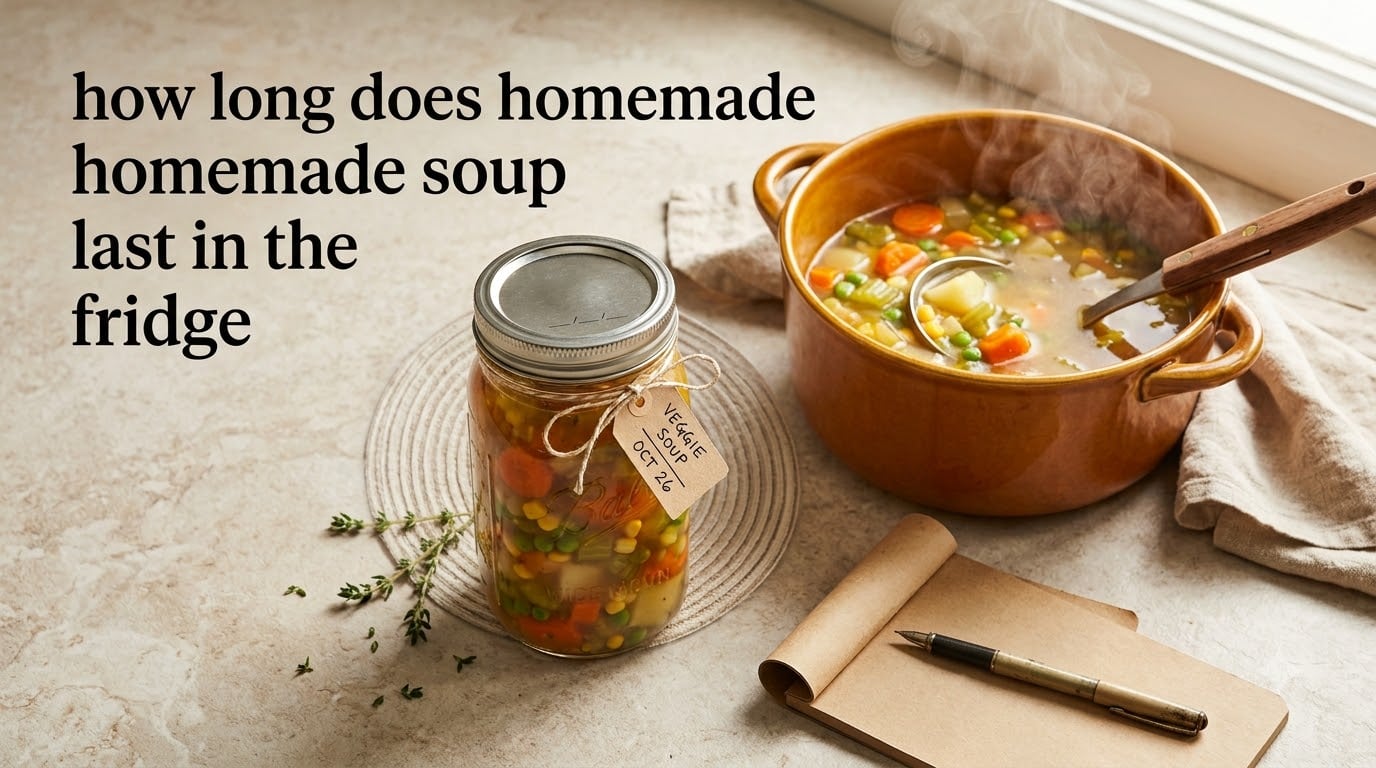
Homemade soup lasts 3 to 4 days in the fridge when stored in an airtight container at 40°F (4°C) or below, per USDA guidance for cooked foods. That window is shorter than most home cooks expect, and it is the reason a Sunday-night pot of chicken noodle can start to smell “off” by Wednesday lunch.
I have cooked in restaurant kitchens where the rules are stricter, and I have batch-prepped soup at home for years, and the gap between the official 3 to 4 day rule and what people actually do (often a week, sometimes ten days) is one of the most common food safety questions I get asked. This guide lays out the USDA baseline, breaks it down by soup type, and gives you a real-world storage playbook so your leftover soup stays safe and tasty.
Table of Contents
How Long Does Homemade Soup Last in the Fridge?
Homemade soup lasts 3 to 4 days in the refrigerator at or below 40°F, according to the USDA Food Safety and Inspection Service. Cream-based, seafood, and rice- or pasta-heavy soups trend toward the shorter 2 to 3 day end of that window; broth-based and high-acid tomato soup can stretch to day 4 in a properly sealed container.
The 3 to 4 day clock starts the moment the soup finishes cooking, not the moment you put it in the fridge. The faster you cool it and the shallower the container, the closer you stay to that upper bound. Soup left on the stove to cool overnight, or stored in the original pot, often loses a full day of safe life before it is even sealed.
Quick Storage Snapshot
- Broth-based soups (chicken, vegetable, beef, miso, egg drop): 3 to 4 days
- Cream and dairy soups (bisque, potato, cream of mushroom): 2 to 3 days
- Seafood soups and chowders (clam, fish, shrimp): 2 to 3 days
- Bean and lentil soups: 3 to 4 days
- Tomato and other high-acid soups: 3 to 4 days
- Pasta and rice soups (added directly): 2 to 3 days, best stored separately
- Store-bought soup, once opened: 3 to 4 days after transfer to an airtight container
Shelf Life by Soup Type
Soup is not one category. A bowl of miso behaves very differently in the fridge than a creamy seafood chowder, and the type of protein, dairy, and starch in the pot changes your safe window. Here is how long the most common homemade soups actually last in the refrigerator.
| Soup Type | Days in Fridge | Why This Window |
|---|---|---|
| Broth-based (chicken, beef, vegetable, French onion) | 3 to 4 days | Low starch and dairy; cooled quickly it stays safe near the upper bound |
| Chicken noodle | 3 to 4 days | Noodles absorb liquid and break down; cook pasta separately for longer life |
| Vegetable (no meat) | 3 to 4 days | Plant-only soups keep well; r/cookingforbeginners threads consistently report 4 to 5 days when sealed |
| Cream / dairy (bisque, cream of mushroom, potato) | 2 to 3 days | Dairy is an ideal growth medium; do not push past day 3 |
| Seafood chowders (clam, fish, shrimp) | 2 to 3 days | Seafood proteins spoil fastest; smell and texture shift quickly |
| Bean and lentil | 3 to 4 days | High protein but low moisture; stir daily and check for off odors by day 4 |
| Tomato and other high-acid | 3 to 4 days | Acidity slows some bacteria but does not stop them |
| Pasta and rice soups | 2 to 3 days | Starches turn soggy and feed bacteria; store grains separately when possible |
| Store-bought, opened | 3 to 4 days | Transfer to airtight container; ignore the opened can shelf life |
| Pho, ramen broth, pot-au-feu | 3 to 4 days | Broth-dominant French and Vietnamese classics follow the standard broth rule |
Reddit cooks in r/soup and r/cookingforbeginners routinely stretch these windows, and that is fine for low-risk broth and vegetable soups when the fridge is at or below 40°F and the container is sealed. For anything with dairy, seafood, or rice mixed in, treat day 3 as the real deadline.
Why Homemade Soup Spoils Faster Than Store-Bought
The single biggest reason homemade soup has a shorter shelf life than a tetra pak from the grocery store is preservatives. Commercial soups use sodium, acidity regulators, and sometimes nitrites to extend their fridge life to 5 to 7 days. Homemade soup has none of those, so the USDA 3 to 4 day rule is the realistic ceiling.
Three other factors shorten the window further. First, contamination: a wooden spoon rested on the counter, a ladle licked mid-stir, or a tasting spoon dropped back in all introduce bacteria that multiply fast at fridge temperatures. Second, moisture: soup is mostly water, which is exactly the environment bacteria thrive in. Third, pH: most soups are neutral to slightly acidic, which sits in the danger zone for pathogens like Bacillus cereus and Staphylococcus aureus, the usual suspects in leftover-soup food poisoning.
What the “Danger Zone” Actually Means
The USDA defines the danger zone as 40°F to 140°F (4°C to 60°C). Bacteria double in number every 20 minutes in that range. Soup that cools from a rolling boil to room temperature on the counter spends roughly 4 hours in the danger zone. Soup cooled in an ice bath and split into shallow containers crosses the same range in under 90 minutes, and that single habit is what adds an extra safe day to your fridge life.
How to Store Homemade Soup in the Fridge
Safe soup storage is a four-step chain: cool it fast, split it small, seal it tight, and refrigerate at or below 40°F. Skipping any link costs you a day or more of fridge life. Here is the order I follow at home and what we teach in our restaurant prep line.
Step 1: Cool to 70°F Within Two Hours
The USDA two-hour rule says cooked food should drop from hot to under 70°F within 2 hours of cooking, then to 40°F within 4 hours total. An ice bath is the fastest home method: set the pot in a sink filled with ice water and stir occasionally. Soup that would have taken 4 hours to cool on the counter drops to 70°F in about 30 minutes this way.
Step 2: Split Into Shallow Containers
Depth is the enemy of fast cooling. A tall 8-cup container of soup at the center can still be warm the next morning while the fridge reads 38°F. Portion into 2 to 3 inch deep containers; the wider and shallower, the better. Glass works well because you can see the center temp, and BPA-free plastic is lighter for batch prep.
Step 3: Seal Airtight and Label
A loose lid lets fridge air dry out the top layer and picks up odors from neighboring foods. Use containers with a true seal (snap-lock or gasket lids beat plastic wrap every time). Write the date and the soup name on a piece of masking tape; at day 3 you will not remember whether it was Monday’s minestrone or Tuesday’s lentil.
Step 4: Keep Your Fridge at or Below 40°F
An inexpensive fridge thermometer is the best food safety purchase you can make. Home fridges routinely run 42°F to 45°F, especially near the door, and every degree above 40 shortens soup life. If your fridge runs warm, store soup on the back middle shelf, never the door.
Container Choice at a Glance
- Glass jars (wide-mouth Mason or Weck): best clarity, can go straight from fridge to stovetop, but heavy and breakable
- BPA-free plastic: lightweight, good seals, ideal for freezer portions
- Stainless steel: durable but you cannot see contents; not microwave safe
- Original cooking pot: only acceptable for one overnight rest, not for multi-day storage; metal pots cool unevenly in the fridge
- Freezer bags laid flat: best for stacking and fast thawing; leave 1 inch of headspace for expansion
Signs Homemade Soup Has Gone Bad
Sensory checks beat calendar math at the edge of the safe window. A sniff and a visual scan on day 3 will catch spoilage a label date cannot. Here is what to look for, in the order I check it.
1. Smell First
A sour, yeasty, or slightly sweet fermented smell is the earliest warning sign. Fresh broth smells like savory herbs and meat; spoiled broth smells like rising bread dough or old dishwater. If anything smells “off” before you even taste it, toss it.
2. Look at the Surface
Clear broth that turns cloudy, dairy soups that look separated beyond normal, or any sign of mold (white, green, or black fuzz, even tiny specks) means the soup is done. A thin oily sheen on top is normal; chunky or curdled separation is not.
3. Check the Texture
Vegetables and noodles should still hold their shape. Mushy, slimy, or stringy textures past the normal “day-old cooked vegetable” feel point to bacterial breakdown. Rice especially turns gummy fast once it starts to spoil.
4. Taste Only as a Last Check
If smell and sight pass, a tiny taste on the tip of a spoon is reasonable on day 3. Anything bitter, fizzy, or strange means the soup goes in the compost. When in doubt, throw it out is not a cliché; it is the only safe rule at the edge of the window.
Day-by-Day Sensory Check
| Day | Normal Appearance | Warning Signs |
|---|---|---|
| Day 1 | Bright, aromatic, fresh herb scent | None expected |
| Day 2 | Slightly dulled color, normal savory smell | None expected if sealed and cold |
| Day 3 | Vegetable softness, slight broth darkening | Sour or yeasty smell, first sign of cloudiness |
| Day 4 | Edge of safe window for broth-based only | Any slime, separation, or sour note; throw out cream, seafood, pasta |
Can You Freeze Homemade Soup?
Yes, and freezing is the right move whenever you have more soup than you can eat in 3 days. Most homemade soups keep for 2 to 3 months in a 0°F freezer, and many stay good tasting for up to 6 months if sealed well. The trick is knowing which soups freeze gracefully and which ones need a small adjustment first.
What Freezes Well
Broth-based soups, bean and lentil soups, tomato soup, French onion, pho broth, pot-au-feu, and most vegetable soups freeze beautifully. The texture change on thawing is minimal.
What Needs a Tweak
Cream and dairy soups tend to separate when thawed. Freeze the broth base and stir in the cream or milk when you reheat. Pasta and rice absorb liquid and turn soft; freeze them separately or undercook them slightly before freezing. Seafood is best added fresh after reheating the broth.
Freezer Storage Best Practices
- Leave 1 inch of headspace in jars and containers; liquid expands as it freezes
- Cool fully to room temperature (or fridge cold) before freezing; putting warm soup in the freezer raises the temperature of everything around it
- Label with date and soup name; freezer tape peels off at the 2-month mark when you most need it
- Lay freezer bags flat for fast thawing and easy stacking
- Thaw in the fridge overnight, not on the counter; counter-thawing wastes the safe-window advantage
Common Soup Storage Mistakes to Avoid
Most leftover soup problems come from one of five habits. Skipping any of them cuts your safe fridge life noticeably, and the fixes are all simple.
- Leaving soup on the stove overnight to cool. Even 4 hours at room temperature can push bacterial counts into unsafe territory. Use the ice bath method instead.
- Storing soup in the original cooking pot. Tall metal pots cool unevenly, and the lid rarely seals well enough for the fridge. Portion into shallow containers.
- Putting a steaming pot directly into the fridge. It raises the fridge temperature, putting other food at risk. Cool to at least lukewarm first.
- Double-dipping with a used spoon. A licked-and-returned ladle is a common source of Bacillus cereus outbreaks. Use a clean tasting spoon each time.
- Reheating the same pot more than once. Every cool-and-reheat cycle lets bacteria multiply. Reheat only what you plan to eat.
Restaurant and Professional Kitchen Perspective
In a working restaurant, soup lives by different rules than at home, but the underlying science is the same. Our hot line holds soups at 140°F or above in soup kettles, which keeps them safely out of the danger zone for service. Soup that drops below 140°F goes into shallow metal hotel pans, gets an ice paddle, and is either served fast or moved to the walk-in within 2 hours.
The HACCP framework professional kitchens use boils down to the same two thresholds the USDA gives home cooks: keep hot food above 140°F and cold food below 40°F, with a 2-hour total window in between. The difference is just the equipment: a steam table or soup kettle replaces your ice bath, and a walk-in cooler replaces your home fridge. The math is identical.
What home cooks can borrow from the line is the habit of labeling every container with the date and time it came off heat. In our prep kitchen we label everything; if a soup’s label is older than 3 days, it goes. That single habit removes the guessing that makes “is this still okay?” such a common question at home.
Frequently Asked Questions
Can you eat soup after 5 days in the fridge?
It depends on the soup type and how it was stored. For broth-based, vegetable, or bean soups that were cooled quickly and kept in a sealed container at or below 40°F, day 5 is borderline but often still acceptable if there are no off smells, cloudiness, or texture changes. For cream, dairy, seafood, or pasta-heavy soups, day 5 is past the safe window and the soup should be discarded. When in doubt, throw it out.
How do you know if homemade soup has gone bad?
Trust your senses in this order: smell first, then look, then texture. A sour, yeasty, or fermented odor is the earliest warning. Cloudiness in a previously clear broth, any visible mold (white, green, or black specks), or a slimy feel on vegetables or noodles all mean the soup is spoiled. Taste only as a last check, and only after smell and sight pass. If anything tastes bitter, fizzy, or strange, compost it.
How long is homemade chicken noodle soup good for in the fridge?
Homemade chicken noodle soup stays safe for 3 to 4 days in the refrigerator when stored in an airtight container at or below 40°F. The noodles tend to absorb broth and turn soft by day 3, which is normal, not a sign of spoilage. If you plan to keep the soup longer than 3 days, store the noodles separately and add them fresh when reheating.
Can you eat food after 7 days in the fridge?
For most cooked foods including soup, 7 days is past the USDA safe window. The 3 to 4 day rule for soup is shorter than the general 4 day rule for many leftovers, so soup at day 7 should be discarded. Other cooked leftovers like roasted meats or casseroles may stretch to day 4 to 5 in ideal storage, but day 7 is rarely safe across categories. Freezing at day 3 is the better option for anything you will not eat in time.
How long does soup last in the fridge once opened?
Opened store-bought soup, once transferred to an airtight container, follows the same 3 to 4 day rule as homemade soup. Do not store opened soup in the can; transfer it to glass or BPA-free plastic, seal it, and refrigerate. Ignore any longer shelf life printed on the can, because once opened, the preservatives that extend shelf life start to break down.
How long does soup last at room temperature?
Soup left at room temperature should be discarded after 2 hours, per the USDA. Between 40°F and 140°F (the danger zone), bacteria double every 20 minutes, so a pot of soup that sits out through dinner is already past safe limits. On hot days above 90°F, the window shrinks to 1 hour. Cool soup in an ice bath and refrigerate within 2 hours of cooking for the longest safe fridge life.
Can you put hot soup in the fridge?
You can put hot soup in the fridge, but it should be cooled to at least lukewarm first, ideally to 70°F or below within 2 hours. Putting a boiling pot directly into the fridge raises the interior temperature and can put other stored food into the danger zone. Splitting the soup into shallow containers, running an ice bath, and then refrigerating gives you the longest safe fridge life.
Key Takeaways on How Long Homemade Soup Lasts
The short answer to how long homemade soup lasts in the fridge is the USDA 3 to 4 day rule, with cream, seafood, and pasta or rice-heavy soups leaning toward 2 to 3 days. Broth-based and vegetable soups hold the upper bound when they are cooled fast and sealed well. The day-by-day sensory check table above gives you a calm way to decide on day 3 or 4 instead of guessing.
If you cook in larger batches than you can eat in 3 days, freeze the extra portions in shallow containers on day 1 or 2, when the soup is at peak quality. Label every container with the date, keep your fridge at or below 40°F, and trust your nose over your calendar when in doubt. With those habits, your leftover soup will be both safe and genuinely good the next time you reach for it.