
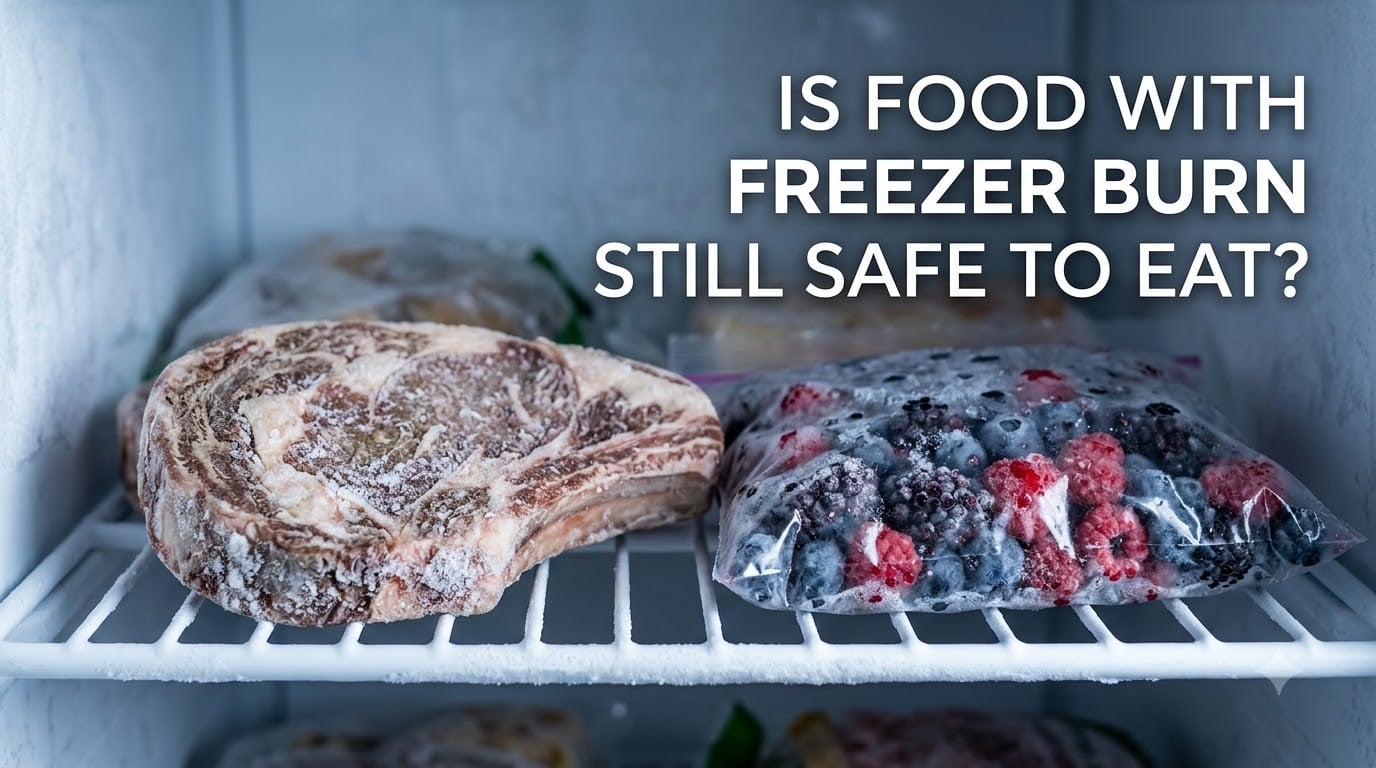
Yes, food with freezer burn is safe to eat. According to the USDA, freezer burn “does not make food unsafe, merely dry in spots.” It is a quality problem, not a safety one. The off-color patches, leathery texture, and “freezer taste” mean your food has lost moisture and flavor, but as long as your freezer stayed at 0°F (-18°C) or below, no harmful bacteria can grow. This guide covers what freezer burn actually is, how to tell it apart from real spoilage, and how to keep it from happening in the first place.
I dug into the USDA’s frozen food guidance, cross-referenced what Healthline, Eating Well, and MeatEater publish, and pulled the real questions home cooks post on Reddit to give you a complete answer.
Table of Contents
What Is Freezer Burn and What Causes It?
Freezer burn is the dehydration of food that happens when air reaches the surface inside your freezer. Water molecules in the food turn directly from ice into vapor through a process called sublimation, then escape into the surrounding air. Once that moisture is gone, the exposed surface dries out, oxidizes, and develops the grayish-brown, leathery patches everyone recognizes.
Three things have to happen for freezer burn to form: air exposure, time, and fluctuating freezer temperature. A torn seal on a freezer bag, a loosely covered container, or a frost-free freezer that cycles through warm and cold phases can all start the process. The longer food sits in those conditions, the worse the damage gets.
Freezer burn is not mold, and it is not rot. It is a physical change, not a microbial one. No bacteria, yeast, or mold is involved. That single fact is what makes the answer to “is food with freezer burn still safe to eat” a clear yes from every major food safety authority.
The science in plain English
Sublimation is the same thing that happens to dry ice at room temperature. Ice goes straight to vapor without ever becoming liquid water. Inside your freezer, that vapor migrates to colder surfaces (the walls, the coils, your other food) and refreezes as frost. The food it left behind dries out and discolors.
Oxidation is the second culprit. When the fats in meat, fish, or dairy are exposed to air, they react with oxygen and develop that characteristic “freezer taste” – cardboardy, stale, sometimes metallic. It is the same chemistry that makes butter go rancid in the fridge, just slowed down dramatically by the cold.
Is Freezer-Burned Food Safe to Eat?
Yes, freezer-burned food is safe to eat. The USDA confirms that freezer burn is a quality issue only, never a safety one. Food that has freezer burn may look unappetizing, feel dry or tough, and taste “off,” but it will not give you food poisoning as long as your freezer held 0°F (-18°C) continuously.
The reason it stays safe is simple: harmful bacteria like Salmonella, E. coli, and Listeria cannot multiply at freezing temperatures. They are dormant, not dead, but they cannot grow or produce toxins in a properly maintained freezer. The clock only starts again when the food begins to thaw.
Where the confusion creeps in is when “freezer burn” gets blamed for what is actually spoilage. If food smells sour, feels slimy after thawing, or changed color in a way that does not match freezer burn (green, black, or fuzzy growth), the problem is bacterial, not freezer burn. That food should be thrown out.
Freezer Burn vs. Spoilage: How to Tell the Difference
This is the question that actually drives most of the worry about whether freezer-burned food is safe to eat. Freezer burn and spoilage look similar at first glance but have completely different causes and consequences. Freezer burn is dry, discolored, and tasteless. Spoilage is wet, smelly, and dangerous.
Here is how to tell them apart at a glance:
| Sign | Freezer Burn | Actual Spoilage |
|---|---|---|
| Cause | Air exposure, sublimation | Bacterial or mold growth after thaw |
| Color | Grayish-brown, bleached white patches | Green, black, pink, or fuzzy growth |
| Texture | Dry, leathery, papery | Slimy, sticky, mushy |
| Smell | Stale, “freezer taste,” cardboardy | Sour, ammonia, rotten, yeasty |
| Safety | Safe to eat after trimming | Throw away |
| Location on food | Surface patches, edges | Spreads through food |
Three rules of thumb for borderline cases:
- When in doubt, thaw it cold. Move the food from the freezer to the fridge overnight. Smell and touch it before cooking. Spoilage reveals itself within hours of thawing. Freezer burn does not get worse once thawed.
- If your freezer lost power more than 4 hours, the food is no longer trustworthy. A full freezer holds safe temps for about 48 hours if you keep the door shut. A half-full freezer only manages about 24 hours. Past that window, spoilage bacteria can grow even if the food looks fine.
- Slimy trumps everything. A thawed chicken breast with freezer burn is safe if you trim off the outer layer. A thawed chicken breast with a slippery film, regardless of color, goes in the trash.
What Freezer Burn Looks Like by Food Type
Freezer burn shows up differently depending on water content and fat. Here is what to look for in the foods home cooks ask about most.
Meat (beef, pork, lamb)
Look for grayish-brown patches with a dry, leathery feel. Steaks and roasts usually develop freezer burn around the edges first where the wrap has the most air contact. Ground meat develops a chalky white or pale crust on the surface. After thawing, the affected areas are noticeably tougher and blander than the rest.
Poultry (chicken, turkey)
Chicken and turkey freeze-burn into papery, white or gray patches. The texture after thawing turns rubbery and dry in the burned zones, while the rest of the breast or thigh cooks normally. As long as there is no sour smell and no slime once thawed, it is safe to cook after trimming.
Fish and seafood
Freezer burn hits fish harder than almost any other food because of the delicate fats. Expect a bleached, chalky surface and a sharp ammonia-like odor after thawing. That smell is the oxidized TMA (trimethylamine) converting to DMA (dimethylamine), a chemistry reaction unique to seafood. A quick rinse in cold water with a squeeze of lemon pulls most of it out, but the texture will be drier than fresh-thawed fish.
Ice cream
The telltale signs are large ice crystals on the surface, a grainy texture, and a hard frozen shell around a softer center. Freezer-burned ice cream is safe to eat but unpleasant – the mouthfeel turns sandy and the flavor fades. You can scrape off the icy crust and re-blend the rest, or use it in milkshakes where the texture change disappears.
Bread and baked goods
Look for white frost on the surface and a dry, crumbly texture once thawed. Freezer-burned bread is safe but loses its soft crumb. Day-old slices work perfectly for toast, French toast, breadcrumbs, or strata. Whole loaves tend to fare better than sliced bread because there is less exposed surface for moisture to escape.
Fruit and vegetables
Berries, sliced mango, and other high-water fruits develop a mushy, icy texture after freezer burn. Vegetables lose their snap and turn leathery. Both are safe to eat, but they cook down better in smoothies, sauces, soups, and stews than they do on their own. Blanching vegetables before freezing dramatically reduces how fast they burn.
Quick reference for what burns fastest:
| Most prone to freezer burn | Why | Least prone |
|---|---|---|
| Lean ground meat | Lots of surface area, no protective fat | Whole cuts of meat on the bone |
| Skinless poultry breasts | Low fat, exposed surface | Fatty fish in vacuum-sealed pouches |
| Berries, sliced fruit | High water content, small pieces | Whole citrus with thick rind |
| Sliced bread | Each slice has exposed faces | Whole unsliced loaves |
| Ice cream (opened tub) | Air in container, repeated scooping | Individually wrapped portions |
| Cooked rice, pasta | Starch dries out fast | Vegetables blanched and dried before freezing |
How to Prevent Freezer Burn: 6 Strategies That Actually Work
Freezer burn is 100% preventable. These six strategies, in order of impact, are what professional kitchens and experienced home cooks actually use.
1. Vacuum seal anything you plan to store longer than a month
Vacuum sealing removes the air that drives sublimation. A countertop vacuum sealer pays for itself in saved meat alone. If you do not own one, the press-and-seal bags work for short-term storage, but they still let a small amount of air sit against the food surface.
2. Wrap tightly in plastic wrap, then foil or freezer paper
For meat, fish, and poultry, wrap each piece tightly in plastic wrap first, squeezing out as much air as possible. Then add a second layer of heavy-duty aluminum foil or butcher freezer paper. The double-wrap creates a backup barrier that survives a small tear in the outer layer.
3. Use rigid containers with minimal headspace for liquids and leftovers
Soups, stews, sauces, and braised meat freeze better in rigid containers filled to within a half-inch of the lid. Less air inside the container means less moisture can escape. Leave a small gap to allow for expansion, but no more.
4. Keep your freezer at 0°F (-18°C) and avoid door swings
Every time you open the door, warm humid air enters and frost-free freezers cycle through a warming phase to melt that frost. Both events accelerate freezer burn. Keep the freezer full (a full freezer holds temperature better than an empty one), organize it so you can find things fast, and group new items toward the back where it is coldest.
5. Label everything with the date
First-in, first-out only works if you can see the dates. A strip of masking tape and a Sharpie on every package is enough. Most freezer-burn problems start with food that got pushed to the back and forgotten for two years.
6. Cool food completely before freezing
Putting warm food in the freezer raises the internal temperature, forces the compressor to work harder, and creates condensation on the food surface – which then freezes into ice crystals that drive freezer burn. Cool food to room temperature in the fridge first, then move it to the freezer.
What to Do with Freezer-Burned Food (Salvage Guide)
Do not throw freezer-burned food away by default. Most of it can be rescued with a few simple techniques. Here is the five-step process I use when I pull something out and find it has gone past its prime.
Step 1: Assess the damage
Cut into the package. If the freezer burn is on the surface only – the classic grayish-brown or whitish patch – you can save it. If the discoloration runs deep, the texture is mushy throughout, or there is any off smell, move on.
Step 2: Trim aggressively
Cut off the affected outer layer plus a quarter-inch of the food underneath. Freezer burn is mostly a surface phenomenon, and that quarter-inch buffer removes any transitional zone where quality has dropped but the color has not yet changed.
Step 3: Reintroduce moisture where you can
For meat and poultry, a quick brine (1/4 cup kosher salt dissolved in 4 cups cold water, soaked 1 to 4 hours) pulls water back into the muscle and seasons it at the same time. Fish benefits from a 30-minute soak in milk or a lemon-water bath to soften the ammonia edge.
Step 4: Cook with bold flavors and wet methods
Braising, stewing, simmering in sauce, and slow-cooking all disguise the drier texture and blander flavor that freezer burn leaves behind. Think chili, curry, gumbo, pulled pork, braised short ribs, French onion soup, or a long-simmered bolognese. Save the high-heat dry methods (pan-searing a steak, roasting a chicken breast plain) for fresh-thawed food.
Step 5: Repurpose what you cannot eat as-is
Freezer-burned bread becomes breadcrumbs, croutons, or French toast. Freezer-burned fruit goes into smoothies, jam, or compote. Freezer-burned vegetables disappear into stock, soup, or stir-fry sauce. Most freezer-burned food has a home – it just is not the home you originally planned.
Can you scrape off freezer burn instead of trimming?
For ice cream, yes – scraping the icy crust off is fine. For solid food like meat or fish, no. Scraping a frozen steak just smears the dry, oxidized layer around and pushes it deeper into the texture. Use a knife and cut the burned section away instead.
Can you refreeze freezer-burned food?
Yes, but only if you thawed it safely in the refrigerator and it has not been at room temperature for more than 2 hours. The quality will drop another notch with each freeze-thaw cycle, so expect more moisture loss, but the safety is unchanged.
Frequently Asked Questions
Can eating freezer-burned food make you sick?
No. Eating freezer-burned food will not make you sick. Freezer burn is a quality issue caused by moisture loss and oxidation, not bacterial growth. Harmful bacteria cannot multiply at freezer temperatures (0°F / -18°C or below), so the food stays safe even if it looks and tastes off. The only way freezer-burned food becomes unsafe is if your freezer lost power for more than 4 hours, the food was stored at room temperature, or it shows signs of actual spoilage (sour smell, slimy texture, fuzzy growth).
Can freezer burn give you diarrhea?
Freezer burn itself does not cause diarrhea. It is dehydration of the food surface, not a microbial contamination. Diarrhea from frozen food points to actual spoilage, cross-contamination after cooking, or unsafe thawing practices – not the freezer burn itself. If you eat freezer-burned food and get sick, the freezer burn was likely masking food that had already started to spoil before freezing, or the food was not handled safely during thawing and cooking.
Can you just scrape off freezer burn?
Scraping works for ice cream – just remove the icy crust and eat the softer center. For solid foods like meat, fish, or poultry, scraping a frozen block does not work and just smears the damaged tissue around. Use a sharp knife to cut off the affected outer layer plus a quarter-inch of food underneath instead. This removes the visibly burned area and the transitional zone where quality has already started to drop.
What foods are most prone to freezer burn?
Lean ground meat, skinless poultry breasts, sliced bread, berries, opened containers of ice cream, and cooked rice or pasta are the most prone. They have either high surface area, low protective fat, or high water content that escapes quickly as ice crystals. Whole cuts of meat on the bone, fatty fish in vacuum-sealed pouches, whole unsliced loaves of bread, and properly blanched vegetables are the least prone because they have natural barriers that slow moisture loss.
Will Ziploc bags prevent freezer burn?
Standard Ziploc bags slow freezer burn but do not prevent it. The seal is good but not airtight, and air still sits against the food surface inside the bag. For short-term storage (under a month), Ziploc bags work fine if you press out as much air as possible before sealing. For longer storage, wrap food in plastic wrap first and then place it inside the Ziploc bag – the double layer dramatically reduces air contact. A vacuum sealer is the only true prevention for food stored longer than a month.
The Bottom Line
Food with freezer burn is safe to eat. It tastes worse, looks worse, and feels worse than fresh, but it will not make you sick as long as your freezer stayed at 0°F (-18°C) or below. The trick is knowing the difference between freezer burn and actual spoilage – freezer burn is dry and discolored, spoilage is slimy and smelly. Trim the burned parts, cook with bold flavors and wet methods, and use what you cannot eat as-is in soups, smoothies, breadcrumbs, or stock.
To avoid freezer burn altogether, wrap food tightly in two layers, vacuum seal anything you plan to store longer than a month, keep your freezer at 0°F, label everything with the date, and cool food completely before freezing. A little prevention now saves a lot of food (and money) later.