
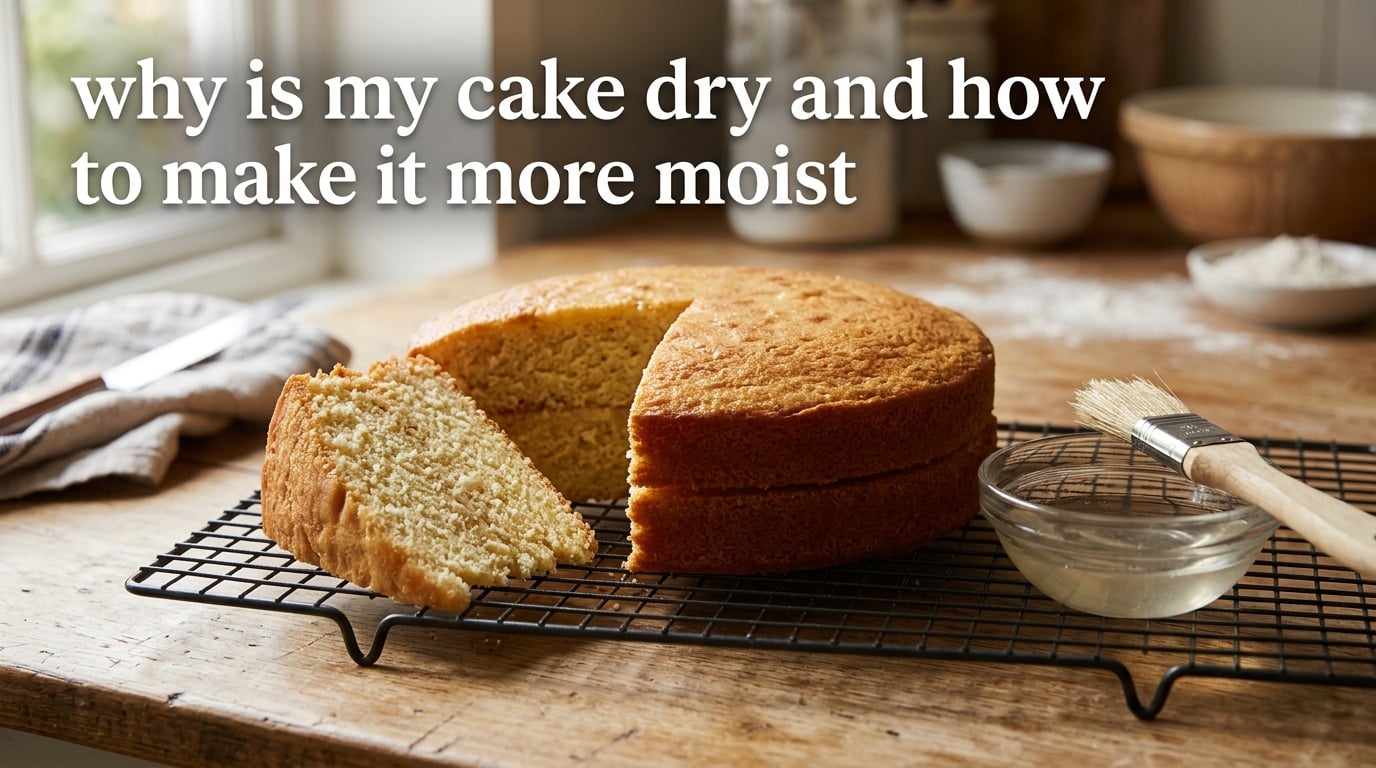
If you have ever sliced into a cake you spent an hour on and watched it crumble dry on the plate, you have asked the same question I have asked a hundred times: why is my cake dry and how to make it more moist? The short answer is that cake moisture is a balance of fat, sugar, liquid, flour protein, and baking time, and the dry version is almost always one of those levers being off. In this guide I will walk you through the ten most common causes, the exact fix for each, and the simple syrup trick that can rescue a cake that is already dry.
Table of Contents
What Actually Makes a Cake Moist (and What “Dry” Really Means)
A moist cake is one whose crumb holds water and fat in a soft, springy network. A dry cake is one where that network has been starved of fat, overcooked, or shredded by too much gluten. Moisture comes from four things working together: fat that coats flour proteins, sugar that locks in liquid, eggs and dairy that add water, and baking time short enough to keep the water inside the crumb.
One important distinction: “moist” and “tender” are not the same word, but they live next door. A cake can be tender (soft crumb) and still taste dry if the starch has gelatinized and the fat is gone, which is what happens when you bake too long or store a cake in the fridge uncovered. Most of the fixes below attack both at once.
10 Common Reasons Your Cake Is Dry (and How to Fix Each One)
These are the ten causes I see over and over in my own kitchen and in forums like Reddit r/Baking and r/AskBaking. Walk down the list, find your culprit, apply the fix, and your next cake will be softer than the last.
1. You measured the flour wrong. Scooping straight from the bag with a measuring cup packs in 15 to 20 percent more flour than the recipe writer intended, and that extra flour sucks up moisture like a sponge. Fix: weigh flour with a kitchen scale (120 g per US cup of all-purpose), or spoon it into the cup and level with a knife.
2. You used all-purpose flour where the recipe wanted cake flour. Cake flour has less protein (around 7 to 9 percent versus 10 to 12 percent), so it forms less gluten and a more tender crumb. Fix: swap in cake flour, or make a quick substitute: for each cup of all-purpose, remove 2 tablespoons of flour and add 2 tablespoons of cornstarch, then sift twice.
3. You used only butter and no oil. Butter gives flavor but solidifies at room temperature, which is partly why a “butter cake” can feel drier on day two. Oil stays liquid, so the crumb stays soft longer. Fix: replace 2 to 4 tablespoons of the melted butter with a neutral oil like canola or vegetable. You will not lose the butter flavor, but you will gain moisture that lasts.
4. You over-mixed the batter. Every extra minute of stirring develops gluten, and gluten is what makes cake chewy and dry. Fix: mix just until the flour disappears, then stop. A few small streaks of flour are fine; they will finish incorporating during the bake.
5. You over-creamed the butter and sugar. Creaming too long whips in so much air that the cake rises high, then collapses as it cools, leaving a dry, dense center. Fix: cream on medium for about 2 minutes until pale and fluffy, then move on. If your recipe calls for room-temperature butter and yours is rock hard, that is a separate problem (see tip 7).
6. You baked it too long or at the wrong temperature. Even five extra minutes past doneness can vaporize a surprising amount of water from the crumb. Fix: trust three tests at once: a toothpick with a few moist crumbs (not wet batter), a gentle press that springs back, and edges that just start to pull from the pan. Use an oven thermometer, because most home ovens run 10 to 25 degrees off the dial.
7. Your ingredients were not at room temperature. Cold butter, cold eggs, cold milk do not emulsify properly, so the batter bakes unevenly with pockets of fat and streaks of dry crumb. Fix: set butter, eggs, and dairy out 30 to 60 minutes before you start. To quickly warm eggs, place them in a bowl of warm (not hot) water for 5 minutes.
8. You used the wrong pan, or the wrong size. A dark metal pan bakes hotter than glass, glass runs hotter than light aluminum, and a pan that is too large gives a thin cake that dries out fast. Fix: use light aluminum for even baking, drop the oven 25 degrees if you switch to glass or dark metal, and size up only one pan diameter if the recipe calls for it.
9. You skipped (or skimped on) the moisture-boosting add-ins. Sour cream, Greek yogurt, buttermilk, and even a little mayonnaise add extra fat and lactic acid that tenderize gluten and hold water in the crumb. Fix: replace 1/4 cup of the milk with sour cream or full-fat yogurt, or swap the milk for buttermilk. This is the closest thing bakers have to a “secret ingredient” for moisture.
10. You stored the cake wrong. Wrapping a warm cake traps steam and makes it soggy, but leaving it uncovered in the fridge dries it out within hours. Fix: cool completely on a wire rack, wrap tightly in plastic, and store at room temperature for up to 2 days. The fridge is the enemy of most cakes except very buttery or cream-cheese-frosted ones.
The 10 Fixes at a Glance
| Cause | Quick Fix |
|---|---|
| Too much flour | Weigh or spoon and level |
| Wrong flour type | Use cake flour or AP minus 2 tbsp + cornstarch |
| All-butter recipe | Swap 2 to 4 tbsp butter for oil |
| Over-mixed batter | Stop mixing when flour disappears |
| Over-creamed butter | Cream 2 minutes only, not 5 |
| Overbaked | Use 3 doneness tests + oven thermometer |
| Cold ingredients | Bring butter, eggs, dairy to room temp |
| Wrong pan | Use light aluminum; adjust temp for glass |
| No moisture add-ins | Add sour cream, yogurt, or buttermilk |
| Bad storage | Wrap at room temp; skip the fridge |
Choosing the Right Flour: Cake Flour vs All-Purpose and How to Measure It
Flour is the most over-measured ingredient in home baking, and it is also the single biggest lever for a moist cake. Cake flour is milled from soft wheat with a protein content of about 7 to 9 percent, while all-purpose flour sits between 10 and 12 percent. More protein means more gluten, and more gluten means a chewier, drier crumb. If your recipe calls for cake flour and you have only all-purpose, do the cornstarch swap I described above rather than substituting cup for cup.
How you measure matters as much as which flour you pick. The “scoop and shake” method packs flour down and adds that 15 to 20 percent extra I mentioned, which is enough to take a perfectly good recipe and turn it into cake-brick territory. A kitchen scale removes the guesswork: 120 grams per US cup of all-purpose, 114 grams per cup of cake flour, 140 grams per cup of whole wheat. If you do not have a scale, spoon the flour into the cup until it mounds, then sweep the back of a knife across the top.
Fat Balance: Butter, Oil, Sour Cream, and Yogurt Explained
Fat does the heavy lifting in a moist cake, and the choice between butter, oil, and dairy fats is one of the most common sources of confusion. Butter is about 80 percent fat with the rest being water and milk solids, and it tastes incredible but solidifies at room temperature, which makes the crumb feel firmer. Oil is 100 percent fat that stays liquid, so a cake made with oil feels softer on day two and day three. Sour cream, Greek yogurt, and buttermilk are mostly water with some fat and lactic acid, and the acid tenderizes gluten so the crumb stays tender.
The “secret ingredient” question that circulates in forums has a real answer: it is any combination of these moisture-boosters, used together. A chocolate cake I bake regularly uses butter for flavor, oil for moisture, and a half cup of sour cream for tenderness, and it stays soft for three days on the counter. If you bake dairy-free, swap the sour cream for full-fat coconut yogurt or an extra tablespoon of oil plus a teaspoon of apple cider vinegar.
Fat and Moisture Boosters Compared
| Ingredient | What it adds | Best for |
|---|---|---|
| Butter | Flavor, structure, some moisture | Butter cakes, pound cakes |
| Vegetable oil | Long-lasting moisture, soft crumb | Chocolate cake, carrot cake |
| Sour cream | Tang, tenderness, fat + water | Red velvet, spice cakes |
| Greek yogurt | Protein, tang, moisture | Vanilla, lemon, carrot |
| Buttermilk | Acid that tenderizes gluten | Almost any cake, especially spice |
| Mayonnaise | Fat + acid + emulsified eggs | Chocolate cake rescue |
Mixing Technique: Creaming, Folding, and the Over-Mix Trap
Gluten is the enemy of a moist cake, and mixing is where gluten gets built. When you cream butter and sugar, you are not just combining them; you are forcing air into the fat so it can hold tiny pockets that expand in the oven. When you add flour, every stroke of the whisk or spatula lines up gluten proteins into strands, and once those strands form, no amount of baking magic will undo them.
The right rhythm is creaming until pale and fluffy (about 2 minutes on medium), adding eggs one at a time and beating just until each disappears, then folding in the dry ingredients by hand. With a stand mixer, that means low speed and under a minute. With a hand whisk, that means wide circles and patience. Stop the moment the last streak of flour vanishes.
Baking Time, Temperature, and Doneness Tests You Can Trust
Most home ovens are miscalibrated by 10 to 25 degrees, and that small drift adds up to a lot of overbaked cakes. An oven thermometer that hangs on the middle rack tells you the truth your dial will not. If the thermometer reads 350 but your dial is set to 350, you are actually baking at 325 or 375, and the cake knows.
Trust three doneness tests together, because no single test is reliable on its own. First, the toothpick test: insert a wooden skewer in the center, and pull it out with a few moist crumbs attached, not wet batter and not perfectly clean. Second, the spring-back test: gently press the top with a fingertip, and the cake should spring back without leaving a dent. Third, the visual test: the edges should just start pulling away from the pan and the top should look set, not jiggly in the center.
Pan material changes the math. A dark metal pan runs about 10 degrees hotter than a recipe expects; drop the oven 25 degrees to compensate. A glass pan also runs hot and retains heat longer, so pull the cake 5 minutes before the recipe says. Light aluminum is the safe default for almost every cake recipe.
How to Fix a Cake That Is Already Dry: The Simple Syrup Rescue
If the cake is already baked and you can feel the dryness, a simple syrup soak will bring it back. Simple syrup is just equal parts sugar and water, heated until the sugar dissolves, sometimes flavored with vanilla, citrus zest, or a splash of liqueur. Brushed onto warm cake layers, it absorbs in minutes and adds back the moisture the oven took out.
Here is the basic method I use for almost every layer cake that comes out a little drier than I wanted.
Step 1. Combine 1/2 cup water and 1/2 cup granulated sugar in a small saucepan over medium heat. Stir until the sugar fully dissolves, then remove from heat.
Step 2. Stir in 1 teaspoon vanilla extract, or the zest of one lemon or orange for a citrus cake. Let the syrup cool to lukewarm; hot syrup will tear the cake.
Step 3. Place the cake layer on a wire rack over a sheet pan so the extra syrup can drip off. Using a pastry brush, brush the top of the warm layer generously, soaking the surface until it stops absorbing.
Step 4. Repeat on the second layer. For a really dry cake, brush the sides too, or poke small holes with a skewer so the syrup reaches the center.
Step 5. Let the layers rest 10 to 15 minutes before frosting. The syrup will soak in fully and the surface will be tacky, not wet, which is exactly what you want under buttercream.
If you do not want to make syrup, brush the layers with milk, fruit juice, or even a thin fruit compote. A dry cake also makes a great trifle: cube it, layer it with custard and whipped cream, and let it soak overnight in the fridge. The dryness becomes an asset because the cake absorbs the custard instead of going soggy.
How to Keep a Cake Moist Overnight and for Days
Storage is where most cakes quietly lose their moisture. A cake that tasted perfect at dinner can taste like sawdust the next morning if it sat uncovered on the counter or, worse, went into the fridge. Cold air is dry air, and a fridge pulls moisture out of anything that is not sealed.
The best routine is simple: cool the cake completely on a wire rack (no pan, no towel on top), then wrap it tightly in two layers of plastic wrap or place it in a sealed cake carrier. Store at room temperature for up to 2 days. For longer storage, freeze the unwrapped cake until firm, then wrap in plastic and foil, and freeze for up to 3 months. Thaw at room temperature, still wrapped, so condensation forms on the wrap, not the cake.
One reason a cold cake can feel drier even when it is technically fine: the fat in the crumb is solid at refrigerator temperature, so the cake feels firm and the tongue registers that as “dry.” Letting the cake come fully to room temperature before serving brings the fat back to liquid and the perceived dryness disappears.
Box Cake Mix Rescue: How to Make a Boxed Cake Moist
Box mixes get a bad rap for being dry, but the dryness almost always comes from the baker, not the brand. The mix itself is balanced; the issue is that most home bakers follow the box directions literally and skip the easy upgrades that turn a basic mix into a bakery-style cake. Here are the swaps I make every time I bake from a box.
Replace the water with whole milk, buttermilk, or even a mix of milk and sour cream. Replace the oil called for (usually vegetable oil) with melted butter plus a tablespoon of extra oil for moisture. Add one extra egg beyond what the box asks for; the extra yolk adds fat and the extra white adds structure without drying. If the box calls for 1 cup of water, try 3/4 cup water plus 1/4 cup sour cream or yogurt instead. These four swaps alone take a standard box mix from “fine” to “genuinely moist” with almost no extra effort.
High-Altitude, Pan Size, and Other Adjustments Most Articles Skip
Above about 3,000 feet, the air is thinner, leavening gases expand faster, and moisture evaporates quicker from the batter. Bakers in places like Denver, Albuquerque, or Salt Lake City often find their cakes dome, crack, and dry out within a day. The fixes are well known in high-altitude communities: reduce baking powder by 1/4 teaspoon per teaspoon called for, increase liquid by 1 to 2 tablespoons per cup, raise the oven temperature by 15 to 25 degrees to set the structure before the leavening escapes, and reduce sugar by a tablespoon per cup because sugar weakens the crumb at altitude.
Pan shape changes the bake, too. A Bundt pan holds more batter deeper than a layer pan, so the center takes longer to set and the edges dry out before the middle is done. A sheet pan spreads the batter thin, so it bakes fast but loses moisture quickly once out of the oven. Layer pans strike the best balance for most home bakers, sitting somewhere in between. If you switch pan types, expect a 5 to 10 minute swing in bake time either way.
Finally, do not double a cake recipe unless you really have to. Doubling throws off the ratios of leavening, liquid, and mixing time, and the result is almost always a dry, dense cake with a gummy center. If you need more cake, bake two batches back to back instead.
Frequently Asked Questions
How to moisten a too dry cake?
Brush the warm cake layers with a simple syrup made from equal parts sugar and water, plus a teaspoon of vanilla. Let it soak in for 10 to 15 minutes, then frost. For an extremely dry cake, poke small holes with a skewer so the syrup reaches the center, or brush the layers with milk, fruit juice, or a thin fruit compote.
How to make a cake extremely moist?
Use a combination of butter, oil, and a moisture-booster like sour cream, Greek yogurt, or buttermilk. Weigh the flour, swap all-purpose for cake flour when you can, avoid over-mixing, and pull the cake from the oven a minute or two before you think it is done. Wrap tightly at room temperature once cooled.
How to increase moisture in a cake?
Add moisture on three fronts at once: replace 2 to 4 tablespoons of melted butter with oil, swap a quarter cup of milk for sour cream or yogurt, and brush the baked layers with simple syrup. Also reduce bake time by 2 to 3 minutes so the crumb retains more of its water.
What can I do with a cake that is too dry?
Soak it with simple syrup, brush it with milk or juice, or transform it into a trifle by cubing the cake and layering it with custard and whipped cream overnight. Frosting also masks mild dryness, especially buttercream, which adds fat back to the surface of every slice.
How to fix an overbaked dry cake?
Brush generously with simple syrup on top, sides, and inside any holes you poke with a skewer. Let it rest 15 minutes, then frost. For very dry cakes, slice the layers in half horizontally and soak the cut surfaces too. Serve at room temperature so the fat in the crumb softens back to liquid.
What is the secret ingredient that keeps cakes moist?
It is not one ingredient, it is a combination. The closest thing to a single secret is sour cream or full-fat Greek yogurt, which adds fat, lactic acid, and water. Pair that with a swap from butter-only to a butter-plus-oil fat blend, and the crumb stays soft for days.
What are the best tips for making cake moist?
Weigh flour instead of measuring by cup, use cake flour when the recipe allows, mix only until the flour disappears, bake until a toothpick has moist crumbs rather than wet batter, and store the cake wrapped at room temperature rather than in the fridge. Add a moisture-booster like sour cream or buttermilk for extra insurance.
The Bottom Line
The question of why is my cake dry and how to make it more moist almost always comes down to three levers: how much flour goes in, what kind of fat holds it together, and how long it spends in the oven. Measure flour by weight or by spoon-and-level. Build fat from butter, oil, and a moisture-booster like sour cream instead of butter alone. Mix only until the flour disappears, and pull the cake a minute early. If the cake is already dry, brush it with simple syrup and let the crumb soak it back up.
Start with the next cake you bake and pick two or three of these fixes. Weigh the flour, swap two tablespoons of butter for oil, add a quarter cup of sour cream. That single change usually makes the difference between a cake that crumbles and a cake that disappears by the second slice. And if the cake still comes out dry, you have the simple syrup rescue ready to go.