
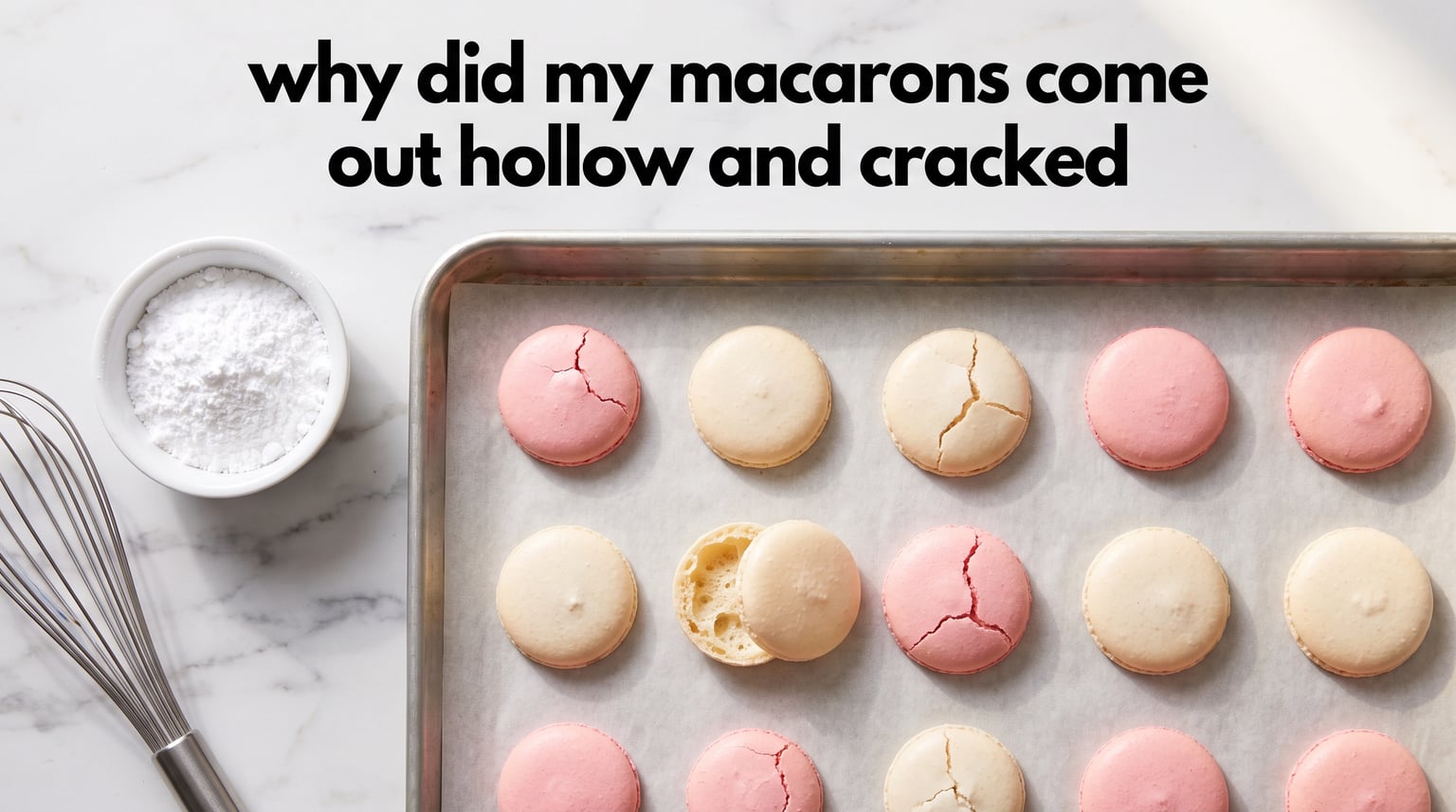
If you just pulled a tray of macarons out of the oven and the tops look like a cracked desert and the bottoms have empty pockets when you bite in, take a breath. Why did my macarons come out hollow and cracked is the most common macaron question I get from readers, and the answer almost always comes down to five fixable things: oven temperature, mixing, resting time, meringue stability, and humidity.
I have baked hundreds of batches in two different kitchens on two continents, and I still get the occasional cracked shell. The good news is that hollow and cracked macarons are a diagnostic moment, not a failure. Your oven, your batter, or your climate is whispering a specific problem, and once you learn to read the symptoms you will rarely lose another tray.
This guide covers cracking and hollowness together, which most other sources split into separate articles. That split makes troubleshooting harder, because in real life both problems usually share the same root cause. By the end you will know exactly which cause is yours, how to fix the next batch, and what to do with the hollow shells sitting on your counter right now.
Table of Contents
Quick Diagnosis: Why Your Macarons Came Out Hollow and Cracked
Before you read the full guide, scan this list. Nine times out of ten, your batch fits at least two of these causes. The most common reasons macarons crack on top and go hollow inside are:
- Oven too hot — steam bursts through the top before the shell sets, causing cracks and hollow air pockets.
- Oven too cold — the inside never dries out, leaving a wet, sticky hollow center.
- Undermixed or overmixed batter — trapped air expands and escapes, or the batter is too loose to hold structure.
- No resting / drying time before baking — the skin never forms, so the shell cracks the moment heat hits it.
- Overwhipped or unstable meringue — too much air creates pockets; weak meringue collapses and leaves gaps.
If more than one of these fits your last batch, you are normal. Macarons are sensitive to small changes, and even 5 degrees Fahrenheit or one minute of overmixing can flip a batch from perfect to hollow. The rest of this guide walks through each cause, what it looks like, and how to fix it.
How Oven Temperature Causes Both Cracked and Hollow Shells
Oven temperature is the number-one reason macarons come out cracked on top and hollow inside. Most macaron recipes call for 300 to 325 degrees Fahrenheit with a convection setting or 325 to 340 in a conventional oven, but the dial on your oven is rarely accurate.
I keep two oven thermometers in my oven at all times, one on each rack. The first time I did this I found my old oven ran 30 degrees hot. That single discovery fixed more batches than any technique change I have ever made.
Too Hot: Cracks, Brown Tops, and Feet That Rise Too Fast
When your oven runs hot, the outside of the shell sets almost immediately while the inside is still liquid and full of steam. That steam has nowhere to go except up, so it bursts through the top and you get cracks. The same trapped steam also creates air gaps inside, which is why a hot oven can give you both symptoms at once.
Signs your oven is too hot:
- Tops brown before the baking time is even halfway done.
- Cracks appear within the first 5 minutes of baking.
- Feet rise very tall and fast, then collapse.
- Shells feel hollow and dry on the inside.
Fix: Lower your oven temperature by 5 to 10 degrees at a time and test with one or two shells before piping a whole tray. Place an oven thermometer on the rack you bake on. If you use convection, drop another 25 degrees from the recipe’s stated temperature, because fan ovens run hotter than conventional ones.
Too Cold: Hollow, Sticky Centers and Pale Tops
A too-cold oven is the silent killer of macarons. The shells look fine on the outside, sometimes even pretty, but when you crack one open the inside is gummy, wet, or hollow with a sticky layer. The outside sets slowly enough that the inside never reaches the temperature needed to dry out.
Signs your oven is too cold:
- Shells look pale and never develop a slightly toasted color.
- Feet rise slowly or barely rise at all.
- Bottoms are sticky when you peel them off the mat.
- Inside feels like wet meringue when you bite in.
Fix: Raise your oven 5 to 10 degrees, and add 1 to 2 minutes to the baking time. Again, trust the thermometer, not the dial. Bakers on Reddit’s r/Baking subreddit frequently report that a 25-degree difference is all it takes to go from perfect shells to cracked ones, which is why I always test with a sacrificial shell before committing a full tray.
Macaronage Mistakes That Lead to Hollow and Cracked Macarons
Macaronage is the folding step where you combine the whipped meringue with the almond flour and powdered sugar. It is the most skipped-over part of any macaron recipe, and it is where most hollow and cracked batches are born.
The goal of macaronage is to deflate the meringue just enough so the batter flows slowly like lava, not so much that you knock all the air out, and not so little that pockets of air stay trapped.
Undermixed Batter: Trapped Air, Hollow Shells, and Cracked Tops
An undermixed batter is thick, glossy, and holds its shape aggressively when piped. When you lift the spatula, the batter stands in a stiff peak instead of flowing down in a thick ribbon. Those stiff peaks trap pockets of air inside, and during baking that air expands, creating hollow shells and forcing cracks through the surface.
What undermixed batter looks like:
- Pipes with sharp, pointy tops that hold their shape.
- Shells show visible air bubbles after resting.
- Macarons crack in the oven even when the temperature is right.
Fix: Keep folding. The ribbon stage is your checkpoint: lift the spatula and let the batter fall back into the bowl. It should flow in a thick, continuous ribbon that disappears back into the surface within about 10 to 15 seconds. If it piles up and sits there, keep going.
Overmixed Batter: Runny, Spread-Out Shells With No Feet
An overmixed batter is thin, soupy, and flows off the spatula like heavy cream. Once piped, it spreads outward instead of holding a round shape. Without structure to rise against, the shells bake thin and flat, often without feet, and sometimes hollow because the batter cannot hold steam inside.
What overmixed batter looks like:
- Batter ribbons run off the spatula without breaking.
- Piped rounds flatten and merge into each other on the tray.
- Shells bake into thin, lacy discs with no rise.
Fix: Unfortunately, you cannot un-overmix. The best you can do is pipe the batter as-is into very small rounds and bake them as macaron bites, or fold in a tablespoon of extra sifted almond flour to thicken the batter slightly. Some bakers on cooking forums salvage overmixed batter by adding a small amount of Italian meringue to restabilize it, but I would treat that as a rescue only.
The Ribbon Stage: Your Visual Checkpoint
The ribbon stage is the single most reliable sign that your macaronage is correct. To test, scoop up batter on your spatula and let it pour back into the bowl. The batter should fall in a slow, thick ribbon that takes 10 to 15 seconds to dissolve into the rest of the batter. If it disappears faster, you have likely overmixed. If it piles up on top and stays there, you have undermixed.
I drop a small test round on the tray and tap it before piping the full batch. If the test spread too thin, I knew I had overmixed. If it held its peak stubbornly, I knew I had more folding to do.
Why Skipping the Rest Time Creates Cracked Shells
The rest time, sometimes called the drying time or skin formation step, is the quiet pause after piping where the macarons sit on the counter and form a matte, dry skin. This skin is what traps steam inside the shell during baking so the feet rise and the tops stay smooth.
If you skip or shorten the rest time, the surface of the macaron is still wet when it hits the oven heat. Steam escapes upward immediately, the top cracks, and you get the classic “cracked macaron with no feet” result.
How to tell when your shells have rested long enough:
- Touch a shell lightly with a clean fingertip. No batter should stick.
- The surface should look matte and slightly dry, not glossy or wet.
- This usually takes 20 to 45 minutes depending on your kitchen’s humidity.
Why your rest time varies: Humidity is the biggest factor. On a humid day above 50 percent, your shells may need 45 to 60 minutes. On a dry winter day, 15 to 20 minutes may be plenty. If you live in a humid climate and your shells will not form a skin no matter how long you wait, run a dehumidifier in the kitchen for an hour before baking or add a teaspoon of cornstarch to your dry ingredients. Bakers on Pies and Tacos have used the cornstarch trick successfully for years.
One cooking.stackexchange answer put it bluntly: 99.9 percent of the time, cracks are because you did not dry the macaroons long enough. That single sentence has saved me more batches than I can count.
Meringue Problems That Cause Hollow Shells
The meringue is the structural backbone of every macaron. If the meringue is wrong, the whole shell is wrong, even if your oven, mixing, and rest time are perfect.
Overwhipped Meringue: Dry, Grainy, and Cracking
An overwhipped meringue looks dry, grainy, and almost clumpy. The egg whites have gone past stiff peaks into a state where the protein structure has started to break down and clump. When baked, this meringue cannot expand smoothly, so it cracks and creates hollow pockets as it sets unevenly.
Reddit’s r/Baking community has a great line on this: if you overbeat your egg whites, they overexpand, causing them to crack and the shells to be hollow.
Fix: Stop whipping the moment your meringue hits stiff peaks with a glossy, smooth surface. If you have already gone past and the meringue looks dry or curdled, your best bet is to start over. Trying to “fix” overwhipped meringue by whipping further or adding liquid almost always makes it worse.
Underwhipped Meringue: Weak Structure and Spread-Out Shells
An underwhipped meringue has soft peaks that flop over when you lift the whisk. It is too loose to support the almond flour mixture, and the batter ends up runny and unable to rise properly. The shells bake flat, often without feet, and feel gummy inside.
Fix: Keep whipping on medium speed until you see firm, glossy peaks. The tip of a peak should stand straight up without curling over.
Unstable Meringue From Humidity or Old Egg Whites
Meringue hates humidity. On a humid day, the egg whites absorb moisture from the air, and the foam becomes loose and weepy. Old egg whites that have sat in the fridge for a week have similar problems because the proteins have started to break down.
Fix: Age your egg whites in the fridge for 24 to 48 hours uncovered, which lets some water evaporate and concentrates the proteins. For very humid climates, add 3 to 4 percent egg white powder by weight of your egg whites. This stabilizes the foam and is the single most common trick I have seen fix hollow shells for home bakers. Add it to the egg whites at the start of whipping.
Underbaking and Humidity: The Hidden Causes of Hollow Macarons
Sometimes the shell looks perfect on the outside, the feet rose beautifully, no cracks anywhere. Then you bite in and find a hollow pocket or a sticky layer just under the top. That is almost always one of two things: underbaking or humid storage.
Underbaking Creates Hollow Shells Even With a Perfect Oven
If you pull your macarons out too early, the inside has not had time to dry. The outer shell sets and looks done, but the inside is still wet meringue, which collapses inward as it cools and leaves a hollow gap.
How to know your macarons are actually done:
- The shell does not wobble or shift on its feet when you touch it.
- The bottom is dry and pulls cleanly off the silicone mat or parchment.
- The top is firm to a light tap, not soft.
Bake time is usually 14 to 18 minutes at the right temperature, but it varies by oven. If you are unsure, sacrifice one shell from the corner of the tray and crack it open. If the inside is wet or sticky, give the rest another 2 minutes. Many bakers I know use this trick religiously. The “perfect looking” shell means nothing if the inside is gummy.
Humidity During Storage: Why Macarons Get Soft and Hollow Overnight
Macarons need to mature in the fridge, but they also need to be sealed. If you leave them in an open container or store them in the fridge next to uncovered food, they absorb ambient moisture, the shell softens, and a hollow gap can form between the meringue center and the outer shell.
Fix: Once filled, place macarons in an airtight container with a small piece of paper towel to absorb excess moisture. Maturation actually fixes small hollow gaps because the filling absorbs into the meringue over 24 to 48 hours and fills in tiny air pockets. If the hollowness is slight, you may notice it disappears by the second day.
How to Fix Hollow and Cracked Macarons in Your Next Batch
If you have read this far, you probably already have a guess at what went wrong. Use the steps below to test and isolate the cause, one variable at a time.
Step 1: Calibrate Your Oven With a Thermometer
Place an oven thermometer on the rack you bake on. Preheat for at least 20 minutes. If the actual temperature is more than 10 degrees off your dial setting, adjust and write the real number on a piece of tape stuck to your oven. Every batch from now on uses the real number.
Step 2: Test One Shell Before Piping a Full Tray
Pipe a single shell in the corner of your tray. Bake it at your test temperature. If it cracks, lower 5 degrees and try again. If it comes out hollow, raise 5 degrees and try again. Once you find the sweet spot, pipe the rest. This has saved me more wasted trays than any other habit.
Step 3: Get the Meringue Right First
Whip your egg whites to glossy, firm peaks. Stop the moment they reach stiff peaks. In humid conditions, add egg white powder at 3 to 4 percent of the egg white weight. In dry conditions, age your egg whites uncovered in the fridge for a day before whipping.
Step 4: Fold to the Ribbon Stage
Test the batter with the ribbon test on every batch. The batter should fall from your spatula in a thick ribbon that takes 10 to 15 seconds to disappear. No test, no piping. The visual cue is everything.
Step 5: Rest Until the Skin Forms
Let the piped shells sit until they pass the touch test. No batter should stick to a clean fingertip. In humid kitchens, run a fan or dehumidifier nearby. In dry kitchens, 15 minutes may be enough. In humid ones, expect up to an hour.
Step 6: Bake to Doneness, Not to Time
Trust the shell, not the clock. A shell is done when it is firm to a light tap and lifts cleanly off the mat. If you are unsure, crack one open. The inside should be dry, slightly chewy, and never wet or sticky.
Step 7: Mature in the Fridge Before Eating
Once filled, store your macarons in an airtight container in the fridge for at least 24 hours before serving. This maturation step softens the meringue slightly and fills in tiny gaps. Slight hollowness often disappears during maturation, which is one of the great macaron secrets nobody tells beginners.
What to Do With the Cracked and Hollow Macarons You Already Baked
You do not have to throw them out. Cracked and hollow macarons are still perfectly edible, and there are several ways to rescue the batch without wasting it.
- Sandwich them anyway. Cracks are cosmetic. A filled macaron tastes just as good, and the filling hides the cracks.
- Crush them into toppings. Crush the shells into coarse crumbs and sprinkle over ice cream, yogurt, or pancakes.
- Mix them into ice cream or cheesecake. Stir crushed macarons into softened ice cream and refreeze for instant macaron ice cream.
- Use them as a pie crust. Mix crushed shells with a little melted butter and press into a tart pan for a quick macaron crust.
- Make macaron bark. Spread leftover shells over melted chocolate with a pinch of flaky salt for a no-bake treat.
Are cracked macarons still good? Yes. Cracks do not affect flavor or food safety. They are a visual issue, not an edible one. If your batch is too ugly to gift, repurpose it into something else and enjoy the flavor without the presentation stress.
Frequently Asked Questions
How to fix hollow macarons?
Bake at a slightly higher temperature (5 to 10 degrees), extend baking time by 1 to 2 minutes, mix your batter to the ribbon stage, and let shells mature in the fridge for 24 hours. Small hollow gaps often fill in during maturation.
Why did my macarons come out cracked?
Cracked tops are almost always caused by an oven that is too hot, batter that is undermixed with trapped air, or shells that did not rest long enough to form a dry skin before baking.
What does it mean if my macarons are hollow?
Hollow macarons have an air pocket between the outer shell and the inner meringue. It usually means the batter was undermixed, the meringue was overwhipped, the oven was off, or the shells were underbaked.
What do overmixed macarons look like?
Overmixed macaron batter is thin, runny, and flows off the spatula like heavy cream. When piped, the rounds spread outward instead of holding their shape, and the baked shells are flat with little to no feet.
Why are my macarons hollow and sticky?
Hollow and sticky macarons are almost always underbaked, baked at too low a temperature, or stored in a humid environment. Bake longer at a higher temperature and store in an airtight container.
Why are my macarons slightly hollow?
Slight hollowness is normal and often disappears after 24 to 48 hours of maturation in the fridge, because the filling absorbs into the meringue and fills small gaps.
Can you save cracked macarons?
Yes. Cracked macarons taste just as good as smooth ones. Sandwich them with filling to hide the cracks, or crush them into ice cream, pie crusts, yogurt toppings, or chocolate bark.
What is the ribbon stage in macarons?
The ribbon stage is the visual checkpoint for properly mixed batter. Lift your spatula and let the batter fall back into the bowl. It should flow in a thick ribbon that takes 10 to 15 seconds to disappear into the surface.
Final Thoughts on Hollow and Cracked Macarons
Hollow and cracked macarons are not a sign that you are bad at baking. They are your oven and your batter telling you exactly what to fix. Start with the oven thermometer, because most cracking and hollowness traces back to temperature. Then check your mixing, your meringue, and your rest time, one at a time. Each batch teaches you something, and the fifth or sixth tray you bake will almost certainly be the best one.
Be patient with yourself, and remember that even professional pastry kitchens pull the occasional cracked tray. The macarons you just pulled out of the oven are a clue, not a failure. Diagnose, adjust, and try again. Your next batch is going to be better.