
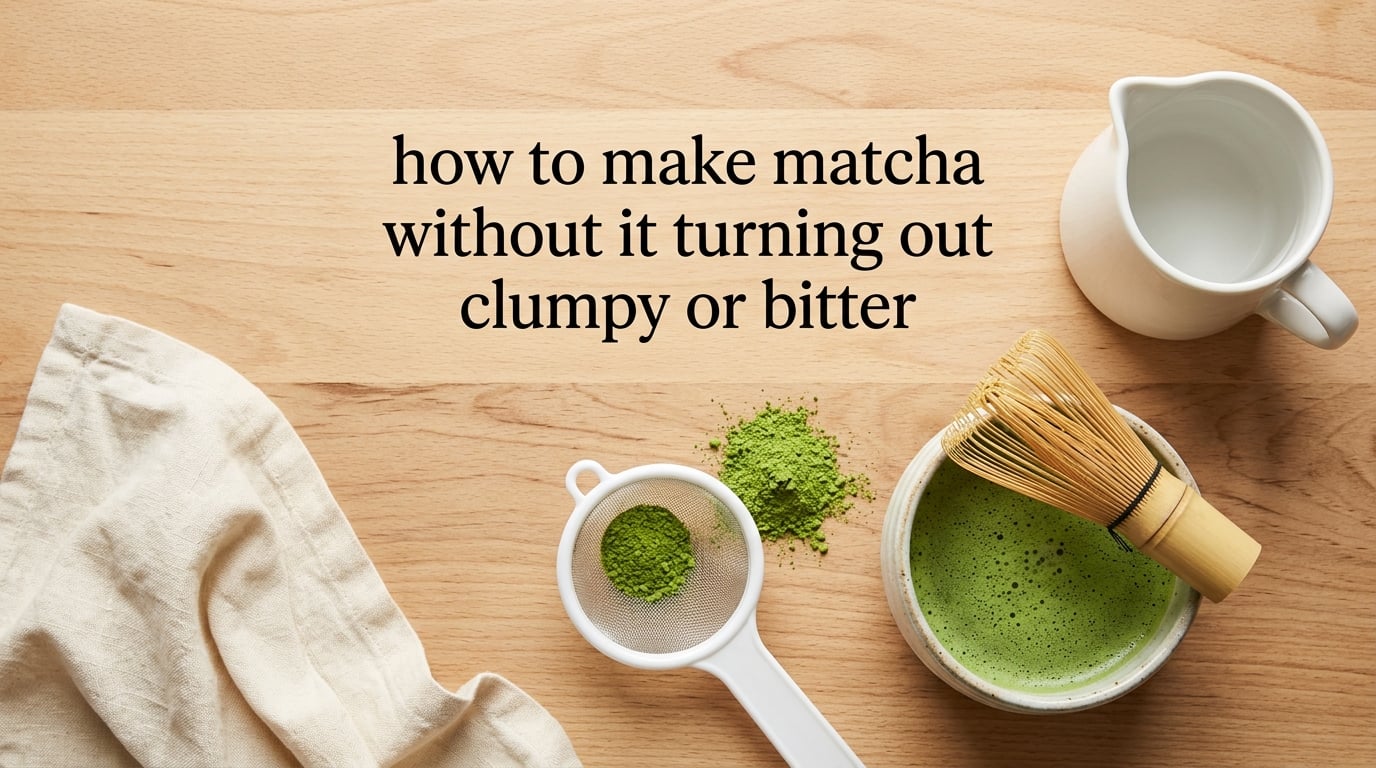
I have made more bad cups of matcha than I care to admit — gritty, bitter, sludge-at-the-bottom disasters that put me off green tea for a solid year. When I finally figured out how to make matcha without it turning out clumpy or bitter, the difference was so stark that I went back and tested 14 different powders to figure out which steps actually matter. This guide is what I wish someone had handed me on day one.
Table of Contents
Quick Answer: How to Make Matcha Without Clumping or Bitterness
To make matcha without clumps or bitterness, sift 1 to 2 grams (about 1/2 to 1 teaspoon) of matcha powder into a wide bowl, dissolve it in 30 ml (2 tablespoons) of warm water at 70 to 80 degrees C (158 to 176 degrees F) to form a smooth paste, then whisk briskly in a W or M motion for 15 to 20 seconds before diluting with more warm water or milk. Skip boiling water, skip dumping powder straight into a full cup, and skip stirring with a spoon.
That is the whole method in three sentences. The rest of this article explains why each rule exists, what to do when you do not have a bamboo whisk, and how to fix a cup that has already gone wrong.
Why Matcha Goes Wrong: The Two Failure Modes
Almost every bad cup of matcha comes from one of two failures: clumps that settle into a gritty sludge at the bottom, or bitterness that hits the back of your tongue like over-steeped green tea. They look like different problems but share the same root cause — you are treating matcha like instant coffee when it is actually closer to a finely ground spice.
Why Matcha Clumps (It Is a Suspension, Not a Solution)
Matcha powder is made from shade-grown tea leaves that have been stone-ground into particles as small as 5 to 10 microns. Those particles do not dissolve in water the way sugar or instant coffee does. They form a suspension — floating around in the liquid until gravity wins and they pile up at the bottom of your cup.
Three things make clumping worse: humidity in the canister causes powder to form micro-clumps before you even start, static charge makes the fine particles cling to each other and to the sieve, and adding powder to a full cup of water gives it nowhere to go except into a wet lump at the surface. Sifting breaks up the micro-clumps. The paste method (dissolving the powder in a small splash of water first) gives each particle a wet coating before it has to fight the rest of the liquid. Whisking adds the mechanical force needed to keep particles separated.
Why Matcha Tastes Bitter
Bitterness in matcha comes from catechins — the same bitter compounds found in green tea — and they extract fastest at high temperatures. Water above 85 degrees C (185 degrees F) over-extracts these compounds in seconds. Boiling water does it almost instantly.
The second cause of bitterness is over-dosing. More matcha in the same amount of water means each sip carries more extracted compounds. A 2 gram serving in 60 ml of water tastes balanced; the same 2 grams in 30 ml tastes harsh. The third cause is whisking too long or too aggressively — yes, it is possible to overdo it and pull bitter compounds out of the leaf.
On r/Matcha, one home brewer put it simply: the water temp really makes or breaks my matcha — using cooler water makes the matcha taste less bitter overall. That single change fixed more cups for me than any equipment upgrade.
Quick Visual Diagnostic: Is Your Matcha Fresh?
Before you even start whisking, look at the powder. Vibrant jade green signals fresh, properly stored ceremonial-grade matcha. Dull olive or yellowish green means oxidation has set in, and that powder will taste flat, grassy, or bitter no matter how well you whisk it. If your matcha smells like dried hay or seaweed rather than sweet umami, it is past its prime and no technique will rescue it.
How to Make Matcha Without Clumps or Bitterness (5-Step Method)
This is the method I now use every morning. It takes about 90 seconds once your water is at the right temperature.
Step 1: Warm Your Water to 70 to 80 degrees C (158 to 176 degrees F)
Bring water to a boil, then let it cool for 3 to 4 minutes. If you have a temperature-controlled kettle, set it to 75 degrees C (167 degrees F). The Japanese tea ceremony calls this yuzamashi — the deliberate cooling of boiling water to protect delicate leaves. Matcha never wants to see boiling water.
Step 2: Sift 1 to 2 Grams (1/2 to 1 Teaspoon) of Matcha
Place the powder in a fine-mesh sieve over your bowl or cup. For traditional usucha (thin tea), use 2 grams or about 1 teaspoon. For a starter cup or a stronger concentrate, use 1 to 1.5 grams or 1/2 to 3/4 teaspoon. Sifting does two things: it breaks up any micro-clumps that formed in storage, and it aerates the powder so it mixes in faster.
Step 3: Make a Smooth Paste With 30 ml (2 Tablespoons) of Warm Water
This is the most important step. Add just a small splash of your warm water to the sifted powder and stir with the tip of your whisk (or a small spoon) until you have a glossy, lump-free paste. Coffee people call this blooming. Matcha people call it the paste method. Same idea: give the powder a chance to hydrate evenly before adding more liquid.
Skip this step and you will spend the rest of the morning chasing clumps with your whisk.
Step 4: Whisk in a W or M Motion for 15 to 20 Seconds
Add another 60 to 70 ml of warm water (4 to 5 tablespoons), then whisk briskly in a W or M shape, dragging the whisk along the bottom of the bowl. This is the motion traditional tea masters use because it creates shear force without introducing too much air. You are not making a meringue — you want a fine, even microfoam on top, not big bubbles.
If you are using an electric frother, hold it against the bottom of the bowl and move it in small circles for about 10 seconds. If you are using a shaker bottle, add all the water at once, seal, and shake hard for 20 seconds.
Step 5: Dilute, Pour, and Drink Within 3 to 4 Sips
For traditional usucha, top up with another 30 to 50 ml of warm water to reach about 120 ml total. For a matcha latte, pour the paste-and-whisk concentrate into 180 to 240 ml of warmed milk. For an iced matcha latte, pour the concentrate over ice and cold milk.
Drink it within 3 to 4 sips if you can. Matcha is a suspension and the powder will start to settle within a few minutes even after perfect whisking. That is not a flaw — it is the nature of the drink.
What You Need: Tools for Smooth, Frothy Matcha
You do not need every piece of gear on this list. Pick the option that matches your budget and how often you actually drink matcha.
Bamboo Whisk (Chasen)
The traditional choice. A chasen has 80 to 120 fine tines carved from a single piece of bamboo, and the W motion works because those tines create thousands of tiny shear points. They cost very little and last 2 to 3 years with proper care (rinse in cold water only, no soap, dry tines-up). Beginners sometimes find them intimidating because they are delicate — rinse gently and do not press the tines against the bowl.
Electric Milk Frother
A handheld electric frother is the easiest swap for a bamboo whisk. Press it against the bottom of your bowl, move in small circles for 10 seconds, and you get a surprisingly good microfoam. The downside is less traditional crema and a slightly thinner mouthfeel, but for daily lattes it is the most beginner-friendly option. jadeleafmatcha specifically recommends blending matcha into a smaller amount of water first, then pouring into your drink — which works equally well with a frother.
Shaker Bottle
A small cocktail shaker or dedicated matcha shaker is the fastest option for iced drinks. Add sifted matcha, water, and ice, shake for 20 seconds, and pour. The downside is less control over foam texture and more cleaning. Best for on-the-go use.
Fork or Small Whisk (No Special Tools)
If you have none of the above, a regular kitchen fork works in a pinch. Make your paste in 30 ml of water, then whisk vigorously with the fork in a circular motion for 30 to 45 seconds. The result is not as silky as a chasen but it gets the clumps out. If you only make matcha occasionally, this is enough.
What About a Sieve?
If you do not have a matcha-specific sieve, a fine-mesh tea strainer or even a small flour sifter works. The goal is just to break up clumps before they hit the water. On r/tea, several users report success with a small stainless steel mesh tea ball — they pre-grind the matcha further by pressing the powder through the mesh with a spoon.
Three Matcha Recipes to Put the Method to Work
These ratios work with ceremonial or culinary grade. Adjust the powder amount to taste — start at the lower end and work up.
Traditional Usucha (Thin Tea)
This is the Japanese tea ceremony version. Clean, balanced, and the best way to taste your matcha.
- 2 grams (1 teaspoon) matcha, sifted
- 30 ml (2 tablespoons) warm water for the paste
- 70 ml (1/3 cup) warm water to finish
Sift, make a paste, whisk in a W motion for 15 seconds, top up with the rest of the water, whisk once more. Drink from a wide bowl (chawan) so the surface area helps aroma rise.
Hot Matcha Latte
For mornings when you want something creamier without the bitterness of an espresso roast.
- 2 grams (1 teaspoon) matcha, sifted
- 30 ml (2 tablespoons) warm water for the paste
- 180 to 240 ml (3/4 to 1 cup) warmed milk of choice
- Optional: 1 to 2 teaspoons honey, maple syrup, or simple syrup
Make the paste, whisk with 30 ml of water, then pour into warmed milk. Whole dairy milk froths best; oat milk is the closest non-dairy option. Sweeten to taste — matcha is naturally a little bitter and a small amount of sweetener rounds the flavor without overpowering it.
Iced Matcha Latte
The trick here is keeping the matcha from sinking and clumping at the bottom of the glass.
- 2 grams (1 teaspoon) matcha, sifted
- 60 ml (1/4 cup) warm water for the concentrate
- 180 ml (3/4 cup) cold milk
- Ice
Sift the matcha into a small jar, add the warm water, seal, and shake hard for 20 seconds. Pour over ice, top with cold milk, and stir once. Drink quickly or stir between sips, because iced matcha separates fast — the cold temperature slows the suspension and the ice melts unevenly.
Troubleshooting: Problem, Cause, Fix
If something still goes wrong, run through this matrix before giving up. Most problems have a one-step fix.
- Problem: Clumps floating or sinking. Cause: Skipped sifting or added powder straight to a full cup. Fix: Always sift first and use the paste method.
- Problem: Bitter or astringent taste. Cause: Water too hot (above 85 degrees C / 185 degrees F) or too much matcha for the water amount. Fix: Cool water to 75 degrees C and reduce powder by 0.5 grams.
- Problem: Matcha settles to the bottom in seconds. Cause: This is normal — matcha is a suspension. Fix: Drink within 3 to 4 sips, or pour through a fine strainer into the cup right before drinking.
- Problem: No foam on top. Cause: Whisked too gently or whisk tines are worn out. Fix: Whisk faster, or replace your chasen if the tines are bent.
- Problem: Grassy or hay-like taste. Cause: Powder is old or oxidized. Fix: Buy smaller tins more often, store in the fridge, and use within 4 to 6 weeks of opening.
- Problem: Weak or watery taste. Cause: Too much water for the dose. Fix: Increase matcha to 2.5 grams or reduce total water to 90 ml.
- Problem: Iced matcha separates from milk in seconds. Cause: Cold temperature collapses the suspension faster. Fix: Shake the concentrate with a small amount of warm water first, then pour over ice and milk.
Common Mistakes When Making Matcha (and How to Avoid Them)
These are the errors I see most often in home kitchens, including my own early attempts.
- Using boiling water. Anything above 85 degrees C (185 degrees F) extracts bitter compounds. Cool it for 3 to 4 minutes after boiling.
- Skipping the sift. Even fresh, high-grade matcha develops micro-clumps in the tin. Sifting takes 5 seconds and saves you a gritty cup.
- Adding powder straight to a full cup. The powder floats, hydrates unevenly, and forms clumps. Always start with a paste.
- Stirring instead of whisking. A spoon stirs; a whisk emulsifies. You need shear force, not circular motion.
- Whisking too long or too hard. Past 30 seconds you are over-extracting. Keep it to 15 to 20 seconds of brisk whisking.
- Storing matcha in the cupboard. Light, heat, and oxygen kill matcha fast. Store in an airtight tin in the fridge once opened.
- Buying too much at once. Matcha is best within 4 to 6 weeks of opening. Buy smaller tins more often.
- Using hard water. High-mineral water can mute flavor and add graininess. Filtered water is a noticeable upgrade.
Frequently Asked Questions
How to avoid clumpy matcha?
Sift the powder first, then dissolve it in 30 ml (2 tablespoons) of warm water at 70 to 80 degrees C (158 to 176 degrees F) to make a smooth paste before adding more liquid. Whisking in a W or M motion for 15 to 20 seconds keeps particles evenly suspended.
How to make matcha without it being bitter?
Use warm water between 70 and 80 degrees C (158 and 176 degrees F), never boiling. Stick to 1 to 2 grams of matcha per 120 ml total liquid, and whisk for only 15 to 20 seconds. Boiling water and over-dosing are the two biggest causes of bitterness.
What are the common mistakes when making matcha?
The most common mistakes are using boiling water, skipping the sift, adding powder straight to a full cup, stirring with a spoon instead of whisking, whisking too long, and storing matcha in a warm or sunny spot. Each one alone can ruin a cup.
How to remove bitterness from matcha?
If the cup is already made, dilute it with more warm water or milk and add a small amount of sweetener. Going forward, lower the water temperature to 75 degrees C and reduce the matcha dose by 0.5 grams.
How to make matcha without sifting?
You can press the powder through a fine-mesh strainer with the back of a spoon, or pre-mix it dry with a tiny pinch of sugar to break up clumps. The paste method with a small splash of water also helps even if you skip the sift.
Is it okay to drink clumpy matcha?
Yes, clumpy matcha is safe to drink — it just tastes gritty and may have concentrated bitter pockets where the powder did not dissolve. Sifting or using the paste method fixes the texture and gives a much smoother flavor.
Why does my matcha keep sinking to the bottom?
Matcha is a suspension, not a solution. Powder particles will always settle over time. Drink it within 3 to 4 sips, or pour through a fine strainer right before drinking to catch the settled powder.
How to dissolve matcha powder without a whisk?
Make a paste in 30 ml of warm water using a fork or small spoon, stirring until smooth. Then add the rest of the water and shake hard in a sealed jar for 20 seconds, or whisk vigorously with a fork for 30 to 45 seconds.
Final Thoughts on Smooth, Sweet Matcha
Learning how to make matcha without it turning out clumpy or bitter comes down to three rules: warm water at 70 to 80 degrees C (158 to 176 degrees F), sift the powder and dissolve it in a paste first, and whisk briskly in a W or M motion for 15 to 20 seconds. Everything else is refinement.
Start with a small dose, drink it within a few sips, and adjust from there. After a week of mornings, the muscle memory kicks in and you stop thinking about the steps entirely. That is when matcha becomes the easiest drink in your kitchen.