
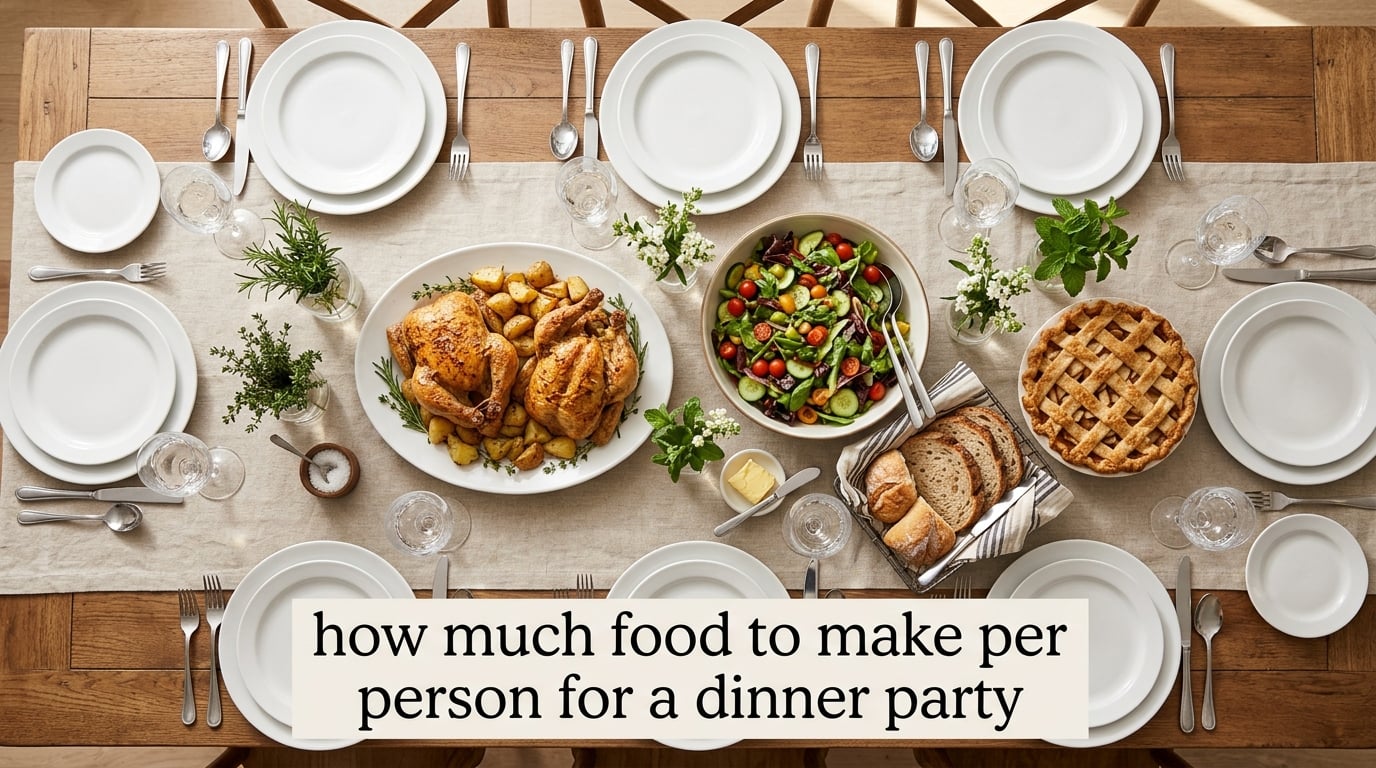
For a sit-down dinner party, plan about 1 pound of total food per adult (around 0.5 lb per child), broken down into roughly 6 to 8 ounces of cooked protein, 8 ounces of sides, 2 to 4 ounces of appetizers, and one dessert portion per guest. Multiply each per-person serving by your guest count, use cooked weight for proteins, and adjust upward by 10 to 15 percent for buffets, big eaters, or holiday meals.
I’ve hosted dinner parties for six people and for thirty, and the math is the same: once you know the per-person servings, scaling up is just multiplication. This guide gives you the exact numbers caterers use, the raw-versus-cooked conversions home cooks forget, and a quick-reference table for the most common dinner party sizes. You’ll also get adjustments for kids, vegetarians, and buffet-style service, plus a make-ahead timeline so you spend less time stressed and more time at the table.
Table of Contents
The Quick Rule: 1 Pound of Food Per Adult
The catering industry has used the same rule of thumb for decades: about 1 pound of total food per adult, and 0.5 pound per child under twelve. That single number is your anchor, and every other portion in this guide rolls up to it.
Here is how a 1-pound-per-adult dinner breaks down by weight:
- 6 to 8 ounces of cooked protein (meat, fish, or vegetarian main)
- 6 to 8 ounces of sides, split between starch and vegetable
- 2 to 4 ounces of appetizers, if served
- 1 dessert portion (a slice of cake, a scoop of ice cream, a cookie or two)
- 1 to 2 bread rolls, plus butter
If you skip a course, redistribute its weight into the others. A no-appetizer dinner party pushes the protein and sides up. A heavy-hors d’oeuvres cocktail evening drops the main course to about 4 ounces per person and increases appetizers to 8 to 10 pieces per hour.
Per-Person Serving Sizes by Course
Use this table as your default reference. All weights are cooked weight unless the row says otherwise. Pick the row that matches your menu and multiply by your guest count.
| Course | Per Adult | Per Child (under 12) |
|---|---|---|
| Main protein (cooked) | 6 to 8 oz (170 to 225 g) | 3 to 4 oz (85 to 115 g) |
| Starch side (potatoes, rice, pasta) | 4 to 6 oz (115 to 170 g) | 2 to 3 oz (55 to 85 g) |
| Vegetable side | 4 oz (115 g) | 2 oz (55 g) |
| Salad | 2 to 3 oz (55 to 85 g) | 1 to 2 oz (28 to 55 g) |
| Appetizer (sit-down dinner) | 2 to 4 oz, about 3 to 5 bites | 1 to 2 oz, about 2 bites |
| Bread / rolls | 1 to 2 rolls | 1 roll |
| Butter | 1 to 1.5 tbsp | 0.5 tbsp |
| Dessert | 1 portion or slice | 0.5 portion |
| Coffee (after dinner) | 1 cup | 0.5 cup or none |
| Water (still or sparkling) | 2 cups (500 ml) | 1 cup (250 ml) |
One quick note on units: 1 ounce equals about 28 grams, and 16 ounces make 1 pound. If you cook with metric measurements, 1 pound is roughly 450 grams. Most European recipes already work in grams, which makes scaling easier.
Appetizer Portions Per Person
Appetizer math depends on whether the appetizers replace a meal or precede one. A cocktail party with no plated main needs 8 to 10 hors d’oeuvres per guest per hour. A sit-down dinner with appetizers only needs 3 to 5 pieces per guest total, served in the first 30 to 45 minutes.
For a dinner party of 8 with appetizers served before a plated main, plan 32 to 40 total bites, divided across 2 to 3 varieties. Reddit’s r/Cooking community consistently lands on 3 pieces per person when 2 to 3 varieties are on offer, which lines up with my own experience hosting.
If you’re doing a DIY cheese or charcuterie board instead of passed appetizers, plan 2 to 3 ounces of cheese per person and 1 to 2 ounces of cured meat per person. Add 1 ounce of crackers per guest, plus a small bowl of nuts and fruit.
Main Course Protein Portions
Protein is where most home cooks miscalculate, because grocery store prices are on raw weight, not cooked weight. A 6-ounce cooked steak starts as about 8 to 9 ounces raw. A whole roasted chicken loses roughly 25 percent of its weight during cooking. Bone-in cuts lose more than boneless.
Use this conversion table when you are buying protein:
| Protein | Cooked Per Person | Buy Raw Per Person |
|---|---|---|
| Boneless chicken breast | 6 oz | 8 oz (0.5 lb) |
| Bone-in chicken (whole or parts) | 6 oz cooked meat | 10 to 12 oz raw |
| Boneless beef roast or steak | 6 to 8 oz | 8 to 10 oz |
| Bone-in pork loin or shoulder | 6 oz cooked | 9 to 10 oz raw |
| Whole fish (gutted, head on) | 6 oz fillet | 12 to 14 oz whole |
| Fish fillet or salmon | 6 oz | 7 to 8 oz |
| Shrimp, peeled | 6 oz | 6 oz (no change) |
| Dry pasta (cooked weight 3 oz) | 3 oz cooked | 1.5 to 2 oz dry (about 90 g) |
| Tofu or tempeh | 5 to 6 oz | 5 to 6 oz |
For an 8-person dinner party with one protein, buy roughly 4 to 5 pounds of raw boneless meat, or 5 to 6 pounds raw if it is bone-in. That’s the math that prevents the mid-party “we ran out of chicken” moment.
Side Dish, Salad, and Starch Portions
Sides do most of the volume work on a dinner plate. Plan two sides for a sit-down dinner: one starch (potatoes, rice, pasta, polenta) and one vegetable. Add a salad only if it replaces one of those, or if your menu is three courses.
Per person, you’ll need 4 to 6 ounces of starch and 4 ounces of vegetable. For a dinner party of 10, that’s about 3 to 4 pounds of cooked starch and 2.5 pounds of cooked vegetables. If you are serving a grain salad like farro or quinoa, treat it as the starch and skip a separate vegetable side if you have another cooked vegetable on the menu.
For bread, plan 1 to 2 rolls or slices per person. A standard baguette serves about 6 to 8 people. Butter goes at 1 to 1.5 tablespoons per person, which is one stick of butter (8 tablespoons) covering 5 to 8 guests.
Dessert Portions Per Person
Dessert is the easiest course to plan because guests either take a slice or they don’t. Plan for one portion per adult and a half portion per child, and you’ll rarely run out.
Here are the portion sizes that translate to grocery and bakery math:
- Whole pie (9 inch, 8 slices): 1 pie per 6 to 8 guests
- Sheet cake (9×13, serves 12 to 15): 1 pan per 12 to 15 guests
- Layer cake (8 inch round, 10 to 12 slices): 1 cake per 10 to 12 guests
- Ice cream (1.5 quart container): about 10 to 12 scoops, so 1 container per 10 guests
- Cookies or petit fours: 2 to 3 per person
- Tart or cheesecake (10 inch): 12 slices, 1 per 10 to 12 guests
If you are serving a plated dessert and a cheese course, scale dessert down to a half portion and offer 1 ounce of cheese per person instead of 2.
Drinks: Wine, Beer, and Non-Alcoholic Quantities
Drink math is the course that catches hosts off guard. The standard rule from caterers and event planners is 2 drinks per guest in the first hour, and 1 drink per guest every hour after that. A 4-hour dinner party with 10 guests needs roughly 50 drinks total, split across wine, beer, and non-alcoholic options.
For wine specifically, plan 1 bottle per 2 guests for a wine-forward dinner (about 5 glasses per 750 ml bottle). That means 4 bottles for 8 people, 5 bottles for 10 people, and 6 bottles for 12 people. For a mixed drink crowd, 1 bottle of wine per 3 guests covers most people.
Beer goes at 2 to 3 per person over the course of an evening. For 10 guests, buy a 12-pack and you’ll have a couple left over. If your crowd prefers cocktails, plan 2 to 3 mixed drinks per guest and stock accordingly.
Non-alcoholic drinks are easy to overlook. Plan 2 cups of water per person (still and sparkling combined), 1 to 2 soft drinks per guest for non-drinkers, and a coffee cup per person if you’re serving after-dinner coffee. One 12-cup coffee maker handles 10 to 12 guests with one full pot.
Time of day matters here. An afternoon or brunch dinner party drinks about a third less alcohol than an evening event. A late-night supper drinks about the same as evening, but guests drink faster in the first hour.
Quick-Reference Table for 6, 8, 10, 12, and 20 Guests
This is the table most competitors skip. Most party calculators only serve 25, 50, or 100 guests. Here is what you actually need for an intimate dinner party:
| Item | 6 guests | 8 guests | 10 guests | 12 guests | 20 guests |
|---|---|---|---|---|---|
| Total food (cooked) | 6 lb | 8 lb | 10 lb | 12 lb | 20 lb |
| Cooked protein (6 to 8 oz each) | 2.5 to 3 lb | 3 to 4 lb | 4 to 5 lb | 5 to 6 lb | 8 to 10 lb |
| Raw boneless protein to buy | 3 to 3.75 lb | 4 to 5 lb | 5 to 6.25 lb | 6.25 to 7.5 lb | 10 to 12.5 lb |
| Starch side (cooked) | 1.5 to 2.25 lb | 2 to 3 lb | 2.5 to 3.75 lb | 3 to 4.5 lb | 5 to 7.5 lb |
| Vegetable side (cooked) | 1.5 lb | 2 lb | 2.5 lb | 3 lb | 5 lb |
| Salad (mixed greens) | 9 oz | 12 oz | 15 oz | 1.25 lb | 2 lb |
| Appetizer bites (sit-down) | 18 to 30 | 24 to 40 | 30 to 50 | 36 to 60 | 60 to 100 |
| Bread rolls | 6 to 12 | 8 to 16 | 10 to 20 | 12 to 24 | 20 to 40 |
| Butter | 6 to 9 tbsp | 8 to 12 tbsp (1 to 1.5 sticks) | 10 to 15 tbsp | 12 to 18 tbsp | 20 to 30 tbsp (2.5 to 4 sticks) |
| Dessert portions | 6 | 8 | 10 | 12 | 20 |
| Wine bottles (750 ml) | 3 | 4 | 5 | 6 | 10 |
| Beer (12-pack coverage) | 1 (with extras) | 1 | 1 | 1 to 2 | 2 |
| Sparkling or still water (1 L) | 3 | 4 | 5 | 6 | 10 |
Multiply the per-person serving by your actual guest count. If your head count is between two of these rows, round up to the next size. Better to have a small leftover than a guest who leaves hungry.
Adjustments: Buffet, Kids, Big Eaters, and Dietary Needs
The base numbers assume a sit-down dinner with mixed adults of average appetites. The moment your party changes, the math changes with it. Here are the multipliers experienced hosts and caterers actually use.
Buffet vs Sit-Down
Buffet service runs about 10 to 15 percent more food than plated service. Guests serve themselves generously, take seconds, and the visual abundance of a buffet encourages larger portions. Plan 1.1 to 1.15 pounds of total food per adult for a buffet. If your buffet runs longer than 90 minutes, lean toward 1.25 pounds.
Kids at the Table
Children under 12 eat about half what adults eat, but they often want their own smaller portion of everything on the menu. Plan 0.5 pound of total food per child, including a small protein, a small starch, and a small dessert. Teenagers eat closer to adults, so adjust upward if your dinner party includes a hungry 15-year-old.
Big Eaters and Athletes
If your guest list includes a few people who eat noticeably more, add 2 to 3 ounces of protein and 2 ounces of starch for each big eater. The same rule applies if you’re hosting a post-sports dinner or a working crowd that skipped lunch.
Vegetarian and Vegan Guests
Vegetarian and vegan mains often need larger volume per person because plant proteins are less calorie-dense than meat. Plan 7 to 9 ounces of cooked vegetarian protein per adult (tofu, tempeh, beans, lentils, seitan), and add an extra 2 ounces of starch or grain to round out the plate. Vegan guests typically eat the same volume as vegetarians; just skip the dairy and eggs.
Gluten-Free Guests
Gluten-free guests don’t need extra volume, but they need a clearly safe starch. Set aside rice, potatoes, or quinoa before any wheat-based ingredient touches the pan. One pound of gluten-free pasta cooks the same as wheat pasta, but the noodles clump faster, so time it separately.
Make-Ahead Timeline and Leftover Planning
Stress at a dinner party usually comes from doing too much on the day of the event. Here’s the timeline I use when hosting 6 to 12 guests, and the same timeline works for any size:
| When | What to Prep |
|---|---|
| 2 days before | Shop for non-perishables, defrost protein in the fridge, marinate if using |
| 1 day before | Make dessert, prep salad dressings, chop vegetables, brine or salt protein |
| Day of, morning | Set the table, prep appetizers, roast vegetables that reheat well |
| 1 to 2 hours before | Cook the protein to 80 percent done, finish sauces, chill wine and beer |
| Reheat sides, finish protein in the oven, plate cold appetizers | |
| After dinner | Pack leftovers within 2 hours, label and refrigerate |
On the leftover question: cook intentionally for leftovers if your menu allows it. Soups, braises, pasta sauces, and roasted vegetables improve overnight. Plan 1.5 pounds of total food per adult if you want a clean next-day lunch out of it, which is the strategy food writers like the Food52 host have made a habit of.
Sample 8-Person Dinner Party Menu With Quantities
To put all of this into practice, here is a worked example for an 8-guest sit-down dinner party with one appetizer, one protein, two sides, a salad, bread, and dessert.
- Appetizer: cheese and charcuterie board. 1.5 lb cheese, 0.75 lb cured meat, 8 oz crackers, small bowl of olives and nuts.
- Main: roasted chicken (bone-in). Buy a 5 to 6 lb chicken, which yields about 3 lb cooked meat, enough for 6 to 8 oz per person.
- Starch side: 2 lb of potatoes (about 6 medium russets), roasted.
- Vegetable side: 2 lb of green beans or asparagus, enough for 4 oz per guest.
- Salad: 12 oz mixed greens with a simple vinaigrette.
- Bread: 1 baguette (about 12 oz), sliced, with 1 stick of butter.
- Dessert: 1 nine-inch apple pie (8 slices, 1 per guest).
- Drinks: 4 bottles of wine, 1 twelve-pack of beer, 4 liters of sparkling water, coffee for those who want it.
This menu totals about 8 lb of cooked food for 8 guests, hitting the 1-pound-per-adult target with a small leftover buffer for the chicken and potatoes.
Frequently Asked Questions
How much food do I need for a party of 25 people?
For a sit-down dinner party of 25 guests, plan about 25 pounds of total cooked food. That breaks down to roughly 10 to 12 pounds of cooked protein, 8 pounds of starch sides, 6 pounds of vegetable sides, 75 to 125 appetizer bites, 2 to 3 pies or 2 sheet cakes for dessert, and 12 to 13 bottles of wine plus a case of beer.
How much food do I need for 100 guests?
For 100 guests, plan around 100 pounds of cooked food total. That includes 38 to 50 pounds of cooked protein (50 to 63 lb raw boneless), 25 pounds of starch sides, 25 pounds of vegetable sides, 600 to 800 appetizer portions, 8 to 10 pies or 7 to 8 sheet cakes, 50 bottles of wine, and 8 to 10 cases of beer.
What is a good meal to feed a large crowd of 20 people?
A reliable menu for 20 people is a roasted protein with two sides and a salad. Plan 10 to 13 pounds of raw boneless protein (or 13 to 16 lb bone-in), 7 to 10 pounds of starch, 5 pounds of vegetables, 2.5 pounds of salad greens, 60 to 100 appetizer bites, 20 dessert portions, and 10 bottles of wine.
How much food for 20 guests?
For a sit-down dinner party of 20 guests, plan 20 pounds of cooked food. That breaks down to 8 to 10 pounds cooked protein, 5 to 7.5 pounds starch, 5 pounds vegetables, 60 to 100 appetizer bites, 20 dessert portions, 10 bottles of wine, and 2 cases of beer.
How much finger food for 40 guests?
For a cocktail party of 40 guests over 2 hours, plan 640 to 800 finger food pieces total (8 to 10 per guest per hour). Spread that across 4 to 6 varieties for visual variety, and add 20 bottles of wine plus 4 cases of beer. Skip the plated main if finger food is the entire meal.
How many trays of food do I need for 20 guests?
A standard full-size catering tray (about 9 by 13 inches) serves 8 to 10 guests as a side, or 5 to 6 guests as a main. For 20 guests, plan 2 trays of protein and 2 to 3 trays of sides for a sit-down dinner, or 4 to 5 trays total if it’s a buffet with a mix of mains, sides, and salads.
How much food to make for a party calculator?
Use this formula: total food in pounds equals number of adults plus half the number of children. Then split that total into 30 percent cooked protein, 35 percent starch sides, 25 percent vegetable sides, and 10 percent appetizers and extras. Multiply by 1.1 for buffets and 0.75 for cocktail-only events.
Is there a free catering food calculator app?
Yes. The Save The Food Guestimator is a free online calculator that handles appetizers, mains, sides, and drinks for any guest count. For spreadsheet users, the USDA’s portion planning guide and most catering association templates work as free offline calculators once you fill in your guest count.
Final Thoughts on Dinner Party Quantities
The math behind how much food to make per person for a dinner party is shorter than it feels. One pound per adult, broken into 6 to 8 ounces of cooked protein, 8 ounces of sides, a dessert, and 2 to 4 ounces of appetizers if you’re serving them. Multiply by your guest count, use raw weight when you shop, and round up by 10 to 15 percent for buffets or big eaters. Once you have those numbers, hosting stops being guesswork and becomes a recipe you can actually plan around.
Pick your menu, count your guests, and run the per-person servings down the columns of the quick-reference table above. You’ll know exactly what to buy, and you’ll walk into your dinner party confident that the food will land.