
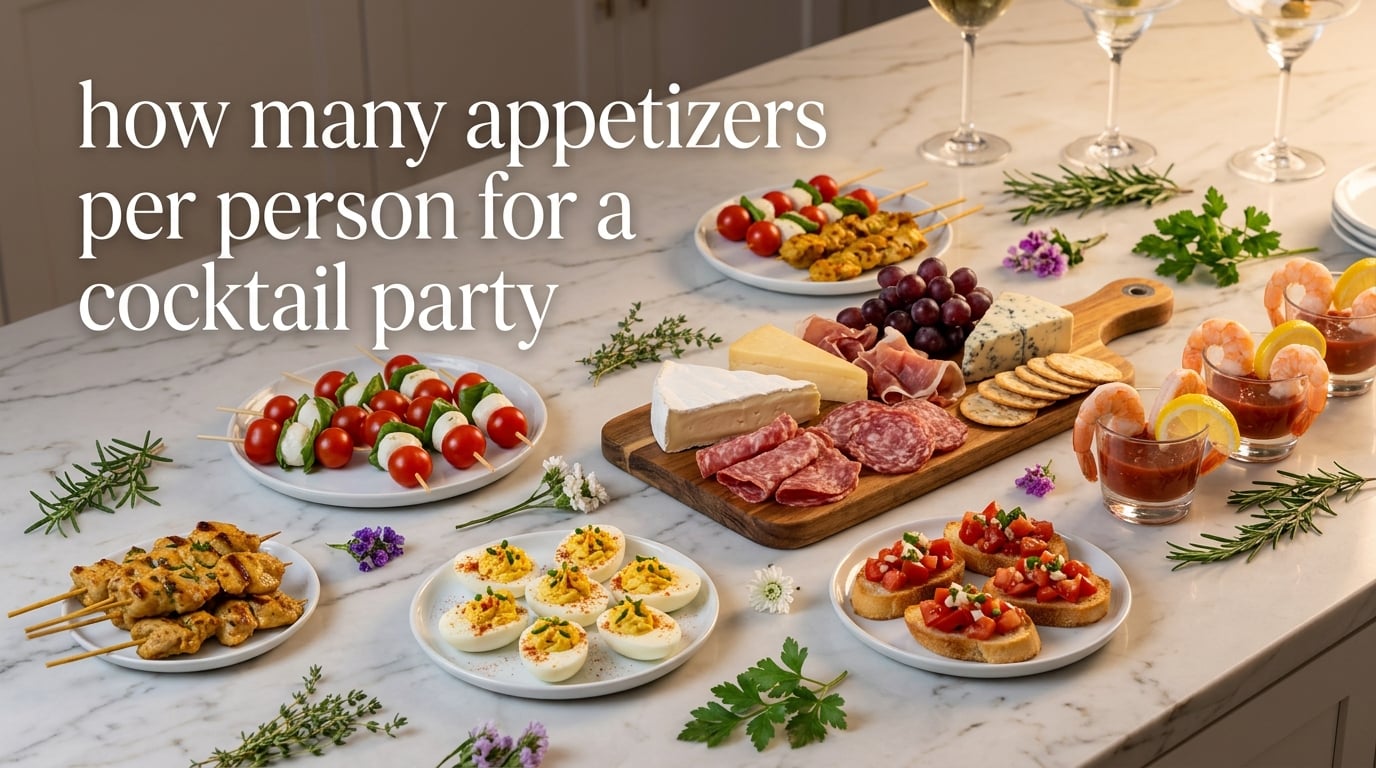
For a standard 2-hour cocktail party where appetizers replace a full meal, plan on 8 to 12 appetizer pieces per person. That single number is the rule of thumb every caterer I’ve worked with uses as a starting point, and it is what the top-ranking guides for “how many appetizers per person for a cocktail party” all converge on. The exact figure shifts based on event length, whether dinner follows, how the food is served, and your guest list, which is why the rest of this guide exists.
I host at least six cocktail-style events a year and have planned menus for 20-person house parties, 100-guest weddings, and corporate receptions in between. The math below is what I wish someone had handed me the first time I had to feed 75 people standing up with no dinner following. We will cover the headline rule, per-event-length breakdowns, service-style multipliers, a quick calculator for your guest count, and the small adjustments (alcohol, kids, weather, dietary restrictions) that change the total by 10-15% in either direction.
Table of Contents
How Many Appetizers Per Person for a Cocktail Party? The Headline Rule
Plan 8 to 12 appetizer pieces per person for a standard 2-hour cocktail party. If no meal follows, lean toward 12. If a full dinner is served afterward, drop to 3 to 5 pieces per guest. Every catering guideline I have read, from Messina’s Catering to Canapés USA to Better Homes & Gardens, lands within this range.
The reason the range is wide is that “cocktail party” covers several very different events. A 90-minute pre-dinner reception needs far less food than a 4-hour open house where guests graze all evening. Once you answer three questions, the math becomes simple:
- How long is the event?
- Is a meal being served afterward?
- Will food be passed on trays, set out on a buffet, or displayed at stations?
Those three answers give you a baseline count. From there, you stack adjustments: alcohol being served (add 10-15%), outdoor summer heat (subtract 5-10%), children in attendance (count kids as roughly half an adult), and dietary restrictions (plan one vegetarian and one vegan option regardless of guest count). Walk through the next sections in order and the right number for your event becomes obvious.
Appetizers Per Person by Event Length
Event length is the single biggest variable. Most catering guides, including Miss Vickie’s calculator and Canapés USA’s portion table, scale pieces per person by hours rather than guest count, because guests eat at a predictable pace of 4-6 bites per hour once you account for service style. Here is the per-hour breakdown that I use as my starting point for any cocktail party:
| Event Length | Pieces Per Person (Baseline) | Front-Loaded First Hour | Each Additional Hour |
|---|---|---|---|
| 1 hour (quick toast or pre-dinner mingling) | 4 to 6 pieces | 5 pieces | n/a |
| 2 hours (standard cocktail party) | 8 to 12 pieces | 5 pieces | 3 pieces |
| 3 hours (extended reception) | 10 to 15 pieces | 5 pieces | 3 pieces |
| 4+ hours (open house, grazing event) | 14 to 20 pieces | 5 pieces | 3-4 pieces |
The “front-loaded first hour” column matters more than people realize. Hosts in wedding forums consistently report that the first 45 minutes of any cocktail event is when guests eat the most, because they have just arrived, drinks are flowing, and the buffet looks fresh. After that first rush, consumption drops by about a third. Plan accordingly: load the trays heavily for the opening, then refill at a steady pace.
For 4-hour-plus events, the math shifts because you are no longer running a true cocktail hour; you are running an appetizer-only event or a heavy hors d’oeuvres reception. Plan 14 to 20 pieces per person for that scenario, and lean toward the higher number if no meal follows at any point. Forums.theknot.com threads on 4-5 hour dinner-time parties confirm that anything below 14 pieces leaves guests hungry by hour three.
Pieces Per Person by Meal Context
Whether a full meal follows changes everything. A cocktail party where guests will sit down to a plated dinner 30 minutes later is a very different animal from a cocktail party that replaces dinner entirely. Here is how the count shifts:
| Meal Context | Pieces Per Person | Typical Duration | Notes |
|---|---|---|---|
| Pre-dinner mingling (full plated meal follows) | 3 to 5 pieces | 30-60 minutes | Enough to take the edge off; focus on 2-3 light bites |
| Cocktail-only event (light meal or no meal follows) | 8 to 12 pieces | 2 hours | The standard cocktail party; this is the headline rule |
| Heavy hors d’oeuvres / appetizer-as-meal | 12 to 15 pieces | 2-3 hours | Substantial, filling options; mix of proteins and starches |
| Open house / extended grazing (no meal at any point) | 14 to 20 pieces | 4+ hours | Plan refill points; rotate dishes every 90 minutes |
Pre-dinner mingling is the easiest scenario to misjudge because the temptation is to over-feed. Guests know dinner is coming, they pace themselves, and they will only graze on a handful of items. Stick to 3-5 pieces per person and choose light, one-bite options: olives, marinated cheeses, deviled eggs, shrimp cocktail, simple crostini. Anything heavier than that competes with the meal and wastes budget.
Cocktail-only events and heavy hors d’oeuvres events look similar on paper but require different food choices. A standard 2-hour cocktail party can lean 60% light and 40% substantial. A heavy hors d’oeuvres event needs the inverse: 40% light bites to start, 60% substantial fillings (sliders, beef wellington bites, stuffed mushrooms, bacon-wrapped scallops) so guests actually leave full. Messina’s Catering runs their all-appetizer menus as a five-course progression for exactly this reason.
Service Style Multipliers: Passed Trays, Buffet, Stations, Grazing Table
How you serve the food changes the count, because guests eat differently depending on whether they have to walk to the food or whether the food walks to them. Here are the multipliers I apply to the baseline pieces-per-person number once I know the service style:
| Service Style | Multiplier vs Buffet Baseline | Why the Change |
|---|---|---|
| Buffet table (self-serve) | Baseline (1.0x) | Guests serve themselves; some over-serve, others under-serve |
| Passed trays (waitstaff circulating) | +10% (1.10x) | Servers offer; guests more likely to accept a second piece |
| Food stations (2-3 themed setups) | +6% (1.06x) | Slight bump; guests browse but only take what looks good |
| Grazing table (large spread, self-serve) | -5% (0.95x) | Visual abundance encourages restraint; grazing peaks early then drops |
| Carving or action station (chef-served) | +8% (1.08x) | Performance element drives second helpings |
Passed trays consistently require 10% more food than a buffet, according to both Canapés USA and Miss Vickie’s reference tables. The reason is straightforward: when a server walks up with a tray and makes eye contact, guests accept a piece even if they weren’t planning to take one. Multiply your baseline by 1.10 for any event where the majority of food will be passed.
Grazing tables are the inverse trick. A large, visually abundant spread actually suppresses consumption slightly, partly because guests feel they’ve “already seen” everything and partly because grazing is a slow, picking-at-food activity rather than a build-a-plate activity. If you are building a charcuterie-and-cheese grazing table as the centerpiece of a 2-hour event, plan on the lower end of the 8-12 pieces-per-person range. You will likely have leftovers, which is the right problem to have with a grazing table.
Quick Calculator: Pieces Needed by Guest Count
Once you know your pieces-per-person baseline, multiply by your guest count. Here is a quick reference table covering the most common party sizes, assuming a standard 2-hour cocktail party with the 10-piece midpoint and no adjustments:
| Guest Count | Light (8 pp) | Standard (10 pp) | Generous (12 pp) | Heavy Hors (15 pp) |
|---|---|---|---|---|
| 10 guests | 80 pieces | 100 pieces | 120 pieces | 150 pieces |
| 20 guests | 160 pieces | 200 pieces | 240 pieces | 300 pieces |
| 30 guests | 240 pieces | 300 pieces | 360 pieces | 450 pieces |
| 50 guests | 400 pieces | 500 pieces | 600 pieces | 750 pieces |
| 75 guests | 600 pieces | 750 pieces | 900 pieces | 1,125 pieces |
| 100 guests | 800 pieces | 1,000 pieces | 1,200 pieces | 1,500 pieces |
| 150 guests | 1,200 pieces | 1,500 pieces | 1,800 pieces | 2,250 pieces |
For a 20-person cocktail party, the standard column gives you 200 pieces total, which is roughly 6-7 pieces per type if you offer three appetizers, or 4-5 pieces per type if you offer five. The math works the same whether your event has 10 people or 150. Pick your column based on context, multiply by guest count, then divide across however many varieties you plan to serve.
One practical rule of thumb: round up by 5-10% to cover the waste buffer. Reddit threads on r/weddingplanning are unanimous that hosts would rather have leftovers than run out of food mid-event. Plan for 5% buffer if you have a precise head count, 10-15% if RSVPs are fuzzy. Empty trays at minute 75 of a 2-hour party is the social disaster you are trying to avoid.
How Many Different Appetizer Types to Offer
Variety matters more than volume once you cross about 30 guests. A 10-person cocktail party with 3 appetizers feels generous; a 100-person cocktail party with 3 appetizers feels like a supply shortage, because lines form and trays empty fast. The general guideline, which Messina’s Catering uses and wedding-planning forums confirm, scales variety with guest count:
| Guest Count | Number of Different Appetizers | Variety Mix Suggestion |
|---|---|---|
| 10-15 guests | 4 to 5 appetizers | 2 proteins, 1 vegetarian, 1-2 light bites |
| 20-30 guests | 6 to 8 appetizers | 3 proteins, 2 vegetarian, 1 vegan, 1-2 light bites |
| 50 guests | 10 to 13 appetizers | 4 proteins, 3 vegetarian, 1 vegan, 1 gluten-free, 2-3 light bites |
| 75-100 guests | 14 to 17 appetizers | 5 proteins, 4 vegetarian, 2 vegan, 1 gluten-free, 3 light bites |
| 150+ guests | 18 to 22 appetizers | 6+ proteins, 5 vegetarian, 2 vegan, 1 gluten-free, 4+ light bites |
The mix column matters as much as the count. Aim for at least one vegetarian and one vegan option regardless of guest count, because you will always have at least one guest who is vegetarian and another who has gone vegan since you last saw them. If your guest list includes anyone with a known gluten sensitivity, add a gluten-free option too, even if it is just a crudités platter with a tahini-based dip.
Variety also affects how the event feels. A party with 8 different appetizers reads as abundance. A party with 3 different appetizers in large quantities reads as institutional. For cocktail events specifically, perceived abundance is part of the experience. Err toward more types and slightly smaller per-type quantities rather than fewer types and larger trays.
Adjustments That Change the Number
The baseline pieces-per-person is your starting point, but real events have variables that move the count up or down by 5-15%. Here are the most common adjustments, with the multiplier to apply to your baseline number:
| Adjustment | Multiplier | When to Apply |
|---|---|---|
| Alcohol being served (open bar or hosted wine/beer) | +10% to +15% | Always when drinks are flowing; alcohol increases consumption |
| Late afternoon event (3-5 pm, before dinner) | Baseline to +5% | Late afternoon is peak snack time; guests are hungry |
| Evening event (7-10 pm) | Baseline | Evening appetites are predictable; baseline works |
| Lunch-time event (11 am-1 pm) | -5% | Lunch-time guests eat lighter; they know a meal is coming |
| Younger crowd (20s-30s, networking or party) | +10% to +15% | Younger guests eat more per hour, especially with drinks |
| Older crowd (60+) | -10% | Older guests eat less and prefer lighter options |
| Children attending (count as half adult) | 0.5x per child | Standard rule; adjust for actual age distribution |
| Outdoor summer event (heat above 85 F) | -5% to -10% | Heat suppresses appetite; plan cooler, refreshing options |
| Winter indoor event (cold weather) | +5% | Cold weather increases appetite; lean toward hot options |
| Vegetarian-heavy guest list | No change to count, change to mix | Increase vegetarian options to 40-50% of total varieties |
| Multiple dietary restrictions | +1-2 options, baseline count | Add vegan, GF, nut-free options without raising per-person count |
| Uncertain headcount (fuzzy RSVPs) | +5% to +15% buffer | Add buffer; running out is worse than leftovers |
The alcohol adjustment is the one that gets missed most often, and it matters. Caterers report that open-bar events run 10-15% higher consumption than dry events. Plan for it, especially at wedding cocktail hours where guests are drinking steadily for 90+ minutes.
The children adjustment is also worth quantifying. The common rule across wedding forums is to count each child as half an adult when planning appetizers, then skew the kid options toward simpler finger foods (chicken tenders, mini sliders, fruit skewers, cheese cubes) rather than sophisticated canapés. A 50-guest party with 10 kids is effectively 45 adult equivalents, which puts you at 360-450 pieces for a 2-hour cocktail party rather than 400-500.
Dietary restrictions don’t usually change the total count, but they change the variety mix. If you have a confirmed vegan count of 5+ guests, plan at least 2 vegan options. If gluten-free guests are confirmed, add a gluten-free option that is naturally GF (crudités, most shrimp cocktails, caprese skewers) rather than trying to make a gluten-free version of something that isn’t.
Cost Per Guest Budgeting
Cost per guest varies wildly based on whether you cook from scratch, hire a caterer, or do a hybrid. As a rough planning guide for 2026 events:
| Tier | Cost Per Guest | What You Get |
|---|---|---|
| Budget (DIY / grocery store) | Lowest tier | Store-bought apps, cheese boards, vegetable platters, simple hot items |
| Mid-range (mixed DIY + a few specialty items) | Moderate tier | Homemade with 1-2 premium ingredients (good cheese, charcuterie, seafood) |
| Premium (catered or full homemade premium) | Highest tier | Wagyu sliders, seafood towers, premium charcuterie, made-to-order stations |
For a 50-person 2-hour cocktail party at the mid-range tier, expect to spend in the moderate range per guest, which translates to a total event budget in the moderate thousands range. The premium tier roughly doubles that, and the budget tier comes in at roughly half. These are planning ballparks, not quotes; actual prices vary by region, season, and how much you cook yourself.
Two ways to stretch budget without lowering quality: cut variety and bump portion size (fewer types, more of each), or move from a 4-hour open house to a 2-hour cocktail party (less time, less food, less cost). Both keep the event itself intact while lowering the line item.
Popular Cocktail Party Appetizer Ideas
For a crowd-pleaser cocktail party menu, mix one hot substantial, one cold substantial, two-to-three lighter bites, and one showstopper. Here are the categories and named picks that consistently work:
- Skewers (caprese, antipasto, shrimp and pineapple, beef satay): Easy to eat standing up, easy to prep ahead, visually appealing on a tray. Skewers consistently rank as a top crowd-pleaser in catering guides.
- Charcuterie and cheese board: Works as both a grazing centerpiece and a passed item. Plan 2-3 ounces of cheese per guest plus a rotating selection of cured meats.
- Bruschetta and crostini: Tomato bruschetta, mushroom crostini, whipped ricotta with honey. Endlessly customizable, vegetarian-friendly, cheap to make in volume.
- Shrimp cocktail: The classic cocktail party appetizer for a reason. Plan 2-3 large shrimp per guest if it’s the only seafood option, 1-2 if you’re serving other proteins.
- Mini quiches and deviled eggs: Two-bite substantial options that hold well at room temperature for 60-90 minutes. Deviled eggs especially are a low-cost crowd-pleaser.
- Stuffed mushrooms and bacon-wrapped scallops: Hot substantial options that feel premium without requiring a professional kitchen. Both reheat well in a low oven.
- Bite-sized sliders and beef wellington bites: For an appetizer-as-meal event, these are the fillings that turn a cocktail party into a heavy hors d’oeuvres reception.
- Spring rolls and soup shooters: Modern, photogenic, easy to make vegetarian. Soup shooters especially work for shorter, more formal cocktail events.
For transportable picks if you are bringing food to someone else’s cocktail party, skewers, deviled eggs, and a wrapped cheese board travel best. Avoid anything that needs to be hot at service time, anything that drips, and anything that requires last-minute assembly.
Make-Ahead vs Day-Of Prep Timing
Most cocktail party appetizers divide cleanly into make-ahead (1-3 days before) and day-of (2-4 hours before) categories. Skewers, deviled eggs, marinated cheeses, and most cold substantial options can be fully prepped 24-48 hours ahead. Bruschetta toppings, dips, and charcuterie boards can be assembled the morning of. Hot items like stuffed mushrooms, mini quiches, and bacon-wrapped scallops should be assembled the day before and cooked 30-45 minutes before guests arrive.
A practical timeline for a 7 pm cocktail party: prep cold items Wednesday and Thursday, assemble hot items Friday afternoon, cook hot items 6:15-6:45 pm on Saturday. That gives you 15 minutes to plate and stage before guests walk in.
Frequently Asked Questions
How many appetizers should I serve at a cocktail party?
For a standard 2-hour cocktail party where appetizers replace a full meal, plan 8 to 12 appetizer pieces per person. For a pre-dinner cocktail hour with a meal to follow, plan 3 to 5 pieces per person. For a heavy hors d’oeuvres reception with no meal, plan 12 to 15 pieces per person.
How many appetizers do you need for 20 people?
For a standard 2-hour cocktail party with 20 guests, plan 160 to 240 appetizer pieces total. That breaks down to 8 to 12 pieces per person, depending on whether a meal follows and how much alcohol is being served. With 6 different appetizer types, that is roughly 25-40 pieces per type.
How many appetizers per person before dinner?
For a pre-dinner cocktail hour where a meal is served afterward, plan 3 to 5 pieces per person over 30-60 minutes of mingling. Focus on light, one-bite options like olives, marinated cheeses, deviled eggs, shrimp cocktail, and simple crostini. Anything heavier competes with the meal.
How many appetizers per person if there is no main meal?
If no meal follows, plan 12 to 15 appetizer pieces per person for a 2-3 hour event. For 4+ hours with no meal, plan 14 to 20 pieces per person. Lean toward the higher number with substantial options (sliders, beef wellington bites, stuffed proteins) so guests actually leave full.
How many passed appetizers per person?
Plan 10 to 13 pieces per person when appetizers are passed on trays by waitstaff. Passed service increases consumption by about 10% compared to a self-serve buffet, because guests are more likely to accept a second piece when a server offers it directly. Use the 10% multiplier on your baseline pieces-per-person count.
How many different appetizers for a party of 50?
For a party of 50 guests, plan 10 to 13 different appetizer types. The mix should include 3-4 proteins, 2-3 vegetarian options, 1 vegan option, 1 gluten-free option, and 1-2 light bites or sweet/savory bites. Variety scales with guest count; a 100-person event needs 14 to 17 types to keep stations moving and lines short.
What appetizer is known as a crowd pleaser?
Skewers, charcuterie boards, bruschetta, shrimp cocktail, deviled eggs, and mini quiches are consistently rated as crowd-pleasers across catering guides and wedding-planning forums. Skewers in particular work because they are easy to eat standing up, look appealing on a tray, and can be made in advance. A mix of one hot, one cold, and several lighter options covers the broadest range of guests.
Planning Your Cocktail Party Appetizers: The Short Version
To recap how many appetizers per person for a cocktail party: 8 to 12 pieces per person for a standard 2-hour event with no following meal, 3 to 5 pieces per person if a full dinner follows, and 12 to 15 pieces per person for a heavy hors d’oeuvres reception. Multiply by your guest count, add 5-15% for an alcohol buffer and a waste buffer, adjust for service style (passed trays need 10% more), and divide across 6-13 different appetizer types depending on guest count.
Use the calculator table in this guide to lock down your total piece count, the variety table to choose how many types to offer, and the adjustment table to fine-tune for your specific event. The FAQ section above answers the most common questions in plain numbers, so you can pull the figures straight into your planning spreadsheet.