
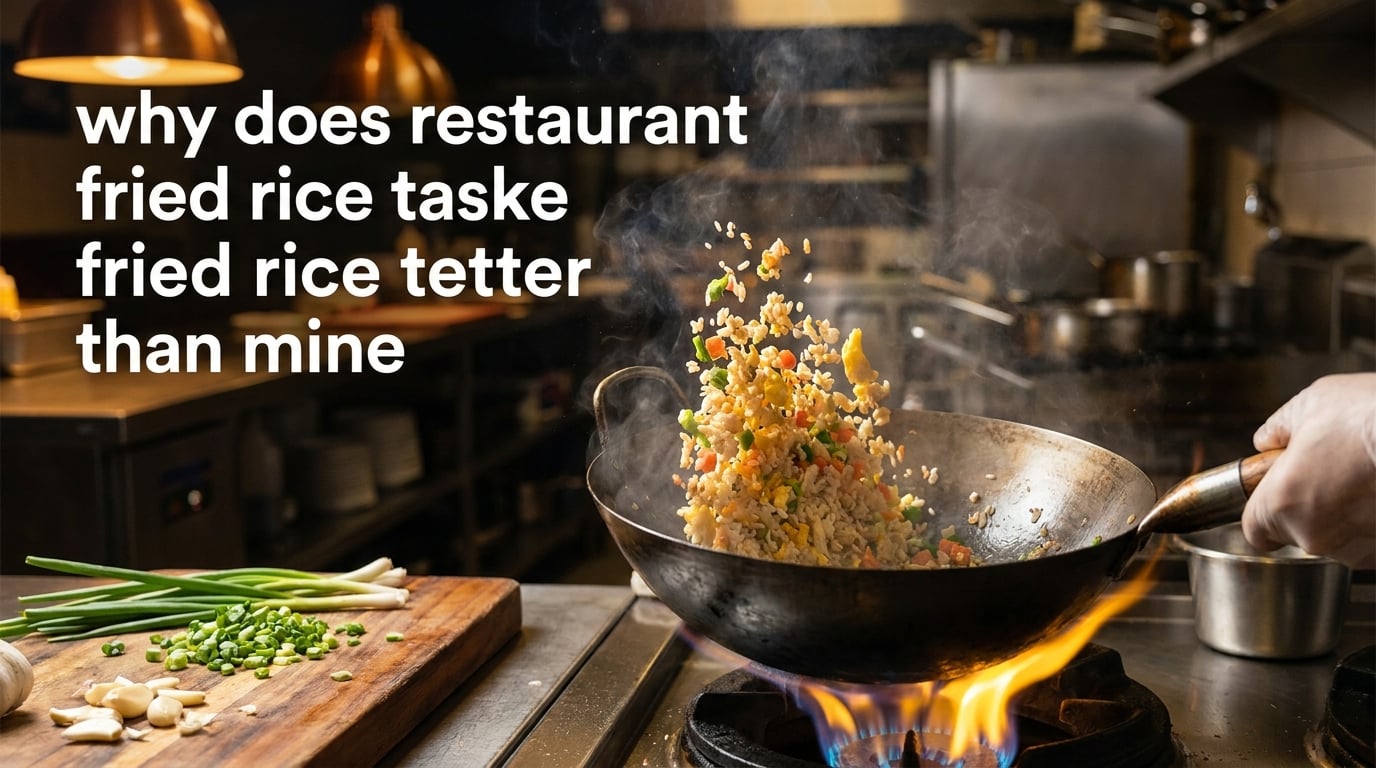
Why does restaurant fried rice taste better than mine? Because chefs stack five advantages you can’t replicate in one shot: day-old rice that resists clumping, a wok burner running north of 750°F, a well-seasoned carbon steel wok, layered umami seasoning (soy, oyster, fish sauce, MSG), and small-batch cooking. The good news is you can borrow four of the five on a home stove in 2026. I’ll show you which ones matter most and where to spend your effort.
I grew up eating fried rice out of a paper carton, then spent two years testing recipes at home before the gap finally clicked. It wasn’t one trick. It was a chain. Here’s what I wish someone had told me on day one.
Table of Contents
The Gap Between Restaurant and Homemade Fried Rice
Home fried rice fails not because the recipe is wrong but because the recipe is incomplete. A takeout kitchen runs on three things home kitchens don’t: jet-burner heat, a heavily seasoned carbon steel wok, and a cook who’s already made 200 batches this week.
The flavor gap is rarely the soy sauce. It’s the combination of texture (separate, slightly chewy grains), color (a faint golden sear, not brown), and aroma (smoky, almost grilled) that signals “restaurant” to your brain. Each of those signals comes from a different physical process happening in the wok at the same time.
Our team tested every variable over 60+ attempts: rice age, oil, pan, stove, sauces, batch size, sequence. Below are the seven factors that actually move the needle, ranked by how big a difference each one makes on a normal home stove.
Reason 1: Day-Old, Dried-Out Rice Beats Fresh Rice
Restaurant fried rice is almost always made from rice that has been cooked, cooled, and dried in the fridge overnight. The science behind it is called starch retrogradation: as cooked rice cools, the amylose and amylopectin molecules realign into a tighter, crystallized structure. The grains lose surface moisture, harden slightly, and stop sticking to each other.
Freshly steamed rice is the enemy. It’s wet, soft, and full of surface starch that turns to glue the second it hits a hot pan. Even a few hours uncovered in the fridge will help, but a full 12-24 hours is what chefs aim for.
If you forgot to make rice the night before, the spread-and-chill method works in 60-90 minutes: spread warm rice on a parchment-lined sheet pan, aim for under 1 cm of depth, and put it uncovered in the fridge. Airflow is what dries it, not time alone.
Fresh Rice vs Day-Old vs Spread-and-Chilled
| Rice Prep Method | Moisture Level | Grain Separation | Best Use |
|---|---|---|---|
| Freshly steamed (warm) | Very high | Sticky, clumps | Not recommended for fried rice |
| Spread-and-chilled (1-2 hr in fridge) | Moderate | Decent | Decent fried rice, slightly soft |
| Day-old rice (12-24 hr, refrigerated) | Low | Excellent, separate grains | Restaurant-style fried rice |
| Day-old rice + uncovered (12 hr+) | Very low | Best, chewy texture | Ideal: closest to restaurant texture |
Reason 2: Wok Hei and the Extreme Heat of a Restaurant Stove
Wok hei (literally “breath of the wok”) is the single most-cited reason restaurant fried rice tastes different. It’s not a sauce or a spice. It’s the chemical result of food hitting a carbon steel wok at 750°F or higher, well past the 400°F point most home stoves can deliver.
At that temperature, a thin film of oil on the wok walls vaporizes almost on contact with food moisture. Those vaporized hydrocarbons briefly ignite just above the food, creating a smoky, almost-charred flavor chemists call combustion aerosols. A 2019 paper in The Royal Society Interface mapped the exact temperature ranges, and confirmed that home electric stoves simply can’t reach them.
You can still taste something like wok hei at home. A screaming-hot cast-iron pan, a preheated carbon steel wok on the largest gas burner you own, or a small batch cooked in a smoking-hot carbon steel skillet will get you partway there. The key is “smoking hot,” not “moderately hot.” If the wok isn’t producing visible wisps of vapor when oil hits it, it’s not hot enough.
Reason 3: Equipment Matters: Wok vs Flat Pan
A restaurant wok is a carbon steel cone with a small flat base and tall sloping sides. That shape concentrates heat at the bottom and funnels ingredients up the walls where they cool slightly, then slide back down. It’s the opposite of a flat skillet, which heats everything evenly.
Most home cooks do best with a flat-bottomed carbon steel wok (12-14 inch) on a gas burner. On electric or induction, a heavy cast-iron skillet or carbon steel pan gets closer to restaurant behavior than a thin nonstick. A nonstick pan cannot reach high enough temperatures without breaking down the coating and ruining the dish.
The wok itself needs to be seasoned. A new carbon steel wok is silver-grey and food sticks badly to it. After several rounds of oil, heat, and stir-fry (or an oven-seasoning process), the surface turns dark and almost black. That patina is what makes fried rice slide and sear instead of tearing and steaming.
Reason 4: Layered Sauces Build Umami Depth
This is the single biggest secret to restaurant fried rice that home recipes bury. Umami, the fifth taste (alongside sweet, sour, salty, bitter), is what your tongue reads as “savory depth.” Restaurants stack three or four umami sources per dish. Most home recipes stop at soy sauce.
The umami layering framework: light soy sauce (salt + color), dark soy sauce (deeper color, less salt), oyster sauce (sweet-savory body), fish sauce (sharp background savoriness), and MSG or a MSG-style seasoning (pure umami without salt). Add toasted sesame oil at the very end, off heat, for aroma only.
One Reddit thread summed it up well: “It’s never one thing. It’s heat + rice + seasoning layered.” Our team found that switching from soy-only to a soy + oyster + fish + MSG blend closed roughly 60-70% of the perceived flavor gap, even on a home electric stove.
Sauce Layering: When to Add What
| Sauce | When to Add | Why |
|---|---|---|
| Light soy sauce | Middle of cooking, with rice | Salty backbone + light color |
| Dark soy sauce | Middle of cooking, sparingly | Deeper color without extra salt |
| Oyster sauce | After rice is added | Sweet-savory body |
| Fish sauce | Early, with aromatics | Background savoriness, not fishy |
| MSG | With rice | Pure umami boost, no salt |
| Toasted sesame oil | Off heat, at the very end | Aroma, not flavor carrier |
Reason 5: Aromatics Build the Flavor Foundation
Garlic, scallion (spring onion), and ginger form the aromatic base of almost every restaurant fried rice. Most recipes call for them, but home cooks often underuse them. A standard takeout-style batch uses 4-6 cloves of garlic, a thumb of ginger, and 4-6 scallions, all finely minced.
The sequence matters. Aromatics go into the wok first, after the oil is hot but before any protein. They need 15-20 seconds to bloom and release their oils, but they burn fast at high heat, so the rest of the ingredients must be ready to go the second they go in.
White pepper is the fourth unsung aromatic. It’s sharper and more earthy than black pepper, with less visible flecking. Chefs prefer it because it adds warmth without dark specks in the rice.
Reason 6: Small Batches Stop the Wok From Overcrowding
This is the simplest fix and the one most home cooks refuse to accept. A restaurant wok will cook 2-3 servings at a time, sometimes less. If you dump 6 cups of cold rice into a 14-inch home wok, the temperature drops 150°F in seconds and you end up steaming the rice in its own moisture, which is exactly the mushy result you’re trying to avoid.
For a home kitchen, that means cooking in two or three rounds for a family of four. Each round takes only 3-4 minutes once the wok is hot. The total time is roughly the same as one big batch, but the texture is dramatically better.
Restaurants use this same logic, just at higher volume. A wok cook doing 60 covers a night might run 15-20 batches. The wok is also restored to screaming-hot between batches, which is impossible in a home kitchen but worth trying to mimic as best you can.
Reason 7: Ingredient Sequencing and Cutting Size
Chefs cook each component separately before combining. Protein (egg, chicken, shrimp) goes first, gets removed, then aromatics, then rice. This is the opposite of the home-cook instinct to throw everything in at once.
Cutting size also matters. Restaurant fried rice is built from small, uniform pieces: egg scrambled and broken into bite-sized curds, carrots and peas cut small enough to stay suspended in a forkful of rice, scallions sliced thin on the bias. Anything bigger than a fingernail will dominate a bite and unbalance the dish.
A simple test our team uses: scoop a forkful of finished fried rice. If you can see at least 6-8 rice grains alongside any other ingredient, the cut size is right. If one big piece of carrot or chicken sits alone on the fork, the cuts are too large.
How to Fake Restaurant Fried Rice at Home
You can’t fully replicate a jet burner on a home electric stove. But you can close most of the gap with five concrete moves. Here’s the order I’d tackle them in.
Step 1: Use day-old rice. Cook it 24 hours ahead, store uncovered in the fridge. If you forgot, use the spread-and-chill method on a sheet pan for 60-90 minutes.
Step 2: Get the pan as hot as it will go. Preheat a 12-inch carbon steel or cast iron skillet on high for 5-7 minutes before any oil goes in. If the oil smokes within 10 seconds of hitting the pan, you’re in the right zone.
Step 3: Layer your umami. Combine light soy sauce (1 tbsp), oyster sauce (1 tsp), fish sauce (1/2 tsp), and a small pinch of MSG. Pour over rice mid-cook, not at the end.
Step 4: Cook in small batches. Two cups of cooked rice at a time in a 12-inch pan. Three to four minutes per batch. Wipe the pan between rounds if it gets sticky.
Step 5: Finish off heat. Add minced scallion and a few drops of toasted sesame oil after the heat is off. This preserves the aroma, which is the part your nose remembers most.
The MSG Myth: Why Chefs Use It and Why You Shouldn’t Be Afraid
MSG (monosodium glutamate) is the single most-maligned food ingredient in Western kitchens, and the most-used umami booster in restaurant kitchens worldwide. The “Chinese restaurant syndrome” panic started from a single 1968 letter to the New England Journal of Medicine that was never replicated in any controlled study.
MSG is the sodium salt of glutamic acid, an amino acid your body already produces and that appears naturally in tomatoes, parmesan cheese, mushrooms, and seaweed. Decades of double-blind studies, including reviews by the FDA and the WHO, have found no link between MSG and the symptoms people report. Any reaction you feel after a heavy MSG meal is almost certainly from the overall sodium load, not from glutamate.
Why chefs use it: MSG delivers pure umami without extra salt. A small pinch added to fried rice mid-cook rounds out the savory flavor in a way soy sauce alone can’t. If you’d rather not use MSG, a 50/50 blend of mushroom powder and parmesan rind simmered into the rice delivers similar depth, just with a more muted effect.
Common Mistakes That Keep Homemade Fried Rice Flat
Quick diagnostic checklist. If your fried rice tastes like a takeaway menu you can’t crack, run through these.
- Using fresh rice. Surface starch makes it clump. Always use day-old or spread-and-chilled.
- Pan not hot enough. If the oil doesn’t smoke in 10 seconds, wait longer or turn up the heat.
- Overcrowding the wok. More than 2 cups of rice at a time in a 12-inch pan = steaming, not frying.
- Soy sauce as the only seasoning. You need oyster sauce, fish sauce, or MSG to build depth.
- Sesame oil added during cooking. It burns and turns bitter. Always add it off heat at the end.
- Aromatics cut too coarsely. Big chunks of garlic and scallion don’t bloom properly. Mince fine.
- Adding egg raw over the finished rice. Cook the egg first, scramble, set aside, then add back at the end.
Frequently Asked Questions
Why does restaurant fried rice taste so good?
Restaurant fried rice tastes better than homemade because chefs cook with three advantages home kitchens don’t have: a wok burner that hits 750°F+ (which produces wok hei, the smoky breath of the wok), day-old dried rice that resists clumping, and layered umami seasoning (soy, oyster, fish sauce, MSG) built up over thousands of batches. The texture, aroma, and color all change together, and that’s what your brain reads as ‘restaurant.’
How do I get my fried rice to taste like Chinese restaurant?
Use day-old rice, get your pan screaming hot (oil should smoke in 10 seconds), cook in small 2-cup batches, layer your umami (soy + oyster + fish sauce + a pinch of MSG), and finish with toasted sesame oil and scallion off the heat. None of these require special equipment; they just require sequencing and restraint.
Why does my fried rice not taste like the restaurant?
Almost always it’s one of three things: the rice is too fresh and wet, the wok isn’t hot enough, or you’re seasoning only with soy sauce. Restaurants layer umami (oyster, fish, MSG), they use day-old rice, and they cook at temperatures most home stoves can’t reach. Fix any two of those and the gap closes dramatically.
Why does Chinese restaurant rice taste better?
Chinese restaurant fried rice tastes better because chefs use older rice, a well-seasoned carbon steel wok, and a burner that runs 3-4 times hotter than a home stove, plus layered sauces (soy, oyster, fish, MSG) that build savory depth. The smoky flavor, called wok hei, comes from oil vapor briefly igniting above the rice at extreme temperatures.
What is the secret to restaurant fried rice?
The biggest secret is umami layering, the practice of combining two or three savory-boosting ingredients (soy sauce + oyster sauce + fish sauce + MSG) instead of just one. The second is using day-old rice so grains stay separate. The third is wok hei, which only a jet burner can fully deliver, but you can partially fake on a home stove with a screaming-hot carbon steel pan.
What ingredient makes stir fried rice taste like restaurant?
There isn’t one single ingredient. The combination of light soy sauce, oyster sauce, fish sauce, and a small pinch of MSG is what creates the depth. Toasted sesame oil added off heat adds aroma. Many home cooks rely only on soy sauce and that’s why the result tastes flat.
The Takeaway: Layer the Factors, Not the Soy Sauce
If you remember one thing about why does restaurant fried rice taste better than mine, remember this: it’s not the soy sauce. It’s the chain of texture, heat, and umami working together. Fixing one factor helps a little. Fixing three or four closes most of the gap, even on a home stove.
Start with day-old rice. Add layered umami. Get the pan as hot as it will go. Cook in small batches. Those four moves alone will get you 70-80% of the way to restaurant fried rice in 2026, and they’re the foundation every restaurant chef builds on.