
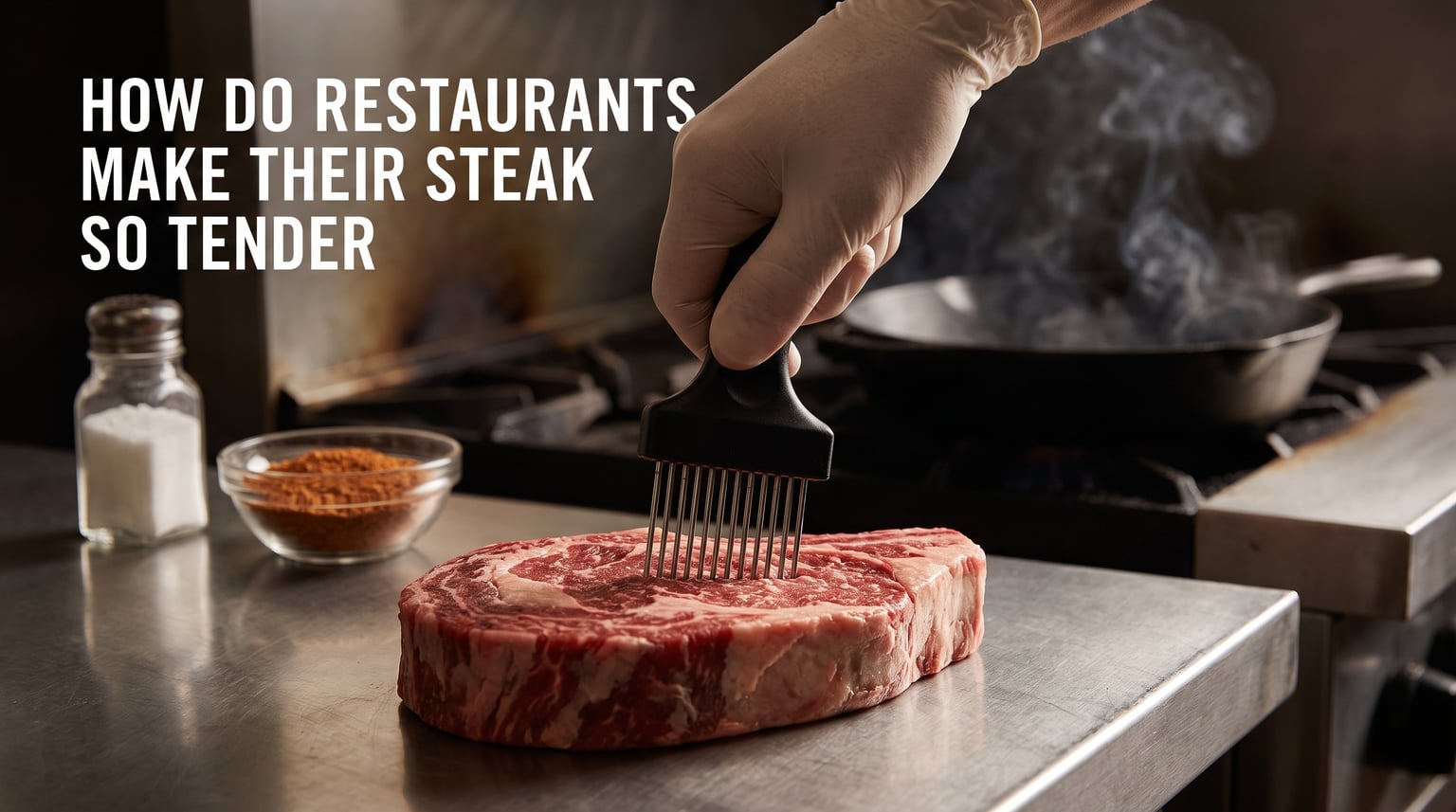
If you have ever wondered how do restaurants make their steak so tender while your home-cooked steak comes out chewy, you are not alone. The difference comes down to a handful of professional techniques layered together: better beef, patient aging, mechanical or enzymatic tenderizing, blistering-hot broilers, and a few seconds of butter at the end. Restaurants combine these steps every shift, often on cheaper cuts than you would guess. Our team broke each one down after weeks of kitchen testing, food-science reading, and conversations with line cooks. Below is the full playbook you can use at home tonight.
Table of Contents
Quick Answer: The Restaurant Steak Techniques
- Start with USDA Prime or high-Choice beef for visible marbling and a buttery texture.
- Dry-age or wet-age the beef for 14 to 45 days so natural enzymes soften muscle fibers.
- Mechanically tenderize tough cuts with a Jaccard needle tenderizer or commercial blade tenderizer.
- Use salt brines, dry rubs, or enzymatic powders (baking soda, bromelain) to pre-tenderize.
- Sear on a broiler or cast-iron pan reaching 700 to 1000 degrees F for a true Maillard crust.
- Rest the steak one-third of its cook time in a warm spot to lock in juices.
- Finish with the fat-flash – a spoon of hot butter or beef tallow basted over the top.
Why Restaurant Steak Feels Different From Home Cooking
Restaurant steak feels softer the moment your knife slides in because every step before the plate is optimized for tenderness. A steakhouse controls the beef grade, the aging window, the tenderizing tool, the cooking surface, and the rest time. At home, you usually control one or two of those steps at most.
Professional kitchens also handle dozens of steaks every hour, so they have muscle memory for the exact moment a crust forms. Even a great home pan rarely reaches the 700 degrees F a restaurant broiler delivers. That heat gap alone changes how tender the final bite feels, because a fast sear keeps the interior juicier and the muscle fibers shorter.
The Cut and the Grade: USDA Prime and Marbling
Restaurants start with the best grade their budget allows. USDA Prime is the top tier, with abundant marbling – thin veins of fat woven through the muscle. Marbling is what melts during cooking and gives steak that soft, almost oily mouthfeel you cannot fake with a rub. Fine-dining steakhouses buy Prime almost exclusively. Chain steakhouses stretch their budget by buying upper Choice and using technique to make up the difference.
Cut matters as much as grade. Ribeye has the most internal fat, so it stays tender even on a cheap blowtorch. Sirloin and strip are leaner, which is why restaurants lean on tenderizing tools for those cuts. Flank and skirt are flavorful but tough, which is exactly why they are always marinated and sliced across the grain in a restaurant. Knowing your cut lets you choose the right restaurant trick for the job.
Thickness: The Hidden Lever
Steakhouses cut steaks 1.5 to 2 inches thick. A thicker steak spends more time building crust while the center stays rare, and rare muscle fibers are more relaxed than fully cooked ones. If your supermarket sells 1-inch cuts, you can pound them to 1.5 inches or use a reverse-sear to even out the cook.
Aging the Beef: Dry Aging vs Wet Aging
Aging is the single biggest reason an expensive steakhouse steak tastes different from a grocery store steak. Aging lets natural enzymes inside the beef slowly break down connective tissue. The result is meat that is more tender and more flavorful before it ever hits a pan.
Dry Aging
Dry aging means hanging beef in a temperature- and humidity-controlled cooler for 14 to 45 days. Moisture evaporates, concentrating flavor. Enzymes tenderize the muscle fibers. The outside forms a dry crust that gets trimmed off, leaving steak with a nutty, almost cheesy depth. Dry-aged ribeye is the benchmark for steakhouse bragging rights, and it is expensive because you lose up to 30 percent of the original weight to trim and moisture loss.
Wet Aging
Wet aging is what most grocery stores and many chain steakhouses do. The beef is vacuum-sealed in a bag and aged in its own juices for 7 to 28 days. Enzymes still tenderize the meat, but you keep the weight and skip the trim loss. Wet-aged steak tastes milder and beefier, less nutty than dry-aged, and it costs less. Both methods make steak more tender than unaged beef of the same grade.
For home cooks, dry aging is doable in a fridge set to 34 to 38 degrees F with a small fan, but wet aging is far easier: just buy vacuum-sealed Choice or Prime, leave it in the bag in your fridge for a week, and you have already beaten most home steaks.
Mechanical Tenderizing: Jaccard, Blade Tenderizer, and Mallet
When the cut is lean and the budget is tight, restaurants pull out a tool. Mechanical tenderizers physically break muscle fibers so a steak cooks faster, feels softer, and absorbs marinade more evenly. The Kitchn staff tested seven tenderizing methods side by side and found mechanical options among the most effective for tough cuts.
Jaccard Needle Tenderizer
The Jaccard is a hand-held roller lined with 48 to 96 tiny razor blades. You roll it across the steak and it makes dozens of micro-cuts that slice through tough fibers without ripping the meat apart. Steakhouses have used the Jaccard for decades. It is the same idea as poking with a fork, but cleaner, faster, and far more consistent. Reviews on r/Cooking regularly call the Jaccard worth every penny for flank, skirt, and sirloin.
Commercial Blade Tenderizer
High-volume restaurants use a tabletop blade tenderizer that presses the steak between belts of sharp little blades. Some chain suppliers even blade-tenderize steaks at the packing plant before shipping them to the restaurant. This is why a Texas Roadhouse sirloin can feel softer than a hand-cut sirloin you bought at the same price. The cut itself was already tenderized for you.
Meat Mallet
The old-school meat mallet still has a place. A textured face flattens the steak to an even thickness, which is great for pounding out chicken-fried steak or for thinner cuts that cook too fast on a screaming-hot grill. The downside is it changes the steak’s shape, so it works best for marinades and stir-fry strips, not for a thick center-of-the-plate ribeye.
Marinades, Dry Rubs, and the Salt Brine Trick
Seasoning is where restaurants add flavor and tenderness at the same time. Salt is the workhorse, but the form matters.
The Salt Brine
A simple brine of 1 tablespoon kosher salt per cup of water, used as a 1-hour to 24-hour soak, lets salt penetrate deep into the muscle. Salt dissolves some muscle proteins and lets them hold on to more water during cooking. That extra moisture reads as tenderness on the plate. Reddit users in r/Cooking routinely credit a salt brine as the single biggest upgrade they made to home steaks.
Dry Rubs
Dry rubs coat the surface and pull surface moisture out, which actually helps the sear. Coarse kosher salt, black pepper, garlic powder, and a little sugar is the classic steakhouse blend. The trick is to salt at least 45 minutes before cooking so the salt can dissolve and re-absorb – a step called dry-brining. Salted-just-before-searing steaks taste flat and often bead up with moisture on the pan.
Acidic Marinades
Marinades with vinegar, citrus, or yogurt break down surface proteins and add tang. They work best on thin, tough cuts like flank or skirt. Marinate for 30 minutes to 4 hours; longer than that and the acid turns the outside mushy. Serious Eats and Tested-by-Kitchn both found that over-marinating is a myth worth ignoring – more time is not always better.
Baking Soda and Bromelain
Two enzymatic tricks show up in restaurant prep rooms. A light coating of baking soda (about 1 teaspoon per pound for 15 to 30 minutes, then rinsed off) raises the surface pH so proteins cannot contract as hard. The result is a noticeably more tender crust. Bromelain, the enzyme in pineapple, shows up in commercial meat tenderizer powders; Adolph’s is the classic brand. Use sparingly or the steak turns mushy.
What Chain Restaurants Do Differently (Texas Roadhouse, Outback, LongHorn)
Chain steakhouses cannot afford Prime beef at every location, so they lean on technique, sourcing contracts, and consistency. Here is what they have shared or what regulars have pieced together from Reddit, Quora, and supplier interviews.
Texas Roadhouse
Texas Roadhouse hand-cuts its steaks at the restaurant and seasons them with a proprietary salt-and-pepper blend, applied liberally. Long-time fans on r/Cooking have pointed to the nutritional info, which lists a hefty sodium bump after cooking – evidence that salt is doing real work as a tenderizer. The chain also serves thinner hand-cut steaks that cook fast and stay tender, and it finishes them with a buttery pan baste that adds richness.
Outback Steakhouse
Outback’s signature seasoning – a peppery, paprika-heavy dry rub – is dusted on right before the high-heat grill sear. Outback specs Choice-grade beef and tenderizes many of its cuts at the packing plant with a blade tenderizer. The smoky rub plus the pre-tenderized muscle gives their sirloin a softer bite than equivalent grocery cuts.
LongHorn Steakhouse
LongHorn’s “Fresh, Never Frozen, Never Pre-Cut” promise means most steaks are cut in-house from primal subprimals, then dry-aged in walk-in coolers for about 28 days. The chain also seasons with a bold spice blend and finishes steaks on a flat-top grill with butter basting, which is essentially a home fat-flash on a production scale.
The High-Heat Sear: Broilers, Cast Iron, and Salamanders
Cooking technique is the step you can copy at home most easily. Restaurants bring serious heat: infrared broilers, salamanders, and deck ovens that push surface temperatures from 700 to 1000 degrees F. Home ovens usually top out around 500 to 550 degrees F on the broiler setting, which is why restaurant steaks get a deeper, faster crust.
The Maillard Reaction
That crust is not just color. It is the Maillard reaction, a browning that rebuilds amino acids and sugars into hundreds of new flavor and aroma compounds. The same steak cooked low and slow to the same internal temperature will taste blander and feel softer-in-a-bad-way because the Maillard layer never formed. Restaurants chase that crust and stop short of burning it.
Cast Iron at Home
To match restaurant heat at home, preheat a heavy cast-iron skillet on high for 5 minutes, add a high-smoke-point oil like avocado or grapeseed, and sear the steak for 90 seconds to 2 minutes per side. Then drop the pan into a 450 degrees F oven to finish. Add butter, garlic, and thyme in the last minute and tilt the pan to baste the top. That move alone will copy a steakhouse butter baste.
Salamander Broilers
Many fine-dining restaurants keep a salamander – a small overhead broiler – for finishing steaks after they come off the main grill. The salamander flash-sears the top in seconds without overcooking the interior. J. Kenji Lopez-Alt at Serious Eats recommends a similar home move: broil on high for the last minute on each side to set the crust without driving the pan full of smoke.
Resting the Steak: Carryover Cooking and the Fat-Flash Finish
Resting is the easiest tenderness boost of all, and yet most home cooks skip it. J. Kenji Lopez-Alt puts it bluntly: resting meat for about one-third of its total cooking time keeps more juice inside the steak than on the cutting board.
How to Rest Correctly
Pull the steak 5 to 10 degrees F before your target internal temperature. Carryover cooking will finish the job. Tent loosely with foil on a warm plate (or a cheap pie pan on top of a sheet tray, as r/Cooking users like to suggest). Five minutes for a thin steak, 10 to 15 minutes for a thick one. Cutting into a steak that has not rested is the fastest way to lose 20 percent of the juice to the board.
The Fat-Flash Finish
J. Kenji also popularized the fat-flash finish. Instead of long resting and losing the crust, he tops the steak with a hot spoon of browned butter or beef tallow right at plating. The fat melts and re-sears the top while the steak relaxes underneath. This is exactly what restaurants do when they plate with compound butter or a foaming butter sauce. You get tender meat and a crackling top in the same bite.
Slicing Against the Grain: The Final Tenderness Move
Every steak has a grain – the direction of the long muscle fibers. Cutting perpendicular to those fibers shortens each one, so the steak feels tender instead of chewy on the fork. This is why flank and skirt are always sliced thin at a 45-degree angle against the grain, even after the best marinade.
Look at the steak raw and you will see thin lines running one way. Slice across them, not along. For thick steaks like ribeye, run a sharp knife along the side to spot the grain, then slice the steak against it before plating. Chefs slice to order and arrange each piece with the cut edges up so every bite feels like the most tender bite.
Common Mistakes Home Cooks Make
A few recurring errors keep showing up in kitchen forums. Skipping any one of them will undo the work of the previous steps.
- Skipping the rest. Juices puddle on the plate and the steak feels dry and tight.
- Salting right before searing. Salt needs 45 minutes to dissolve into the meat and pull moisture back in.
- Cooking cold steak straight from the fridge. Temper the steak on the counter for 20 to 30 minutes so the center cooks evenly.
- Over-marinating acidic blends. More than 4 hours turns the surface mushy.
- Using a nonstick pan for the sear. It never gets hot enough for a true crust. Use cast iron or stainless steel.
- Slicing with the grain on long cuts. A perfect medium-rare flank sliced along the grain still feels tough.
Frequently Asked Questions
What does Texas Roadhouse do to make their steaks so tender?
Texas Roadhouse hand-cuts steaks in-house, seasons them liberally with a salt-forward dry rub, and finishes them on a hot grill with a butter baste. Long-time fans and Reddit threads on r/Cooking point to the restaurant’s sodium bump on nutrition labels as evidence that salt is doing real tenderizing work, alongside thinner hand-cut steaks that cook fast and stay tender.
What is the secret to a super tender steak?
The single biggest secret is layering: start with well-marbled beef, age it if you can, mechanically tenderize tough cuts, salt it well ahead of cooking, sear over high heat, and rest it before slicing. Any one step helps. Combining all of them is how a 60 dollar steakhouse ribeye feels softer than a 12 dollar grocery steak.
How do steakhouses get their steak so tender?
Steakhouses control every step of the chain: USDA Prime or upper-Choice beef, dry or wet aging for days or weeks, optional mechanical tenderizing, salt-heavy seasoning, infrared broilers at 700 to 1000 degrees F, and a short rest before plating. The Maillard crust from those broilers plus the relaxed muscle fibers from resting is the tenderness two-step your home pan rarely matches.
How do professional chefs tenderize steak?
Professional chefs reach for three tools: a Jaccard needle tenderizer for clean, fast fiber-cutting; a commercial blade tenderizer at the packing plant for high-volume cuts; and a meat mallet for thinner or pounded cuts like chicken-fried steak. They also lean on salt brines, dry rubs, and enzymatic powders like baking soda or bromelain when budgets are tight.
How do restaurants tenderize steaks?
Restaurants combine methods. They select cuts with good marbling, age them in a cooler, blade-tenderize at the supplier or in-house with a Jaccard, salt-brine or dry-rub them ahead of time, and finish on a screaming-hot broiler or flat-top with a butter baste. Layering two or three of these steps is how a relatively inexpensive cut ends up feeling like Prime.
What do restaurants use to tenderize steaks?
Most steakhouses use a Jaccard roller or a commercial blade tenderizer for thin cuts, salt brine or dry rubs for seasoning moisture, baking soda for surface pH adjustment, and bromelain-based commercial powders when budget allows. The Jaccard is the most common single tool because it works on every cut with no flavor change.
Putting It All Together: Restaurant Tenderness at Home
The full answer to how do restaurants make their steak so tender is not one trick. It is a chain of small ones that stack up: marbled beef, patient aging, mechanical or enzymatic tenderizing, salt well ahead of cooking, a hot sear, a short rest, and a slice against the grain. You do not need to run all seven to feel a difference. Salt early, sear hot, rest well, and slice right, and you will already beat most home steaks. Add a Jaccard and a 14-day wet-age and you will be running your own steakhouse on a Tuesday night.