
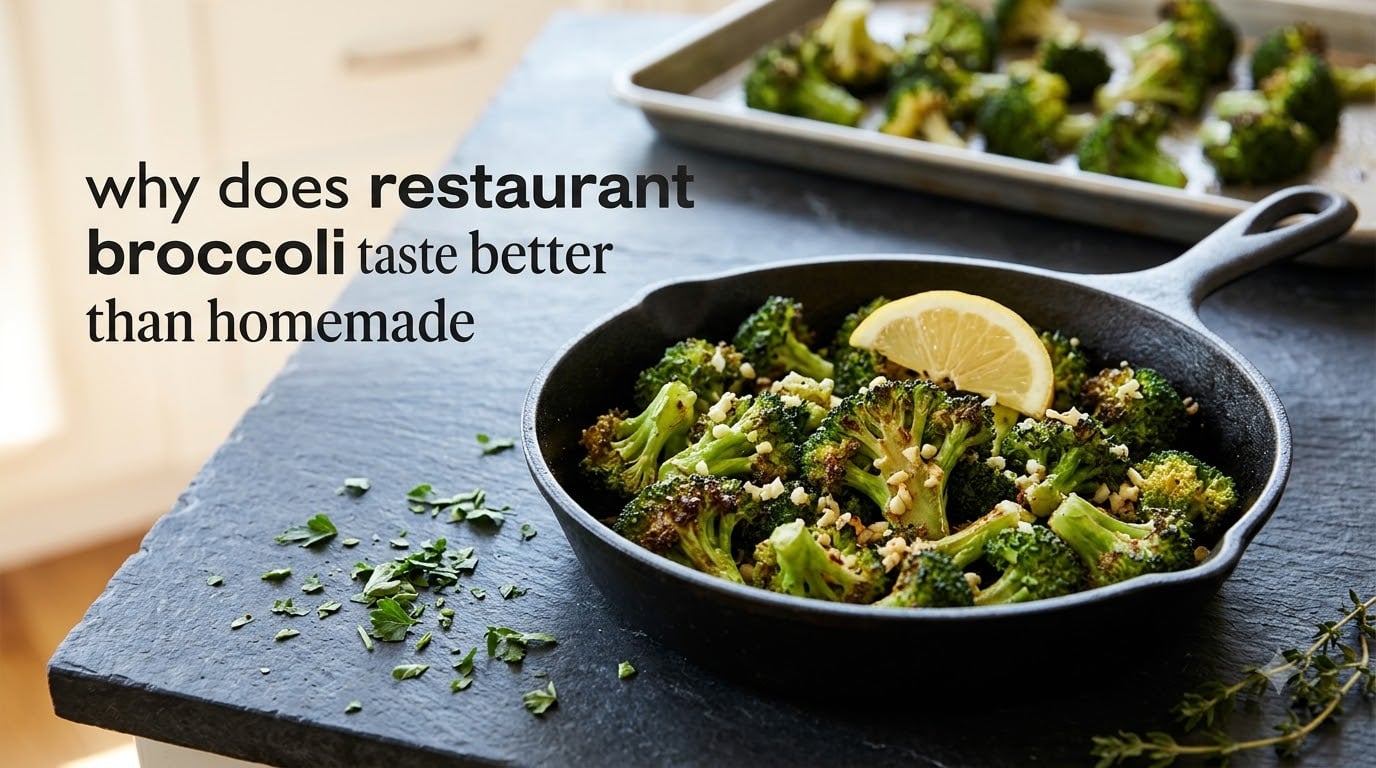
If you’ve ever wondered why does restaurant broccoli taste better than homemade, the short answer is this: chefs treat broccoli like a steak, not a side dish. They salt it aggressively, cook it at high heat, use far more fat than you probably do at home, and finish it with a squeeze of acid that brightens the entire bite. Home cooks, by contrast, tend to steam it gently, under-season it, and pull it off the heat too late. After testing the restaurant method side-by-side with my usual weeknight steam for a few months, I can tell you the difference is real, and it has almost nothing to do with the broccoli itself.
In this guide, I’ll walk through the six reasons restaurant broccoli wins, what chain restaurants like Outback, Texas Roadhouse, and Cracker Barrel do differently, and a step-by-step recipe you can run in your own kitchen tonight to get that same crispy-edged, deeply seasoned, bright green florets.
Table of Contents
Why Restaurant Broccoli Tastes Better Than Homemade
Restaurant broccoli tastes better because chefs combine aggressive seasoning, very high heat, generous fat, blanching, and an acid finish. Home cooks usually steam at low heat with little salt and no fat, which leaves the florets grey, watery, and flat. The restaurant method is closer to roasting a vegetable than boiling one, and that single shift in approach explains most of the flavor gap.
- More salt, added at multiple stages. Chefs salt the blanch water, season the florets before they hit the pan, and finish with flaky salt at the plate.
- Higher heat than home stoves can deliver. Restaurants run ovens at 425 to 500 degrees Fahrenheit and pans at full throttle, which drives browning.
- Blanching and shocking in ice water. This locks in vibrant green color, sets the texture, and removes any raw bite.
- More fat than you think is reasonable. Olive oil, butter, and even bacon fat carry fat-soluble flavor compounds straight into the broccoli.
- An acid finish. Lemon juice or vinegar at the very end brightens everything and balances the richness.
- Single-layer cooking in small batches. No crowding the pan, so each floret actually sears instead of steaming in its own moisture.
How Most Restaurants Cook Broccoli
Most restaurants cook broccoli using a three-step method: salt the blanch water, shock the florets in ice water, then finish them in a screaming-hot pan with plenty of fat and a finishing squeeze of acid. This is the same workflow you’ll see in professional kitchens from neighborhood bistros to high-end steakhouses, and it’s the fastest way to get restaurant-quality broccoli at home.
- Blanch in heavily salted water. The water should taste like sea water. Boil florets for 60 to 90 seconds, just until they turn bright green.
- Shock in ice water. Drain immediately and plunge into a bowl of ice water to stop the cooking. This is the move that keeps the green color and the crisp-tender bite.
- Finish in a hot pan with fat. Toss the dried florets into a hot skillet with olive oil, butter, or both, and let them sit undisturbed for 30 to 60 seconds so the edges caramelize.
- Season in layers and finish with acid. Salt during the blanch, season in the pan, then add lemon juice at the end. Top with garlic, chili flakes, Parmesan, or Calabrian chiles if you want to push it further.
This is the same method fine-dining chefs on Reddit’s r/Chefit recommend for dense vegetables, and it works because it solves three home-cook problems at once: under-seasoning, overcooking, and lack of browning.
Seasoning Is the Number One Secret
Seasoning, especially salt, is the single biggest reason restaurant broccoli tastes better than homemade. Chefs season at every stage of cooking, while home cooks tend to salt once at the end, when the broccoli is already on the plate and the salt can’t penetrate or balance the flavor.
The first stage is salting the blanch water. When broccoli florets go into plain water, they actually leach flavor out into the pot. When you salt the water like pasta water, the cells absorb some of that seasoning, so the broccoli arrives at the pan already seasoned from the inside. Aim for water that tastes distinctly salty, similar to ocean water.
The second stage is seasoning the florets right before they hit the hot pan. Toss them with kosher salt, a little black pepper, and any dry spices you want. This is the layer that creates the crust, because salt draws out a tiny amount of surface moisture, which then evaporates quickly and concentrates the flavor.
The third stage is the finishing salt. A pinch of flaky Maldon or a crunchy sea salt right before serving adds a final pop of texture and brightens the entire bite. If you’ve ever noticed how restaurant food seems “brighter” than your homemade version, this is one of the reasons.
High-Heat Cooking Beats Steaming Every Time
High-heat cooking beats steaming every time because the Maillard reaction, the chemical browning that creates deep savory flavor, only kicks in above 300 degrees Fahrenheit. Steaming tops out around 212 degrees, which means you are essentially cooking broccoli at a temperature where browning is impossible.
Restaurants roast broccoli at 425 to 450 degrees Fahrenheit, sometimes 500 in a commercial convection oven. At those temperatures, the surface of each floret dries out fast, the natural sugars caramelize, and you get those signature crispy brown edges that contrast with the tender center. Steamed broccoli has none of that contrast because everything cooks at the same low, moist temperature.
High heat also solves another problem home cooks run into: soggy, waterlogged florets. Steam condenses on the surface of the broccoli and drips back down, essentially braising the vegetable in its own moisture. A 425-degree oven drives that moisture off, leaving you with dry heat contact, which is what you want for browning.
If you only change one thing about how you cook broccoli at home, this is the change. Get your oven to 425 degrees, spread florets on a sheet pan in a single layer, drizzle with olive oil, season well, and roast for 18 to 22 minutes. The first time you taste the difference, you’ll understand why every restaurant kitchen runs hot.
The Blanch and Shock Technique Chefs Swear By
The blanch and shock technique is what gives restaurant broccoli its signature bright green color and crisp-tender bite, and it’s the step most home cooks skip entirely. Blanching briefly boils the vegetable, then shocking immediately stops the cooking by plunging it into ice water, and the result is a floret that looks alive and holds its texture even after a final sear.
The chemistry is simple but important. When broccoli hits boiling salted water, the cells quickly heat through and any enzymes that cause browning or softening get deactivated. If you leave it in the hot water too long, those same cells break down completely and the broccoli turns olive-drab and mushy. Ice water halts that process at exactly the right moment.
For stir-fry broccoli specifically, the technique is even more important. A 60 to 90 second blanch followed by an ice bath means the florets go into your wok or skillet already cooked through on the inside, so all you have to do in the pan is sear the outside. That is why restaurant stir-fry broccoli has charred edges and a tender snap at the same time, and home stir-fry often has raw centers or burnt exteriors.
The practical setup is easy. Bring a large pot of water to a rolling boil, salt it well, drop in the florets for 60 to 90 seconds, drain, and immediately transfer to a bowl of ice water. Once cool, drain again and pat dry on a clean towel. Dry florets are essential for searing, because wet florets will steam in the pan no matter how hot it is.
Restaurants Use Way More Fat Than You Do
Restaurants use way more fat than home cooks, and that fat carries the flavor compounds that make broccoli actually taste like something. Broccoli is full of fat-soluble flavor molecules, meaning they only express themselves when dissolved in oil or butter. Steam can’t release them, and a thin film of oil can’t either. You need a real coating.
The standard restaurant move is at least two tablespoons of olive oil per pound of broccoli for roasting, or a generous knob of butter plus oil for pan-searing. For a sheet pan of florets, that means tossing them thoroughly so every piece has a sheen, not just a few spots of oil. The same goes for finishing in the pan: enough butter to coat, enough garlic to actually brown, enough chili flakes to distribute evenly.
Fat also carries flavor from aromatics. Garlic, anchovies, Calabrian chiles, lemon zest, and Parmesan all release their flavor into oil or butter, then transfer that flavor into the broccoli. This is why restaurant broccoli often tastes like it has “more going on” than your version, even when the broccoli itself is the same variety from the same store.
If you are cooking for kids or watching calories, you can scale the fat back, but do not eliminate it. A teaspoon of olive oil is not enough to coat a pound of broccoli. Aim for at least one tablespoon per pound as a floor, and two tablespoons if you want the full restaurant effect.
The Acid Finish Most Home Cooks Skip
The acid finish is the small detail that makes restaurant broccoli pop, and it is the single most-skipped step in home cooking. A squeeze of lemon juice, a splash of white wine vinegar, or even a few drops of rice vinegar at the very end of cooking brightens the entire dish and balances the richness from the butter or oil.
Why does this work? Acid counteracts the earthy, slightly bitter compounds in broccoli, particularly when the broccoli has been cooked for a while. The Maillard browning and the caramelization create deep savory notes, but they can also lean heavy. Acid cuts through that and lifts the flavor toward the brighter end of the spectrum.
The timing matters. Add acid at the very end, after the broccoli is off the heat or in the last 30 seconds of cooking. If you add lemon juice too early, it cooks off and leaves a flat, sometimes bitter taste. If you add it at the end, it stays bright and aromatic.
Different acids pair with different finishes. Lemon juice is the classic steakhouse choice, especially with garlic and Parmesan. Rice vinegar works beautifully with sesame oil and soy for an Asian-leaning broccoli. White wine vinegar pairs nicely with butter and herbs for a French-style preparation. Sherry vinegar with a little smoked paprika is excellent on roasted florets.
Why Pan Crowding Ruins Home Broccoli
Pan crowding ruins home broccoli because crowded vegetables steam in their own moisture instead of searing, which means no browning, no caramelization, and the same watery result you would have gotten from boiling. Restaurants avoid this by cooking in small batches on large sheet pans, a habit home cooks can copy with a single piece of equipment.
The rule is simple: each floret should have space around it on the pan. If two florets touch, the spot where they touch will steam instead of brown. For a standard half sheet pan, that means no more than about a pound of raw broccoli at a time. For a skillet, even less, because pan depth traps steam.
If you have more broccoli than fits in a single layer, split it into two batches rather than piling it up. The first batch roasts in 18 to 22 minutes at 425 degrees, and you hold it on the pan while the second batch cooks. By the time you combine them, both batches have proper browning and the total cooking time is barely longer than your usual overcrowded version.
Carryover cooking is the related issue. Broccoli continues to cook for a minute or two after you pull it from the heat, so chefs intentionally undercook it slightly and let carryover finish the job. If you cook it until it looks “done” in the pan, it will be overcooked on the plate. Pull it when the stems are just barely tender and the edges are browned but not black.
Chain Restaurant Secrets: Outback, Texas Roadhouse, Cracker Barrel
Chain restaurants have signature methods that explain why their broccoli tastes the way it does, and these are surprisingly easy to copy at home. Outback, Texas Roadhouse, and Cracker Barrel each use a different approach, but all of them lean on the same fundamentals: lots of seasoning, fat, and a finishing touch.
How Does Outback Steakhouse Season Their Broccoli?
Outback Steakhouse seasons their broccoli with a buttery, garlicky finish and a generous hand of salt, often with a touch of crushed red pepper for warmth. The florets are steamed until just tender, then tossed in a pan with melted butter, minced garlic, and a final pinch of kosher salt. Some copycat recipes add a splash of chicken broth to keep the pan sauce loose, plus a squeeze of lemon at the very end.
To make it at home, steam your florets for 3 to 4 minutes, then transfer to a hot skillet with 3 tablespoons of butter, 3 cloves of minced garlic, and a pinch of crushed red pepper. Toss for 60 to 90 seconds, splash in 2 tablespoons of chicken broth, and finish with lemon juice and flaky salt. The whole dish takes about 10 minutes from start to finish.
How Does Texas Roadhouse Cook Their Broccoli?
Texas Roadhouse cooks their broccoli by stir-frying florets in butter with garlic and a little seasoned salt, often with a hint of smoked paprika in copycat recipes. The texture is softer than a roast, more like a quick sauté, with the broccoli holding its shape but taking on the buttery flavor all the way through. Some versions add a splash of soy sauce for umami depth.
The home method is simple: melt 3 tablespoons of butter in a large skillet over medium-high heat, add 4 cloves of minced garlic, cook just until fragrant, then add 1 pound of blanched broccoli florets and toss for 3 to 4 minutes. Season with kosher salt, black pepper, a pinch of smoked paprika, and finish with a small splash of soy sauce if you want the umami bump.
How Does Cracker Barrel Cook Their Broccoli?
Cracker Barrel cooks their broccoli in a similar butter-and-garlic style, but the chain leans toward a longer simmer with chicken broth so the florets take on a softer texture and absorb more of the savory broth flavor. It’s less of a sear and more of a buttery braise, with the broccoli tender all the way through and seasoned with a generous hand of salt and pepper.
To recreate it, melt 4 tablespoons of butter in a deep skillet, sauté 4 cloves of minced garlic for 30 seconds, add 1 pound of broccoli florets and 1/3 cup of chicken broth, cover, and simmer for 6 to 8 minutes until the broccoli is tender but still holds its shape. Remove the lid, season heavily with kosher salt and black pepper, and let the broth reduce for another minute before serving.
How to Make Restaurant-Style Broccoli at Home
To make restaurant-style broccoli at home, follow the chef workflow: blanch in heavily salted water, shock in ice water, dry thoroughly, then sear in a screaming-hot pan with olive oil and butter. Season at every step and finish with acid and flaky salt. The whole method takes about 15 minutes from start to finish, and the result is broccoli that tastes like it came out of a steakhouse kitchen.
- Bring a large pot of water to a rolling boil. Salt it generously, about 1 tablespoon of kosher salt per quart of water. While the water heats, fill a large bowl with ice and cold water and set it next to the stove.
- Blanch 1 pound of broccoli florets for 60 to 90 seconds. The florets should turn bright green but stay crisp. Drain immediately and plunge into the ice water for 1 to 2 minutes. Drain again and pat dry on a clean kitchen towel. Wet florets will not sear.
- Heat a large skillet over medium-high heat for 2 minutes. Add 2 tablespoons of olive oil and 1 tablespoon of butter. When the butter stops foaming and just begins to turn golden, add the broccoli in a single layer.
- Let the broccoli sit undisturbed for 60 seconds. This is where the browning happens. Don’t move it around. After 60 seconds, toss, then let it sit another 60 seconds on the other side.
- Add 4 cloves of minced garlic, a pinch of crushed red pepper, and a final seasoning of kosher salt and black pepper. Toss for 30 seconds, just until the garlic is fragrant.
- Off heat, squeeze in half a lemon and finish with flaky sea salt. Toss once more and serve immediately. Optional toppers: grated Parmesan, toasted breadcrumbs, a drizzle of good olive oil, or a few anchovy fillets melted into the pan butter.
The first time I made this for friends, one of them said it tasted like a steakhouse side. That comment has stuck with me because the recipe is not complicated; it just pays attention to every step most home cooks skip.
Common Mistakes That Keep Homemade Broccoli Bland
The most common mistakes that keep homemade broccoli bland are easy to fix once you see them. If your broccoli comes out mushy, grey, bitter, or just plain boring, one of these is almost always the cause.
- Steaming instead of roasting or searing. Steam cooks at 212 degrees, which means no browning, no caramelization, and a watery texture. Switch to 425-degree oven heat or a screaming-hot pan.
- Salting only at the end. Salt at every stage: blanch water, pre-sear seasoning, and finishing salt. A single pinch at the plate is not enough.
- Crowding the pan. Overloaded pans steam instead of sear. Cook in a single layer, or split into two batches.
- Skipping the acid finish. A squeeze of lemon or a splash of vinegar at the very end is the difference between flat and bright.
- Not using enough fat. One teaspoon of oil is not enough to coat a pound of broccoli. Aim for at least one to two tablespoons per pound.
- Overcooking out of fear. Broccoli keeps cooking after you pull it from the heat. Pull it when the stems are just barely tender and let carryover finish the job.
- Cooking from wet florets. After blanching and shocking, dry the broccoli thoroughly. Moisture on the surface guarantees steaming, no matter how hot the pan is.
Frequently Asked Questions
How do restaurants make their broccoli taste so good?
Restaurants make broccoli taste better by salting it at multiple stages, cooking it at very high heat (425F+), blanching and shocking it for color and texture, using generous fat like olive oil or butter, and finishing with a squeeze of lemon or vinegar. They also cook in small batches so each floret actually sears instead of steaming.
Why is restaurant broccoli so good?
Restaurant broccoli tastes better because chefs treat it like a steak: aggressive seasoning, high heat, more fat, and an acid finish. Home cooks usually steam at low heat with minimal seasoning, which leaves the florets grey, watery, and flat compared to the restaurant version.
How does Outback Steakhouse season their broccoli?
Outback seasons their broccoli with melted butter, minced garlic, kosher salt, and a pinch of crushed red pepper. The florets are steamed until just tender, then tossed in the buttery garlic mixture and finished with a splash of chicken broth and a squeeze of lemon.
How does Texas Roadhouse cook their broccoli?
Texas Roadhouse stir-fries broccoli florets in butter with garlic and seasoned salt, often adding a hint of smoked paprika and a splash of soy sauce. The florets stay tender but hold their shape, and the buttery flavor coats every piece.
How does Cracker Barrel cook their broccoli?
Cracker Barrel cooks broccoli in a buttery garlic braise with chicken broth, simmering the florets until tender and letting them absorb the savory broth flavor. The texture is softer than a roast, and the dish is finished with a heavy hand of salt and pepper.
How to make broccoli like Outback Steakhouse at home?
Steam florets for 3 to 4 minutes, then transfer to a hot skillet with 3 tablespoons of butter, 3 cloves of minced garlic, and a pinch of crushed red pepper. Toss for 60 to 90 seconds, splash in 2 tablespoons of chicken broth, and finish with lemon juice and flaky salt.
Why does my homemade broccoli taste bitter?
Homemade broccoli tastes bitter when it is overcooked, because long cooking breaks down sulfur compounds and develops a bitter edge. It also tastes bitter when under-seasoned, since salt balances the natural bitter notes. Pull broccoli earlier, season more aggressively, and finish with acid to brighten the flavor.
Why does cooked broccoli smell bad?
Cooked broccoli smells bad, often described as sulfurous, when it is overcooked and sulfur compounds break down into volatile molecules. Blanching briefly, shocking in ice water, and avoiding long cook times keeps the smell mild and pleasant.
The Bottom Line
The reason why restaurant broccoli tastes better than homemade comes down to six small habits: aggressive seasoning, high heat, blanching and shocking, generous fat, an acid finish, and single-layer cooking. None of these are hard or expensive. They just take a little more attention than the default “steam and serve” approach most home cooks default to.
Start with one change this week. Salt your water and blanch the florets before you roast them, then taste the difference. Once you see how bright the green stays and how quickly the edges caramelize, you’ll understand why every professional kitchen treats broccoli like a steakhouse side rather than a diet afterthought. Pick up a lemon, a knob of butter, and a sheet pan, and you’ll have restaurant-quality broccoli on the table in 15 minutes.