
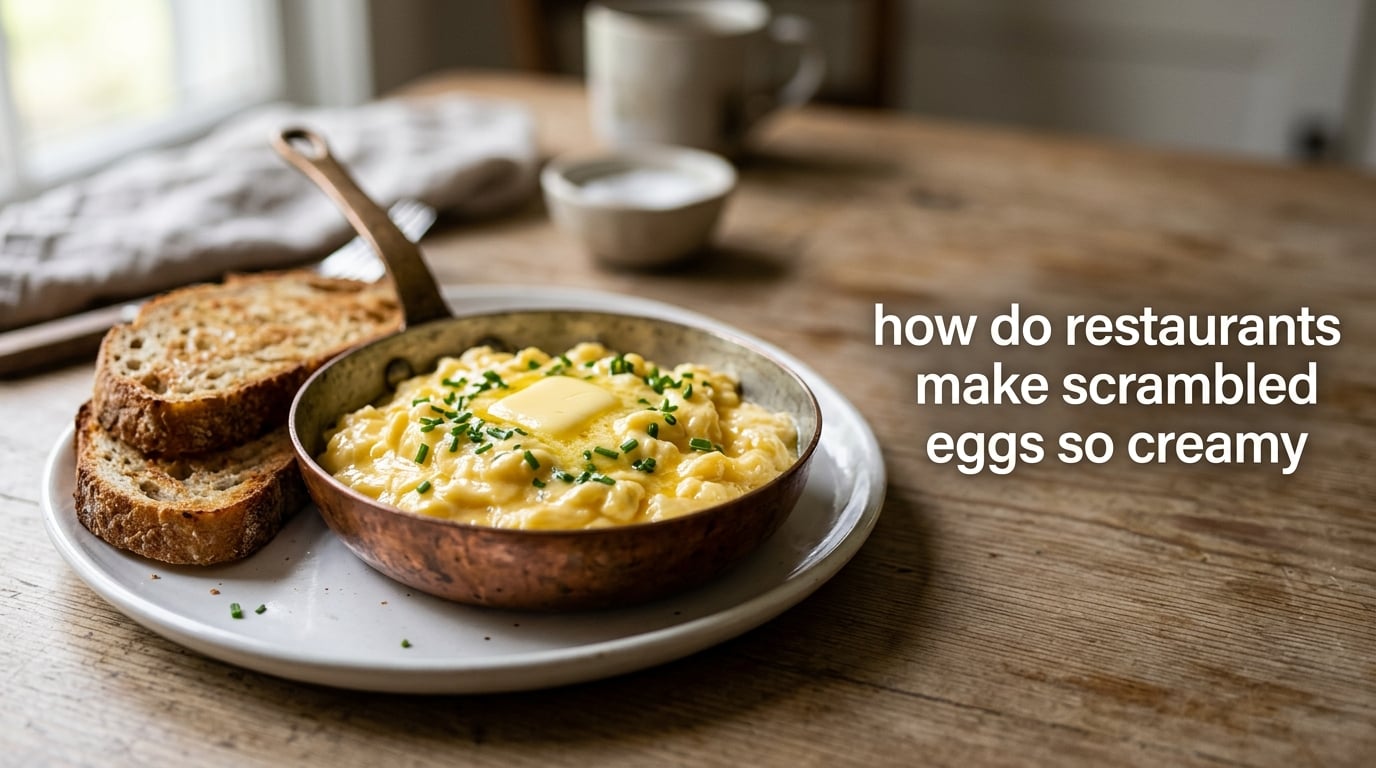
If you’ve ever ordered scrambled eggs at a brunch spot and wondered why yours at home come out dry, brown, and a little rubbery while theirs arrive pillowy, glossy, and almost custard-like, you’re not alone. This is one of the most-searched cooking questions online, and the answer is less about a secret ingredient and more about a handful of small technique shifts you can copy tonight.
In this guide, I’ll walk through exactly how restaurants make scrambled eggs so creamy, the science behind why it works, the seven specific techniques chefs use, and a step-by-step method you can use at home on a regular nonstick pan. I’ll also cover Gordon Ramsay’s famous method, compare American diner and French bistro styles side-by-side, and answer the seven most-asked questions from cooking forums.
Table of Contents
Why Are Restaurant Scrambled Eggs So Creamy?
Restaurant scrambled eggs are creamy because chefs cook them low and slow in butter, stir constantly with a silicone spatula to form small tender curds, and pull the pan off the heat while the eggs still look slightly wet so carryover heat finishes cooking them. Fat coats the egg proteins, slowing the bonds that would otherwise tighten and squeeze out moisture, which is why gentle heat plus generous butter is the foundation of the entire technique.
To understand why this works, it helps to know what’s happening at a molecular level. Eggs are about 90% water and 10% proteins. When heat rises, those proteins unwind (denature) and bond to each other (coagulate), squeezing out the water as steam. High heat makes that bonding fast and tight, which is the rubbery texture most home cooks know too well.
Restaurants keep the heat low so proteins bond slowly and gently, leaving tiny pockets of water trapped inside a soft network of curds. That’s the custardy mouthfeel you’re chasing: a stable structure that still feels wet on the tongue.
The science, in plain terms
Three things happen at once when you scramble eggs: proteins denature, water evaporates, and fat emulsifies with the proteins. Butter (which is roughly 80% fat and 20% milk solids) wraps each protein in a thin fatty layer, slowing how fast the proteins can bond. The slower they bond, the smaller the curds and the more water they retain.
This is also why high-fat dairy like heavy cream or crème fraîche produces a richer result than water. Fat physically gets in the way of protein bonds, and water does the opposite — it adds steam that puffs the eggs up but doesn’t slow coagulation. Both can work, but for very different textures.
The 7 Techniques Chefs Use for Creamy Scrambled Eggs
If you only have a minute, here are the seven techniques that separate restaurant scrambled eggs from most home versions. None of them require special equipment or expensive ingredients.
- Cook on low heat, not medium. If the butter sizzles when it hits the pan, the heat is too high. Aim for a gentle sizzle and slow, lazy bubbles.
- Use more butter than you think. Restaurants often use one to two tablespoons of butter per three eggs. The fat is the creaminess.
- Stir constantly with a silicone spatula. Long, slow pushing and folding strokes build small curds instead of one large rubbery pancake.
- Add dairy — but pick the right one. Heavy cream and crème fraîche are richer; whole milk is lighter; water makes fluffier but less rich eggs.
- Pull the pan off the heat early. Take the eggs off while they still look glossy and slightly underdone. Carryover heat will finish them in 30 to 60 seconds.
- Don’t overcrowd the pan. Cook three to four eggs at a time in an 8-inch skillet. Crowding drops the pan temperature and makes uneven, wet spots.
- Season at the right moment. Salt early (before cooking) for tender curds, or at the end for a cleaner, more pronounced salt flavor.
Master these seven moves and you’ll get restaurant-style results from a basic nonstick pan in under five minutes.
Step-by-Step: How to Cook Creamy Scrambled Eggs at Home
Here’s the exact method I use on busy mornings when I want eggs that taste like they came from a brunch spot. Total active time is about 4 minutes; total time including prep is closer to 6.
What you’ll need
- 3 large eggs, ideally pasture-raised and room temperature
- 1 tablespoon heavy cream or whole milk
- 1.5 tablespoons unsalted butter
- Fine sea salt and freshly ground white or black pepper
- 8-inch nonstick skillet
- Heat-resistant silicone spatula
The method
Step 1 — Whisk gently. Crack the eggs into a cold bowl. Add the cream and a small pinch of salt. Whisk with a fork just until the yolks and whites are combined and the mixture is uniform. Don’t whip air into it; you want a calm, even blend.
Step 2 — Melt butter over low heat. Add the butter to the cold skillet. Put the pan on low. Let the butter melt slowly while you finish the next step — by the time you turn back, it should be foamy but not browned.
Step 3 — Pour and pause. Pour the eggs into the pan. Let them sit untouched for about 20 to 30 seconds, just until you see the edges starting to set and a thin layer form on the bottom.
Step 4 — Push, don’t scramble. Use the silicone spatula to push the set edges toward the center while tilting the pan so uncooked egg flows into the empty space. Repeat every 10 to 15 seconds with long, gentle strokes.
Step 5 — Watch for the glossy stage. After about 90 seconds, the eggs will form large, soft curds with a shiny, wet surface. This is your cue. Take the pan off the heat now, even though the eggs look slightly underdone.
Step 6 — Carryover finish. Keep stirring gently off the heat for 30 seconds. The eggs will continue to set from residual heat. Stop when they look like soft, small curds with a satiny surface.
Step 7 — Season and serve. Add a small pinch of salt, a few grinds of pepper, a knob of cold butter, and fresh chives if you have them. Serve immediately on warm toast or a plate. Scrambled eggs lose creaminess within 90 seconds of sitting, so plate timing matters.
Why carryover cooking is the secret weapon
Eggs hold a lot of residual heat. The temperature of your curds continues to climb for 30 to 60 seconds after you pull the pan off the burner. If you wait until the eggs “look done” in the pan, carryover will overcook them by the time they reach the plate. Pulling early is the single biggest jump in texture for home cooks.
Gordon Ramsay’s Method (and Why It Works)
Gordon Ramsay famously adds crème fraîche, butter, and chives to his scrambled eggs, and the technique mirrors everything the science predicts. He cooks in a nonstick pan over low heat, pulls the pan off the burner several times during cooking to control the temperature, and finishes by folding in cold butter and chives for a glossy, rich finish.
The crème fraîche matters because it is roughly 36 to 40% fat — much higher than milk — and contains lactic acid, which subtly slows protein bonding. The result is a tangier, creamier curd that holds together without going dense. If you don’t have crème fraîche, the closest substitutes are sour cream or a 50/50 mix of heavy cream and whole-milk yogurt.
Ramsay also stirs in long, slow arcs rather than rapid chopping motions, which is exactly what builds the small, soft curds you want. Quick chopping breaks the curds into tiny, dry-looking bits, which is the diner-style texture some people love and others find too fine.
American Diner vs French Bistro Scrambled Eggs
The “right” way to scramble eggs depends entirely on which restaurant tradition you’re copying. American diners and French bistros approach the same dish from opposite ends of the heat and texture spectrum. Here’s how they differ.
| Element | American Diner Style | French Bistro Style |
|---|---|---|
| Heat level | Medium to medium-high | Low, often using a bain-marie |
| Fat | Butter, often with a touch of oil to prevent burning | Generous butter; sometimes clarified butter |
| Add-in liquid | Whole milk or water | Cream or crème fraîche |
| Stirring | Quick chopping into fine curds | Long, slow pushing strokes; barely stirred |
| Curd size | Small, fine, fluffy | Large, soft, custardy ribbons |
| Finish | Served hot, sometimes with cheese folded in | Pulled off heat early; glossy and slightly loose |
| Color | Pale yellow, sometimes with light brown edges | Buttery yellow, no browning at all |
If you’ve been chasing a particular restaurant’s scrambled eggs and your home version isn’t matching, the heat and stir style is almost always the difference. French bistros want soft, custardy ribbons; diners want fine, fluffy curds with a touch of color. Pick one and tune your technique accordingly.
Why diner eggs often taste “better than homemade”
Diner scrambled eggs usually taste richer than home versions because commercial kitchens use a much heavier hand with butter and often finish with a slice of American or cheddar cheese folded in during the last 30 seconds. The salt and fat from the cheese amplifies flavor even before the eggs hit the toast.
Milk vs Cream vs Crème Fraîche vs Water: Which Makes Creamier Eggs?
This is one of the most-debated questions in cooking forums, and the answer depends on what kind of “creamy” you mean. Rich, custardy, fluffy, and velvety are four different goals, and each liquid hits one of them better than the others.
| Liquid | Fat % | Effect on eggs | Best for |
|---|---|---|---|
| Water | 0% | Adds steam; produces fluffier, lighter curds | American diner style; volume cooking |
| Whole milk | ~3.5% | Balanced moisture and richness; mild flavor | Everyday home cooking; mild taste |
| Heavy cream | ~36% | Rich, velvety curds; noticeably heavier | Bistro-style eggs; rich mouthfeel |
| Crème fraîche | ~36–40% | Rich like cream, plus tangy lactic acid | Gordon Ramsay method; finishing eggs |
My rule: use cream or crème fraîche when you want soft, rich, custardy ribbons. Use whole milk for everyday breakfast eggs where you want moisture without weight. Use water only when you want light, diner-style fluff — and even then, a teaspoon of butter at the end will save the texture.
Common Mistakes: Why Your Scrambled Eggs Turn Out Rubbery
If your homemade scrambled eggs come out dry, rubbery, brown, or stuck to the pan, one of these seven mistakes is almost always the cause. I’ve made all of them myself over the years.
- Heat too high. The most common cause. If the butter browns within seconds, the heat is too high. Drop to medium-low and try again.
- Cooking too long. Scrambled eggs only need 60 to 90 seconds on the heat. The rest is carryover. If you stand over the pan waiting for them to “look done,” you’ve already overcooked them.
- Whisking air into the eggs. A violent whisk adds foam, which turns into dry pockets once cooked. Whisk gently until just combined.
- Crowding the pan. Four eggs in a 12-inch skillet will never cook evenly. Use a smaller pan or cook in two batches.
- Wrong pan. Stainless steel gives great color but sticks easily. For creamy eggs, use a nonstick skillet or well-seasoned cast iron.
- Wrong tool. A fork chops the curds into tiny dry bits. A silicone spatula pushes and folds without breaking the surface.
- Skipping the salt timing. Salt pulls moisture out of the eggs. Add it early for tender curds, or only at the end if you want a sharper salt pop.
The fix for almost every rubbery-egg problem is the same: lower the heat, add more butter, and pull the pan off earlier than feels right. Eggs go from perfect to overcooked in about 20 seconds, so trust the visual cues more than the clock.
Troubleshooting: what if my eggs are already overcooked?
If your scrambled eggs have already gone rubbery, you can’t fully undo the damage, but you can rescue the meal. Slide them onto a plate, top with cold butter, and let it melt into the hot curds — the added fat softens the texture and adds moisture back. A sprinkle of crème fraîche or a splash of warm cream stirred in at the table will also help. Next time, pull the pan 30 seconds earlier.
Frequently Asked Questions
What is the secret to creamy scrambled eggs?
The secret is cooking on low heat with plenty of butter and stirring constantly with a silicone spatula to form small, soft curds. Pull the pan off the heat while the eggs still look slightly wet, and let carryover heat finish them. Fat coats the proteins and slows coagulation, which keeps water trapped inside the curds for that custardy texture.
How do restaurants get their scrambled eggs so fluffy?
Restaurants get fluffy scrambled eggs by combining low heat, gentle continuous stirring, and often a small splash of water or milk that creates steam as it cooks. Steam puffs the curds up from the inside, while low heat prevents the proteins from tightening. Diner-style kitchens lean especially hard on this approach.
What does Gordon Ramsay add to his scrambled eggs?
Gordon Ramsay adds crème fraîche, cold butter, and fresh chives to his scrambled eggs, finishing them off the heat so they stay glossy and soft. The crème fraîche brings extra fat and a subtle tang, while the cold butter at the end creates a velvety finish. He cooks the eggs in a nonstick pan over low heat and pulls the pan off the burner several times during cooking to control the temperature.
What makes restaurant scrambled eggs so good?
Restaurant scrambled eggs taste so good because chefs cook them low and slow, use generous butter, and finish with a small pat of cold butter or fresh herbs right before serving. The combination of fat, gentle heat, and the freshness of just-cooked eggs produces a richer flavor and a creamier texture than most home versions.
Why are diner scrambled eggs so good?
Diner scrambled eggs are so good because commercial kitchens cook on higher heat with butter or oil, chop the curds into small fine pieces for a fluffy texture, and often fold in cheese during the last 30 seconds. The browned edges, salt from the cheese, and fast turnover all add up to a richer, more savory breakfast than home cooking usually delivers.
The Bottom Line
If you’ve been wondering how restaurants make scrambled eggs so creamy, the answer is really about seven small choices repeated every time: low heat, plenty of butter, constant gentle stirring, the right dairy, an early pull from the heat, a non-crowded pan, and well-timed seasoning. None of those moves alone is dramatic, but together they produce eggs that look glossy, feel custardy, and taste richer than anything you’ve made at home.
Try the step-by-step method above tomorrow morning with a heavy hand on the butter and a 30-second-earlier pull. Once you see the difference, you’ll never go back to medium-high heat and a fork.