
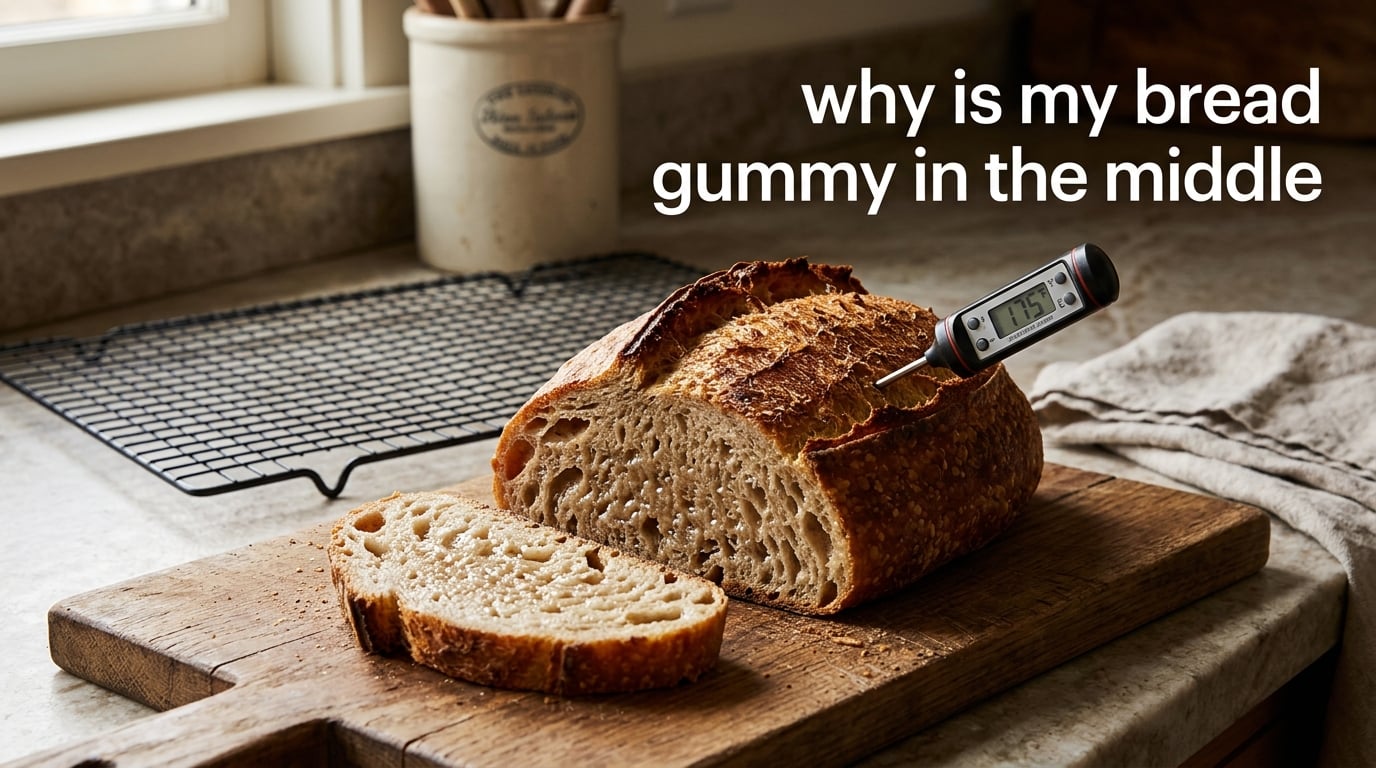
You’re staring at a golden-brown loaf, slice into it, and the inside is sticky and raw. If you’re asking why is my bread gummy in the middle, the short answer is that the crumb didn’t finish setting in the oven, or you cut it before the interior had time to firm up. In our test kitchen, this is the single most common complaint from home bakers, and it’s almost always one of four causes.
In this guide, I’ll walk you through those four causes, show you exactly how to diagnose which one is yours, and share the rescue technique that gets a finished-but-gummy loaf back on track. You’ll also get the specific numbers bakers on Reddit and The Fresh Loaf trust most: an internal temperature of 205 to 210°F and a cooling window of 2 to 4 hours for sourdough.
Table of Contents
Quick Answer: The 4 Common Causes of Gummy Bread
If you only have 60 seconds, here are the four reasons bread ends up gummy in the middle. Each one links to a deeper fix further down.
- The loaf is underbaked. The starches in the crumb never reached full gelatinization. Pull it when the internal temperature hits 205 to 210°F.
- You sliced too soon. Steam is still trapped inside. Wait at least 45 to 60 minutes for yeasted loaves and 2 to 4 hours (some bakers say 7) for sourdough.
- The dough was over-hydrated. More water means more moisture the oven has to drive off. Lower hydration or extend the bake.
- The dough was under-fermented or over-fermented. Either breaks the structure that holds gas and lets the crumb stay dense and tacky.
Those four cover roughly 95% of cases we see. The rest comes down to oven hot spots, shaping, and the flour itself. Skip ahead to the diagnostic checklist if you already know one of these sounds like your loaf.
What Does Gummy Bread Look and Feel Like?
Gummy bread almost always fools you from the outside. The crust is golden, often beautifully scored, and smells fully baked. The betrayal happens when you cut it open.
The signs to look for in the crumb:
- Sticky, tacky interior that clings to the knife and pulls into “dough strings”
- Dense, wet-looking crumb with no springiness when pressed
- A pale, raw-looking center even though the loaf reads as done
- Visible moisture or a wet line running through the middle of the slice
Forum bakers on The Fresh Loaf and r/Sourdough also describe “dough balls” sticking to the blade and a faint raw flour taste. If any of those match what you’re seeing, the crumb didn’t fully set.
Cause #1: The Interior Is Underbaked
An underbaked center is the most common reason for a gummy middle, and it usually hides behind a perfectly browned crust. The crust colors early because sugar and Maillard reactions happen at the surface; the crumb has to reach 205 to 210°F internal temperature for the starches to fully gelatinize and the structure to set.
If your oven runs cool, has hot spots, or you’re baking dense enriched doughs (rye, whole wheat, gluten-free), the crust can brown before the center catches up. Pull the loaf at color and you’ll cut into raw starch.
How to fix it:
- Use an instant-read thermometer. Probe into the thickest part of the bottom or side. Look for 205 to 210°F.
- If the top browns too fast, tent with foil for the last 15 to 20 minutes of the bake.
- Rotate the loaf halfway through to even out hot spots.
- Add 5 to 10 minutes to your bake time if your oven runs consistently cool (a separate oven thermometer helps confirm).
Cause #2: You Sliced the Bread Too Soon
Hot bread is still full of steam. When you slice too early, that steam escapes all at once and the crumb collapses into a gummy, sticky mass. The starches are cooked but they haven’t had time to firm up as the loaf cools.
The cooling window depends on the bread:
- Yeasted sandwich loaves: 45 to 60 minutes minimum on a wire rack.
- Lean yeasted boules: 1 to 2 hours.
- Sourdough: 2 to 4 hours is the standard; experienced bakers on Reddit and The Fresh Loaf often wait 6 to 8 hours or even overnight.
How to fix it:
- Cool the loaf on a wire rack so air circulates on all sides; a flat counter traps steam underneath.
- Resist the urge to slice “just the heel” to test. Wait the full time.
- Slice with a sharp, serrated bread knife in a single smooth motion — dragging encourages gumminess.
Cause #3: Too Much Water or High Hydration Dough
Hydration is the baker’s word for the ratio of water to flour by weight. Higher hydration (75% to 85%) creates an open, airy crumb in skilled hands, but it also leaves more moisture that the oven has to drive off. If your dough is wetter than your bake time accounts for, that moisture stays trapped inside and shows up as gumminess.
The Fresh Loaf forum thread on damp flour (around 14% moisture content in polypropylene sacks) showed the same effect — extra water in the flour behaves like extra water in the dough.
How to fix it:
- Drop hydration 2% to 5% and see if the interior sets more reliably.
- Extend the bake by 5 to 10 minutes; the extra time lets moisture escape.
- Crack the oven door for the last 5 minutes to vent residual steam.
- For whole wheat, rye, or high-fiber flours, add 5 to 10 minutes and confirm internal temperature.
Cause #4: Under-Fermented or Over-Fermented Dough
Fermentation builds the gluten network and creates the gas bubbles that give bread its open crumb. If you cut fermentation short, the dough lacks structure and bakes dense and gummy. If you let it run too long, the gluten weakens and the loaf collapses inward, again leaving a wet, sticky center.
Symptoms to tell them apart:
- Under-fermented: tight crumb, dense, few holes, gummy and pale.
- Over-fermented: flat top, large irregular holes, sticky crumb, sour or alcoholic smell.
How to fix it:
- Use the poke test: floured finger into the dough. If the indent springs back slowly and leaves a slight mark, it’s ready. If it snaps back fast, give it more time.
- Track bulk fermentation by temperature and time, not just clock minutes — warmer kitchens ferment faster.
- For sourdough, look for a domed, jiggly top with visible bubbles along the sides.
Other Factors That Make Bread Gummy
Once you’ve ruled out the four main causes, a few less common variables are worth checking:
- Uneven oven heat. One side of the loaf browns and sets while the other stays raw. Rotate the pan halfway through bake.
- Steam management. Dutch oven or covered-bake builds oven spring and an open crumb; a dry, cold oven collapses structure. But leaving the lid on too long can also trap moisture inside if your bake time is short.
- Flour type and protein content. Whole grain and rye contain pentosans that absorb extra water. If you swap them in at the same hydration as white flour, expect gumminess unless you extend the bake.
- Shaping tension. A loosely shaped loaf spreads in the oven, creating thick zones that bake unevenly. Tight surface tension helps heat distribute evenly.
Diagnostic Checklist: Find Your Cause in 5 Steps
This is the shortcut most troubleshooting guides skip. Run through these in order and you’ll usually land on your cause inside five minutes.
- Check internal temperature. Bake a fresh test loaf with a probe and note the reading at color. If it’s under 205°F, your fix is longer bake time.
- Cool a full 4 hours and re-slice. If the gummy texture disappears, your fix is patience, not a recipe change.
- Review your bulk fermentation. Were there bubbles along the sides? Did the dough grow 50% to 75%? If not, give it more time.
- Test hydration by feel. Was the dough soft and slack, or firm and bouncy? Slack dough with the same bake time usually means too much water.
- Check your oven. Run an empty oven at 350°F with a separate thermometer. If it’s off by 25°F or more, recalibrate or buy an oven thermometer.
Whichever step reveals the problem tells you which of the four causes is yours. Fix that one variable first, then re-bake before changing anything else.
How to Fix Gummy Bread (and How to Rescue a Loaf That’s Already Baked)
Here’s the action plan, cause by cause, plus the rescue technique for a loaf that’s already out of the oven.
If it’s underbaked: Bake longer next time. Aim for 205 to 210°F internal. Tent with foil if the top darkens too early.
If you sliced too soon: Wait. There’s no shortcut, but you can speed the cooling without compromising texture: place the loaf on a wire rack in a room with a fan moving air gently around it.
If hydration is too high: Drop 2% to 5%, or extend bake by 5 to 10 minutes, or vent steam in the last 5 minutes of bake.
If fermentation is off: Adjust bulk time by 30 to 60 minutes based on dough cues, not the clock.
Rescue an already-baked gummy loaf: This is the trick from The Fresh Loaf that bakers swear by. Turn the oven off, return the loaf to the cooling rack inside the closed oven, and leave it for 20 to 30 minutes. The residual heat gently drives off interior moisture without over-browning the crust. Slice and check. Repeat once if needed.
If the loaf is only mildly gummy, you can also slice it and toast the slices — the dry heat finishes setting the crumb in the toaster or oven.
Sourdough vs Yeasted Bread: How Troubleshooting Differs
Sourdough and yeasted bread fail differently, so the fix isn’t always the same.
- Cooling time: Sourdough needs 2 to 4 hours at minimum, often 6 to 8. Yeasted loaves are usually fine at 45 to 90 minutes.
- Internal temperature target: Both target 205 to 210°F, but sourdough’s longer bake naturally drives off more moisture.
- Common cause: Yeasted bread gummies usually trace to underbaking or slicing early. Sourdough gummies more often come from under-fermentation or shaping tension.
- Rescue technique: Works for both. The off-oven rest is especially helpful for sourdough because of its higher hydration.
Climate, Altitude, and Flour Adjustments
Two loaves baked from the same recipe can behave like completely different doughs in different kitchens. Here are the adjustments that matter most.
- Humid climates: Flour absorbs ambient moisture. Reduce water 2% to 3% or extend bake 5 minutes.
- Dry climates: Dough loses moisture to the air. Add 1% to 2% water or cover during bulk fermentation.
- High altitude (above 3,000 ft): Lower atmospheric pressure means loaves reach a lower peak internal temperature. Bakers at 6,000 ft report maxes around 199°F. Extend bake time by 10 to 15 minutes and rely more on visual cues plus cooling time.
- Damp flour: If your flour feels heavy or clumps, dry it briefly in a low oven (170°F for 10 minutes) before weighing, or reduce added water.
Tools That Take the Guesswork Out
You don’t need much, but these three pieces of gear earn their space fast.
- Instant-read thermometer. The single biggest upgrade for diagnosing gummy bread. A reading of 205 to 210°F removes all doubt.
- Wire cooling rack. Air circulation underneath prevents the bottom from getting soggy and speeds even cooling.
- Kitchen scale. Hydration calculations by weight (not volume) keep your dough consistent from bake to bake.
Frequently Asked Questions
What are the common causes of gummy bread?
The four most common causes of gummy bread are an underbaked interior, slicing the loaf before it has cooled, dough that is over-hydrated, and dough that is under- or over-fermented. Less common causes include uneven oven heat, poor steam management, dense flours that need more bake time, and loose shaping that creates thick zones.
How to fix bread that is doughy in the middle?
Bake until the internal temperature reaches 205 to 210°F, cool the loaf on a wire rack for at least 45 to 60 minutes for yeasted bread or 2 to 4 hours for sourdough, drop hydration 2% to 5% if your dough runs wet, and extend bulk fermentation if the dough lacks bubbles and dome. For an already-baked loaf, return it to a turned-off oven for 20 to 30 minutes to drive off interior moisture.
Is gummy bread okay to eat?
Gummy bread is generally safe to eat as long as it has actually reached an internal temperature above 200°F and shows no signs of mold, off smells, or visible spoilage. The texture is unpleasant because starches didn’t fully set, but it isn’t a food-safety issue. If the loaf is also underbaked and raw in the center, it’s best to re-bake rather than eat it raw.
What does gummy bread look like?
Gummy bread looks golden and fully baked on the outside, but the inside is sticky, dense, and pale. The crumb clings to the knife when sliced, often pulling into dough strings, and the interior may look wet or show a raw line through the middle of the slice.
The Bottom Line
If your bread is gummy in the middle, work through the four causes in order: underbaked, sliced too soon, over-hydrated, or off fermentation. Confirm with an instant-read thermometer at 205 to 210°F and respect the cooling window — 45 to 60 minutes for yeasted loaves, 2 to 4 hours (often more) for sourdough. For a loaf that’s already out of the oven and gummy, the off-oven rest rescues most cases in 20 to 30 minutes. Diagnose first, change one variable, then bake again. That’s how every gummy loaf in our kitchen has eventually become a great one.