
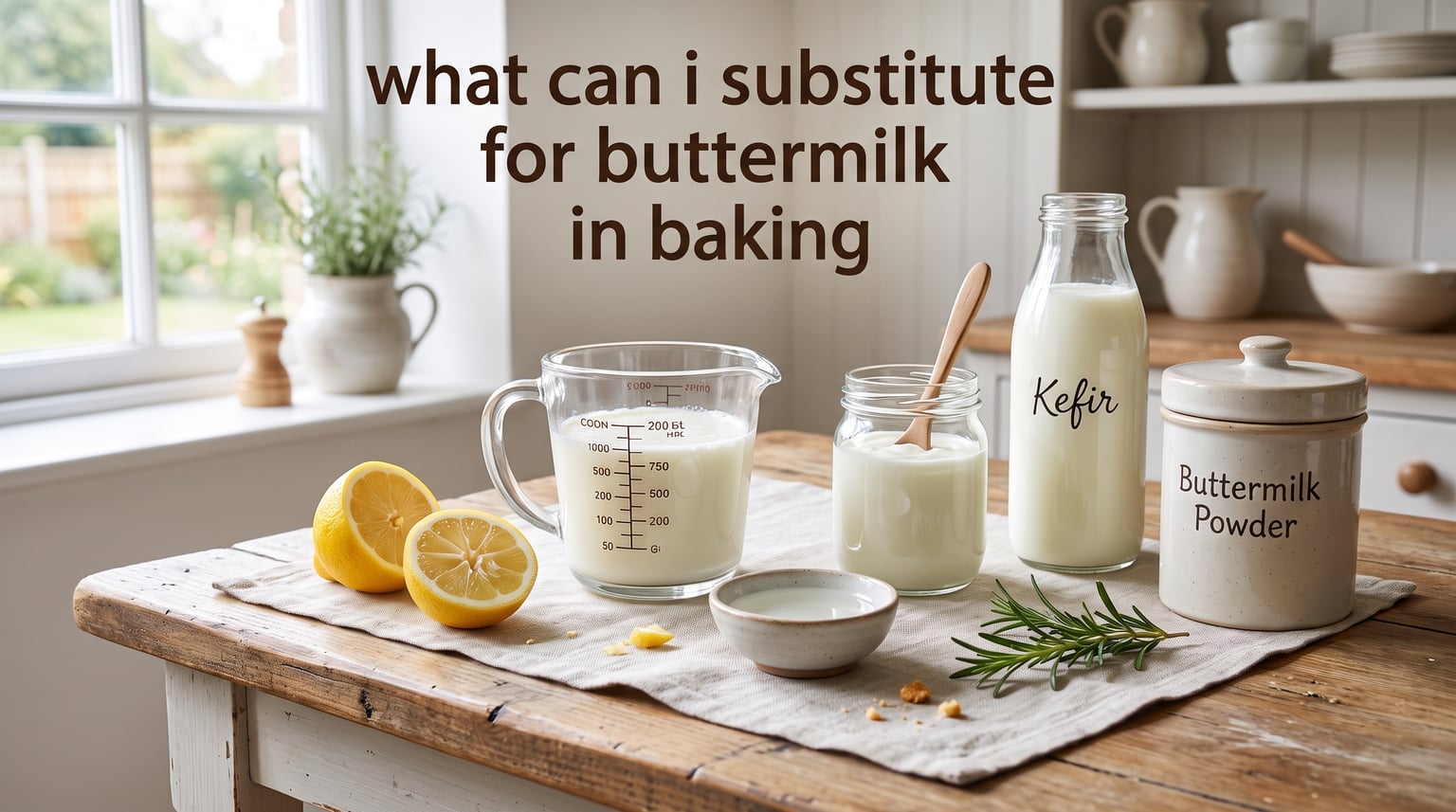
You cracked open the recipe, scanned the wet ingredients, and realized your bottle of buttermilk is nowhere to be found. Maybe it’s 9 p.m., maybe you’re out of town, or maybe buttermilk just doesn’t sell in your country. Whatever the reason, I want to save your bake.
In our test kitchen, we ran seven buttermilk substitutes through pancakes, biscuits, cakes, soda bread, and muffins. Every swap on this list works — but the ratio, rest time, and best recipe type differ. Below you’ll find the canonical DIY ratio that matches the AI Overview answer, plus six other methods, a ratio cheat sheet, and a recipe-by-recipe guide so you know exactly which swap to reach for tonight.
Table of Contents
Quick Answer: The Best Buttermilk Substitute for Baking
1 tablespoon of lemon juice or white vinegar plus enough regular milk to reach the 1-cup line, left to rest for 5 to 10 minutes. This is the same ratio Sally’s Baking Addiction, King Arthur, and The Kitchn all recommend, and it works in pancakes, biscuits, cakes, muffins, and quick breads. The acid gently curdles the milk so it mimics the tang and texture of cultured buttermilk, which is exactly what most leavened bakes need.
You can swap lemon juice for white vinegar or apple cider vinegar 1:1. Whole milk gives the richest result, but 2% works fine. Skip this method only when the recipe needs more than 1 cup of buttermilk — the texture starts to drift and real buttermilk is the better call.
What Is Buttermilk and Why Does It Matter in Baking?
Modern buttermilk isn’t the thin liquid your grandmother poured off the butter churn. Today’s cultured buttermilk is milk that’s been fermented with live lactic acid bacteria. Those bacteria convert a small amount of the milk’s lactose into lactic acid, which gives buttermilk its tangy flavor and thicker, creamier texture.
In baking, buttermilk matters for three reasons. First, the lactic acid reacts with baking soda to produce carbon dioxide bubbles that leaven the batter. Second, the acid tenderizes gluten strands so cakes stay soft and biscuits stay flaky. Third, the tang rounds out sweet flavors in pancakes, waffles, and muffins.
If you swap in plain whole milk without any acid, two things happen. Baking soda can’t react on its own, so the bake turns out dense and flat. The acid that normally softens gluten is gone, so the crumb tightens. The flavor also goes flat — pancakes lose their signature tang and cake loses depth.
You don’t need cultured buttermilk’s exact flavor profile in every recipe. You need the same acidity and roughly the same viscosity. That’s what every substitute on this list supplies.
1. Milk + Lemon Juice or White Vinegar (Best All-Around Swap)
This is the buttermilk substitute I reach for first when I’m out of buttermilk. It’s pantry-friendly, takes five minutes, and works in almost every bake where buttermilk is called for.
How to make it
Step 1. Measure 1 tablespoon of fresh lemon juice or distilled white vinegar into a 1-cup liquid measuring cup.
Step 2. Pour cold whole milk (or 2% milk) into the same cup until the total liquid reaches the 1-cup line.
Step 3. Give it a quick stir and let it sit on the counter for 5 to 10 minutes.
Step 4. By the time the rest is over, the milk should look slightly curdled and smell faintly tangy. Use it as a 1:1 swap for the buttermilk in your recipe.
Why this method works
The acid in lemon juice or vinegar gently coagulates milk proteins near the surface. After a few minutes, the milk thickens and develops the sour note buttermilk is known for. The Kitchn ran this method through pancakes and rated it 3 out of 10 for flavor nuance, but a perfect 10 for accessibility. Sally’s Baking Addiction used it in cornbread muffins, shortcake biscuits, and no-yeast bread with no texture problems at all.
Lemon juice vs vinegar
Fresh lemon juice gives a softer, fruitier tang. White distilled vinegar tastes sharper and can read slightly harsh in delicate cookies or light cakes. Apple cider vinegar sits in the middle — milder than white vinegar, more mellow than lemon. For most recipes, all three acids work 1:1.
Best for
Pancakes, waffles, biscuits, muffins, quick breads, cornbread, and standard cakes. Use 2% or whole milk for the richest crumb. This method is less reliable in recipes that need more than 1 cup of buttermilk, since the flavor of the acid starts to come through.
What the science says
Lactic acid and acetic acid both lower the pH of milk to roughly the same range as cultured buttermilk (around 4.4 to 4.6). When that acid meets baking soda in the batter, it triggers the same carbon dioxide reaction that real buttermilk would. The bubbles form during mixing and again in the oven’s heat, lifting the batter and setting the crumb.
2. Plain Yogurt or Sour Cream (Best for Cakes and Muffins)
Plain whole-milk yogurt and sour cream are my go-to swaps in cakes, cupcakes, and muffins where I want the richest possible crumb. They already have the tang, the body, and the milk fat buttermilk brings to the table.
How to substitute
For every 1 cup of buttermilk the recipe calls for, use 1 cup of plain whole-milk yogurt or full-fat sour cream. If the yogurt or sour cream is very thick (Greek yogurt or a heavy sour cream), thin it with a little milk or water until it pours like buttermilk — roughly 3/4 cup yogurt plus 1/4 cup milk.
Why it works
Both yogurt and sour cream are fermented dairy products. They already contain lactic acid, live cultures, and milk solids in roughly the same ratios buttermilk has. King Arthur Baking tested this method across biscuits, pancakes, and cake and rated it the best substitute for cake specifically, because the added milk fat makes the crumb more tender than the milk + acid method.
Best for
Yellow cake, chocolate cake, red velvet cake, cupcakes, muffins, banana bread, and pound cake. Less ideal for biscuits where you want extra lift, since the thicker body of yogurt can weigh down the dough slightly.
Reader tip
One Sally’s Baking reader reported using the whey drained off homemade Greek yogurt as a perfect buttermilk swap. If you strain yogurt regularly, save that whey in a jar in the fridge — it behaves almost exactly like buttermilk.
3. Kefir (Closest Flavor Match to Real Buttermilk)
Kefir is the closest thing you can buy off the shelf to real buttermilk. Serious Eats called it “almost indistinguishable from the real thing” in their biscuit tests. Plain kefir is fermented milk, just like cultured buttermilk, and you can swap it 1:1 with no other adjustments.
How to substitute
Use plain unflavored kefir in place of buttermilk 1:1. If your kefir is too thick to pour easily, whisk it with a tablespoon of milk until it loosens up.
Why it works
Kefir is fermented with a different mix of bacteria and yeast than buttermilk, but the result — lactic acid, tangy flavor, creamy body — is functionally similar in baking. The pH is in the same range, the milk solids are present, and the viscosity behaves the same way in batter.
Best for
Biscuits, pancakes, scones, Irish soda bread, cornbread, and any bake where you want the closest possible match to real buttermilk flavor. Works equally well in cake and muffins.
What to watch for
Some flavored or sweetened kefirs on the shelf will wreck a savory bake. Always reach for plain unflavored kefir — the kind sold in the dairy aisle next to yogurt, not the drinkable flavored bottles.
4. Cream of Tartar + Milk (When You’re Out of Lemons)
When you have no lemon, no vinegar, and no yogurt in the fridge, cream of tartar is your backup plan. It’s a dry acid powder that bakers usually keep in the spice cabinet for stabilizing egg whites.
How to substitute
For 1 cup of buttermilk, whisk 1 3/4 teaspoons of cream of tartar into 1 cup of milk. Stir, rest 5 to 10 minutes, then use as a 1:1 swap. The mixture will look slightly foamy and smell faintly of cream of tartar.
Why it works
Cream of tartar is tartaric acid. It dissolves into milk and lowers the pH into the same range buttermilk sits in. The Kitchn ranked this method 2 out of 10 in pancakes — workable, but the cream of tartar flavor is detectable in light bakes.
Best for
Pancakes, waffles, biscuits, and cornbread where the cream of tartar’s faint metallic edge blends into the other ingredients. Skip this method for delicate vanilla cakes and sugar cookies, where the flavor reads as off.
What to watch for
Don’t double or triple the cream of tartar. Too much adds a bitter aftertaste and the milk will refuse to thicken properly. Stick to the 1 3/4 teaspoons per cup ratio.
5. Powdered Buttermilk (Pantry Staple for Frequent Bakers)
Powdered buttermilk is real cultured buttermilk that’s been spray-dried into powder. The Kitchn rated it the best buttermilk substitute in their pancake test, and Bob’s Red Mill and King Arthur both sell it. If you bake often, a canister in the pantry ends the buttermilk problem for good.
How to substitute
Reconstitute the powder with water before adding to your batter. For every 1 cup of buttermilk, whisk 1/4 cup of buttermilk powder into 1 cup of cool water. Let it sit for 5 minutes, give it another whisk, then use it like fresh buttermilk.
Why it works
The powder is made from real buttermilk, so once it’s rehydrated, it behaves identically in batter. It has the same acidity, same milk solids, same flavor profile. The shelf life is years instead of weeks.
What to watch for
Multiple Reddit bakers have warned that adding powdered buttermilk directly to dry ingredients creates clumps that never fully dissolve. Always whisk it with water first, separately from the rest of the batter. The clumps are not the end of the world, but they leave chalky pockets in the finished bake.
Best for
Everything buttermilk does — pancakes, biscuits, cakes, muffins, scones, cornbread, quick breads. This is the only substitute that gives you a true flavor match.
6. Dairy-Free and Vegan Buttermilk Substitutes
For lactose-intolerant bakers or anyone cooking dairy-free, the same acid + milk principle applies — only the milk swaps out. The Kitchn tested almond milk + apple cider vinegar and ranked it 1 out of 10 in pancakes because almond milk lacks milk solids. Soy milk and oat milk give a noticeably better result because they have more protein and body.
Best dairy-free options
Soy milk + 1 tablespoon apple cider vinegar per 1 cup soy milk. Whisk, rest 10 minutes, use 1:1. Soy milk has the most protein of the plant-based milks, so it curdles properly and provides the body buttermilk normally supplies.
Oat milk + 1 tablespoon apple cider vinegar per 1 cup oat milk. Whisk, rest 10 minutes, use 1:1. Oat milk curdles well and tastes neutral in most baked goods.
Almond milk + 1 tablespoon apple cider vinegar per 1 cup almond milk. Works but the result is thinner and slightly watery in cakes. Reserve this for pancakes and muffins where the texture difference is less noticeable.
Coconut milk (carton, not canned) + 1 tablespoon apple cider vinegar per 1 cup. Use only in recipes where a faint coconut note won’t clash — muffins, banana bread, tropical cakes.
How long to rest
Plant-based milks take a little longer to curdle than dairy. Give the mixture a full 10 minutes, and don’t worry if you don’t see obvious curdling — the acid has still done its job at the pH level.
Lactose-free option
If you’re lactose-intolerant but not vegan, lactose-free whole milk (Lactaid and similar brands) plus 1 tablespoon of lemon juice or vinegar per cup works exactly like regular dairy buttermilk. Sally’s team confirmed this swap. The crumb is slightly less tender than full-fat dairy buttermilk because lactose-free milk is often lower in fat, but it still gives the rise and tang you need.
Buttermilk Substitute Ratio Cheat Sheet
Most recipes call for 1 cup of buttermilk, but smaller amounts come up in cookies, biscuits, and muffins. Here’s the breakdown for any amount the recipe throws at you.
For 1/4 cup buttermilk: 3/4 teaspoon acid + enough milk to reach the 1/4 cup line. Rest 5 minutes.
For 1/2 cup buttermilk: 1 1/2 teaspoons acid + enough milk to reach the 1/2 cup line. Rest 5 minutes.
For 3/4 cup buttermilk: 2 1/4 teaspoons acid + enough milk to reach the 3/4 cup line. Rest 5 to 10 minutes.
For 1 cup buttermilk: 1 tablespoon acid + enough milk to reach the 1-cup line. Rest 5 to 10 minutes.
For amounts above 1 cup, swap in plain yogurt or kefir instead of milk + acid — the texture stays consistent.
Best Buttermilk Substitute by Recipe Type
Different bakes want different things from buttermilk. A pancake batter is forgiving and thin, while a biscuit dough is stiff and needs lift. Here’s the swap I reach for in each.
Pancakes and waffles: Milk + 1 tablespoon lemon juice or white vinegar. Rest 10 minutes. The thin batter works perfectly with this method, and the tang comes through beautifully.
Biscuits and scones: Kefir 1:1, or milk + 1 tablespoon white vinegar for the flakiest layers. Greek yogurt thinned with a little milk also works.
Cakes (yellow, chocolate, red velvet): Plain whole-milk yogurt 1:1, or milk + 1 tablespoon lemon juice. The yogurt method gives the most tender crumb.
Muffins and quick breads: Milk + 1 tablespoon apple cider vinegar, or plain yogurt 1:1. Both produce a moist, tender result.
Soda bread and cornbread: Buttermilk powder reconstituted in water, or milk + 1 tablespoon white vinegar. These bakes need the tang more than the creaminess.
Cookies: For small amounts (1 to 3 tablespoons of buttermilk), skip the acid and just use whole milk. The flavor won’t register in a sweet cookie dough.
When to Just Buy Real Buttermilk
There’s an honest answer here. DIY buttermilk substitutes work, but they are not identical to real cultured buttermilk. Real buttermilk has more milk solids, a deeper fermented flavor, and a thicker body that no pantry swap fully replicates.
When the recipe calls for more than 1 cup of buttermilk — think tall layer cakes, big batches of pancakes, or holiday soda bread — the substitute flavor and texture start to drift. The cake may turn out slightly flatter, the pancakes slightly less rich. That’s when a small carton of store-bought buttermilk is worth the trip.
Many international readers on Reddit point out that buttermilk is genuinely hard to find outside the US. In that case, kefir is the closest substitute you can buy. Kefir is widely available in most European, Australian, and Canadian supermarkets and gives you a true fermented-dairy swap.
Can You Freeze Buttermilk?
Yes. Buttermilk freezes well and keeps for up to three months in the freezer. Pour it into ice cube trays or small freezer bags in the exact amounts your recipes call for — 1/4 cup portions are perfect for biscuits and cookies, 1 cup portions for pancakes and cakes.
Thaw frozen buttermilk overnight in the fridge. It will look separated when it thaws, but a quick whisk brings it back to its original consistency. Use thawed buttermilk exactly the way you’d use fresh.
DIY soured milk lasts 3 to 5 days in the fridge in a sealed jar. After that, the flavor sharpens and the texture changes. Make only what you need for the recipe at hand.
Frequently Asked Questions
What can you use if you don’t have buttermilk?
The most reliable substitute is 1 tablespoon of lemon juice or white vinegar stirred into enough milk to reach the 1-cup line, then rested for 5 to 10 minutes. The acid curdles the milk into a tangy, thickened liquid that behaves like buttermilk in pancakes, biscuits, cakes, muffins, and quick breads.
What happens if I use milk instead of buttermilk in baking?
Plain milk lacks the lactic acid buttermilk contains. Without that acid, baking soda can’t react and produce carbon dioxide, so the bake rises poorly and turns out dense. The crumb also tightens because the acid that softens gluten is missing, and the flavor loses its signature tang.
How do you substitute for buttermilk in baking?
For every 1 cup of buttermilk, stir 1 tablespoon of lemon juice or white vinegar into enough milk to reach the 1-cup line and rest 5 to 10 minutes before adding to the batter. For amounts above 1 cup, swap in plain yogurt or kefir 1:1 instead for better texture.
Can I substitute buttermilk for yogurt in baking?
Plain whole-milk yogurt works as a direct 1:1 swap for buttermilk in cakes, muffins, and quick breads. The lactic acid, milk fat, and creamy body in yogurt behave very similarly in batter. If the yogurt is very thick, thin it with a splash of milk until it pours like buttermilk.
Is there a good substitute for buttermilk when baking?
Yes. Milk plus 1 tablespoon of lemon juice or white vinegar per cup is the most accessible substitute and works in nearly every recipe. Kefir is the closest flavor match if you can buy it. Plain yogurt and sour cream give the richest crumb in cakes and muffins.
Does buttermilk substitute taste good?
The DIY milk and acid method is mild, tangy, and pleasant in pancakes, biscuits, and muffins. In delicate cakes or cookies where the buttermilk flavor is the star, real buttermilk tastes noticeably better. Kefir and yogurt substitutes come closest to the real flavor.
Do buttermilk substitutes actually work?
Yes. The Kitchn, Sally’s Baking Addiction, King Arthur, and Serious Eats have all tested buttermilk substitutes in real recipes. The substitutes rise, brown, and flavor the bakes correctly. The differences from real buttermilk are subtle and only noticeable in side-by-side comparisons.
Final Verdict
Now you know exactly what to substitute for buttermilk in baking — and which swap fits the recipe in front of you. The 1 tablespoon of lemon juice or white vinegar plus milk to the 1-cup line, rested 5 to 10 minutes, is your universal backup and the same ratio the top baking sites recommend. Reach for yogurt or kefir when you want a richer crumb. Use powdered buttermilk when you bake weekly. Try cream of tartar when the lemons are gone. Pick a plant-based option when you’re cooking dairy-free.
Save this page to your phone for the next time you’re mid-recipe and the buttermilk isn’t on the shelf. The ratio cheat sheet and recipe-by-recipe table will get you back to baking in five minutes.