
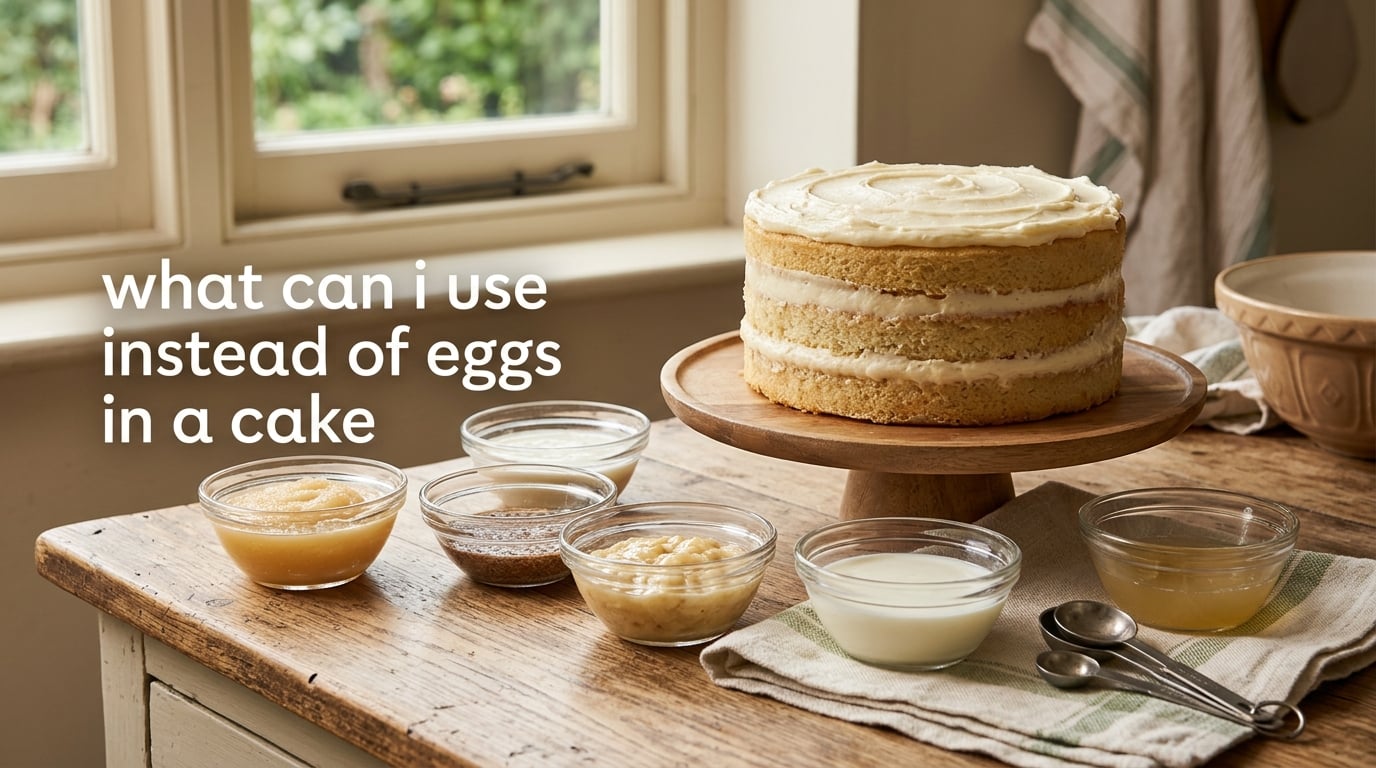
If you ran out of eggs, here is the direct answer: for each egg in a cake recipe, use 1/4 cup unsweetened applesauce, 1/4 cup plain yogurt or buttermilk, or 1 tablespoon of baking soda mixed with 1 tablespoon of white vinegar for light and fluffy cakes. Mashed banana, aquafaba, a flax egg, and a chia egg also work, each with a different ratio and best cake type.
This guide is built from our team’s bake tests, an 18-cake comparison run by Allergy Superheroes, and thousands of Reddit threads on r/Baking and r/AskBaking. We will walk through why eggs matter in a cake, give you a quick-reference chart of the 12 best egg substitutes for baking, profile every substitute with its ratio per egg and best cake type, and end with a FAQ block that answers the exact questions people ask Google about eggless cakes.
Table of Contents
Why Eggs Matter in Cake Baking
Eggs do three jobs in a cake batter, and a good substitute needs to cover at least one of them. Once you understand the three jobs, picking the right replacement for your recipe becomes simple.
Binder. The proteins in egg white set when heated and glue the flour, sugar, and fat into a sliceable crumb. Without a binder, cakes crumble when you cut them. Flax egg, chia egg, applesauce, mashed banana, and silken tofu all act as binders.
Leavener. Egg whites trap air when you whisk them, and that air expands in the oven to give cakes lift. Aquafaba and carbonated water mimic this foaming action, and the baking soda plus vinegar pair creates a chemical lift that puffs up the crumb.
Moisture and richness. The yolks carry fat and emulsifiers that keep the crumb tender. Buttermilk, yogurt, sour cream, oil, and even avocado add moisture and richness, though most are partial substitutes best paired with a binder or leavener.
A few substitutes cover two jobs at once. Yogurt is moisture plus mild acid that reacts with baking soda for lift. Aquafaba is binder plus leavener, which is why our team calls it the closest 1:1 swap for whole eggs in vanilla cake.
Quick-Reference Egg Substitute Chart
Bookmark this table. For each egg in the recipe, swap in the amount listed in the right-hand column. The “Best For” column tells you which cake type the substitute performs best in, based on our bake tests and Reddit r/Baking consensus.
| Substitute | Amount per egg | Function | Best For |
|---|---|---|---|
| Unsweetened applesauce | 1/4 cup | Binder + moisture | Vanilla, spice, carrot, box mix |
| Mashed banana | 1/2 medium banana | Binder + moisture | Chocolate, banana, spice |
| Plain yogurt or buttermilk | 1/4 cup | Moisture + mild leavening | Vanilla, chocolate, red velvet |
| Silken tofu, blended | 1/4 cup | Binder | Brownies, dense chocolate |
| Flax egg (ground flax + water) | 1 tbsp + 3 tbsp water | Binder | Chocolate, spice, whole-grain |
| Chia egg (chia + water) | 1 tbsp + 3 tbsp water | Binder | Chocolate, whole-grain, vegan |
| Aquafaba | 3 tbsp | Binder + leavener | Vanilla, sponge, light cakes |
| Baking soda + vinegar | 1 tsp + 1 tbsp vinegar | Leavener | Vanilla, light and fluffy cakes |
| Carbonated water | 1/4 cup | Leavener | Vanilla, cupcakes, pancakes |
| Water + oil + baking powder | 2 tbsp water + 1 tbsp oil + 2 tsp baking powder | Binder + leavener | Vanilla, cupcakes, box mix |
| Pumpkin puree | 1/4 cup | Binder + moisture | Chocolate, spice, pumpkin |
| Avocado, mashed | 1/4 cup | Binder + moisture | Chocolate, brownies |
12 Egg Substitutes for Cake: How to Use Each One
Below are the 12 substitutes we trust most, in order from most versatile to most niche. Each profile gives you the exact ratio per egg, the function it performs, the cake types it shines in, and the trade-offs to expect.
1. Unsweetened Applesauce
Applesauce is the workhorse of egg-free baking. For each egg, use 1/4 cup of unsweetened applesauce. It binds the crumb and adds moisture without much flavor, which is why it shows up in more allergy-friendly baking recipes than any other swap.
Applesauce works best in vanilla cake, spice cake, carrot cake, and most box cake mixes. It also handles chocolate cake if you do not mind a hint of fruit sweetness. Reddit r/Baking users consistently report the most reliable results with applesauce for everyday cakes.
The trade-off: applesauce can make a cake dense if you use too much. If the recipe calls for 3 or more eggs, cut the sugar by 1 to 2 tablespoons to keep the cake from feeling gummy.
2. Plain Yogurt or Buttermilk
For each egg, use 1/4 cup of plain yogurt or buttermilk. The acid in dairy reacts with baking soda in the batter, which gives you a soft, fluffy crumb similar to what eggs would have produced.
Buttermilk and yogurt shine in vanilla, chocolate, and red velvet cake. They are the top pick on our team for red velvet because the mild tang mirrors the original flavor profile. r/AskBaking users confirm buttermilk is the most reliable swap for chocolate cake.
The trade-off: Greek yogurt is thicker than regular yogurt. If you use Greek, thin it with 1 tablespoon of milk per 1/4 cup before adding to the batter. Also avoid flavored or sweetened yogurt, since it will throw off the sugar balance.
3. Aquafaba
Aquafaba is the thick liquid from a can of chickpeas. For each egg, use 3 tablespoons of aquafaba. Whisk it briefly with a fork before folding into the batter to mimic the foam-like lift eggs provide.
Aquafaba is the closest 1:1 swap for whole eggs in vanilla cake, sponge cake, and any recipe where you want airiness. In the Allergy Superheroes 18-cake bake-off, aquafaba tied for first place on rise and flavor.
The trade-off: aquafaba has a faint bean aroma that can show up if you use too much. Stick to the 3-tablespoon-per-egg ratio and pair it with strong flavors like cocoa, citrus zest, or almond extract to mask any trace taste.
4. Flax Egg
To make one flax egg, stir 1 tablespoon of ground flaxseed with 3 tablespoons of water and let it sit for 10 minutes. The mixture turns gel-like and acts as a binder.
Flax egg is a favorite in vegan baking and works especially well in chocolate cake, spice cake, and whole-grain cakes where a slight nutty note fits the flavor profile. r/Baking users like it for banana bread and pumpkin bread, where the texture blends in.
The trade-off: ground flax leaves tiny brown specks in light-colored cakes. If you are making a pure white vanilla cake, swap to chia egg or applesauce instead. Flax can also turn gummy if the batter sits too long, so bake right after mixing.
5. Chia Egg
A chia egg follows the same recipe as a flax egg: 1 tablespoon of chia seeds mixed with 3 tablespoons of water, rested 10 minutes. The seeds swell and create a similar gel binder.
Chia is best for chocolate cake, vegan cake, and whole-grain cake where the visible specks disappear into the crumb. r/Baking users note chia has a milder flavor than flax, which makes it a slightly cleaner swap.
The trade-off: like flax, chia adds specks. It is also more expensive per egg swapped, so save it for recipes where you would benefit from the cleaner taste.
6. Mashed Banana
For each egg, use 1/2 of a medium banana, mashed until smooth. Banana binds and adds moisture with a sweet, fruity flavor.
Mashed banana is a natural fit for chocolate cake, banana cake, spice cake, and carrot cake. Reddit home bakers report great results with banana in chocolate, where the cocoa hides any fruit flavor.
The trade-off: banana flavor is strong. In vanilla or white cake, it will come through, so use applesauce or yogurt instead. Also reduce added sugar by 1 tablespoon per banana used, since the fruit adds natural sweetness.
7. Silken Tofu
For each egg, blend 1/4 cup of silken tofu until completely smooth, then fold it into the batter. Silken tofu binds without adding much flavor and keeps the crumb moist.
Silken tofu works best in brownies, dense chocolate cake, and pumpkin cake where you want a fudgy texture. Bigger Bolder Baking recommends silken tofu as one of the top shelf-stable swaps for vegan baking.
The trade-off: a few r/Baking users have reported a soy aftertaste when silken tofu is overused. Cut the swap to 1/4 cup per egg and pair it with vanilla or almond extract. Do not use firm or extra-firm tofu, which will leave chunks.
8. Baking Soda + Vinegar
This is the classic chemical leavening swap. For each egg, mix 1 teaspoon of baking soda with 1 tablespoon of white vinegar and add it to the batter last, right before pouring into the pan. The reaction creates bubbles that lift the cake.
This swap is best for vanilla cake, light and fluffy cakes, and cupcakes. Curious Cat Bakery calls it their favorite egg replacer for vegan cakes, and Duncan Hines names it the ideal swap for “all things light and fluffy.”
The trade-off: the reaction happens fast, so you must get the batter into the oven within 30 seconds of mixing. If you wait, the lift is gone before the cake hits the heat.
9. Carbonated Water
For each egg, use 1/4 cup of plain carbonated water. The bubbles add lift to the batter without any flavor or aftertaste.
The Kitchn tested 8 egg substitutes head-to-head and rated carbonated water as the overall winner for vanilla muffins, citing the clean flavor and reliable rise. It also works in cupcakes and pancakes.
The trade-off: carbonated water adds lift but no binding, so pair it with 1 tablespoon of oil or 2 tablespoons of applesauce per egg if your recipe leans on egg for structure.
10. Water + Oil + Baking Powder
For each egg, combine 2 tablespoons of water, 1 tablespoon of neutral oil, and 2 teaspoons of baking powder. The baking powder lifts, the oil adds moisture, and the water keeps the batter loose.
This combo is a strong pick for vanilla cake, cupcakes, and box cake mix. It is one of The Kitchn’s top two recommended swaps because it gives a fluffy texture with almost no flavor impact.
The trade-off: this swap adds extra fat, which can make the cake feel heavy if the original recipe already has a lot of butter or oil. Cut the recipe’s added fat by 1 to 2 tablespoons to balance.
11. Pumpkin Puree
For each egg, use 1/4 cup of plain canned pumpkin puree (not pumpkin pie filling). Pumpkin binds and adds moisture with a gentle earthy sweetness.
Pumpkin is perfect for chocolate cake, spice cake, pumpkin cake, and carrot cake. It pairs especially well with warm spices like cinnamon and nutmeg.
The trade-off: pumpkin adds orange color and mild flavor. In vanilla or white cake, it will tint the crumb. It also holds a lot of water, so make sure to drain the puree on a paper towel for 1 minute if your batter looks soupy.
12. Avocado
For each egg, mash 1/4 cup of ripe avocado until smooth. Avocado binds and adds moisture and richness thanks to its natural fats.
Avocado is the top choice for chocolate cake and brownies, where its color and richness blend right into the cocoa. Duncan Hines lists it as a unique option for fudgy baked goods.
The trade-off: avocado flavor is mild but detectable in light-colored cakes. Keep it to chocolate recipes, and add 1 teaspoon of lemon juice per avocado to keep the color from browning.
Best Egg Substitute by Cake Type
Different cakes depend on eggs for different reasons. A vanilla layer cake needs lift. A chocolate fudge cake needs binding. A sponge cake needs foam. Here is the cheat sheet we use when a recipe does not give a swap.
Vanilla cake: Buttermilk, yogurt, baking soda plus vinegar, or carbonated water. You want lift and a clean flavor.
Chocolate cake: Applesauce, mashed banana, aquafaba, or avocado. Cocoa hides any aftertaste, and these swaps add the moisture chocolate cake needs.
Sponge cake: Aquafaba or carbonated water. Both mimic the foam that gives sponge its airy crumb.
Pound cake: Yogurt, silken tofu, or pumpkin puree. Pound cake is dense, so you want a swap that binds and adds richness rather than air.
Box cake mix: Applesauce, carbonated water, or the water-oil-baking powder combo. Box mixes are forgiving, and these swaps match the original ratios closely.
Red velvet cake: Buttermilk is the only swap that preserves the classic tang. Pair it with 1 teaspoon of baking soda per cup of buttermilk for proper lift.
How to Replace 2 or 3 Eggs in a Cake Recipe
Most guides only give you a per-egg ratio, but real recipes often call for 2 or 3 eggs. Here is how to scale the swap without ending up with a gummy or sunken cake.
For 2 eggs: Double the swap. Two flax eggs (2 tablespoons ground flax plus 6 tablespoons water) or 1/2 cup applesauce. With buttermilk or yogurt, use 1/2 cup total. The baking soda plus vinegar swap scales to 2 teaspoons baking soda plus 2 tablespoons vinegar.
For 3 eggs: Triple the swap, but with one adjustment. For 3 eggs, use 3/4 cup applesauce or 3/4 cup buttermilk, and cut 1 tablespoon of sugar from the recipe to compensate for the extra moisture. Reddit users on r/Baking note that 3-egg recipes are where most eggless cakes fail, so the sugar trim matters.
Stacking rules:
- Never stack more than one wet swap. Pick applesauce OR yogurt, not both.
- Always pair a liquid swap (yogurt, buttermilk) with a binder (flax, chia) when replacing 3+ eggs.
- Avoid stacking baking soda and vinegar with baking powder. Pick one leavening method to prevent the cake from rising fast then collapsing.
- Add 1/4 teaspoon extra baking powder per egg replaced beyond the first, to keep the lift steady.
Box Cake Mix and Pantry-Only Substitutions
Box cake mixes are more forgiving than scratch recipes, but the swap still matters because box mixes are calibrated to a specific liquid-to-dry ratio. For each egg on the box, use 1/4 cup applesauce, 1/4 cup carbonated water, or the water-oil-baking powder combo from section 10. All three gave our team the closest rise to a standard egg version.
If you have absolutely nothing on hand except pantry basics, here is the emergency stack in order of preference.
- Baking soda plus vinegar plus 1 tablespoon of oil (works in vanilla box mix only).
- Plain water plus 1 tablespoon of oil plus 2 teaspoons baking powder.
- A mashed ripe banana (only for chocolate or spice box mix).
The trade-off with emergency swaps is that the cake will not rise as tall and may have a tighter crumb. It will still bake through and slice cleanly if you do not open the oven door during the first 25 minutes.
When NOT to Substitute Eggs
Not every baked good forgives an egg swap. Eggs do chemical work in these recipes that no plant-based substitute can fully replicate.
Meringues and pavlovas: These depend on whipping egg whites to stiff peaks and setting the foam in a low oven. Aquafaba is the one exception. Use 3 tablespoons of aquafaba per egg white, whip to stiff peaks, and you can make vegan meringue.
Angel food cake: The entire structure is whipped egg white foam. Aquafaba is your only plant-based option, and even then the result will be slightly denser than the classic.
Crustless custards and curds: Eggs are the thickener. There is no clean swap. Use a starch-thickened pudding instead if you need a vegan alternative.
Macarons: The shells rely on aged egg whites for structure and the signature “feet.” Aquafaba works but requires aging the aquafaba in the fridge for 24 hours before whipping.
Souffles: The lift comes from whipped egg whites folded into a base. Aquafaba can sub in, but the timing and folding technique are stricter than with real eggs.
Frequently Asked Questions
What can I use in a cake when I don’t have eggs?
For each egg, use 1/4 cup unsweetened applesauce, 1/4 cup plain yogurt or buttermilk, or 1 tablespoon of baking soda plus 1 tablespoon of white vinegar for light and fluffy cakes. Mashed banana, aquafaba, a flax egg, and a chia egg also work. The best swap depends on your cake type – buttermilk for vanilla, applesauce for chocolate, and aquafaba for sponge.
What can I do with cake mix if I don’t have eggs?
For each egg called for on the box, use 1/4 cup of applesauce, 1/4 cup of carbonated water, or the combo of 2 tablespoons water plus 1 tablespoon oil plus 2 teaspoons baking powder. Box mixes are forgiving and accept all three swaps with a near-normal rise. Avoid stacking multiple wet swaps in box mix to keep the crumb from going gummy.
What is the best egg replacer for cake?
Buttermilk or plain yogurt at 1/4 cup per egg is the most versatile replacer across vanilla, chocolate, and red velvet cakes. The acid in dairy reacts with baking soda to give soft lift and a tender crumb. Aquafaba at 3 tablespoons per egg is the closest 1:1 swap when you need both binding and leavening for vanilla or sponge cake.
What are the downsides of egg substitutes in cake?
The main trade-offs are flavor, color, and rise. Mashed banana and pumpkin puree leave noticeable flavor and color in light cakes. Flax and chia leave visible specks. Baking soda plus vinegar loses lift if the batter sits before baking. Applesauce can make cakes dense if overused, and silken tofu can leave a faint soy aftertaste in vanilla recipes. Choosing the swap that matches the cake type solves most of these issues.
Can Greek yogurt replace eggs in baking?
Yes. Use 1/4 cup of Greek yogurt per egg, thinned with 1 tablespoon of milk since Greek yogurt is thicker than regular. Greek yogurt adds moisture, mild tang, and protein for binding. It works especially well in chocolate and spice cakes, where the tang complements the flavors. Stick to plain unsweetened Greek yogurt to avoid throwing off the sugar balance.
Can you substitute eggs for anything in a cake?
Yes, for most cake recipes you can substitute eggs using applesauce, yogurt, buttermilk, mashed banana, aquafaba, silken tofu, a flax egg, a chia egg, carbonated water, baking soda plus vinegar, pumpkin puree, or avocado. The exceptions are meringues, angel food cake, custards, macarons, and souffles, where eggs do chemical work that most substitutes cannot replicate. Aquafaba is the only plant-based option for meringues.
What else can I use if I don’t have eggs and nothing else?
The emergency stack is baking soda plus vinegar plus 1 tablespoon of oil for vanilla cake, water plus oil plus baking powder as a second option, and a mashed ripe banana only for chocolate or spice cake. The cake will not rise as tall and the crumb will be tighter, but it will bake through and slice cleanly. Do not open the oven door for the first 25 minutes to keep the lift steady.
Final Thoughts on Baking Cakes Without Eggs
You have more options than ever for what you can use instead of eggs in a cake. The shortcut: buttermilk or yogurt for vanilla and red velvet, applesauce for chocolate and box mix, aquafaba for sponge and airy cakes, and baking soda plus vinegar when you need light and fluffy lift fast. Pick the swap that matches the cake’s job and you will get a tender, sliceable crumb every time.
Start with one recipe from our quick-reference chart, bake it through, and note the texture. After two or three tests you will know which substitute lives in your pantry as your default. If you have run out of eggs in the middle of a bake, reach for buttermilk or carbonated water first and you will be back on track in under five minutes.