
Brisket is one of those rare cuts where the second slice can be just as good as the first – if you reheat it the right way. The wrong move turns 14 hours of smoke into something dry and tough. The right move keeps the bark crisp and the interior juicy enough to slice with a fork.
If you have ever searched how to reheat brisket without drying it out, you already know the problem: a beautiful cook on day one, a sad leftover on day two. After testing the oven, slow cooker, stovetop, smoker, and sous vide methods side by side across multiple briskets, our team put together this definitive guide. We will walk through the consensus winner, why the microwave fails, what liquids to add, and how to keep brisket warm for a buffet without losing moisture.
Table of Contents
The Quick Answer: How to Reheat Brisket Without Drying It Out
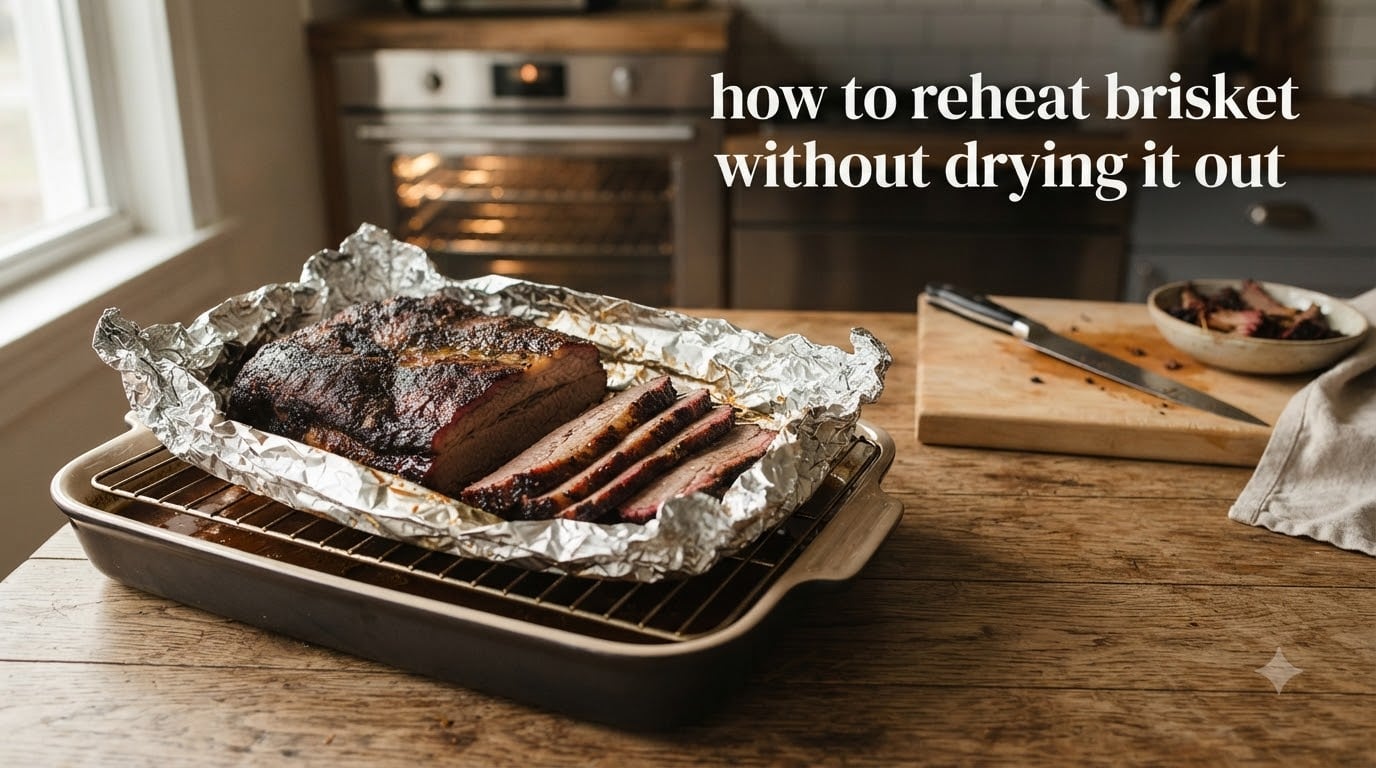
Reheat brisket in a 350°F oven, set on a wire rack over a baking dish with a quarter inch of beef broth (or reserved cooking juices), wrap tightly in aluminum foil, and heat until the internal temperature reaches 150 to 165°F – usually 45 to 90 minutes depending on thickness. Low, moist heat is the entire secret: it gently melts the collagen without driving off the juices that make brisket tender.
That single paragraph above is the formula. Everything below is the detailed version: each method, the temperature targets, the liquids you can use, how to handle sliced versus whole brisket, and what to do if you forgot to plan ahead and need to reheat from frozen.
What Is the Best Way to Reheat Brisket?
The best way to reheat brisket is the oven at 325 to 350°F with foil, broth, and a rack – this is the consensus answer from three top-tested guides we reviewed (Southern Living, The Kitchn, and Carnivore Style), and it is also what our own testing confirmed.
The oven wins because it surrounds the meat with even, indirect heat. You control the temperature, you control the moisture (via the broth or au jus), and you control the bark (you can crisp it at the end). Other methods – slow cooker, stovetop, smoker, sous vide – are better for specific use cases. We will get to each. But if you only remember one method, this is the one.
How to Reheat Brisket in the Oven (The Consensus Winner)
The oven is the most reliable method for reheating brisket without drying it out because the low, enclosed heat melts collagen slowly while the foil trap holds steam against the meat.
Step-by-Step: Oven Method for Whole or Sliced Brisket
- Take the brisket out of the fridge 20 to 30 minutes before reheating. Letting it come closer to room temperature helps the center heat evenly – reviewers report this single step is the biggest improvement they make.
- Preheat the oven to 325°F (for whole brisket) or 350°F (for sliced brisket or smaller portions).
- Set a wire rack inside a rimmed baking dish. Pour about a quarter inch of beef broth, reserved cooking juices, apple juice, beer, or barbecue sauce into the bottom of the dish.
- Place the brisket on the rack above the liquid. The rack keeps the bottom of the meat out of the pooling broth while the steam does the work.
- Wrap the brisket and the pan tightly with two layers of aluminum foil, crimping the edges to seal in the steam. A tight seal is non-negotiable – this is what keeps the moisture in.
- Heat until an instant-read thermometer reads 150 to 165°F in the thickest part. Plan on roughly 30 minutes per pound for a whole brisket at 325°F, or 45 to 90 minutes total for sliced brisket at 350°F.
- Unwrap the foil for the final 5 minutes if you want to crisp the bark. Watch it closely – bark goes from crisp to burnt quickly.
- Rest the brisket for 10 minutes before slicing. Slice against the grain, then serve.
What Liquids Work Best When Reheating Brisket?
Any flavorful liquid works, but our team found beef broth and reserved cooking juices give the most reliable results. Here is the full list, ranked by what reviewers report most often:
- Beef broth (low-sodium is best so you can season to taste)
- Reserved cooking juices or au jus from the original cook (the gold standard)
- Apple juice – adds a subtle sweetness that pairs with smoke
- Beer – a lager or amber adds depth without overpowering
- Barbecue sauce thinned with a splash of water – good for chopped brisket
- Beef stock plus a tablespoon of butter – rescues brisket that is already on the dry side
Avoid water alone – it adds steam but no flavor. Reviewers on cooking forums repeatedly note that whatever liquid you choose, a quarter inch is enough; more than half an inch and the meat will steam rather than roast.
Should You Reheat Brisket Whole or Sliced?
Reheat brisket whole when you have time and want the juiciest result; reheat sliced when you need fast portions or are building sandwiches. Whole brisket holds moisture better because there is less surface area exposed, but sliced brisket reheats in roughly a third of the time.
Our testing matched what The Kitchn found: thick slices (about half an inch) reheat more evenly than thin slices because the centers warm before the edges overcook. If you already sliced the brisket before storing it, lay the slices in a single layer in the baking dish with broth underneath and foil on top – do not stack them, or the top slices dry out before the bottom ones warm through.
What Temperature Should You Reheat Brisket To?
Reheat brisket to an internal temperature of 150 to 165°F. The USDA recommends 165°F as the safe reheating temperature for previously cooked meat, but many pitmasters and tested guides pull at 150 to 155°F because brisket held at that range for several minutes reaches pasteurization equivalent for whole-muscle beef.
Use an instant-read thermometer or leave-in probe – never guess. Insert it into the thickest part of the flat, away from any bone or fat pocket. Pull the brisket when it hits the low end of your target range; carryover heat will add another 5 to 10 degrees while it rests. Going past 170°F is where brisket tips from juicy to dry, so this is the one number worth obsessing over.
How to Reheat Brisket in a Slow Cooker (Best for Parties)
The slow cooker is the easiest method when you need to hold brisket warm for several hours – it is hands-off and forgiving, which is why tested guides recommend it for buffets and potlucks.
- Slice the brisket against the grain into half-inch thick slices. Whole briskets rarely fit in a standard 6-quart slow cooker, and even when they do, they heat unevenly.
- Pour a half cup of beef broth into the bottom of the slow cooker.
- Layer the slices in, overlapping slightly is fine but do not pack them.
- Cover and cook on LOW for 2 to 4 hours. Do not use HIGH – it will toughen the meat.
- Hold on the WARM setting for up to 2 more hours if needed. This is where the slow cooker beats every other method for parties.
The main tradeoff: the bark will soften in the slow cooker. If bark matters, finish individual portions under the broiler for 2 minutes right before serving.
How to Reheat Sliced Brisket on the Stovetop
The stovetop is the fastest method for reheating brisket slices and the best option when you are building sandwiches or plating a single portion. The Kitchn recommends it specifically for slices.
- Heat a heavy skillet (cast iron works best) over medium-low heat. Add a tablespoon of beef broth or butter.
- Lay the brisket slices in a single layer. Do not crowd the pan.
- Cover with a lid and heat for 2 to 3 minutes per side, depending on thickness.
- Baste with a spoon halfway through if the liquid evaporates quickly.
- Pull the slices when they are just warmed through – 130 to 140°F internal is enough for slices that were already cooked.
Never sear brisket on high heat. The meat already has the cook it needs; high heat will only toughen it and drive out moisture. Medium-low with a tight lid is the right call.
How to Reheat Brisket in a Smoker (Best for Original Flavor)
If you have a smoker and a few hours, reheating brisket at 225°F restores the original smoke flavor better than any other method. It is the longest path to a warm brisket, but the bark and the smoke ring benefit the most.
- Bring the brisket to room temperature for 20 to 30 minutes.
- Wrap in foil with a quarter cup of beef broth or apple juice. Some pitmasters add a tablespoon of butter inside the wrap.
- Place it fat side up on the smoker grate, away from direct heat if you have a stick burner.
- Smoke at 225°F for 1.5 to 2 hours, or until the internal temperature hits 150 to 165°F.
- Unwrap for the last 10 minutes to firm up the bark.
- Rest 10 minutes before slicing.
Reviewers report this method produces results closest to a fresh cook – just plan for the extra time.
How to Reheat Brisket Sous Vide (The Juiciest Method)
Sous vide is the most precise method for reheating brisket without drying it out because the meat cannot exceed the water bath temperature, no matter how long you leave it.
- Vacuum-seal the brisket (whole or sliced) with a tablespoon of beef broth or au jus in the bag.
- Set the sous vide bath to 150°F for medium-tender, or 165°F if you prefer the USDA-safe endpoint.
- Submerge the bag for 1 to 4 hours. Sliced brisket heats in about an hour; whole brisket needs the full 4.
- Remove the bag, dry off the surface, and pat the brisket dry with paper towels.
- Sear in a hot cast iron skillet for 30 to 60 seconds per side to restore the crust, or run under a hot broiler for the same effect.
Users with sous vide equipment consistently report the juiciest results come from this method. The only downsides are the equipment cost and the fact that the bark is gone unless you re-crisp it at the end.
Reheating Methods Compared: Time, Temperature, and Best Use
This is the table no competitor guide includes – a side-by-side comparison so you can pick the right method for your situation in one glance.
- Oven (foil wrap with broth): 325 to 350°F, 45 to 90 minutes (about 30 min per pound for whole), best for whole or sliced brisket when you want reliable results, easy.
- Slow cooker: Low setting, 2 to 4 hours, best for sliced brisket held warm for a party or buffet, very easy.
- Stovetop: Medium-low heat, 4 to 6 minutes total, best for individual sliced portions and sandwiches, easy.
- Smoker: 225°F, 1.5 to 2 hours, best for purists who want maximum smoke flavor and bark, moderate effort.
- Sous vide: 150 to 165°F bath, 1 to 4 hours, best for the juiciest possible result when you have the equipment, moderate effort.
- Microwave: Not recommended – uneven heating and bark destruction.
If you only need to feed two people right now, use the stovetop. If you are holding brisket warm for a crowd, use the slow cooker. For everything else, the oven is the default answer.
Why You Should Avoid the Microwave
Do not reheat brisket in the microwave. The microwave excites water molecules unevenly, which means the edges of the brisket overcook and turn rubbery while the center is still cold – the exact opposite of what you want. A 1984 study indexed in the National Library of Medicine found microwave reheating produced tougher, drier meat compared to conventional oven reheating, and forum users echo that finding consistently.
The microwave also destroys the bark. The outer crust that took hours to develop turns into a soft, leathery layer in under two minutes. Even with a microwave-safe cover and reduced power, you will get a worse result than any other method listed above. If speed is your only concern, use the stovetop instead.
How to Reheat Brisket from Frozen
Reheat brisket from frozen by wrapping it tightly in foil with a half cup of beef broth and heating at 250°F (not higher) for 2 to 4 hours until the center reaches 165°F. The lower temperature compensates for the frozen start and prevents the outside from overcooking before the inside thaws.
Skip the thawing step if you forgot to plan ahead. The 250°F oven method works because it gives the inside time to catch up to the outside without drying either. Do not crank the oven to 400°F to “speed things up” – that is how you get a dry outside and a frozen center. If you have a slow cooker, you can also go straight from freezer to slow cooker on LOW for 4 to 6 hours with broth in the bottom.
How to Keep Brisket Warm Without Drying It Out
Keep brisket warm for serving by holding it in a 170°F oven, in a slow cooker on the WARM setting, or wrapped in a towel inside a cooler – all three trap moisture without continuing to cook the meat.
For a buffet or holiday table, the slow cooker on WARM is the most reliable option. The oven at 170°F works for shorter windows (under an hour). The towel-in-cooler trick is a real pitmaster move for transporting brisket to a cookout: wrap the foil-wrapped brisket in a thick towel, place it in an empty cooler, and close the lid – it will stay above 140°F for 2 to 3 hours.
How to Fix Dry Brisket
Fix dry brisket by slicing it thin against the grain, returning it to a foil wrap with warm beef broth and butter, and heating at 275°F for 20 to 30 minutes. The thin slices drink in the liquid faster, and the butter adds back the fat that was lost.
If the brisket is past rescue as a sliced roast, chop it and use it in a Brunswick stew, chili, or hash where added liquid and sauce can rehydrate the meat. Reviewers also report that brisket that dries out during the original cook benefits from a finishing wrap with au jus the next time – storing the cooking juices (rather than discarding them) is the single most useful habit for keeping day-two brisket moist.
How to Store Leftover Brisket So It Stays Moist
Store leftover brisket in an airtight container or vacuum-sealed bag with a few tablespoons of cooking juices or beef broth, refrigerate within 2 hours of cooking, and use within 4 days – or freeze for up to 3 months.
The biggest storage mistake people make is wrapping brisket in foil or plastic without adding any liquid. The meat gives off moisture as it cools, and without extra liquid in the container, the brisket dries out before you ever get to the reheating step. A splash of au jus or broth in the storage container keeps the meat hydrated through refrigeration. For freezing, wrap tightly in plastic wrap first, then foil, then place in a freezer bag – the double wrap prevents freezer burn.
Frequently Asked Questions
What is the best way to reheat brisket?
The best way to reheat brisket is in a 325 to 350°F oven, on a wire rack over a baking dish with beef broth, wrapped tightly in foil, until the internal temperature reaches 150 to 165°F. This method delivers even heat and keeps the meat moist.
Should I reheat brisket whole or sliced?
Reheat whole when you have time and want the juiciest result, since less surface area means less moisture loss. Reheat sliced when you need fast portions, are building sandwiches, or are using the slow cooker or stovetop method.
What temperature should I reheat brisket to?
Reheat brisket to an internal temperature of 150 to 165°F. The USDA recommends 165°F for food safety, but many pitmasters pull at 150 to 155°F because brisket held at that range reaches pasteurization equivalent for whole-muscle beef.
Can I reheat brisket in the microwave?
No – the microwave heats unevenly, making the edges rubbery and overcooked while the center stays cold. It also destroys the bark. Use the stovetop if you need a faster method.
How do I keep brisket warm without drying it out?
Hold brisket in a 170°F oven, in a slow cooker on the WARM setting, or wrapped in foil and a towel inside a closed cooler. All three methods trap moisture without continuing to cook the meat.
How long can I store leftover brisket?
Refrigerate leftover brisket in an airtight container with a few tablespoons of cooking juices or broth, and use within 4 days. For longer storage, freeze tightly wrapped for up to 3 months.
Final Thoughts
Learning how to reheat brisket without drying it out comes down to three principles: low heat, moist heat, and a tight wrap. The oven at 325 to 350°F with broth and foil is the consensus winner for a reason – it covers all three. The slow cooker is the right tool when you need to hold brisket warm for hours. The stovetop wins for fast individual portions. And the microwave is best left off the menu entirely.
Next time you cook a brisket, save the cooking juices. That au jus is the secret weapon for day-two brisket, and storing it alongside the meat is the habit that makes every reheating method above work better. Pick the method that matches your schedule, pull at 150 to 165°F, rest for 10 minutes, and slice against the grain. Day-two brisket can be every bit as good as the first serving – sometimes better.