
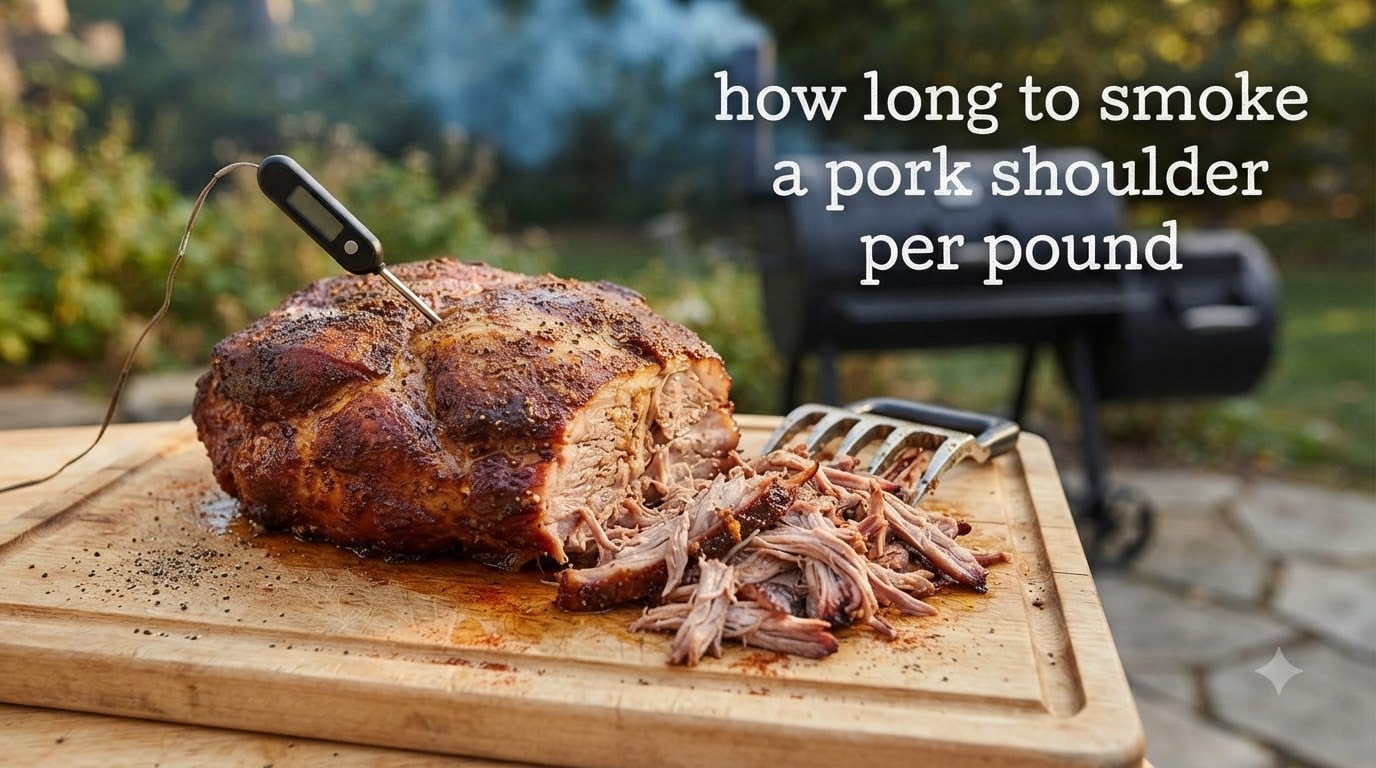
Figuring out how long to smoke a pork shoulder per pound is the first question every pitmaster asks before firing up the smoker. The short answer: plan for 1.5 to 2 hours per pound at 225°F. But that simple formula hides a lot of nuance. Stall times, meat shape, bone presence, and even the weather can shift your cook by hours.
I have smoked well over a hundred pork shoulders on everything from a basic kettle grill to a competition-grade offset stick burner. This guide breaks down everything I have learned about timing, temperature, and technique so your next pulled pork comes out perfect every time.
Table of Contents
Quick Answer: How Long to Smoke a Pork Shoulder Per Pound
At 225°F, expect roughly 1.5 to 2 hours per pound of pork shoulder. At 250°F, that drops to about 1 to 1.5 hours per pound. A 10-pound shoulder at 225°F typically takes 15 to 20 hours total.
These are estimates, not guarantees. The only reliable way to know when your pork shoulder is done is by internal temperature and probe tenderness, not by the clock. Aim for an internal temperature of 195 to 205°F, and slide the probe in like you are checking if butter is soft.
Smoking Time Per Pound Chart
This chart gives you a practical planning framework based on weight and smoking temperature. Use it to estimate your start time, but always verify with a thermometer.
| Weight | At 225°F | At 250°F | At 275°F |
|---|---|---|---|
| 5 lbs | 7.5 to 10 hours | 5 to 7.5 hours | 4 to 5.5 hours |
| 8 lbs | 12 to 16 hours | 8 to 12 hours | 6.5 to 9 hours |
| 10 lbs | 15 to 20 hours | 10 to 15 hours | 8 to 11 hours |
| 12 lbs | 18 to 24 hours | 12 to 18 hours | 9.5 to 13 hours |
| 15 lbs | 22 to 30 hours | 15 to 22 hours | 12 to 16.5 hours |
Notice how a 10-pound shoulder at 225°F could finish in 15 hours or stretch past 20. That range accounts for the stall, meat density, and how often you open the smoker lid. If you are cooking for a party, start earlier than you think you need to.
Best Temperature for Smoking Pork Shoulder
Most pitmasters smoke pork shoulder between 225°F and 275°F. Each temperature range has trade-offs worth understanding.
225°F — The Classic Low and Slow
This is the gold standard for competition-style pulled pork. The longer cook time gives smoke more opportunity to penetrate the meat and builds a deep, complex bark. The connective tissue and collagen break down slowly, producing incredibly tender results.
The downside is time. A 10-pound shoulder at 225°F can easily take 18 hours. If you are not starting the night before, this temperature can leave you scrambling when guests arrive.
250°F — The Sweet Spot for Most Cooks
I default to 250°F for backyard cooks. You shave a few hours off the total time without sacrificing much bark or tenderness. Many competition teams run their smokers at 250°F because it balances quality with predictability.
275°F — Hot and Fast
Smoking at 275°F is perfectly valid and produces excellent pulled pork in less time. The bark will be slightly less developed, and you may notice a thinner smoke ring. But for a weeknight cook or when you are short on time, it gets the job done.
Internal Temperature for Perfect Pork Shoulder
The target internal temperature for smoked pork shoulder is 195 to 205°F. This is when collagen fully converts to gelatin, and the meat becomes pull-apart tender.
Here is what most people miss: the number on your thermometer is only half the story. The real test is probe tenderness. Slide your temperature probe into the thickest part of the shoulder. If it slides in with the resistance of warm butter, the meat is done regardless of the exact number.
I usually pull my shoulder off the smoker at 200 to 203°F. Carryover cooking during the rest period will push the internal temperature up another 5 to 10 degrees. Pulling at 203°F and resting has given me the most consistent results across dozens of cooks.
The Stall: Why Your Pork Shoulder Stops Rising in Temperature
Every pork shoulder hits a point where the internal temperature seems to freeze, usually somewhere between 150 and 170°F. This is called “the stall,” and it is completely normal. Do not panic.
What Causes the Stall
As the meat heats up, moisture evaporates from the surface. This evaporative cooling works exactly like sweat on your skin — it pulls heat energy out of the meat. The stall typically lasts 2 to 4 hours, sometimes longer on larger cuts.
During this time, your temperature probe will barely move. Many beginners assume their smoker is broken or crank up the heat. Resist that urge. The stall is where the magic happens — fat is rendering, collagen is converting, and bark is developing.
How to Beat the Stall
If you are short on time, you can wrap the pork shoulder in foil or butcher paper once it hits the stall. This traps moisture and pushes the meat through the stall in about half the time. This technique is called the “Texas Crutch.”
The trade-off is softer bark. Foil creates a steaming effect that can make the exterior mushy. Butcher paper breathes slightly, so it preserves more bark while still accelerating the cook. Most experienced pitmasters I have talked to prefer butcher paper for this reason.
Best Wood for Smoking Pork Shoulder
Pork shoulder is forgiving with wood choice, but certain woods produce better results. Here are the top options:
Hickory — The classic choice for pork. It delivers a strong, bacon-like smoke flavor that stands up to the rich meat. Use it in moderation; too much hickory can turn bitter on very long cooks.
Apple — Mild and slightly sweet. Apple wood produces a lighter smoke that complements pork without overpowering it. Great for beginners or anyone who prefers a subtle smoke flavor.
Cherry — Similar to apple but with a slightly richer, fruitier note. Cherry also gives the meat a gorgeous mahogany color that looks incredible when you slice into it.
Oak — A middle-of-the-road option. Not as assertive as hickory but more pronounced than fruit woods. Oak is a reliable all-purpose wood for pork shoulder.
Pecan — Nutty and sweet with a milder profile than hickory. Pecan is a regional favorite in the South and pairs beautifully with pork. If you can find it, it is worth trying.
Fat Side Up or Down: Does It Matter?
This is one of the most debated topics in BBQ forums, and the honest answer is: it depends on your smoker. The fat cap serves as an insulating layer, protecting the meat from direct heat.
Fat side up lets the melting fat baste the meat as it renders. This works best in smokers where heat comes from below, like most vertical water smokers and pellet grills.
Fat side down puts the fat between the heat source and the meat, acting as a heat shield. This is the preferred orientation for offset smokers and kamado grills where the heat radiates from one direction.
I have done it both ways many times. The difference in the finished product is minimal. What matters more is consistent temperature and not opening the smoker too often. Pick the orientation that makes sense for your smoker and stick with it.
To Wrap or Not to Wrap: Foil vs Butcher Paper
Wrapping is optional, but it solves two problems: beating the stall and preventing the exterior from drying out during very long cooks.
Foil (The Texas Crutch)
Aluminum foil creates a tight seal that steams the meat. It pushes through the stall fastest and keeps the shoulder incredibly moist. The downside is bark texture — foil can make it soft and wet. Some cooks finish the last 30 minutes unwrapped to re-crisp the bark.
Butcher Paper
Unwaxed pink butcher paper is the preferred choice among serious pitmasters. It holds in enough moisture to power through the stall but lets steam escape so the bark stays intact. If you are going to wrap, butcher paper is the way to go.
No Wrap
Going unwrapped produces the best bark and deepest smoke flavor. It also takes the longest. If you have the time and patience, unwrapped is the purist approach. The meat may have a slightly drier exterior, but a good rest in a cooler will redistribute the juices.
Resting Time After Smoking
Rest your smoked pork shoulder for at least 30 minutes, but ideally 1 to 2 hours. Resting allows the juices to redistribute throughout the meat. Skip this step and those juices will pour out onto your cutting board instead of staying in the meat.
The best method is the “faux cambro” technique. Wrap the shoulder in foil (if not already wrapped), then in old towels, and place it in an empty cooler. This holds the meat at a safe temperature for hours without overcooking it. I have held shoulders this way for up to 4 hours with no loss in quality.
Community smokers on forums like Smoking Meat Forums consistently report that resting for at least one hour makes a noticeable difference in juiciness. It is the easiest improvement you can make to your pulled pork.
Troubleshooting Common Pork Shoulder Problems
My Cook Is Taking Way Longer Than Expected
This happens to everyone. If your shoulder has been on the smoker for 18 hours and the internal temp is only 185°F, you are likely dealing with a particularly dense piece of meat or a longer-than-usual stall. Wrap it tightly in foil, bump your smoker temperature to 275°F, and push through. There is no shame in helping the meat along.
The Meat Is Dry
Dry pork shoulder usually means it was overcooked or not rested long enough. Next time, start checking internal temperature earlier and pull the meat at 200°F instead of waiting until 210°F. Also, make sure you rest for at least an hour. If the meat is already dry, mix in some of the rendered juices from the foil when you pull it.
No Bark Formation
Poor bark usually comes from too much moisture on the surface. Make sure the meat is dry before applying your rub. If you are spritzing, do not start until hour 4 or 5 — early spritzing washes off the rub before it can form a crust. Also, avoid opening the smoker lid frequently, which drops the temperature and disrupts bark development.
Running Out of Fuel Mid-Cook
This is a common problem with charcoal smokers during long overnight cooks. Start with a full fuel load and use the snake method or a slow-feeder arrangement for longer burns. Have extra fuel ready and check your smoker every 2 to 3 hours. For pellet grills, make sure the hopper is topped off before you go to bed.
The Smoke Flavor Is Too Strong or Bitter
Heavy, white smoke indicates incomplete combustion and deposits acrid flavors. You want thin, blue smoke that is barely visible. Make sure your wood is seasoned (not green), your vents are open enough for proper airflow, and you are not smothering the fire with too much wood at once.
Frequently Asked Questions
How long does it take to smoke a pork shoulder at 225°F?
At 225°F, plan for approximately 1.5 to 2 hours per pound. A typical 8 to 10 pound pork shoulder takes 12 to 20 hours at this temperature. The exact time depends on factors like meat density, ambient weather, and how often you open the smoker lid.
How long does it take to smoke a 10 pound pork shoulder?
A 10 pound pork shoulder at 225°F takes roughly 15 to 20 hours. At 250°F, expect 10 to 15 hours. Always start earlier than you think — the meat can rest in a cooler for hours if it finishes early.
Do you smoke a pork shoulder fat side up or down?
It depends on your smoker. Fat side up works best when heat comes from below, like on most pellet grills and vertical smokers. Fat side down is better for offset smokers and kamado grills where heat hits from the side. The difference in the final product is minimal.
What temperature should a pork shoulder be smoked to?
Smoke pork shoulder until the internal temperature reaches 195 to 205°F. The most reliable test is probe tenderness — a thermometer probe should slide into the thickest part with almost no resistance, like poking into soft butter. Many pitmasters pull at 203°F.
How long do you smoke a pork shoulder per pound at 250°F?
At 250°F, plan for about 1 to 1.5 hours per pound. An 8 pound shoulder takes roughly 8 to 12 hours, while a 12 pound shoulder takes 12 to 18 hours. This temperature cuts several hours off the cook compared to 225°F without significantly affecting quality.
Should I wrap my pork shoulder in foil while smoking?
Wrapping is optional but helps push through the stall faster. If you wrap, use butcher paper instead of foil — it preserves bark better while still accelerating the cook. Wrap once the meat hits 160 to 170°F internal temperature and the bark has set.
How long should I let pork shoulder rest after smoking?
Rest your pork shoulder for at least 30 minutes, but 1 to 2 hours is ideal. Wrap it in foil, then towels, and place it in an empty cooler. This faux cambro method holds the meat at a safe temperature for up to 4 hours while the juices redistribute.
Conclusion
Knowing how long to smoke a pork shoulder per pound comes down to one core rule: at 225°F, budget 1.5 to 2 hours per pound, and verify doneness with a thermometer rather than a clock. The meat is ready when it hits 195 to 205°F internally and probes like soft butter.
Every pork shoulder is a little different. Stall times vary, shapes affect heat distribution, and ambient weather plays a role. The best pitmasters are the ones who use these time estimates as a starting point and rely on temperature and feel for the finish line. Fire up that smoker, trust the process, and enjoy some of the best pulled pork you have ever made.