
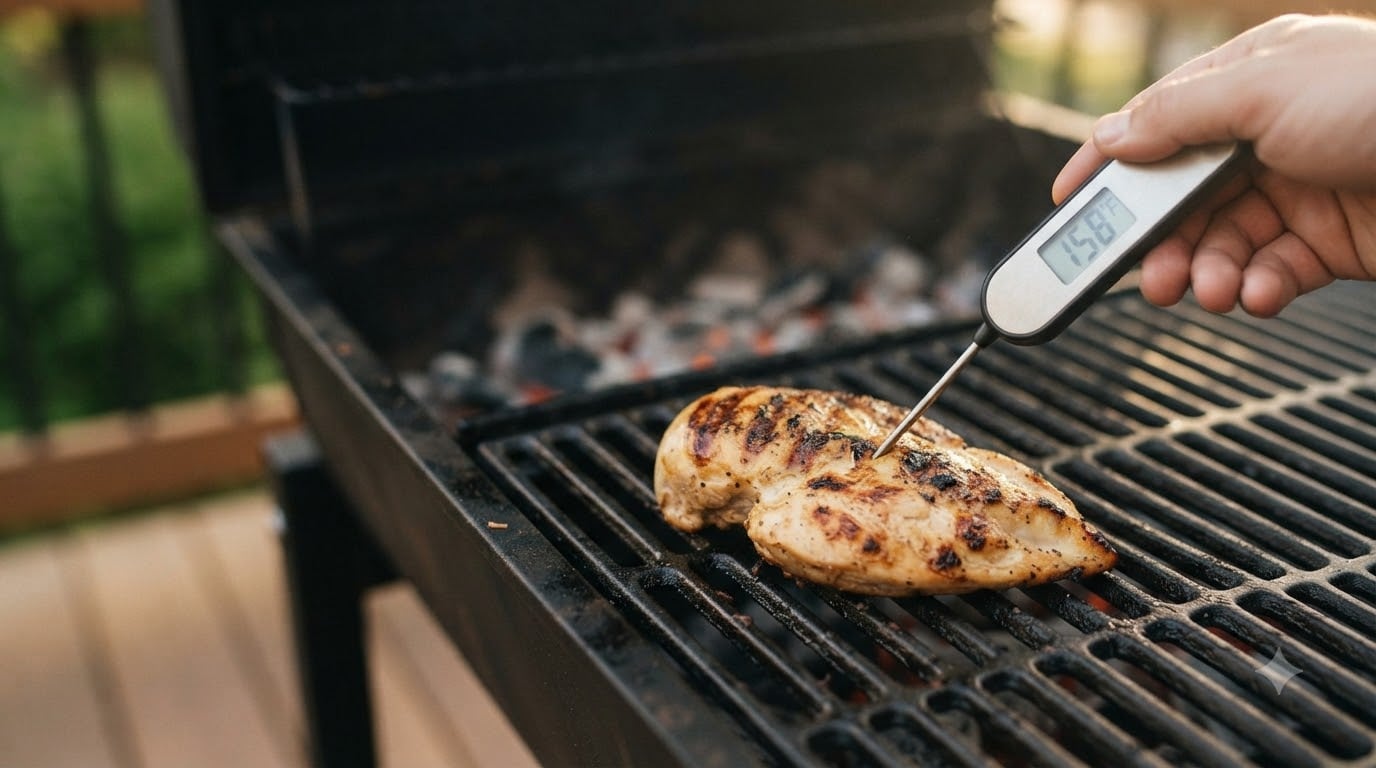
Your grilled chicken burns outside but stays raw inside because the heat is too high for the cut you’re cooking, so the exterior chars long before the center reaches the safe 165°F internal temperature. I have hit this exact wall with thick boneless breasts more times than I want to admit, and the fix is almost always the same: lower the grill heat, even out the thickness, set up two cooking zones, and stop guessing with a timer. Use a meat thermometer and this problem disappears for good.
In this guide I’ll walk you through every cause I have seen in my own cooking and in our team’s grill sessions, the temperature targets for each cut, and the exact two-zone method that prevents the burnt-outside-raw-inside disaster. By the end you will know how to grill juicy, evenly cooked chicken on a gas or charcoal grill in 2026.
Table of Contents
Why Grilled Chicken Burns on the Outside but Stays Raw Inside
Grilled chicken burns on the outside but stays raw inside because heat moves through meat slowly, and when the surface temperature is far above what the center can absorb, the exterior scorches before the interior is cooked. Chicken breast is the usual victim because it’s lean, thick on one end and thin on the other, and contains very little fat to slow the burn.
The science is straightforward. When you sear meat over high heat, the Maillard reaction browns the surface fast, but conductive heat only travels into the flesh at roughly 1 cm every few minutes. A 2 cm-thick breast on a screaming-hot grill will burn the outside in 3 minutes and still be cold in the middle after 10. That is why almost every experienced cook on Reddit’s r/AskCulinary points to heat management as the root cause.
Three forces work against you at once: direct radiant heat, the thickness of the cut, and the lack of a finishing environment. Solve any one of them and your chicken improves. Solve all three and you get reliably juicy, golden, fully cooked meat every time.
Main Causes of Burnt Outside and Raw Inside
Most burnt-raw chicken disasters trace back to one or more of the following causes. I have listed them in the order I check them when something goes wrong on my grill.
1. Heat is too high. Medium-high (around 375 to 450°F) is the sweet spot for most chicken. Anything above 500°F scorches the surface long before the center cooks. As one Quora answer put it bluntly: “If any food is burning on the outside but still raw in the middle, it is being cooked at too high of a temperature.”
2. The cut is unevenly thick. A chicken breast is naturally thicker on the thick end, sometimes by a full inch. That thin tail overcooks while the bulge stays raw. Pounding the breast to an even 3/4-inch thickness solves about half of all grilling failures.
3. You are skipping the preheat. A grill that is not fully preheated forces you to leave food on longer to reach safe temperature, and uneven preheat creates hot spots that scorch.
4. The marinade is too sugary. Sugar caramelizes around 250°F and burns fast. A heavy BBQ or teriyaki glaze applied at the start of grilling is a recipe for charred outside, raw inside.
5. No thermometer, just the clock. Chicken thickness varies, so does grill temperature. Cooking to a fixed time is guessing. The only reliable doneness test is an instant-read thermometer reading 165°F in the thickest part.
6. Constant flipping or pressing. Every time you press the meat with a spatula, juice escapes and the surface cools unevenly, which tempts you to crank the heat back up.
Safe Internal Temperature Guide for Chicken Cuts
Chicken is safe to eat when its thickest part reaches 165°F internal temperature, but different cuts feel and taste better when pulled a few degrees earlier. Here is the temperature guide I follow on every grill session, and the one our team uses to train new cooks at our restaurant.
| Cut | Pull from heat | Final temp after rest | Approx. grill time |
|---|---|---|---|
| Boneless breast (pounded to 3/4 inch) | 160°F | 165°F | 4 to 6 minutes total |
| Boneless thigh | 170°F | 175°F | 6 to 8 minutes total |
| Bone-in thigh or drumstick | 175°F | 180°F | 10 to 14 minutes |
| Chicken wing | 175°F | 180°F | 8 to 10 minutes |
| Spatchcocked whole chicken | 160°F breast | 165°F breast / 180°F thigh | 45 to 60 minutes |
Always insert the thermometer into the thickest part, away from bone. Bone conducts heat faster than meat and will give you a falsely high reading, which is the most common mistake beginners make when they finally pull out a thermometer.
How to Fix the Problem: Step-by-Step Grilling Method
The single best fix for burnt outside, raw inside chicken is the two-zone fire. You set up one hot side for searing and one cooler side for finishing. Follow this exact sequence and you will not need to throw away another piece of chicken.
Step 1: Preheat the grill for 10 to 15 minutes. On a gas grill, light all burners on high, close the lid, and wait. On charcoal, light the coals and wait until they are coated in white ash. Target 400°F on the hot side.
Step 2: Set up two zones. On a gas grill, turn one burner off (or down to low) and leave the other on medium-high. On a charcoal grill, pile all the coals on one half of the grate. You should have a direct-heat side and an indirect-heat side.
Step 3: Pat the chicken dry and oil the grates. Moisture on the surface steams instead of sears, and un-oiled grates cause sticking, which tears the crust when you flip.
Step 4: Sear on the hot side. Place the chicken over direct heat for 2 to 3 minutes per side to build color. Do not move it. You want grill marks, not constant fiddling.
Step 5: Move to the cool side and close the lid. Transfer the chicken to indirect heat, close the lid, and let it cook through with convection. This is where the inside actually finishes.
Step 6: Check with a thermometer. Insert an instant-read thermometer into the thickest part. Pull the chicken at the temperatures listed above. It will coast up to safe temperature during the rest.
Step 7: Rest 5 minutes before slicing or serving. Resting lets juices redistribute and lets carryover cooking finish the job. Skip this and the juice runs onto the cutting board instead of staying in the meat.
How to Pound Chicken for Even Thickness
Pounding chicken breasts to an even 3/4-inch thickness is the single cheapest technique that prevents burnt-outside-raw-inside failures. I do it for every boneless breast I grill, and our team does the same in the restaurant kitchen before any breast hits the pan or grill.
Step-by-step pounding method
1. Slice the breast in half horizontally. If it is very thick, butterfly it open. Two thin halves cook faster and more evenly than one thick piece.
2. Place between plastic wrap or in a zip bag. This prevents splatter and keeps the raw juice off your counter.
3. Use a meat mallet or rolling pin. Start from the center and gently pound outward until the breast is an even 3/4 inch everywhere. Do not flatten it thinner, or it will dry out.
4. Season and grill immediately. Salt draws out moisture, so season just before the chicken hits the grill, not 10 minutes ahead.
Two-Zone Grilling Method Explained
Two-zone grilling means arranging your fire so one half of the grill is hot and the other half is cooler. You sear on the hot side, then finish on the cool side with the lid closed. This single setup fixes more grilled-chicken problems than any gadget you can buy.
Direct heat versus indirect heat
Direct heat is flame or coals directly under the food. It is great for searing, building color, and creating grill marks, but it cooks only the surface. Indirect heat is a closed-lid environment with no flame under the food, similar to an oven. It cooks the inside gently and evenly.
How to set it up on gas and charcoal
On a gas grill with three or more burners, turn one burner off (or to low) and leave the others on medium-high. On a two-burner grill, turn one burner off entirely. On a charcoal grill, bank all the lit coals to one side of the charcoal grate and leave the other side empty.
Why two zones work for chicken
Two zones let you build flavor fast without overshooting the surface temperature. Searing locks in juices and creates the Maillard crust. The indirect side then cooks the interior to a safe 165°F without burning that crust. Forum cooks on r/AskCulinary repeatedly point to this setup as the simplest fix for burnt-outside, raw-inside chicken.
Sugary Marinades and Glazes: Timing Tips
Sugary marinades burn fast because sugar caramelizes around 250°F and scorches at higher temperatures. If you brush BBQ sauce, teriyaki, or honey glaze on raw chicken at the start of grilling, the outside will char while the inside is still raw. Almost every BBQ cook I know learned this the hard way.
Three timing rules that prevent this:
1. If the sauce contains more than 1 tablespoon of sugar per 1/4 cup of liquid, wait. Brush it on during the last 2 to 3 minutes of grilling, or apply it after the chicken comes off the grill.
2. Use the indirect side when saucing. The cooler environment buys you an extra minute or two before the sugars burn.
3. For long marinades (more than 30 minutes), pat the chicken dry before it hits the grill. Surface sugar and surface moisture both block browning and trap steam.
If you have already burned the sauce, do not panic. Move the chicken to the cool side, close the lid, and let it finish at indirect heat for the remaining time. The blackened glaze will taste bitter, but the meat will be safe and you will learn the timing for next time.
Common Mistakes to Avoid When Grilling Chicken
Here are the mistakes I see most often in home kitchens, and the ones I made myself when I started grilling. Avoiding them will fix most burnt-outside-raw-inside problems without changing your equipment.
Skipping the preheat. A cold or unevenly preheated grill creates hot spots. Always preheat with the lid closed for at least 10 minutes.
Cooking cold chicken straight from the fridge. Let chicken sit at room temperature for 15 to 20 minutes before grilling. Cold centers take longer to cook, which means longer on the grill and more burning.
Flipping too often. One flip per side is plenty. Every flip drops the surface temperature and forces more cooking time, which leads to burning.
Cutting to check doneness. Slicing into the chicken releases juice and cools the meat. Use a thermometer instead, and save the knife for after the rest.
Cooking at one temperature the whole time. The two-zone method works because you change zones, not just times. High heat then indirect heat is the magic sequence.
Ignoring hot spots. Every grill has them. The spot above the gas burner or near the coals runs hotter. Rotate pieces if you notice one side browning faster.
Troubleshooting Your Grill Setup
Different grills need different fixes. Here is what I recommend for the two most common home setups.
Gas grill tips
Use a grill thermometer if your lid does not have one. Many gas grills run 50°F hotter at the lid than at the grate, so trust the grate reading, not the dial. Clean the grates before each cook and preheat with the lid closed to burn off old residue.
Charcoal grill tips
Bank coals to one side for two-zone cooking. Use a chimney starter so the coals are evenly lit. Add a handful of fresh coals every 30 minutes for long cooks, and keep the lid vents open enough to maintain 350 to 400°F at the grate.
Kamado and pellet grill notes
These grills behave like ovens, so use them as indirect-only zones for chicken thicker than 1 inch, and finish with a quick sear in a hot cast-iron pan if you want grill marks. Do not try to cook a whole breast on direct heat in a kamado; it will burn before the center cooks.
Resting Time and Carryover Cooking
Carryover cooking is the temperature rise that happens after you pull meat off the heat. A boneless breast pulled at 160°F will coast to 165°F during a 5-minute rest, and a thicker bone-in thigh can rise 5 to 10°F. This is your friend, not your enemy.
Rest the chicken on a warm plate or board, tented loosely with foil. Five minutes is enough for breasts and thighs. Wings need only 3 minutes. Whole spatchcocked chickens need 10 to 15 minutes before carving.
Skipping the rest is a common cause of dry chicken, even when the cook is technically perfect. The juice needs time to redistribute through the meat fibers, and it needs the residual heat to settle.
Frequently Asked Questions
Why is my chicken burnt on the outside but raw on the inside?
Your chicken burns on the outside but stays raw on the inside because the heat is too high for the cut. The exterior scorches long before the center reaches the safe 165°F internal temperature. Lower the grill to medium-high, pound the breast to even thickness, and finish on indirect heat.
Why does chicken burn before cooking through?
Chicken burns before cooking through when the surface temperature is well above what the inside can absorb. This happens with too-high direct heat, uneven thickness, sugary glazes applied too early, or skipping a meat thermometer and cooking by time alone.
How do I grill chicken evenly?
Grill chicken evenly by pounding breasts to a uniform 3/4-inch thickness, preheating the grill for 10 minutes, using a two-zone setup, searing on direct heat for 2 to 3 minutes per side, then finishing on indirect heat with the lid closed until a thermometer reads 165°F in the thickest part.
What temperature should grilled chicken be?
Grilled chicken should reach 165°F internal temperature for food safety. Boneless breast is best pulled at 160°F and rested to 165°F. Thighs and drumsticks taste better at 175 to 180°F because of their higher fat content.
How do you fix a burnt chicken?
Fix a burnt chicken by moving it to the indirect-heat side of the grill, closing the lid, and letting it finish cooking through without further direct contact with flame. A meat thermometer is the only reliable way to confirm the inside is safe without making the outside worse.
Can I save chicken that is burnt on the outside and raw inside?
Yes, you can save chicken that is burnt outside and raw inside by transferring it to indirect heat and finishing the cook with the lid closed. Trim off the burnt surface, verify 165°F with a thermometer, and rest the meat 5 minutes before slicing.
Why does my grilled chicken burn on the outside but stay raw inside on a gas grill?
On a gas grill this usually means all burners are on high, leaving no cooler zone for the chicken to finish. Turn one burner off or down to medium-low, sear the chicken over the hot burner, then move it to the cooler side to cook through gently.
Final Tips for Juicy Grilled Chicken
Fixing the burnt-outside-raw-inside problem is rarely about a new grill or a new gadget. It is about lowering the heat, evening out the thickness, and trusting a meat thermometer instead of the clock. Two-zone grilling, a 5-minute rest, and a target internal temperature of 165°F will deliver juicy, evenly cooked chicken every time you fire up the grill in 2026.
Start with one change on your next cook: pound the breast to even thickness and pull it at 160°F for a 5-minute rest. You will notice the difference in the first bite, and you will never need to ask why your grilled chicken burns outside but stays raw inside again. If you want to go deeper, our cooking guide covers more techniques for tender, golden chicken at home.