
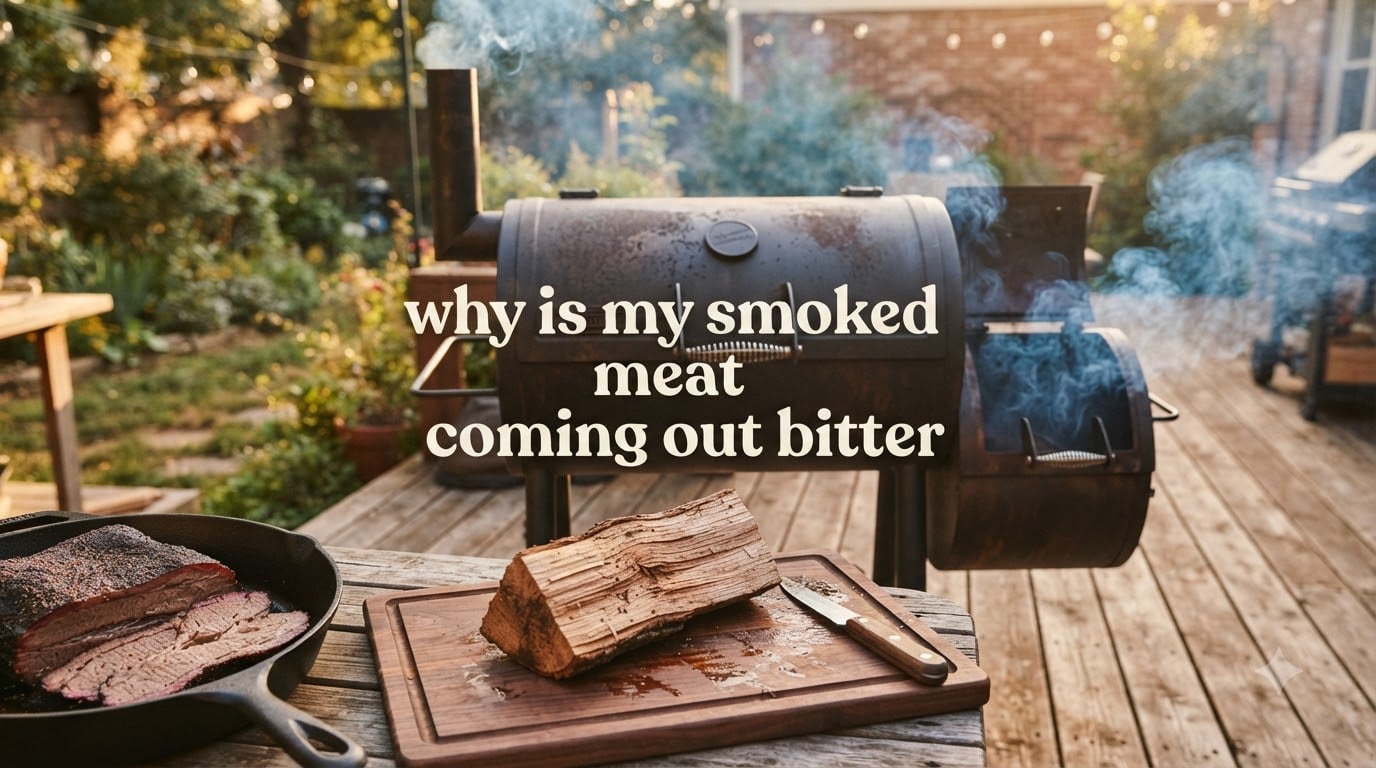
We’ve pulled 14-hour briskets off the smoker and bitten into something that tasted like a dirty ashtray. It’s one of the most deflating moments in low-and-slow cooking, and the worst part is that why your smoked meat is coming out bitter almost always comes down to the same handful of fixable mistakes.
After a few seasons of trial, error, and far too many over-smoked pork shoulders, our team can tell you this: bitter smoke is rarely about the meat. It’s about combustion. Once you understand what clean smoke looks like, how wood actually burns, and what creosote does to a long cook, the problem disappears.
Here is what’s inside this guide: the #1 cause of bitter smoked meat (and the 60-second test to confirm it), the four other common culprits, how to fix a bitter cook mid-fire, and a checklist to make sure it never happens again.
Table of Contents
Short Answer: Why Your Smoked Meat Tastes Bitter
Bitter smoked meat is almost always caused by creosote, a tar-like residue that forms when wood smolders instead of burning cleanly. Creosote develops when smoke is thick and white instead of thin and blue, depositing bitter compounds on the meat’s surface during long cooks. The fix is simple: get airflow right, use less wood than you think, and aim for thin blue smoke at 225 to 275°F.
If you only remember one thing from this article, make it this: thin blue smoke = good flavor. Thick white smoke = bitter meat. That’s the visual rule that solves 95% of bitterness complaints.
| Cause | What You See | Quick Fix |
|---|---|---|
| Creosote from smoldering wood | Thick white or gray smoke | Open intake vents, reduce wood, aim for blue smoke |
| Too much wood | Heavy smoke billowing from the stack | Use 2 to 3 fist-sized chunks per 4 to 6 hours |
| Wrong wood type | Chemical or acrid taste | Switch to fruitwood or mild hardwoods, skip mesquite on poultry |
| Dirty smoker | Black flakes dripping onto meat | Deep clean every 5 to 10 cooks, run a burn-in |
| Smoking too long | Ashtray aftertaste after hour 6 | Front-load smoke in the first 3 to 5 hours |
What Creosote Is and How It Forms
Creosote is a black, tar-like compound that forms when wood combusts incompletely. The chemistry is straightforward: when wood burns hot with plenty of oxygen, it produces water vapor, CO2, and the light, sweet smoke we want. When wood smolders at low temperatures with restricted airflow, it produces heavier compounds, including phenols, tars, and acids. Those heavier compounds are creosote.
Picture the inside of a chimney. The shiny black buildup you scrape out in spring is creosote, and it’s the exact same substance that condenses on the inside of your smoker lid and drips onto your food. That sticky, bitter layer is what you’re tasting.
The visual cue matters. Thin blue smoke is almost invisible in still air and means the wood is combusting cleanly with enough heat and oxygen. Thick white smoke looks dramatic but signals incomplete combustion, full of creosote particles that will coat your meat within minutes. Black, rolling smoke usually means a grease fire or a runaway temperature, and you should shut the intake immediately.
Here’s the rule I give every new pitmaster: if you can smell the smoke strongly from 10 feet away, the smoker is producing too much. Good smoke smells faint and almost sweet right at the source. Standing at the cooker, you should see your hand clearly through the smoke leaving the stack.
Cause 1: Too Much Wood or Over-Smoking
Most beginners load the firebox like they’re heating a house. More wood feels like more flavor, but the opposite is true. Once meat is saturated with smoke compounds, additional smoke turns acrid.
A useful starting point: 2 to 3 fist-sized wood chunks per 4 to 6 hours of cook time. On a small bullet or kettle smoker, that’s often just one chunk at the start and another added at hour two. On an offset, plan on a small split every 45 to 60 minutes rather than loading the firebox with armfuls of wood.
If you’re using chips or pellets, the same rule applies but the timeframe compresses. A handful of chips lasts 20 to 30 minutes. Pellets feed continuously, so the issue with pellet smokers is rarely quantity and more about quality (more on that in the pellet section below).
Quick check: if your meat has a heavy smoke ring and a blackened, almost lacquered bark, you’ve likely oversmoked it. A proper bark should be deep mahogany and slightly crunchy, not jet-black and soot-like.
Cause 2: Poor Airflow and Smoldering Fire
Airflow is the single biggest lever you have on a smoker. Combustion needs oxygen. Restrict it, and wood smolders, producing creosote instead of clean smoke.
On most offset, bullet, and kamado smokers, the rule is to leave the intake vent at least 25 to 50% open for the entire cook. The exhaust vent should be fully open or only slightly choked to fine-tune temperature. A common beginner mistake is closing the intake to lower the temperature and accidentally starving the fire.
Charcoal-only setups need extra attention. Lump charcoal and briquettes both want airflow. If you’re fighting to keep your pit above 225°F, the answer is more fuel and more oxygen, not a closed damper.
On a kamado, the top and bottom dampers work as a pair: bottom feeds oxygen, top controls draft. We run the bottom nearly fully open and modulate temperature almost entirely with the top. If you smell heavy smoke or see white billowing clouds from the top vent, your fire is smoldering and needs more bottom airflow.
Cause 3: Wrong Wood Type (Mesquite, Green, or Pitchy Wood)
Wood choice matters more than most recipes admit. Strong woods like mesquite and hickory carry high concentrations of phenolic compounds. A little goes a long way. A lot turns food bitter and almost chemical-tasting.
Mesquite is the classic offender. It burns hot and fast with bold flavor, but it overwhelms anything except brisket and beef ribs when used in large amounts. For poultry, pork, fish, or anything smoked for less than 4 hours, we default to fruitwoods like apple, cherry, or peach. Hickory and pecan sit in the middle: stronger than fruitwood but milder than mesquite, and they pair with most meats.
Green wood is a guaranteed bitterness source. Wood should be seasoned to 15 to 20% moisture before it burns cleanly. Fresh-cut wood hisses, produces white smoke, and leaves oily residue on the meat. If you’re buying wood, look for “kiln-dried” or “seasoned” labels. A moisture meter costs very little and takes the guesswork out.
Never smoke with softwoods. Pine, spruce, cedar, and fir contain resins that produce harsh, almost turpentine-like smoke. Even in small amounts, they make meat inedible. Stick to hardwoods only.
| Wood Type | Strength | Best For |
|---|---|---|
| Apple, Cherry, Peach | Mild, sweet | Poultry, pork, fish, short cooks |
| Maple, Pecan | Medium | Poultry, ham, vegetables |
| Oak, Hickory | Strong | Pork shoulder, ribs, brisket |
| Mesquite | Very strong | Beef only, short cooks, small amounts |
| Pine, Cedar, Spruce | Toxic | Never use for cooking |
Cause 4: Dirty Smoker and Creosote Buildup
If you’ve been running the same smoker for a few months without a deep clean, the inside walls, lid, and grates are likely coated in creosote. Every time you fire it up, that old buildup softens and drips onto fresh meat, adding bitterness even when your fire is clean.
The visual tell is the black stuff on the inside of the lid. A thin, hard seasoning layer is normal and actually protects the metal. A thick, sticky, tar-like layer is bad. Run a gloved finger across the lid after a 30-minute preheat. If it comes back glossy and oily, your smoker needs cleaning.
For a deep clean: empty the smoker, remove grates and water pans, and scrape all interior surfaces with a wire brush or plastic scraper. Avoid using water on a hot smoker. For heavy buildup, a light coat of oven cleaner, followed by a thorough wipe and a high-heat burn-in cook (see below), removes most residue.
After a deep clean, run a burn-in cook. Light a full chimney of charcoal, close the lid, and let the smoker run at 400°F+ for 45 to 60 minutes with all vents open. This burns off any leftover cleaner, oil, or chemical residue, and starts rebuilding a clean seasoning layer. After that, your next food cook will taste right.
Cause 5: Smoking Too Long (Front-Load Smoke Rule)
Meat stops absorbing smoke flavor around 140°F internal temperature. Below that, smoke compounds penetrate the surface and bind to the proteins. Above it, the bark is mostly set and additional smoke just builds up on the outside as bitter residue.
This is why we front-load smoke. Get the meat on early, run heavy (but clean) smoke for the first 3 to 5 hours, then transition to clean heat for the remainder of the cook. A 12-hour brisket only needs serious smoke for the first 4 hours. After that, plain charcoal or a minimal smoke feed is enough.
If you’re doing a 3 to 5 hour cook like ribs or chicken, 2 to 3 hours of smoke is plenty. Anything beyond that risks bitterness, especially with strong woods.
This is also why a pellet grill, which feeds constant smoke, sometimes produces bitter food. The smoke never stops. To compensate, drop the smoke setting to “low” or use a “super smoke” mode sparingly for the first 2 hours only.
How to Test for Creosote (Ice Water Test + Trial Piece)
If you’re not sure whether your smoker is producing clean smoke, run this 1-minute test before cooking food.
- Light the smoker and bring it to 250°F with your usual wood load.
- Hold a metal bowl of ice water about 6 inches above the smoke source or over the cooking grate for 30 to 60 seconds.
- Pull the bowl out and look at the water surface.
Clean water with no film = clean combustion, good smoke. A slight oily sheen = light creosote, acceptable for short cooks. A thick, dark film that you can scrape with a fingernail = heavy creosote, do not cook food until you fix airflow and reduce wood.
For a real-world test, smoke a small chicken thigh or sausage link for 30 to 45 minutes and taste it. If it tastes clean and smoky, you’re good. If it tastes acrid or ashy, adjust before committing a long cook.
How to Fix Bitter Smoked Meat Mid-Cook and After
If you catch bitterness early (the first 2 to 3 hours of a long cook), you can usually save the cook.
- Open the intake vent fully to increase airflow.
- Pull out any unburned wood to stop heavy smoke production.
- Let the fire burn clean for 15 to 20 minutes before adding the next wood piece.
- Wrap the meat in butcher paper or foil (Texas crutch). This stops further smoke absorption and lets you push through to temperature without making the bark worse.
If the meat is already done and tastes bitter, salvage is limited but possible. Trim off the darkest parts of the bark. Slice thin and serve with a tangy contrast: vinegar-based BBQ sauce, coleslaw with a sharp dressing, pickled onions, or a squeeze of lime. Acid and sweetness mask residual bitterness surprisingly well.
Chop bitter brisket into burnt ends, simmer in sauce, and the sugar and acid balance out most of the off flavor. This is one of the most common rescues we see on competition BBQ forums.
Pellet Grill Specific Causes
Pellet grills make clean smoke easy, but they have their own bitterness traps.
Low-quality pellets are the main culprit. Cheap pellets contain bark, fillers, or oils from the milling process that produce bitter, chemical-tasting smoke. Stick to 100% hardwood pellets from reputable brands. Traeger, Bear Mountain, CookinPellets, and Lumber Jack are widely recommended.
Fire pot creosote is the pellet-grill version of the dirty offset. Pellets that don’t fully ignite leave a tar-like residue in the fire pot. After 8 to 10 cooks, remove the fire pot and scrape it clean. If you skip this, every cook afterward tastes like the last failed one.
Auger jams or inconsistent feed cause pellets to smolder in the fire pot rather than burn hot, producing the same bitter white smoke as a poorly-managed offset. Always store pellets in a sealed container, away from moisture, and run the auger empty at the end of each cook to clear the line.
Finally, switching pellet brands can leave residual flavor in the hopper. After switching, run the auger empty, vacuum the hopper, and do a 30-minute burn-in at high heat before cooking real food.
The Prevention Checklist
Use this checklist before every long cook to keep bitterness from showing up at all.
- Aim for thin blue smoke, not thick white smoke.
- Run the cooker at 225 to 275°F.
- Use 2 to 3 fist-sized wood chunks per 4 to 6 hours.
- Leave intake vents at least 25 to 50% open.
- Front-load smoke in the first 3 to 5 hours, then run clean heat.
- Match wood to meat: fruitwood for poultry, oak or hickory for pork, mesquite only for short beef cooks.
- Skip softwoods (pine, cedar, spruce) entirely.
- Deep clean the smoker every 5 to 10 cooks.
- Run a burn-in cook after deep cleaning.
- Wrap in butcher paper or foil past the bark-forming stage.
Frequently Asked Questions
What does creosote taste like?
Creosote tastes sharp, acrid, and ashy, almost like a dirty ashtray or stale cigarette smoke. It coats the back of the throat and lingers. If your smoked meat makes you want to rinse your mouth out, creosote is almost always the reason.
Can you over-smoke meat?
Yes, you can definitely over-smoke meat. Past about 4 to 6 hours of heavy smoke exposure, the surface stops absorbing flavor and starts collecting bitter residue. Front-load your smoke in the first 3 to 5 hours of a long cook, then transition to clean heat without wood for the rest.
Should I soak wood chips before smoking?
No. Soaking wood chips does not produce more smoke, it produces more steam. Wet wood smolders at a lower temperature, which is exactly what creates creosote and bitter flavor. Use dry, seasoned wood and let it ignite properly.
Why does mesquite taste so bitter on meat?
Mesquite contains high levels of phenolic compounds and tannins. In small amounts on beef, it adds bold flavor. In larger amounts, or on poultry, pork, or fish, those compounds turn harsh and chemical-tasting. Use mesquite sparingly and only for short, hot beef cooks.
Does wrapping meat in foil prevent bitterness?
Yes, wrapping in foil or butcher paper stops further smoke absorption. Once the bark is set, wrapping protects the meat from creosote buildup and lets you finish the cook without adding more bitter compounds. Many pitmasters wrap at 160 to 170°F internal for exactly this reason.
Can pellet grills produce bitter smoke?
Pellet grills can produce bitter smoke when using low-quality pellets, when the fire pot has creosote buildup, or when the auger is feeding inconsistently. Use 100% hardwood pellets, clean the fire pot every 8 to 10 cooks, and empty the hopper between pellet brand changes.
Why does my food taste fine on a grill but bitter on the smoker?
Grilling happens fast at high heat, so smoke has only minutes to contact the food. Smoking is a long, slow exposure, often 4 to 12 hours. That extended time magnifies every bit of creosote and oversmoke. If your food tastes fine on a grill, your seasoning is probably good. The issue is the length of exposure to even slightly dirty smoke.
Final Thoughts: Fix the Smoke and the Flavor Follows
Bitter smoked meat is one of the most common problems in low-and-slow cooking, but it’s also one of the most predictable. Almost every case comes back to combustion: too much wood, not enough airflow, dirty surfaces, or wrong wood for the job. Once you tune those four levers, the bitterness goes away.
Start your next cook with the ice water test. Get clean smoke, light blue and almost invisible, before the meat goes on. Front-load smoke for 3 to 5 hours and run clean heat afterward. Match the wood to the meat, not the other way around. Do a deep clean and burn-in cook every few weeks, and your brisket, ribs, and pork shoulder will come out tasting like they should, not like the bottom of a fire pit.