
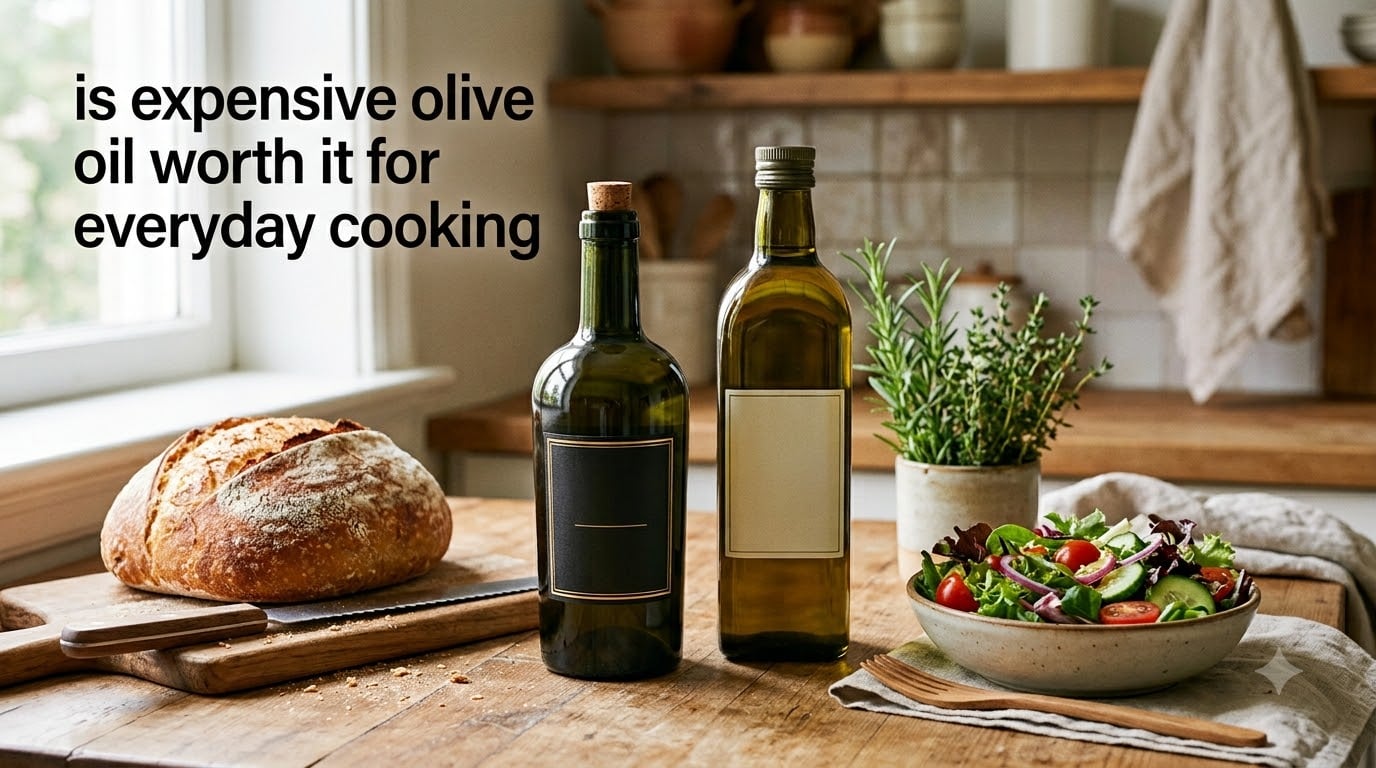
Walk into any grocery store and you’ll see olive oil priced at three dollars next to bottles over twenty. The price gap makes anyone pause at the shelf and ask: is expensive olive oil worth it for everyday cooking, or are we paying for a fancy label?
I’ve spent fifteen years working restaurant kitchens and home stoves side by side, and the honest answer is more interesting than a simple yes or no. Sometimes premium extra virgin olive oil earns its price. Sometimes a mid-priced bottle does the job better than a trophy bottle that’s been sitting under bad lights for six months. Let me walk you through exactly when each one wins.
Table of Contents
Is Expensive Olive Oil Worth It for Everyday Cooking? The Quick Answer
Expensive olive oil is worth it for everyday cooking only when you taste it raw or drizzle it at the end – on salads, bread, finished soups, or pasta. For high-heat searing, deep frying, and baking where flavor gets masked, a fresh, mid-priced extra virgin olive oil works just as well. The smart play is the two-bottle kitchen: one premium finishing oil, one affordable everyday cooking oil.
- Worth the splurge: salad dressings, finishing soups, drizzling on bread, raw dips, low-temp sautés.
- Save your money: deep frying, searing at very high heat, baked goods, long braises, anything masked by other strong flavors.
- Watch for red flags: clear plastic bottles, no harvest date, labels saying “light” or “pure,” suspiciously low prices on “premium” branding.
- Look for these signals: harvest date on the label, dark glass or tin, single-origin or PDO/PGI seal, polyphenol content disclosed in mg/kg.
What Makes Olive Oil Expensive in the First Place
The price jump from a generic bottle to a premium one isn’t marketing fluff – it tracks real costs in the orchard and the mill.
Premium producers pick olives early in the harvest, when the fruit is still green and the polyphenols are at their peak. Green olives yield less oil per ton than ripe purple ones, but the oil is more pungent, more peppery, and far richer in antioxidants. That’s the first surcharge built into the price.
Then there’s milling speed. Top-tier extra virgin olive oil is cold-pressed within 24 to 72 hours of harvest, in mills where the paste never climbs above about 27°C (80°F). Every extra hour between tree and press, and every degree of heat, eats flavor and accelerates oxidation. Producers who invest in fast, hygienic, temperature-controlled milling pay for that discipline in equipment and labor.
Single-origin sourcing adds another layer. When a bottle traces back to one estate, one region, one harvest year, the producer can’t quietly blend in older or lower-grade oil to stretch volume. That’s a quality promise that shows up on the label as PDO (Protected Designation of Origin), PGI (Protected Geographical Indication), or NAOOA certification.
Packaging is the last piece. Dark glass or tin protects the oil from light. Cheap plastic squeeze bottles – the kind with the cute spout – let oxygen seep back in every time you tip them. The cost difference between a dark glass bottle and a clear plastic one is real, and it shows up in how the oil tastes three months later.
What Expensive Olive Oil Actually Buys You
Three things, in order of importance: freshness, polyphenols, and flavor clarity.
Freshness is the biggest one. Olives are a fruit, and olive oil is essentially their fresh juice. Like any juice, it degrades. A premium bottle with a recent harvest date will simply taste greener, brighter, and more alive than a year-old bottle of the same grade. This is the single biggest reason a $25 bottle can taste better than a $9 one – it was likely pressed more recently.
Polyphenols are the natural antioxidants that make extra virgin olive oil the centerpiece of the Mediterranean diet. The headline compound is oleocanthal, the one that gives a fresh, peppery EVOO its throat-catching sting. Early-harvest oils from specific cultivars (Cornicabra, Picual, Koroneiki) often test above 250 mg/kg total polyphenols, the threshold the European Food Safety Authority recognizes for the polyphenol-related health claim.
Flavor clarity is the part your palate notices first. A well-made, fresh EVOO hits you with grassiness, artichoke, tomato leaf, even a pleasant bitterness. A cheap or old bottle tastes flat, sometimes waxy, sometimes closer to vegetable oil than to olive. If you can’t tell the difference between oils side by side, you’re probably tasting one that has already lost most of its volatile aromatics.
When Expensive Olive Oil Is Worth Every Penny
Expensive olive oil earns its price tag in any application where flavor arrives unfiltered, unheated, and in small amounts. Here’s where our kitchen reaches for the good bottle.
- Salad dressings and vinaigrettes: raw oil is the backbone of the dressing, and a grassy, peppery EVOO carries the entire dish.
- Finishing soups, pasta, beans, and grilled vegetables: a tablespoon drizzled at the end delivers aroma that cooking destroys.
- Bread dipping: this is where cultivar and freshness shine the most – and the cheapest place to taste-test a premium oil.
- Pesto and raw sauces: uncooked oil preserves the chlorophyll and grassy notes that disappear at temperature.
- Drizzling on finished proteins: steak, fish, roasted chicken, even pizza – a finishing pour beats any sauce.
In each of these cases, you’re paying for sensory impact per spoonful. The bottle lasts longer too, because you’re using teaspoons at a time, not half-cups.
When Cheap Olive Oil Is Perfectly Fine
This is the part most articles skip, and it’s the one that actually saves you money.
For deep frying, high-heat searing, or any cooking above about 400°F, the delicate polyphenols and aromatic compounds in expensive olive oil are largely destroyed anyway. You won’t taste the difference between a $25 bottle and a $9 one once it’s been to frying temperature. A fresh, mid-priced extra virgin from a recent harvest does the job.
Baking is another place to save. When olive oil goes into a cake, banana bread, or savory pastry, the flavor profile gets buried under flour, sugar, and spices. The polyphenols and oleocanthal that justify the premium price vanish into the crumb. Use a clean, fresh everyday EVOO and keep your premium bottle for finishing.
Long braises, stews, and chilis fall in the same category. The aromatics you paid for cook off in the first twenty minutes. Save the good oil for plating.
The two-bottle logic holds up in restaurant kitchens for exactly this reason. Service line chefs grab a sturdy everyday bottle for the pan. Plating chefs grab the premium bottle for the final pour. Same dish, two oils, smarter spending.
The Smoke Point Myth: Why EVOO Is Safe for Everyday Cooking
The most stubborn myth in olive oil is that it has a low smoke point and shouldn’t be used for everyday cooking. The myth is wrong, and the science backs the correction.
Refined olive oil smokes around 410°F. Extra virgin olive oil smokes around 375 to 410°F depending on the cultivar and freshness. That’s well above the temperature of most everyday cooking – pan-frying eggs clocks in around 250 to 300°F, sautéing vegetables around 350°F, and most roasting sits between 375 and 425°F. The only kitchen task that regularly exceeds EVOO’s smoke point is deep frying, and even there, a fresh EVOO holds up fine.
The North American Olive Oil Association and the Olive Oil Source have both published data showing that the polyphenols in EVOO actually protect the oil from breaking down at typical cooking temperatures. The Cleveland Clinic has run consumer-facing pieces confirming that, contrary to old warnings, you can sauté, roast, and bake with extra virgin olive oil every day without issue.
The real risk factors for olive oil are not heat – they’re light, air, and age. A bottle in a sunny window loses polyphenols faster than one in a hot pan. So the practical smoke-point debate is mostly a distraction. Buy fresh, store it dark and sealed, and use it without fear.
How to Spot Authentic Premium Olive Oil (and Avoid the Scams)
Olive oil fraud is real – studies have shown that a meaningful percentage of “extra virgin” bottles on supermarket shelves are blended with refined olive oil or other seed oils. Here’s the shelf-side checklist our kitchen uses.
- Look for a harvest date, not just a “best by” date. The harvest date tells you when the olives were pressed. “Best by” is two years from bottling and tells you almost nothing about freshness.
- Choose dark glass or tin, never clear plastic. Light and oxygen are olive oil’s two biggest enemies. The cute squeeze bottles let air back in every time you tip them, and clear bottles let light degrade the polyphenols before you even open them.
- Check for certifications: PDO, PGI, NAOOA, or COOC (California Olive Oil Council) seals mean the oil has been independently tested for grade and purity.
- Look for single-origin and country of origin. “Imported from Italy” can mean the oil was bottled in Italy from Greek or Spanish bulk oil. A single-estate, single-country label is harder to fake.
- Check the polyphenol content. Premium producers increasingly print a polyphenol number on the label. Look for at least 250 mg/kg if you care about the antioxidant benefit.
- Ignore “light,” “pure,” and “extra light” labels. These all mean refined, not extra virgin. “Light” refers to flavor, not calories.
If a bottle ticks three or more of these boxes, it’s likely worth a closer look. If it fails on plastic packaging and has no harvest date, no matter how pretty the label looks, walk away.
The Two-Bottle Kitchen Strategy Our Restaurant Swears By
Every kitchen I’ve worked in – from bistros to tasting-menu restaurants – keeps at least two olive oils on the line. The setup is simple, and it pays for itself within a week.
Bottle one: the everyday cooking oil. A fresh, mid-priced extra virgin olive oil in a 750 ml or 1 liter dark glass bottle. This is what goes into the pan for sautéing vegetables, browning meat, and deglazing. It should taste clean, slightly grassy, and smell fresh. Budget-wise, this is your workhorse.
Bottle two: the finishing oil. A small bottle (250 to 500 ml) of premium extra virgin olive oil with a recent harvest date and a single-origin or PDO designation. This is the one you reach for at plating, dressing salads, and dipping bread. A small bottle lasts longer because you use it in teaspoons, not tablespoons.
The two-bottle strategy also protects you from waste. The premium bottle, being smaller, gets used up quickly enough that you never pour stale oil. The everyday bottle, being larger, gets opened, used, and replaced on a steady rotation. Nothing sits past its prime.
If you’re cooking for one or two, you can scale both bottles down. If you’re cooking for a family of five, you might keep three: the everyday cooking oil, the finishing oil, and a neutral high-heat option like avocado oil for the rare deep-fry session.
How to Store Olive Oil So It Stays Worth Buying
The best olive oil in the world turns mediocre if you store it wrong. Here’s the storage rule our team follows.
Keep it dark, cool, and sealed. A pantry or a closed cabinet away from the stove works. Avoid the countertop unless your bottle is dark glass and you use it within a few weeks. Never store olive oil in the fridge – it solidifies, and the temperature cycling breaks down the aromatics faster than consistent cool storage.
Buy smaller bottles if you cook infrequently. A 250 ml bottle you finish in three weeks beats a 1 liter bottle you nurse for six months. Once opened, olive oil starts losing volatile aromatics and polyphenols at a measurable rate. Freshness is half the flavor.
Transferring oil from its original bottle into a countertop dispenser is a common mistake. The transfer introduces oxygen, and most countertop dispensers are clear glass or plastic, both of which let light in. If you want a working bottle on the counter, buy a dark glass one in the size you actually use in a week.
One last storage point: never buy olive oil that’s been sitting in a sunny grocery store window display, no matter how pretty the bottle. If it’s been on display for you, it’s been on display for everyone before you, and the light has been working on it the whole time.
Frequently Asked Questions
Is expensive olive oil actually worth buying?
Expensive olive oil is worth buying for finishing dishes, salad dressings, bread dipping, and any application where you taste it raw. For high-heat searing, deep frying, or baking where flavor is masked, a fresh mid-priced extra virgin olive oil works just as well and saves real money.
Which olive oil is best for everyday cooking?
The best olive oil for everyday cooking is a fresh, mid-priced extra virgin olive oil in a dark glass bottle with a recent harvest date. Look for a recent harvest (within the last 12 months), a polyphenol count above 250 mg/kg if disclosed, and PDO, PGI, or NAOOA certification when possible.
Is olive oil a good choice for day to day cooking?
Yes, olive oil is an excellent choice for day to day cooking. Its polyphenols and oleocanthal hold up well at typical sautéing and roasting temperatures, and the Mediterranean diet research consistently links daily extra virgin olive oil consumption to cardiovascular and metabolic benefits. Choose a fresh bottle and store it dark and sealed.
Is it okay to cook with olive oil every day?
It is okay to cook with olive oil every day, including for sautéing, roasting, and low- to medium-heat frying. The smoke point of extra virgin olive oil sits between 375 and 410°F, comfortably above the temperature of most everyday cooking tasks. The bigger risks to olive oil quality are light, air, and age, not heat.
Is there a downside to extra virgin olive oil?
The main downside of extra virgin olive oil is cost per ounce compared with neutral seed oils, and the risk of buying a stale or fraudulently labeled bottle if you shop without checking the harvest date and packaging. Freshness matters more than price, so a fresh mid-priced EVOO beats a stale premium one every time.
How can I tell if olive oil is high quality?
You can tell if olive oil is high quality by checking four things: a printed harvest date within the last 12 to 18 months, dark glass or tin packaging, a single-origin or PDO/PGI designation, and a polyphenol count of at least 250 mg/kg if disclosed. Tasting it on a piece of bread should give you a peppery throat-tickle from the oleocanthal – that sting is the freshness signal.
Final Verdict on Expensive Olive Oil for Everyday Cooking
So is expensive olive oil worth it for everyday cooking? The honest verdict is conditional. Premium extra virgin olive oil is worth every penny when you finish a dish with it, dress a salad with it, or dip bread into it. It’s overkill for the deep fryer and the cake batter.
The two-bottle kitchen strategy is the move: one fresh, mid-priced everyday extra virgin olive oil for the pan, and one small premium bottle for the finishing pour. Buy both with a recent harvest date, in dark glass, from a producer that prints the polyphenol count. Store them cool, dark, and sealed. Use the everyday oil generously and the finishing oil sparingly.
That’s how you get all the flavor and most of the health benefit of expensive olive oil without paying premium prices on every meal. Freshness beats label prestige every time, and a thoughtful two-bottle setup is the smartest path between your stove and your wallet.