
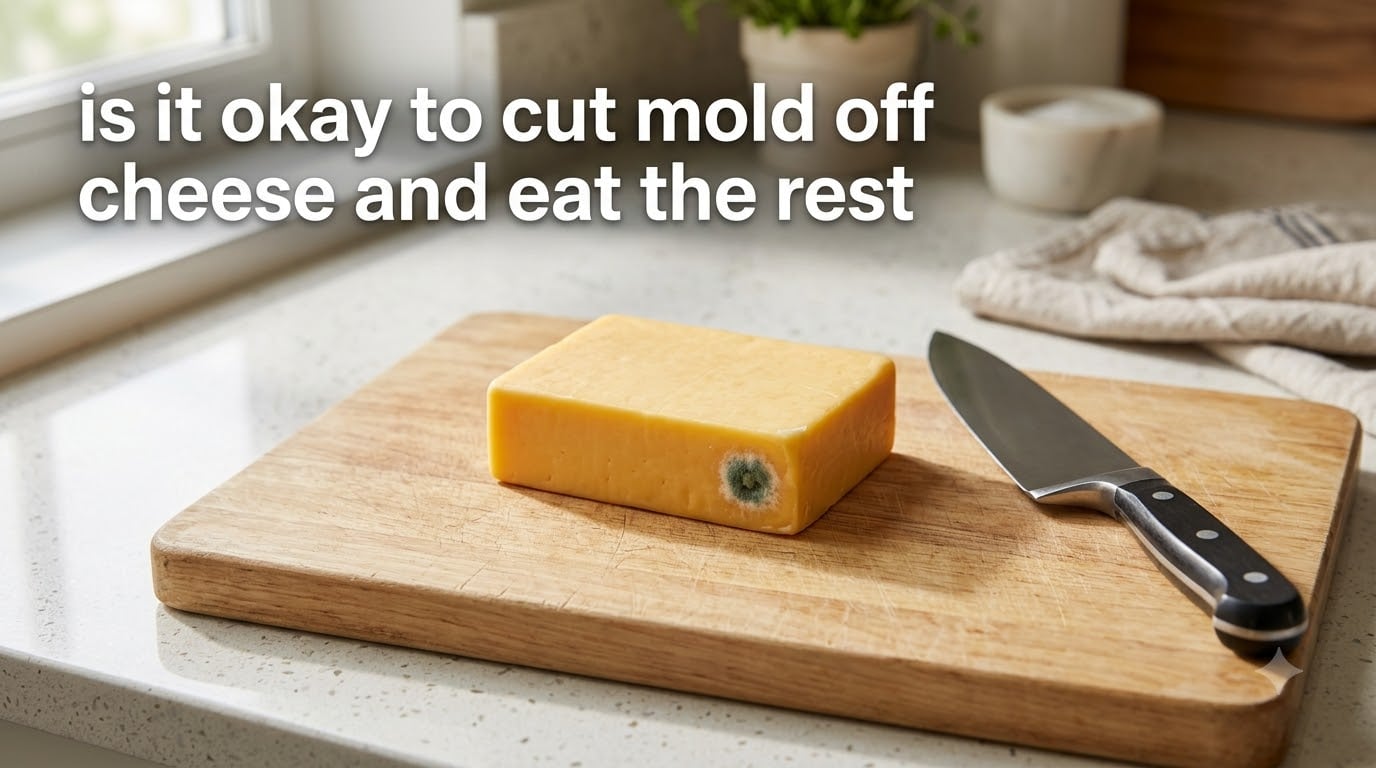
Yes, you can cut mold off certain cheeses and eat the rest – but only if the cheese is hard or semi-hard. For soft cheeses, shredded cheese, sliced cheese, and crumbled cheese, you need to throw the entire thing away. The USDA and Mayo Clinic both confirm this rule, and the reason comes down to moisture content and how deeply mold’s root-like structures can penetrate into different cheese textures.
If you have ever spotted a fuzzy spot on a block of cheddar and wondered whether the rest is salvageable, you are not alone. I have been there too, standing in the kitchen holding a cheese block at arm’s length, trying to decide if it belongs in the trash or back in the fridge. The answer depends entirely on what type of cheese you are dealing with and how much mold has spread.
Table of Contents
Can You Cut Mold Off Cheese and Still Eat It?
You can safely cut mold off hard and semi-hard cheeses. According to the USDA, cut at least 1 inch (2.5 centimeters) around and below the mold spot with a clean knife. This generous margin accounts for the invisible root-like threads (called hyphae) that extend beneath the visible surface.
Soft cheeses, on the other hand, must be discarded entirely when you see mold. The high moisture content in soft cheeses allows mold to spread invisibly throughout the entire product. There is no safe way to salvage them once mold appears.
Here is the quick rule:
Hard and semi-hard cheeses (cheddar, parmesan, Swiss, Gouda, Colby Jack): Cut at least 1 inch around and below the mold. The rest is safe to eat.
Soft cheeses (cream cheese, ricotta, cottage cheese, goat cheese, mozzarella, Brie, feta): Throw the entire container away. No exceptions.
Shredded, sliced, and crumbled cheese: Throw it all away. The increased surface area means mold spores have already spread throughout the package.
Hard Cheese vs Soft Cheese: Why It Matters
The difference comes down to moisture and density. Hard cheeses like cheddar and parmesan are low in moisture and tightly packed, which creates a physical barrier against mold penetration. When mold lands on the surface, its root-like structures (called mycelium) can only travel a short distance before the dense cheese stops them.
Soft cheeses like cream cheese, ricotta, and mozzarella have much higher moisture content. The looser texture lets mold spread its mycelium throughout the entire product in just a few days. What you see on the surface – that small fuzzy spot – is just the tip of the iceberg. Beneath it, the mold has already colonized the cheese you cannot see.
Think of it like water soaking into a sponge versus a ceramic tile. The sponge (soft cheese) absorbs everything deeply. The tile (hard cheese) keeps things on the surface. That is why the same type of mold that is harmless when cut off cheddar can be dangerous if found on mozzarella.
Cheese-by-Cheese Decision Table
Not sure where your cheese falls? Use this quick-reference guide:
| Cheese Type | Verdict | Notes |
|---|---|---|
| Cheddar | Safe to cut | Cut 1 inch around and below mold spot |
| Parmesan / Parmigiano-Reggiano | Safe to cut | Very low moisture – hard for mold to penetrate |
| Swiss / Emmental | Safe to cut | Semi-hard; same 1-inch rule applies |
| Gouda | Safe to cut | Hard Gouda works; young Gouda is softer – toss if unsure |
| Colby Jack | Safe to cut | Semi-hard; use the 1-inch rule |
| Manchego | Safe to cut | Firm texture protects against deep mold penetration |
| Pecorino Romano | Safe to cut | Very hard; same approach as parmesan |
| Cream cheese | Throw away | High moisture means mold spreads invisibly |
| Ricotta | Throw away | Wet texture allows full mold colonization |
| Cottage cheese | Throw away | Extremely high moisture – never salvage |
| Goat cheese (chèvre) | Throw away | Soft and spreadable; mold penetrates throughout |
| Fresh mozzarella | Throw away | High moisture ball or log; toss entirely |
| Feta | Throw away | Crumbly texture does not block mold spread |
| Shredded cheese (any type) | Throw away | Increased surface area means mold is everywhere |
| Sliced cheese (any type) | Throw away | Same as shredded – too much exposed surface |
| Brie | Intentional mold | White rind is Penicillium candidum – safe by design |
| Camembert | Intentional mold | White rind is intentional – safe to eat |
| Blue cheese / Gorgonzola | Intentional mold | Blue-green veins are Penicillium roqueforti – safe by design |
How to Cut Mold Off Cheese the Right Way
Cutting mold off cheese requires more than just slicing off the visible spot. Here is the safe method recommended by the USDA:
Step 1: Get a clean knife. Use a knife that has not touched the moldy area. If you accidentally drag the knife through the mold first, you will spread spores across the clean cheese.
Step 2: Cut at least 1 inch around the mold. Measure generously. Cut 1 inch (2.5 centimeters) beyond the visible mold on all sides. The mold’s invisible roots extend further than what you can see.
Step 3: Cut 1 inch below the mold. Do not forget depth. Slice at least 1 inch beneath the moldy surface as well, not just around it.
Step 4: Discard the cut piece and rewrap. Throw away the moldy portion (do not sniff it – inhaling mold spores can cause respiratory irritation). Rewrap the remaining cheese in fresh parchment paper or a cheese storage bag.
Step 5: Clean your knife and cutting board. Wash with hot soapy water to prevent cross-contamination. Mold spores can survive on surfaces and spread to other foods.
Cheeses That Already Use Mold (And That’s OK)
Some cheeses are intentionally made with specific, food-safe molds. These molds are completely different from the random molds that grow on forgotten cheese in the back of your fridge.
Brie and Camembert get their soft, white rinds from Penicillium candidum, a deliberately added mold. This mold is harmless and contributes to the cheese’s signature creamy texture and earthy flavor.
Blue cheese, Gorgonzola, Roquefort, and Stilton contain Penicillium roqueforti, the mold that creates their distinctive blue-green veins. These molds are safe to eat and are actually what make these cheeses taste the way they do.
The key difference: intentional molds are carefully selected, cultured under controlled conditions, and consumed fresh. Random mold that grows on your cheese in the fridge is uncontrolled and may produce harmful mycotoxins.
Mold Color Decoder: White, Blue, Green, or Black
The color of mold on your cheese does not necessarily tell you if it is dangerous. However, here is what each color typically indicates:
White mold: Could be harmless or could be harmful. On Brie and Camembert, it is intentional. On cheddar or mozzarella, it is unwanted and the cheese should be treated according to the hard/soft rules above.
Blue-green mold: On blue cheese, this is intentional (Penicillium roqueforti). On other cheeses, it is a sign of spoilage – follow the hard vs soft cheese rule to decide whether to cut or toss.
Green mold: Often indicates Aspergillus or other environmental molds. On hard cheese, you can cut it off. On soft cheese, throw it away.
Black mold: Typically indicates more advanced spoilage. While some black molds are not toxic, others can produce mycotoxins. When in doubt, throw it out.
Pink, orange, or red mold: Unusual colors may signal bacterial contamination alongside mold. Discard the cheese regardless of type.
The safest approach is to treat all unwanted mold the same way: cut generously on hard cheese, toss soft cheese entirely, and never rely on color alone to judge safety.
When to Throw It All Away
Even with hard cheeses, there are situations where you should discard the entire block:
Mold covers most or all of the surface. The 1-inch cutting rule works for small spots, not for cheese that is fully colonized.
The cheese is slimy. A slippery or sticky texture indicates bacterial growth, not just mold.
It smells off. A strong ammonia odor or sour smell means the cheese has gone bad beyond just surface mold.
You are in a high-risk group. Pregnant women, young children, older adults, and immunocompromised individuals should avoid eating any cheese that has had mold growth. Listeria, a bacteria that can grow alongside mold, is especially dangerous for these groups. Listeria can cause miscarriage, serious illness in infants, and life-threatening infections in people with weakened immune systems.
It has been in the fridge for months. If you cannot remember when you bought it, the mold is probably not the only problem.
I Accidentally Ate Moldy Cheese – What Should I Do?
If you accidentally ate a piece of moldy cheese, do not panic. Most accidental mold consumption causes no symptoms at all. Your stomach acid is surprisingly effective at neutralizing common mold spores.
What to expect: If you are generally healthy, you will likely experience no symptoms. Some people report mild nausea, stomach discomfort, or a temporary change in taste, but serious illness from a single accidental exposure is rare.
When symptoms appear: If you do get sick, symptoms typically show up within 24 to 72 hours. Watch for nausea, vomiting, diarrhea, and stomach cramps. These are usually mild and resolve on their own within a day or two.
When to call a doctor: Seek medical attention if you experience persistent vomiting, bloody diarrhea, high fever, or symptoms that last more than 48 hours. Pregnant women, young children, elderly adults, and immunocompromised individuals should contact their doctor immediately after eating moldy cheese, even without symptoms, due to the risk of Listeria infection.
How to Prevent Mold on Cheese
Preventing mold growth is easier than dealing with it after the fact:
Use parchment paper or cheese bags instead of plastic wrap. Cheese needs to breathe, and plastic wrap traps moisture that accelerates mold growth.
Store cheese in the vegetable crisper drawer where temperature and humidity are more stable.
Keep different cheeses separate to prevent cross-contamination of mold spores.
Use cheese within 1 to 2 weeks of opening. Hard cheeses last longer than soft, but all cheese deteriorates over time.
Wrap cut cheese tightly in fresh parchment after each use. Avoid reusing the same wrap repeatedly.
Frequently Asked Questions
Is it safe to eat cheese after cutting off mold?
Yes, it is safe to eat hard and semi-hard cheeses after cutting off mold. Cut at least 1 inch (2.5 cm) around and below the mold spot with a clean knife. Soft cheeses, shredded cheese, sliced cheese, and crumbled cheese must be thrown away entirely once mold appears.
Can you cut mold off cheddar cheese and still eat it?
Yes, cheddar is a hard cheese and you can safely cut mold off it. Use a clean knife and remove at least 1 inch of cheese on all sides and beneath the visible mold spot. The remaining cheese is safe to eat.
Can you cut mold off mozzarella cheese?
No, you should not try to cut mold off fresh mozzarella. Mozzarella is a high-moisture cheese, and mold spreads invisibly through the entire product. Throw away the whole piece when you see any mold.
What happens if you accidentally eat moldy cheese?
Most people experience no symptoms from accidentally eating moldy cheese. Your stomach acid typically destroys common mold spores. If symptoms do occur, they usually appear within 24 to 72 hours and include nausea, vomiting, diarrhea, and stomach cramps. These are generally mild and pass within a day or two.
How long after eating moldy cheese would you get sick?
If eating moldy cheese causes symptoms, they typically appear within 24 to 72 hours. Nausea, vomiting, diarrhea, and stomach cramps are the most common symptoms. Serious illness from a single accidental exposure is rare in healthy adults.
Is green mold on cheese dangerous?
Green mold on cheese is not necessarily dangerous. On hard cheeses, green mold can be cut off safely using the 1-inch rule. On soft cheeses, green mold means the entire product should be discarded. On blue cheese, green-blue veins are intentional and safe.
Why can we eat moldy cheese but not moldy bread?
Cheese and bread have different textures and moisture levels. Hard cheese is dense enough to block mold penetration, so cutting away the mold works. Bread is porous and soft, so mold spreads through the entire loaf invisibly. The USDA advises discarding all moldy bread entirely.
Should I go to the ER if I ate mold?
In most cases, no. Accidentally eating moldy cheese rarely requires emergency care. However, seek medical attention if you experience persistent vomiting, bloody diarrhea, high fever, or symptoms lasting more than 48 hours. Pregnant women, young children, elderly adults, and immunocompromised individuals should contact a doctor immediately.
Conclusion
So, is it okay to cut mold off cheese and eat the rest? The short answer is yes for hard cheeses like cheddar, parmesan, and Swiss – just cut at least 1 inch around and below the mold with a clean knife. For soft cheeses like cream cheese, ricotta, and fresh mozzarella, throw the whole thing away. And if you are in a high-risk group, skip the salvage attempt entirely and discard any cheese that has developed mold.