
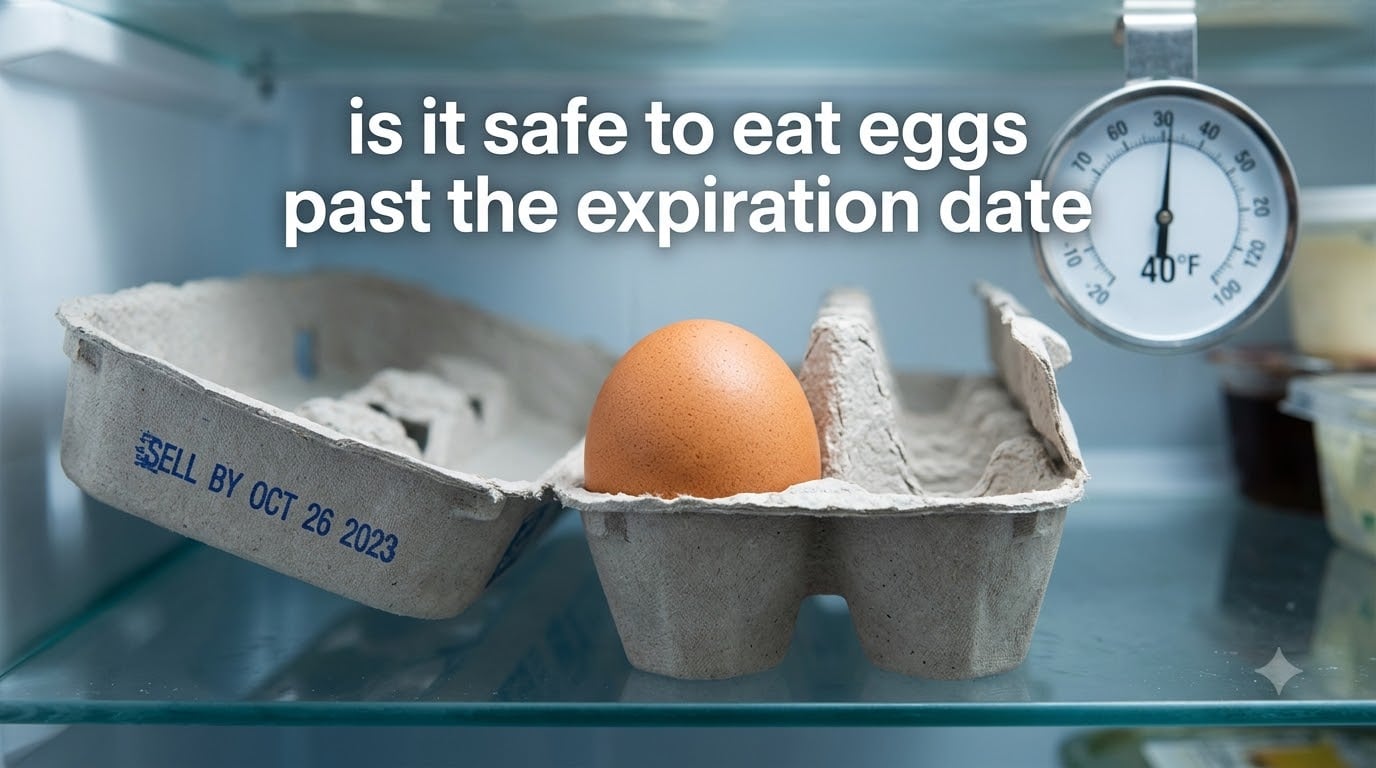
Yes, eggs are generally safe to eat three to five weeks past the expiration date printed on the carton, as long as they have been continuously refrigerated at 40°F (4°C) or below. The USDA confirms that the date on a carton is a quality indicator, not a safety deadline. The key is knowing how to check freshness before you crack one open.
In this guide, we break down what every date label actually means, how long eggs truly last, and exactly how to tell whether that forgotten carton in the back of your fridge is still good. We also cover storage best practices and the real health risks so you can make a confident call every time.
Table of Contents
What the Date on Your Egg Carton Really Means
Most people glance at the date on an egg carton and assume it is a hard expiration date. It is not. The USDA does not require egg producers to place an expiration date on cartons at all — the dates you see are voluntary quality markers set by the producer or retailer.
Sell-By Date
A Sell-By date tells the store how long to keep the product on the shelf. It is not meant for the consumer. Eggs purchased on or before the Sell-By date are typically good for another two to four weeks in your refrigerator if stored properly.
Best-By and Best-Before Dates
Best-By (or Best-Before) indicates the window during which eggs will be at peak quality — meaning firm whites, tall yolks, and the freshest flavor. After this date, quality gradually declines but safety is not automatically compromised.
Use-By Date
A Use-By date is the last date recommended for use of the product at peak quality. Of all the labels, this one is closest to a safety-oriented marker, though eggs can still be safe beyond it if properly refrigerated and they pass freshness tests.
EXP Label
EXP stands for expiration and is used by some producers as a straightforward alternative to Best-By. It carries the same meaning: a quality window, not a cliff edge.
Julian Date (The 3-Digit Number)
Many cartons also carry a three-digit Julian date code that represents the day of the year the eggs were packed. January 1 is 001, and December 31 is 365. A Julian date of 045 means the eggs were packed on February 14. This is the most reliable way to know exactly how old your eggs are. According to the USDA, fresh shell eggs are safe to eat four to five weeks beyond the Julian pack date when kept refrigerated.
EU vs. US Date Labels
In the European Union, eggs carry a legal best-before date set at a maximum of 28 days after laying. This is stricter than the US system, where no federal expiration date is mandated. The EU also prohibits washing eggs before sale, which preserves the natural cuticle — a protective coating on the shell. In the US, eggs are washed and sanitized, which removes the cuticle and is why American eggs must be refrigerated while unwashed European eggs can often be stored at room temperature for a shorter window.
How Long Eggs Really Last Past the Expiration Date
The answer depends on how the eggs have been stored. According to the USDA, properly refrigerated eggs remain safe to use for three to five weeks from the pack date — which often extends well beyond the Sell-By or Best-By date printed on the carton.
Here is a practical timeline to keep in mind:
Refrigerated at 37-40°F (3-4°C): Eggs are generally safe for three to five weeks past the pack date. If the Sell-By date was two weeks ago, you likely have another week or two of safe eating ahead of you.
Left at room temperature: The USDA’s two-hour rule applies. If eggs have been sitting out for more than two hours — or one hour in temperatures above 90°F (32°C) — they should be discarded. Bacteria multiply rapidly between 40°F and 140°F, a range called the danger zone.
After hard-boiling: Hard-boiled eggs should be eaten within one week when refrigerated, though many food safety authorities recommend consuming them within two days for best quality. The cooking process removes the shell’s natural protective layer, making the egg more vulnerable to bacterial contamination.
One important point: Salmonella does not develop inside an egg over time if it was not present at the origin. Spoilage bacteria — the ones that cause bad smells and off textures — are what grow as eggs age. These are unpleasant but rarely dangerous. Salmonella contamination, when it occurs, happens during formation inside the hen or through a cracked shell. This means an older egg that smells and looks normal is unlikely to carry Salmonella if it was safe to begin with.
How to Tell If an Egg Has Gone Bad
Before you cook with any egg that has been sitting in the fridge for a while, run it through these four quick tests. They take less than a minute and will give you a clear verdict.
Test 1: The Smell Test
This is the most reliable indicator. Crack the egg onto a clean plate. A fresh egg has very little odor. A spoiled egg gives off an unmistakable sulfur-like or rotten smell. If you detect any foul odor at all, discard the egg immediately — do not taste it.
Test 2: Visual Inspection
Check the shell before cracking. Discard eggs with visible cracks, slimy residue, or powdery mold on the surface. A slimy shell can indicate bacterial growth, while mold signals the egg has been compromised. After cracking, look at the whites and yolk. Fresh eggs have thick, cloudy whites and a round, firm yolk. Older eggs have runny, transparent whites and a flat, spread-out yolk. Pink, green, or iridescent discoloration in the whites means the egg has gone bad.
Test 3: The Float Test
Fill a bowl or glass with cold water and gently lower the egg in. A fresh egg sinks and lies flat on its side. An egg that stands upright on one end is older but usually still safe. An egg that floats to the surface has a large air cell, which means it has lost significant moisture and has likely gone bad. While the European Food Safety Authority notes that the float test is not a definitive safety indicator on its own, it remains a useful screening tool when combined with the smell and visual tests.
Test 4: The Crack Test
Crack the egg into a bowl and inspect it closely. The yolk should be intact and hold its shape. The whites should be thick enough to hold together rather than spreading watery across the bowl. If the yolk breaks easily and the whites are thin and runny, the egg is past its prime but may still be safe for cooking — just not ideal for poaching or frying.
The bottom line: If an egg passes all four tests, it is safe to cook with. If it fails any single test, throw it out.
The Risks of Eating Expired Eggs
The primary concern with expired eggs is Salmonella, a bacterium that can cause foodborne illness. Symptoms appear within six hours to six days after eating a contaminated egg and include diarrhea, stomach cramps, fever, nausea, and vomiting. Most healthy adults recover within four to seven days, but certain groups face higher risks.
Who Should Be Most Cautious?
The CDC identifies these groups as most vulnerable to severe Salmonella illness:
Pregnant women. Salmonella infection during pregnancy can lead to serious complications including dehydration and, rarely, premature labor.
Children under five. Young children have immature immune systems and are more likely to develop severe symptoms from foodborne bacteria.
Adults over 65. The immune system weakens with age, making older adults more susceptible to complications from Salmonella.
Immunocompromised individuals. Anyone with a weakened immune system — from conditions like HIV, cancer treatment, or organ transplant medications — should take extra precautions with eggs.
For these groups, the safest option is to use pasteurized eggs, especially for recipes that call for raw or lightly cooked eggs such as Caesar dressing, hollandaise sauce, meringue, or homemade mayonnaise. Pasteurized eggs have been heat-treated to kill bacteria without cooking the egg, making them safe to consume even when not fully cooked.
Regardless of who is eating, eggs should always be cooked to an internal temperature of 160°F (71°C) to kill any potential Salmonella. For scrambled eggs, omelets, and casseroles, this means cooking until both the whites and yolks are firm.
How to Store Eggs for Maximum Freshness
Proper storage can add weeks to an egg’s usable life. Here is what matters most.
Keep Them Cold and Consistent
Store eggs in the refrigerator at 37-40°F (3-4°C). The back of the main refrigerator compartment is the best spot because it maintains the most consistent temperature. Avoid the door — the temperature fluctuates every time you open it, which accelerates moisture loss and quality decline.
Keep Eggs in the Carton
The cardboard carton does more than hold eggs together. It protects them from absorbing strong odors and flavors from other foods, prevents moisture loss through the shell, and shields the eggs from light, which can degrade quality over time. Place the carton with the pointed end facing down and the wider end up. The air cell at the wider end stays stable in this position, which helps maintain internal quality.
The Two-Hour Rule
Eggs should not sit at room temperature for more than two hours total. This includes time on the counter during cooking prep, time sitting out at a buffet, and time in a warm car on the way home from the store. In hot weather above 90°F (32°C), this window shrinks to one hour. If eggs have been out longer, err on the side of caution and discard them.
Do Not Wash Eggs Before Storing
In the US, commercial eggs are already washed and sanitized before sale. Additional washing at home removes moisture and can push bacteria through the shell’s pores. If an egg is dirty, wipe it gently with a dry cloth. In the EU, where eggs are sold unwashed, the natural cuticle acts as a barrier against bacteria — washing removes this protection.
Freezing Eggs for Long-Term Storage
Whole eggs in their shells cannot be frozen — the liquid expands and cracks the shell. But you can freeze egg contents for later use. Crack eggs into a container, gently whisk to combine, and freeze for up to one year. For separated eggs, whites freeze well on their own; yolks should be mixed with a pinch of salt or sugar (depending on intended use) to prevent them from becoming gelatinous. Thaw frozen eggs overnight in the refrigerator before using.
Hard-Boiled Eggs: A Different Shelf Life
Hard-boiled eggs follow stricter rules than raw eggs. Once cooked, they should be refrigerated within two hours and consumed within one week — though many food safety sources recommend eating them within two days for the best quality and safety.
The cooking process changes the egg’s structure. The shell becomes more porous after boiling, and the protective cuticle is washed away. This makes the egg more susceptible to bacterial contamination from the environment. If you peel hard-boiled eggs, store them in a sealed container in the refrigerator and use them within five days.
Hard-boiled eggs that have a sulfurous smell stronger than usual, slimy texture, or any discoloration should be thrown out. While a mild sulfur scent is normal for cooked eggs, an overpowering or off smell is a clear sign of spoilage.
Best Culinary Uses for Older Eggs
If your eggs are approaching the end of their optimal window but still pass the freshness tests, you do not need to throw them out. Older eggs can be excellent for certain cooking applications.
Baking. Older eggs are actually preferred for baking in many cases. They peel more easily after hard-boiling, which makes them ideal for deviled eggs and egg salad. Their slightly thinner whites blend more readily into batters and doughs for cakes, cookies, and quiches.
Hard-boiling. Eggs that are one to two weeks old peel significantly more easily than fresh eggs after boiling. The slightly higher pH of older whites reduces the bond between the egg white and the inner membrane, making peeling less frustrating.
Scrambling and omelets. Scrambled eggs and omelets mask the slight quality decline of older eggs. The thinner whites still cook well when whisked and do not need the structural integrity required for poaching or frying.
Avoid using older eggs for poaching, frying sunny-side up, or making meringue and soufflés. These applications rely on thick whites and firm yolks to hold shape, which is where fresh eggs have a clear advantage.
Frequently Asked Questions
How long are eggs good after expiration date?
Properly refrigerated eggs are generally safe for three to five weeks past the pack date, which often extends beyond the Sell-By or Best-By date on the carton. The key is continuous refrigeration at 40°F or below and passing the smell and float tests before use.
Can you eat 2 month old eggs?
Two-month-old eggs are unlikely to be safe even if refrigerated. While the USDA guideline supports three to five weeks past the pack date, eggs at two months have typically lost significant quality and carry a higher risk of spoilage. Run all four freshness tests — if the egg floats, smells off, or looks discolored, discard it.
How to tell if eggs are too old to eat?
Use four quick tests: crack the egg and smell it — a sulfurous or rotten odor means discard it. Check the shell for cracks, mold, or slime. Do a float test in cold water — floating eggs have large air cells and should be thrown out. Inspect the cracked egg for runny whites, flat yolks, or discoloration.
Can you eat eggs 2 weeks after date?
Yes, eggs are often safe two weeks past the Best-By or Sell-By date when continuously refrigerated. The USDA confirms that eggs can remain safe for three to five weeks from the pack date. Always do a quick smell and float test before cooking to verify freshness.
How long can eggs be eaten after expiration?
When stored in the refrigerator at 40°F or below, eggs can typically be eaten for three to five weeks after the pack date printed on the carton. The Sell-By or Best-By date is a quality indicator, not a strict safety deadline. Eggs that pass the smell, visual, and float tests are generally safe to use.
Are 2 month old eggs safe to eat?
Eggs that are two months past their pack date are generally not safe to eat. Most eggs are at their best within three to five weeks of packing when properly refrigerated. At two months, the risk of spoilage bacteria growth increases significantly. Always discard eggs that fail the float test or have an off smell.
Are eggs safe to eat after the expiry date?
Yes, eggs can be safe to eat after the expiry date if they have been continuously refrigerated. Expiry dates are quality indicators set by producers, not absolute safety cutoffs. Run a quick freshness check — smell, visual inspection, and float test — to confirm the egg is still good before cooking.
How late is too late for eggs?
An egg is too late when it fails any freshness test: it floats in cold water, smells like sulfur when cracked, shows mold or slime on the shell, or has discolored whites. In terms of timeline, eggs beyond five weeks past the pack date should be treated with extra caution, and those left unrefrigerated for over two hours should always be discarded.
Conclusion
So, is it safe to eat eggs past the expiration date? In most cases, yes. The date on your carton is a quality benchmark, not a safety alarm. Properly refrigerated eggs can remain safe for weeks beyond that printed date.
The four-step freshness check — smell, visual, float, and crack — gives you a reliable way to evaluate any egg. Store them in the back of your fridge, keep them in the carton, and respect the two-hour rule for room temperature. If an egg passes every test, cook it with confidence. If it fails even one, toss it without guilt.
For vulnerable groups — pregnant women, young children, older adults, and immunocompromised individuals — pasteurized eggs are the safest choice, especially for recipes that call for raw or undercooked eggs. When in doubt, cook eggs to an internal temperature of 160°F (71°C) to eliminate any Salmonella risk.