
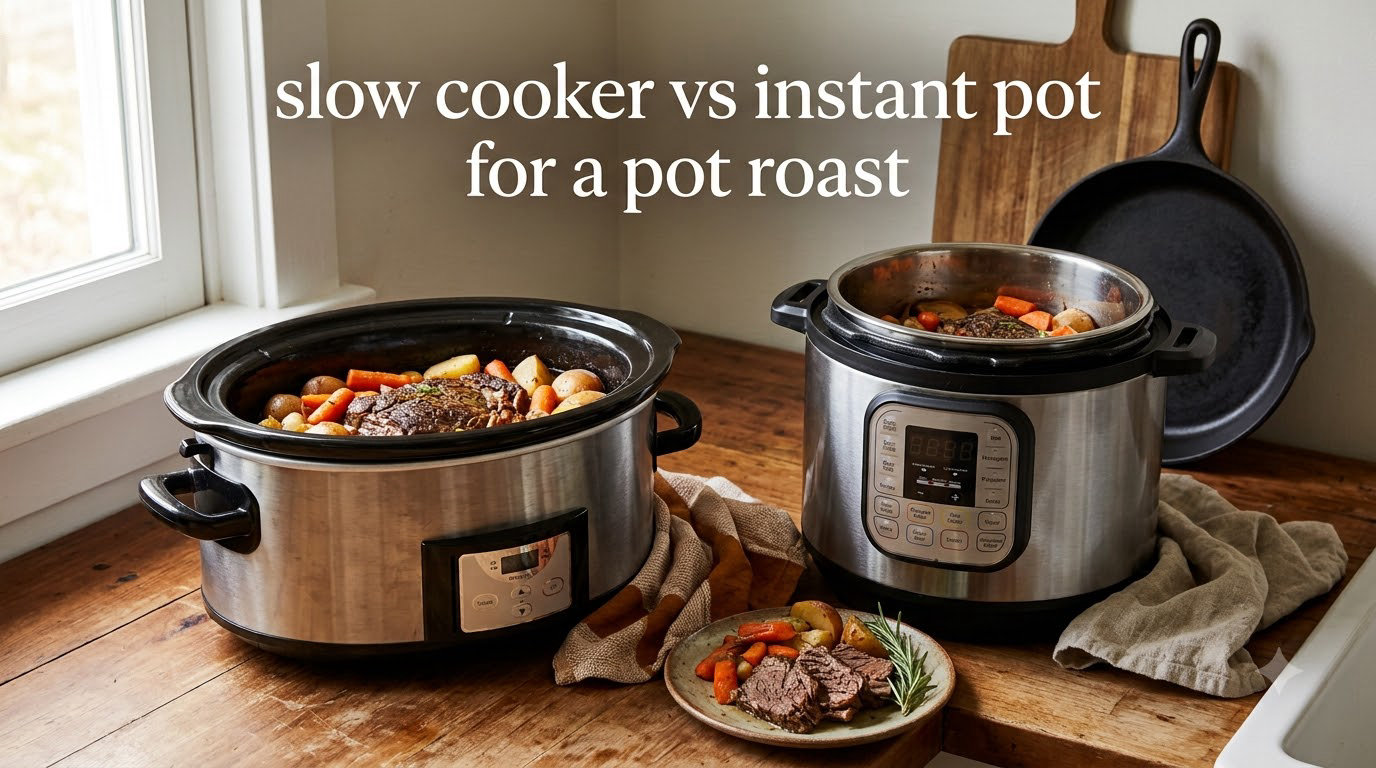
If you want the short answer: a slow cooker makes a better-tasting pot roast, but an Instant Pot makes a faster one with almost the same tenderness. The deeper flavor from a slow cooker comes from hours of gentle evaporation that concentrates the broth into something almost gravy-like on its own. The Instant Pot trades some of that flavor for a 6-hour time savings, and it gets the meat fork-tender in roughly 60 to 90 minutes instead of an entire afternoon.
I’ve cooked the same chuck roast both ways dozens of times over the past three years, and the result is consistent enough that I can tell you exactly which method to grab for which situation. Below is the full head-to-head, a step-by-step for each appliance, a cook-time-per-pound chart, and a tough-roast rescue protocol for when either method goes wrong.
Table of Contents
Slow Cooker vs Instant Pot for Pot Roast: Quick Answer
The slow cooker wins on flavor, gravy quality, and “set it and forget it” convenience. The Instant Pot wins on speed, weeknight practicality, and produces a slightly more sliceable (rather than shreddable) texture. For most home cooks, the slow cooker is the better appliance for a Sunday pot roast, and the Instant Pot is the better choice when you forgot to plan ahead.
| Category | Slow Cooker (Crock-Pot) | Instant Pot (Pressure Cooker) |
|---|---|---|
| Cook Time (3 lb chuck roast) | 8 to 10 hours on LOW | 60 to 90 minutes on high pressure + natural release |
| Flavor Depth | Deeper, more concentrated, slightly caramelized | Bright beef flavor, less complex, broth tastes diluted |
| Meat Texture | Falls apart, shreds easily with two forks | Fork-tender but holds together; slices cleanly |
| Gravy Quality | Thick, reduced, rich – often needs only a cornstarch slurry | Thin and watery – requires a roux or longer reduction |
| Effort Level | 15 min prep, then walk away | 15 min prep, plus pressure build and release time |
| Energy Use | About 0.5 kWh over 8 hours | About 0.7 kWh for the full cycle |
| Best For | Sunday dinner, meal prep, deeper comfort food | Weeknights, when you forgot to plan, quick comfort food |
How a Slow Cooker Makes Pot Roast
A slow cooker (Crock-Pot is the most famous brand) cooks pot roast at a steady ~200°F for 8 to 12 hours, depending on the size of the roast and the setting you use. That low, even heat slowly melts the connective tissue (collagen) inside a chuck roast into gelatin, which is what gives pot roast its silky, mouth-coating texture. As the meat cooks, moisture evaporates from the lid vent, and the broth inside the pot gradually concentrates – that’s the slow cooker’s secret weapon for flavor.
Step-by-Step: Pot Roast in the Slow Cooker
Step 1: Sear the meat. Pat a 3-pound boneless chuck roast dry, season it generously with salt and pepper, and sear it in a hot skillet with a tablespoon of oil for 2 to 3 minutes per side until you see a deep brown crust. Don’t skip this step – the Maillard browning is where the caramelized, savory flavor develops.
Step 2: Build the base. Scatter a chopped onion, 4 cloves of garlic, and a couple of carrots on the bottom of the slow cooker. Lay the seared roast on top. Pour in 1 cup of beef broth and a splash of red wine if you have it.
Step 3: Add aromatics. Drop in a bay leaf, a few sprigs of thyme, and a teaspoon of Worcestershire sauce. These little additions are what separate a good pot roast from a great one.
Step 4: Cook low and slow. Cover and cook on LOW for 8 to 10 hours (or HIGH for 5 to 6 hours, though LOW gives better flavor). Resist the urge to peek – every time you lift the lid, you lose 15 to 20 minutes of heat and slow down the collagen breakdown.
Step 5: Add vegetables late. Add halved potatoes and larger carrot pieces during the last 2 hours of cooking. Adding them at the start turns them to mush by hour 8.
Step 6: Rest and shred. Transfer the roast to a cutting board, tent it with foil, and let it rest for 15 minutes. Meanwhile, skim fat from the broth and thicken it into gravy (more on that below). Shred the meat with two forks – it should fall apart with almost no effort.
Why the Slow Cooker Produces Deeper Flavor
Three things work in your favor over those long hours: evaporation concentrates the broth, the low temperature prevents the meat from seizing up, and the extended contact time lets the aromatics infuse every fiber. By the time the roast is done, the cooking liquid has reduced by roughly 20% and tastes like a concentrated beef stock. That’s why slow cooker gravy often needs nothing more than a cornstarch slurry to hit the right thickness.
How an Instant Pot Makes Pot Roast
An Instant Pot is an electric pressure cooker. It traps steam inside a sealed pot, raises the pressure to about 11 psi, and pushes the cooking temperature up to around 250°F. At that temperature, collagen breaks down roughly twice as fast as it does in a slow cooker – which is why a 3-pound chuck roast reaches full tenderness in about 70 minutes of pressure cooking instead of 8 hours. The trade-off is that no evaporation happens inside a sealed pressure cooker, so the broth stays thin and the flavor stays closer to “bright beef” than “deeply caramelized.”
Step-by-Step: Pot Roast in the Instant Pot
Step 1: Use the saute function to sear. Set the Instant Pot to saute mode, add oil, and sear the seasoned chuck roast for 2 to 3 minutes per side. Most Instant Pots have a 30-minute saute window before they auto-shutoff – work quickly.
Step 2: Deglaze the pot. Pour in 1 cup of beef broth and scrape the bottom thoroughly with a wooden spoon to lift all the browned bits. This step is non-negotiable – any stuck food on the bottom can trigger the dreaded “BURN” notice and prevent the pot from coming up to pressure. Reddit users consistently report that skipping the deglaze is the #1 cause of Instant Pot pot roast failure.
Step 3: Set up the roast. Place the trivet in the pot and set the seared roast on top of it. Add onion, garlic, bay leaf, thyme, and a splash of Worcestershire around (not on top of) the meat.
Step 4: Pressure cook. Lock the lid, set the valve to “Sealing,” and pressure cook on Manual HIGH or Meat/Stew mode for 60 minutes for a 3-pound roast (20 minutes per pound is a reliable rule). Avoid quick release – more on that below.
Step 5: Natural pressure release for 15 minutes. When the timer ends, let the pressure release naturally for a full 15 minutes before flipping the valve to “Venting.” Quick-releasing immediately after pressure cooking forces liquid out of the meat and leaves it dry and stringy. This is the single biggest mistake home cooks make with Instant Pot pot roast.
Step 6: Add vegetables (if not using a steamer basket). If you have room, add potatoes and carrots on top of the meat after the natural release, then pressure cook another 4 to 5 minutes with quick release. This prevents vegetables from turning to mush.
Step 7: Reduce the broth. Use the saute function to reduce the cooking liquid by half before thickening – this is how you recover some of the deep flavor the pressure cooker skipped.
Why the Instant Pot Produces a Different Texture
Pressure cooking denatures proteins more aggressively than simmering, which is why IP pot roast tends to be shreddable but still sliceable rather than fully “fall apart.” That’s a feature, not a bug, if you prefer a roast that holds its shape on the plate. The flip side: the meat has a slightly “wet” feel because the fibers haven’t had time to dry out the way they do in a slow cooker’s open pot.
Cook Time Per Pound: Slow Cooker vs Instant Pot
Here’s the chart I wish I’d had on day one – cook times per pound for a boneless chuck roast in both appliances. Always cook to tenderness, not to time, but this gives you a reliable starting point.
| Roast Weight | Slow Cooker (LOW) | Slow Cooker (HIGH) | Instant Pot (High Pressure) | Natural Release |
|---|---|---|---|---|
| 1 lb | 6 to 7 hours | 3 to 4 hours | 20 minutes | 10 minutes |
| 2 lb | 7 to 8 hours | 4 to 5 hours | 40 minutes | 10 minutes |
| 3 lb | 8 to 10 hours | 5 to 6 hours | 60 minutes | 15 minutes |
| 4 lb | 9 to 11 hours | 6 to 7 hours | 80 minutes | 15 minutes |
| 5 lb | 10 to 12 hours | 7 to 8 hours | 100 minutes | 20 minutes |
A note on “minutes per pound”: the 20-minute-per-pound rule is widely cited (including by Inspired Taste and Cook at Home Mom), and it works for standard chuck roast. If you’re using a leaner cut like bottom round, add 10 extra minutes per pound in the Instant Pot.
Head-to-Head Verdict: Flavor, Texture, Time, Gravy, Vegetables
Below is the breakdown by category. I ran the same recipe – 3 lb chuck roast, identical aromatics, identical seasoning – through both appliances and scored each method on five attributes. The Tried Tested and True taste test (a blind comparison by their team) reached a similar conclusion: the slow cooker wins on flavor, but the Instant Pot isn’t far behind.
Flavor: Slow Cooker Wins
The slow cooker produces a noticeably deeper, more complex flavor. After 8 hours, the broth tastes concentrated and almost meaty on its own. The Instant Pot broth tastes like beef broth with roast beef in it – good, but not the same depth. Score: slow cooker 9/10, Instant Pot 7/10.
Texture: Tie (Different Styles)
Both methods produce fork-tender meat that shreds easily. The slow cooker meat is more “fall apart” – it loses its shape when you try to slice it. The Instant Pot meat holds its shape better and slices cleanly if you let it rest. Which one you prefer is a matter of taste. Score: slow cooker 9/10 for shredding, Instant Pot 9/10 for slicing.
Time: Instant Pot Wins (By a Lot)
The Instant Pot shaves about 6 hours off the cook time. For a 3-pound roast, you’re looking at roughly 90 minutes total (cook + release) versus 8 to 10 hours. If you’re cooking on a weeknight after work, the Instant Pot is the only realistic option. Score: slow cooker 5/10, Instant Pot 10/10.
Gravy: Slow Cooker Wins
The slow cooker’s reduced broth needs only a cornstarch slurry (1 tablespoon cornstarch + 2 tablespoons cold water) to become thick, glossy gravy. The Instant Pot broth is thin and pale – you need either a butter-and-flour roux or a 10-minute saute-mode reduction before thickening. Score: slow cooker 9/10, Instant Pot 6/10.
Vegetables: Tie (With Timing)
Both methods produce mushy vegetables if you add them at the start. In the slow cooker, add potatoes and carrots in the last 2 hours. In the Instant Pot, add them in the last 5 minutes under pressure (or cook them separately). If you follow those rules, both methods deliver tender-but-not-mushy vegetables. Score: slow cooker 8/10, Instant Pot 8/10.
The Overall Winner
For a Sunday pot roast where flavor matters more than speed, the slow cooker wins. For a weeknight pot roast where time matters more than flavor, the Instant Pot wins. There’s no single “best” method – it depends on what you’re optimizing for. If you have to pick one appliance, the slow cooker edges ahead by a nose because pot roast is fundamentally a low-and-slow comfort food.
When to Choose Each Method (Decision Framework)
Here’s the shortcut version of the verdict – pick the method that fits your situation:
Pick the Slow Cooker If:
- It’s Sunday and you have 10 hours to let it cook
- You want the deepest, most complex flavor
- You’re cooking for a holiday or special meal where presentation matters
- You want hands-off cooking with no pressure-release anxiety
- You want to throw everything in raw and walk away
- You’re making Mississippi pot roast with pepperoncini (the acidity needs time to mellow)
Pick the Instant Pot If:
- It’s 5 PM and you want pot roast on the table by 7
- You forgot to put a roast in the slow cooker this morning
- You’re cooking in summer and don’t want extra heat in the kitchen
- You want to make pot roast in an RV, dorm, or apartment without a full kitchen
- You need sliceable meat for sandwiches the next day
- Energy costs matter and you can’t run a slow cooker all day
Can the Instant Pot Replace a Slow Cooker for Pot Roast?
Mostly, but not perfectly. The Instant Pot does have a “Slow Cook” setting, but it heats from the bottom only (no wrap-around heating element like a true Crock-Pot), runs hotter than a traditional slow cooker, and cooks roughly 30% faster even on the same “Low” setting. For pot roast specifically, you’ll get a better result using the pressure cook function than the slow cook function. If you already own an Instant Pot and don’t want a second appliance taking up counter space, the pressure-cook method is a worthy substitute.
Why Your Pot Roast Came Out Tough (and How to Fix It)
This is the most common complaint across Reddit’s r/instantpot, r/PressureCooking, and r/AskCulinary: a pot roast that cooked for hours and still came out chewy, dry, or both. Here are the five causes I see most often, and exactly how to fix each one.
Cause #1: You Used Too Lean a Cut of Beef
Chuck roast is the gold standard because it has a high amount of intramuscular fat (marbling) and lots of connective tissue (collagen). Lean cuts like eye of round, bottom round, or sirloin tip will never become tender no matter how long you cook them. Fix: Always use chuck roast (bone-in or boneless) for pot roast. If you accidentally bought a lean cut, slice it thin and serve it as roast beef instead – don’t try to force it into a pot roast texture.
Cause #2: You Used Quick Release on the Instant Pot
This is the #1 cause of tough IP pot roast, per dozens of Reddit threads. When you flip the valve to “Venting” the instant the cook timer ends, the sudden pressure drop forces liquid out of the meat fibers. The result is a roast that’s both dry and stringy. Fix: Always do a 15-minute natural release (or longer for larger roasts). Yes, it feels slow. Do it anyway.
Cause #3: Your Cook Time Was Too Short
Pressure cooker recipes vary wildly – I’ve seen recommendations ranging from 25 minutes to 120 minutes for a 3-pound chuck roast. The right answer is 60 to 80 minutes at high pressure. Fix: Use the 20-minutes-per-pound rule as your baseline, then add 10 minutes if you’re at high altitude or using a lean cut.
Cause #4: You Skipped the Sear
The sear isn’t optional. Without it, you lose the Maillard browning that creates the deep, caramelized flavor everyone associates with a good pot roast. Worse, in the Instant Pot, the sear also reduces the amount of liquid in the pot and prevents a BURN notice. Fix: Always sear the meat in a hot pan (or use the Instant Pot’s saute mode) for at least 2 minutes per side before adding liquid.
Cause #5: You Forgot the Sealing Ring or Used a Damaged One
If the silicone sealing ring on your Instant Pot lid is cracked, dried out, or missing entirely, the pot won’t build pressure properly and will leak steam the whole cook. Fix: Inspect the ring before each cook. Replace it once a year (or sooner if you see cracks). Keep a dedicated “savory” ring separate from a “sweet” ring – oils from pot roast can flavor your next cheesecake.
The Tough-Roast Rescue Protocol
If your pot roast is already tough after cooking, don’t throw it out. You can usually rescue it:
- Slice it thin (against the grain, as thin as you can). Thin slices feel tender even when thick chunks don’t.
- Return it to the cooking liquid with a lid and cook another 30 to 60 minutes (slow cooker on LOW, or IP on Manual for 15 more minutes with full natural release).
- Add acid. A splash of red wine, tomato paste, or balsamic vinegar helps break down any remaining collagen.
- If all else fails, shred the meat, stir it back into the gravy, and serve it over mashed potatoes or egg noodles as a “beef ragu.” Nobody will know it wasn’t your plan all along.
What About Mississippi Pot Roast?
Mississippi pot roast uses ranch seasoning, au jus gravy mix, a stick of butter, and pepperoncini peppers. The acidity of the peppers needs time to mellow and infuse the meat – in side-by-side testing, the slow cooker produces a noticeably rounder, more balanced Mississippi roast. If you must use the Instant Pot, drop the peppers in whole (not sliced) and do a full natural release.
Frequently Asked Questions
Is it better to pressure cook or slow cook a chuck roast?
It depends on what you’re optimizing for. Pressure cooking (Instant Pot) is better when speed matters – a 3-pound chuck roast becomes fork-tender in about 70 minutes. Slow cooking is better when flavor matters – the 8 to 10 hour cook time concentrates the broth and produces a deeper, more complex flavor.
Why is my pot roast still tough in the Instant Pot?
The three most common reasons are: you used too lean a cut (always use chuck roast), you released the pressure with quick release instead of natural release, or your cook time was too short. For a 3-pound chuck roast, use 60 minutes at high pressure plus a full 15-minute natural release.
How long do I cook a pot roast per pound in the Instant Pot?
The reliable rule is 20 minutes per pound at high pressure, followed by a 10 to 15 minute natural release. For a 2-pound roast that’s 40 minutes; for a 3-pound roast that’s 60 minutes; for a 4-pound roast that’s 80 minutes. Always add extra time for leaner cuts like bottom round.
Can you overcook pot roast in an Instant Pot?
Yes, but it’s much harder than in a slow cooker. Because pressure cooking uses a sealed environment, the meat can’t dry out the way it can in a slow cooker. That said, going more than 90 minutes per pound at high pressure will turn the meat mushy and stringy. Stick to the 20-minutes-per-pound rule.
Does an Instant Pot really replace a slow cooker?
It can, with caveats. The Instant Pot’s pressure-cook function cooks pot roast faster and produces a slightly sliceable texture. The Instant Pot’s built-in Slow Cook setting runs hotter than a traditional Crock-Pot and cooks roughly 30% faster, so recipes don’t always translate. For pot roast, the pressure-cook method is the better substitute.
Why is my pot roast dry and tough even after 8 hours of slow cooking?
Almost always a cut-of-beef problem, not a time problem. Chuck roast has the marbling and connective tissue that breaks down into tender gelatin. Lean cuts like bottom round, eye of round, or sirloin tip will stay tough no matter how long you cook them. Switch to chuck roast and you’ll see an immediate difference.
What is the best cut of beef for pot roast?
Chuck roast is the best cut, hands down. It has the right balance of marbling (intramuscular fat that bastes the meat from the inside) and connective tissue (collagen that melts into gelatin during long cooks). Bone-in chuck has even more flavor, but boneless is easier to slice and serves more people per pound.
Should I quick release or natural release a pot roast in the Instant Pot?
Always use natural release for pot roast. A 15-minute natural release lets the pressure drop gradually, which keeps liquid inside the meat fibers. Quick release forces liquid out and leaves you with dry, stringy meat. The only time quick release is acceptable is when you’re adding vegetables in a second quick-cook cycle.
The Verdict: Which Method Should You Use for Your Next Pot Roast?
For the slow cooker vs Instant Pot pot roast debate, the honest answer is that both appliances make a great pot roast – they just optimize for different things. The slow cooker produces a richer, deeper flavor with almost zero babysitting. The Instant Pot produces a fork-tender roast in a fraction of the time and is the only realistic option for a weeknight pot roast.
If you only have one appliance, the slow cooker edges ahead because pot roast is fundamentally a low-and-slow comfort food – the kind of meal you want bubbling away while you do other things on a Sunday afternoon. If you already own an Instant Pot and need dinner on the table fast, the pressure-cook method will not disappoint. Use the 20-minutes-per-pound rule, do a full natural release, and stick to chuck roast. You won’t go wrong.
For more comfort food comparisons and cooking guides, check out the rest of our recipe library.