
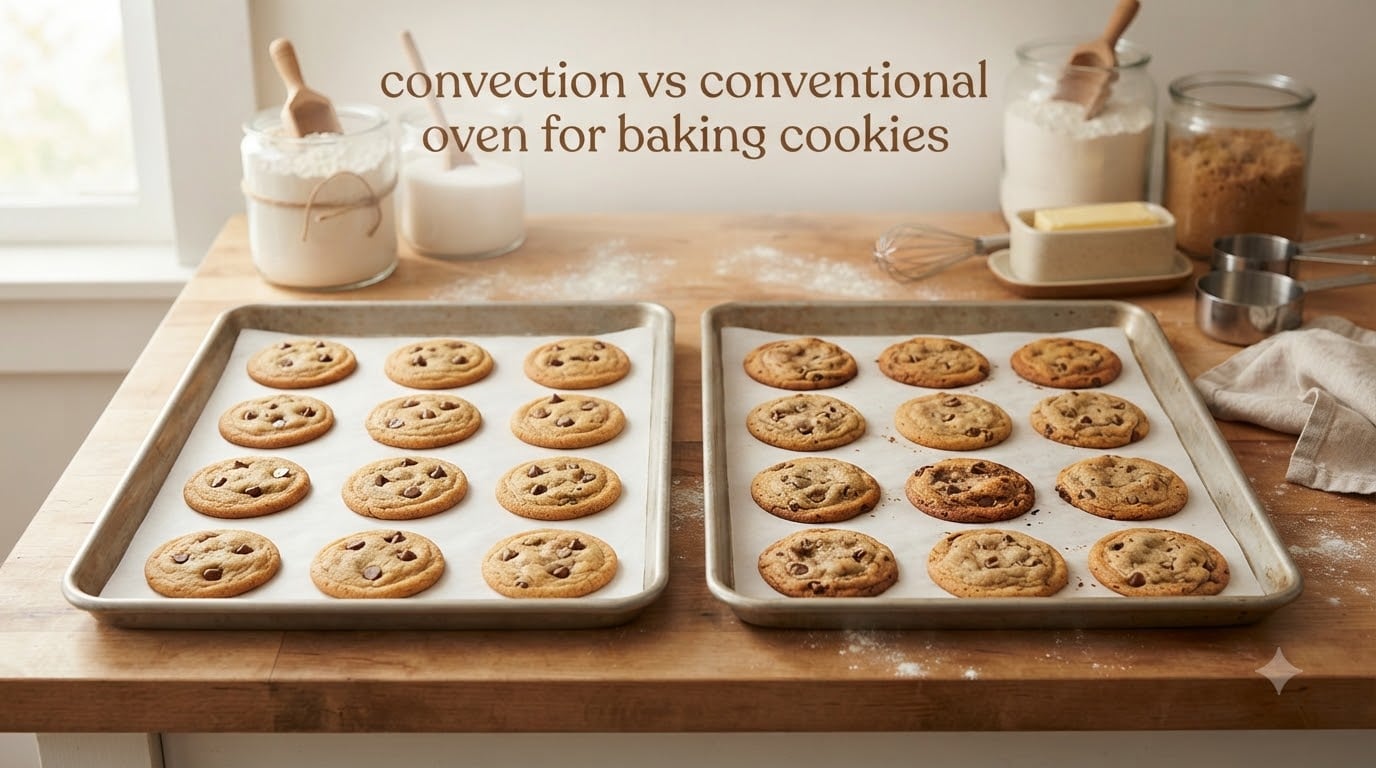
If you bake cookies at home, the convection vs conventional oven question comes up faster than the timer on your first tray. I have tested both oven types side by side in my kitchen for years, and the answer is not as simple as one being better than the other. The right oven depends on the kind of cookie you want to bake.
This guide breaks down exactly how convection and conventional ovens work, the 25 degree rule every baker needs to know, which cookies shine in each oven, and how to fix the most common convection cookie problems. I pulled in insights from professional test kitchens, Reddit baking threads, and my own batch after batch of trial runs.
By the end, you will know which oven setting to reach for when you pull out the mixing bowl, and you will have a conversion shortcut that works on any recipe.
Table of Contents
Quick Answer: Which Oven Should You Use?
Use a convection oven for thin, crispy, evenly browned cookies like lace cookies, macarons, and snickerdoodles. Use a conventional oven for thick, chewy cookies like classic chocolate chip, sugar cookies, and anything where a soft center matters. When switching from conventional to convection, lower the temperature by 25 degrees F and check for doneness about 25 percent earlier than the recipe states.
This is the short version. Below I explain why these differences exist, give you a temperature conversion table, and walk through specific cookie types.
How Convection and Conventional Ovens Work
A conventional oven heats with two radiant elements, one at the top and one at the bottom. Hot air rises naturally from the lower element and slowly settles around your cookie sheet. The heat transfer happens mostly through radiation from hot metal surfaces, which is gentle but uneven. Hot pockets form near the walls and back of the oven, while cooler zones hide behind baking sheets.
A convection oven adds a fan and usually a third heating element wrapped around the fan. The fan pulls air across the heating element and pushes it back into the oven cavity in a continuous loop. This breaks up the thin layer of still air that hugs your cookies, a phenomenon bakers call the boundary layer, and replaces it with moving hot air.
That moving air delivers two big wins. First, heat reaches the cookie surface faster, so baking time drops by roughly 25 percent. Second, the cookie bakes from all sides at once, which produces more even browning across the entire tray.
There are two convection settings on most modern ovens. Convection bake uses the fan with steady, moderate heat and is the right choice for cookies. Convection roast combines the fan with more intense top-down heat and is designed for meats, not delicate cookie dough.
Key Differences Between Convection and Conventional Ovens
The differences show up in five measurable ways: heat distribution, cooking speed, browning, multi-rack performance, and energy use.
| Feature | Conventional Oven | Convection Oven |
|---|---|---|
| Heat source | Top and bottom radiant elements | Elements plus internal fan |
| Air movement | Still air, natural rising | Circulated hot air from fan |
| Heat distribution | Uneven, with hot spots | Even, fan breaks up boundary layer |
| Baking speed | Baseline recipe time | About 25 percent faster |
| Browning pattern | Patchy, often darker on one side | Uniform golden color across tray |
| Multi-rack performance | Uneven between racks | Consistent across multiple trays |
| Temperature adjustment | Use recipe as written | Reduce temp by 25 degrees F |
| Best for cookies | Thick, chewy, soft-centered | Thin, crispy, evenly browned |
The multi-rack performance difference is the one most home bakers underestimate. In a conventional oven, the top rack almost always browns faster than the bottom. You end up rotating pans halfway through baking. In a convection oven, that rotation becomes optional because the fan keeps the temperature consistent at every rack position.
I have baked three trays of chocolate chip cookies at once in both oven types. The convection oven produced three trays that looked nearly identical. The conventional oven produced a darker top tray and a paler bottom tray, even with rotation.
Temperature Conversion: The 25 Degree Rule
The most common question in baking forums is some version of “is 350 convection the same as 350 bake?” The short answer is no. A convection oven at 325 degrees F produces the same final cookie as a conventional oven at 350 degrees F.
The standard conversion rule is simple. When a recipe calls for a conventional temperature, subtract 25 degrees F when using convection. If the recipe says 350 degrees F conventional, set the convection oven to 325 degrees F. If the recipe says 375 degrees F conventional, set convection to 350 degrees F.
| Conventional Temp | Convection Temp | Common Cookie Types |
|---|---|---|
| 325 degrees F | 300 degrees F | Thick sugar cookies, shortbread |
| 350 degrees F | 325 degrees F | Chocolate chip, oatmeal, snickerdoodles |
| 375 degrees F | 350 degrees F | Drop cookies, peanut butter |
| 400 degrees F | 375 degrees F | Lace cookies, thin and crispy |
You also need to shorten the baking time. A good rule of thumb is to check the cookies about 25 percent sooner than the recipe states. Set your timer for 75 percent of the suggested bake time, then start checking for visual doneness.
Here is a conversion example that comes up constantly. A recipe says bake at 350 degrees F for 12 minutes. In a convection oven, set the temperature to 325 degrees F and start checking at 9 minutes. The cookies might finish between 9 and 11 minutes depending on your specific oven.
Some newer ovens have an auto-convert feature that adjusts both temperature and time for you. If your oven has this setting, you can use it. If not, stick with the manual 25 degree rule.
Best Cookies to Bake in a Convection Oven
Convection baking produces the best results with cookies that benefit from even heat and quick, dry cooking. The fan-driven air evaporates surface moisture faster, which is exactly what you want for cookies that need to set quickly and brown uniformly.
Lace cookies are the perfect convection cookie. These thin, buttery discs spread wide and bake into crisp, golden rounds with lacy holes. A conventional oven often leaves the centers pale while the edges burn. Convection eliminates that problem. I have made four batches of lace cookies in a row in convection mode, and every single tray came out with the same golden color edge to edge.
Macarons also shine in convection. The steady airflow dries the outer shell so it forms a foot and a smooth top, then bakes the interior evenly. Many professional bakeries use convection for macarons for this reason. Just keep the fan on low if your oven lets you adjust the speed.
Other cookies that perform well in a convection oven include snickerdoodles, thin sugar cookies, gingerbread, biscotti, and meringues. Anything thin, crispy, or delicate responds well to the even heat distribution.
Batch bakers also benefit. I can run three trays of cookies at once in convection mode and skip the mid-bake rotation that conventional baking requires. For holiday cookie seasons, that time savings adds up.
Best Cookies to Bake in a Conventional Oven
Conventional ovens remain the right choice for cookies that need gentle, slower heat to set properly before browning. Thick cookies with soft centers fall into this category, as do cookies with delicate add-ins that can scorch or blow around.
Classic chocolate chip cookies are the most common conventional cookie. The thick dough needs time to spread, set the edges, and stay soft in the middle. Convection can over-crisp the outside before the center cooks through, leaving you with a cookie that looks done but feels raw when you bite in. I have had this exact problem on multiple test batches.
Sugar cookies for cut-out decorating work best in a conventional oven. The gentler heat helps the cookies hold their shape, which matters when you spent an hour cutting out holiday shapes. Convection can puff and distort the edges.
Shortbread is another conventional winner. The high butter content means the cookies need slow, even heat to melt the butter without browning the surface too fast. Convection can dry out shortbread and make it sandy instead of tender.
Other cookies that prefer conventional baking include thick oatmeal raisin, whoopie pies, filled sandwich cookies, and any cookie where the recipe specifically warns against convection.
There is also the practical reason of familiarity. Most recipes were developed and tested in conventional ovens. If you are baking from a trusted family recipe or following a new cookbook, conventional baking gives you the result the recipe author intended.
Pros and Cons of Convection Baking for Cookies
Convection ovens offer real advantages but come with trade-offs that every cookie baker should understand.
Pros include more even browning across the entire tray, baking times about 25 percent shorter, ability to bake multiple trays at once with consistent results, better for thin crispy cookies, and slightly lower energy use because the shorter cook time offsets the fan power draw.
Cons include the risk of cookies blowing off pans if the fan speed is too high, faster browning that can scorch delicate doughs, recipes requiring manual adjustment rather than direct use, and the learning curve of figuring out what works in your specific oven.
One of the most reported problems on baking forums is cookies getting pushed around by the fan. The King Arthur Baking test kitchen has documented this issue and recommends lowering the fan speed if your oven allows it. Standard cookie doughs with normal portion sizes rarely have this problem, but very soft doughs or cookies baked on low-sided sheets can get nudged.
Pros and Cons of Conventional Baking for Cookies
Conventional ovens have their own list of strengths and weaknesses.
Pros include the gentler radiant heat that suits thick and chewy cookies, recipes work as written without conversion, no risk of fan interference, familiar results that match what most cookbooks assume, and better performance with delicate doughs and batters.
Cons include hot spots that create uneven browning, longer baking times, the need to rotate pans halfway through for even results, and inconsistent multi-rack performance when baking multiple trays at once.
The hot spot problem is the biggest issue. I have baked in conventional ovens where the back left corner always browned faster than the rest of the tray. The fix is rotating the pan 180 degrees at the halfway mark, but that requires remembering and adds a step to every bake.
Troubleshooting Common Convection Cookie Problems
Even experienced bakers run into issues with convection. Here are the most common problems and the fixes that actually work.
If your cookies are burning on the outside but raw in the middle, your temperature is too high or your time is too long. Lower the temperature another 25 degrees F and shorten the bake time. Also consider that dark cookie sheets absorb more heat in convection mode. Switch to light-colored aluminum sheets.
If your cookies are spreading too much, the heat is melting the butter before the flour structure sets. Chill the dough for 30 minutes before baking, or reduce the convection temperature by another 10 to 15 degrees F beyond the standard 25 degree adjustment.
If your cookies are uneven across the tray, your fan might be too strong, or your oven might have cold spots that even the fan cannot fully correct. Try lowering the fan speed setting. If your oven has only one fan speed, rotate the tray 180 degrees at the halfway mark just to be safe.
If cookies are getting blown off the pan, your dough is too soft or your fan is too strong. Chill the dough thoroughly, use higher-sided baking sheets, and reduce the fan speed if your oven allows adjustment. The King Arthur test kitchen recommends freezing delicate doughs for 10 minutes before baking in convection to firm them up.
If your cookies look pale and underbaked, the temperature might be too low after your adjustment. Bump it back up by 10 to 15 degrees F. Some convection ovens run slightly cooler than their displayed temperature, which is why oven thermometers matter.
If you are getting wildly different results between batches, your oven’s actual temperature might be off from the display. Place an oven thermometer inside and check it after 15 minutes of preheating. Most home ovens are off by 10 to 25 degrees F from the display, and that gap matters more in convection mode where small changes have a big effect.
Tips for Adjusting Recipes Between Oven Types
Switching recipes between oven types gets easier once you build a mental checklist. Start by identifying the cookie type. Thin, crispy, and delicate doughs lean convection. Thick, chewy, and soft-centered doughs lean conventional.
When converting a conventional recipe to convection, drop the temperature by 25 degrees F and check for doneness 25 percent earlier. If the recipe says 350 degrees F for 14 minutes, set convection to 325 degrees F and check at 10 to 11 minutes.
When converting a convection recipe to conventional, raise the temperature by 25 degrees F and add 25 percent to the bake time. If the recipe says 325 degrees F convection for 10 minutes, set conventional to 350 degrees F and check at 12 to 13 minutes.
Always preheat fully regardless of oven type. A properly preheated oven matters more for cookies than for almost any other baked good. I give both oven types at least 15 minutes of preheat before loading the first tray.
Use light-colored aluminum baking sheets. Dark sheets absorb more heat and brown the bottoms faster in either oven, but the effect is more pronounced in convection. If you only have dark sheets, drop the temperature another 10 degrees F.
Skip convection for custards, very soft doughs, and any cookie where the recipe explicitly says not to use convection. Recipe developers sometimes call out convection incompatibility for good reason.
For batch baking during the holidays, run the convection oven on multiple racks without rotation. For delicate cookies like macarons, use the lower racks where the airflow is gentler.
Frequently Asked Questions
Is 350 convection the same as 350 bake?
No, 350 degrees F convection is not the same as 350 degrees F conventional bake. A convection oven at 325 degrees F produces the same result as a conventional oven at 350 degrees F. The fan-driven air transfers heat faster, so you need to lower the temperature by 25 degrees F to match the same level of browning and doneness.
When not to use convection bake for cookies?
Skip convection bake for thick chewy cookies like classic chocolate chip, sugar cookies that need to hold their shape, shortbread, and any dough that is very soft or wet. Also avoid convection for custards, filled cookies, and recipes that explicitly say not to use convection. The stronger airflow can over-crisp the outside before the inside cooks through.
What type of oven is best for baking cookies?
A convection oven is best for thin, crispy, evenly browned cookies like lace cookies, macarons, biscotti, and meringues. A conventional oven is best for thick, chewy cookies like chocolate chip, oatmeal raisin, and sugar cookies where a soft center matters. Many serious bakers own both oven types or use the convection setting selectively based on the cookie.
Which oven mode is best for baking cookies?
For convection ovens, use the convection bake setting, not convection roast. Convection bake uses the fan with steady moderate heat that suits cookies. Convection roast combines the fan with intense top-down heat designed for meats and will burn cookies quickly. On conventional ovens, use the regular bake setting and rotate pans halfway through for even results.
Is it better to bake cookies with a convection or regular oven?
It depends on the cookie. Convection produces more even browning and is faster, which makes it better for thin crispy cookies and batch baking multiple trays at once. Regular (conventional) ovens produce gentler heat that suits thick chewy cookies and delicate doughs. The best approach is to match the oven type to the cookie type rather than defaulting to one.
How much faster does a convection oven bake cookies?
A convection oven bakes cookies about 25 percent faster than a conventional oven at the same temperature setting. If a recipe says 12 minutes at 350 degrees F conventional, expect the same cookie to finish in about 9 minutes at 325 degrees F convection. Always check for doneness a few minutes before the adjusted time to avoid overbaking.
Final Verdict on Convection vs Conventional Oven for Cookies
The convection vs conventional oven debate for cookies does not have a single winner. The best oven is the one matched to the cookie you are baking. Convection wins for thin, crispy, and delicate cookies that benefit from even airflow and faster bake times. Conventional wins for thick, chewy, and soft-centered cookies that need gentler radiant heat.
If you own a convection oven, use the 25 degree rule and the 25 percent time check to convert any conventional recipe. If you are buying an oven and you bake cookies often, a true convection model with adjustable fan speed gives you the most flexibility across cookie types.
Whichever oven you use, preheat fully, use light-colored baking sheets, and trust visual cues over the timer. Pull the cookies when the edges look set and the centers look slightly underdone. They finish setting on the sheet after you take them out.