
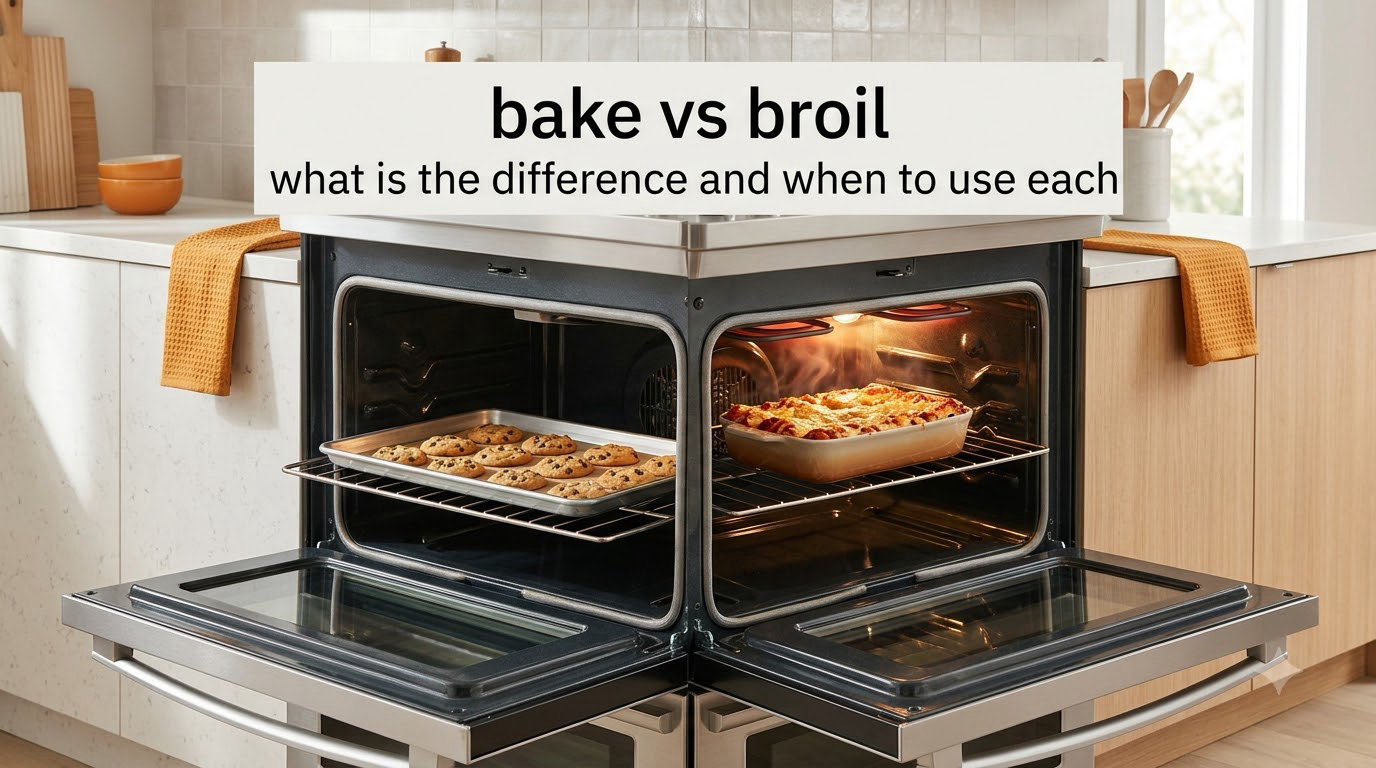
If you’ve ever stared at your oven dial wondering whether to bake or broil, you’re not alone. The difference between baking and broiling comes down to where the heat comes from and how hot it gets. In bake vs broil terms: baking uses steady, surrounding dry heat (typically 300 to 375°F) from both elements to cook food evenly from all sides, while broiling uses only the top element at 500 to 550°F to brown and crisp the surface fast. Picking the right one is the difference between a dry chicken breast and a perfectly charred steak.
I’ve worked both sides of this question, first as a terrified home cook who never touched the broil setting, and later as someone running a restaurant line where broiling is the secret behind every finished plate. Let me save you the burnt-toast learning curve.
Table of Contents
Bake vs Broil: 3 Quick Rules
Before we get into the science, here are the three rules I tell every new cook on our line:
- Heat level: Baking stays at or below 375°F. Broiling runs 500 to 550°F.
- Cook time: Baking is slow (15 minutes to several hours). Broiling is fast (2 to 10 minutes).
- Food type: Bake anything you want cooked all the way through. Broil anything you want browned or crisped on top.
If you remember nothing else, remember those three rules and you’ll choose correctly 90% of the time.
Bake vs Broil at a Glance
| Feature | Bake | Broil |
|---|---|---|
| Heat source | Top and bottom elements | Top element only |
| Temperature | 300 to 375°F (typical) | 500 to 550°F |
| Heat type | Dry, surrounding | Direct, radiant |
| Rack position | Middle | Upper (4 to 6 inches from element) |
| Cook time | 15 minutes to hours | 2 to 10 minutes |
| Best for | Cakes, bread, casseroles, whole proteins | Steak, vegetables, cheese topping, browning |
| Watch closely? | No, set-and-forget friendly | Yes, seconds matter |
What Is Baking?
Baking is cooking with dry, surrounding heat from both the top and bottom elements of your oven. Hot air fills the cavity and slowly transfers heat into the food from every direction.
The bake setting typically runs between 300 and 375°F for most home recipes, though some baked goods (like bread or pizza stone work) push toward 450°F. The key word is surrounding: your food sits on the middle rack and the hot air wraps around it, cooking it evenly inside and out.
How Baking Actually Works
When you set your oven to bake, both heating elements warm up. Most of the actual heat comes from the bottom element, but the top element cycles on briefly to keep the air temperature stable. A fan (if you have convection bake) circulates that hot air so no cold pockets form around the pan.
Because the heat is gentle and comes from all sides, baking is ideal for anything that needs to rise, set, or cook through without burning the outside. Think cakes setting their crumb, bread developing a crust, casseroles heating evenly, or a whole chicken cooking to 165°F without charring.
Baking also retains moisture well. The surrounding air traps steam against the food, which is why a baked potato has a fluffy interior and a baked salmon filet stays tender instead of drying out.
What Is Broiling?
Broiling is cooking with intense, direct heat from only the top heating element. Food sits on the upper rack, close to that element, and the radiant heat browns or chars the surface in minutes.
The broil setting runs 500 to 550°F on most home ovens (some go higher). Instead of cooking food all the way through, broiling’s job is to transform the surface: caramelize sugars, blister peppers, melt cheese, or sear a steak.
How Broiling Actually Works
When you turn the dial to broil, the bottom element stays off and the top element glows red-hot. The food sits 4 to 6 inches below it on the upper rack. That radiant energy hits the top of the food and triggers two fast reactions:
- The Maillard reaction: amino acids and sugars on the surface react under high heat, creating that deep brown color and savory, complex flavor. It’s the same reaction that browns a seared steak or toasted bread.
- Caramelization: natural sugars break down and brown, adding sweetness and depth. Onions, tomatoes, and bell peppers all caramelize beautifully under a broiler.
Think of your broiler as an upside-down grill. Same heat, same Maillard magic, same char flavor, just coming from above.
Side-by-Side: How Baking and Broiling Differ
The technical differences between bake vs broil are smaller than you’d think, but they change the outcome completely.
Heat Source
Bake uses both elements for surrounding heat. Broil uses only the top element for direct, downward radiant heat. That’s the whole game in one sentence.
Temperature
Bake stays in the 300 to 375°F range for most recipes (occasionally up to 450°F). Broil runs at 500 to 550°F. The 150°F+ gap is why broiling takes minutes while baking takes much longer.
Rack Position
For baking, the middle rack is almost always right. It puts the food in the center of the heated air cavity. For broiling, you want the upper rack, 4 to 6 inches below the top element. Any closer and you’ll scorch the food before the inside cooks.
Cook Time
Baking is patient. Cookies take 10 to 12 minutes, bread takes 30 to 45, a whole chicken can run over an hour. Broiling is the opposite: thin steaks take 4 minutes, vegetables take 5 to 8 minutes, cheese melts in 30 to 60 seconds.
What Happens to the Food
Baked food cooks evenly from outside to inside. Broiled food browns aggressively on top while often staying raw or rare underneath. That’s why broiling is usually a finishing technique, not a standalone cooking method for thick cuts.
Bake or Broil? A Food-by-Food Decision Guide
This is the part most guides skip, and it’s the part you actually care about. Here’s how I decide in the kitchen:
| Food | Best method | Why | Typical time |
|---|---|---|---|
| Pizza | Bake (then optional broil) | Needs even heat to melt cheese and cook the crust | 10 to 15 minutes at 475°F |
| Chicken breast | Bake | Thick enough that broiling burns the outside before the inside hits 165°F | 20 to 25 minutes at 400°F |
| Chicken thighs (boneless) | Broil | Thin enough to cook through fast, fatty enough to handle high heat | 6 to 8 minutes per side |
| Steak (1 inch or thicker) | Broil | Wants a hard sear on the outside, rare to medium inside | 4 to 6 minutes total |
| Salmon filet | Broil | Thin cut, benefits from Maillard browning on top | 6 to 8 minutes |
| White fish (cod, tilapia) | Bake | Delicate, dries out fast under direct heat | 12 to 15 minutes at 400°F |
| Vegetables (peppers, asparagus, broccoli) | Broil | Charred edges taste better than steamed | 5 to 10 minutes |
| Root vegetables (potato, squash, carrots) | Bake | Dense, need slow heat to soften through | 30 to 45 minutes at 400°F |
| Bread, rolls | Bake | Needs ambient heat to rise and set the crumb | 20 to 35 minutes |
| Casseroles | Bake, finish with broil | Bake to heat through, broil to brown the top | 25 to 40 minutes, then 2 to 3 under broiler |
| Mac and cheese | Bake, finish with broil | Bake for creamy inside, broil for the crust | 20 minutes bake, 2 minutes broil |
| Toast, open-faced sandwiches | Broil | Fast surface browning, no need to cook through | 1 to 3 minutes |
| Meringue, brûlée topping | Broil | Needs direct heat to brown sugar or set egg whites fast | 30 seconds to 2 minutes |
Common Question: Pizza, Bake or Broil?
Pizza almost always goes on bake. The crust needs ambient heat to cook through and crisp on the bottom, and the cheese needs time to melt without burning. If your cheese isn’t browning enough at the end of bake time, switch to broil for the final 60 to 90 seconds and watch it like a hawk.
When to Use Bake vs Broil
Here’s the decision shortcut I use. Ask yourself two questions:
- Does this food need to cook all the way through? If yes, bake. If no, broil might be enough.
- Is the food thicker than 1 inch, or does it contain batter, dough, or liquid? If yes, bake. If it’s a thin, solid piece (vegetable slice, fish filet, steak), broil works.
When in doubt, bake. It’s forgiving. Broiling rewards attention and punishes inattention in seconds.
The one exception: many dishes benefit from baking first, then broiling to finish. A baked mac and cheese with a broiled top. A baked casserole with charred breadcrumbs. A baked pizza with bubbly, browned cheese. This is the move most restaurant kitchens use, and it’s worth learning.
Common Mistakes (and How to Avoid Them)
1. Walking Away From the Broiler
Food goes from perfect to ash in seconds under a broiler. Reviewers on r/Cooking put it bluntly: “I left the door cracked and stepped away for two minutes. The entire tray was black.” Always stay within arm’s reach of the oven when broiling.
2. Using the Wrong Pan
Glass and ceramic baking dishes can shatter under direct broiler heat. Cast iron, stainless steel, and heavy-gauge sheet pans are broiler-safe. When in doubt, check the pan’s bottom for an oven-safe rating.
3. Skipping the Preheat
Yes, you should preheat for broiling too. Most ovens take 5 to 10 minutes to bring the top element up to broiling temperature. Cold broiler equals uneven browning and longer cook times.
4. Crowding the Pan
If vegetables are piled on top of each other, the bottom pieces steam while the top pieces char. Use a single layer with space between each piece.
5. Forgetting to Flip
Broil heats from above, so the top browns while the bottom sits there. Flip halfway through for even browning, or rotate the pan 180° if your broiler has hot spots (most do).
6. Using Olive Oil Past Its Smoke Point
Regular extra-virgin olive oil smokes around 375°F, well below broil temperatures. Use avocado oil, refined olive oil, or canola oil when broiling.
7. Not Using a Meat Thermometer
Broiling happens so fast that guessing doneness is a recipe for overcooked chicken or undercooked pork. A $15 instant-read thermometer removes all doubt.
A Restaurant Chef’s Perspective
I’ve worked restaurant lines where the broiler is the most-used piece of equipment in the kitchen. Not the bake oven, the broiler. Here’s why: in a professional setting, we bake on sheet pans in big batches, then finish individual plates under the broiler for color and texture. That sear on a piece of salmon, those charred marks on a romaine heart, the bubbling brown cheese on French onion soup, all of that happens at the broiler station.
The home cook version of this is exactly the bake-then-broil technique I mentioned earlier. Cook the dish to temperature using bake, then slide it under the broiler for 60 to 180 seconds to finish. It’s how you get restaurant-quality plating without restaurant-grade equipment.
If you only learn one technique from this article, learn this one. Bake for safety and even cooking. Broil for color, crust, and the kind of finish that makes people say “this tastes like a restaurant.”
Frequently Asked Questions
What are the disadvantages of broiling?
Broiling requires constant attention because food burns in seconds. It only browns the top, leaving thick foods undercooked inside. The high heat can smoke, create splatter, and trigger smoke alarms. Not all cookware is broiler-safe; glass and ceramic can shatter. And broiling dries out lean proteins if you leave them too long.
Can I use bake and broil at the same time?
Most home ovens let you run both elements simultaneously, but it is rarely useful. Baking uses ambient hot air to cook food evenly, while broiling directs intense top heat onto the surface. Running both usually overcooks the outside before the inside is done. A few ovens offer a combined ‘convection roast’ or similar setting that uses both elements plus a fan, which works well for whole chickens and roasts.
Is baking at 500 the same as broiling?
No. Even at 500°F, baking still surrounds the food with hot air from both elements, cooking it evenly on all sides. Broiling at 500 to 550°F only uses the top element, so the heat hits the surface directly from above. Same temperature, very different results. The food under a broiler browns and chars on top; the food in a 500°F oven browns gently all over.
Is broil hotter than 425?
Yes. The broil setting runs 500 to 550°F, well above 425°F. Most broilers can not be set to a lower temperature; they are either on or off. That is why broiling takes minutes and baking at 425 takes much longer for the same food.
Should you broil or bake first?
For most dishes, bake first to cook the food through, then broil at the end to brown the top. This is the standard restaurant technique for casseroles, mac and cheese, and pizza. The only time to broil first is when you are cooking a thin, solid piece of food like a steak or vegetable slice that cooks through quickly under direct heat.
What temperature is broil on an oven?
Most home ovens set the broil function between 500 and 550°F. Some models offer ‘low broil’ around 400°F for slower browning, but the standard broil setting is the highest temperature your oven produces. There is no single industry standard, so check your oven’s manual for the exact rating.
The Bottom Line
The bake vs broil decision comes down to three questions: how thick is the food, does it need to cook all the way through, and do you want surface browning? Baking gives you even, slow, surrounding heat for anything that needs to cook through or rise. Broiling gives you fast, direct, top-down heat for browning, crisping, and finishing. Use bake for safety, broil for color, and the bake-then-broil combo when you want both. That’s the whole bake vs broil difference, and once you internalize it, every recipe in your collection becomes easier.