
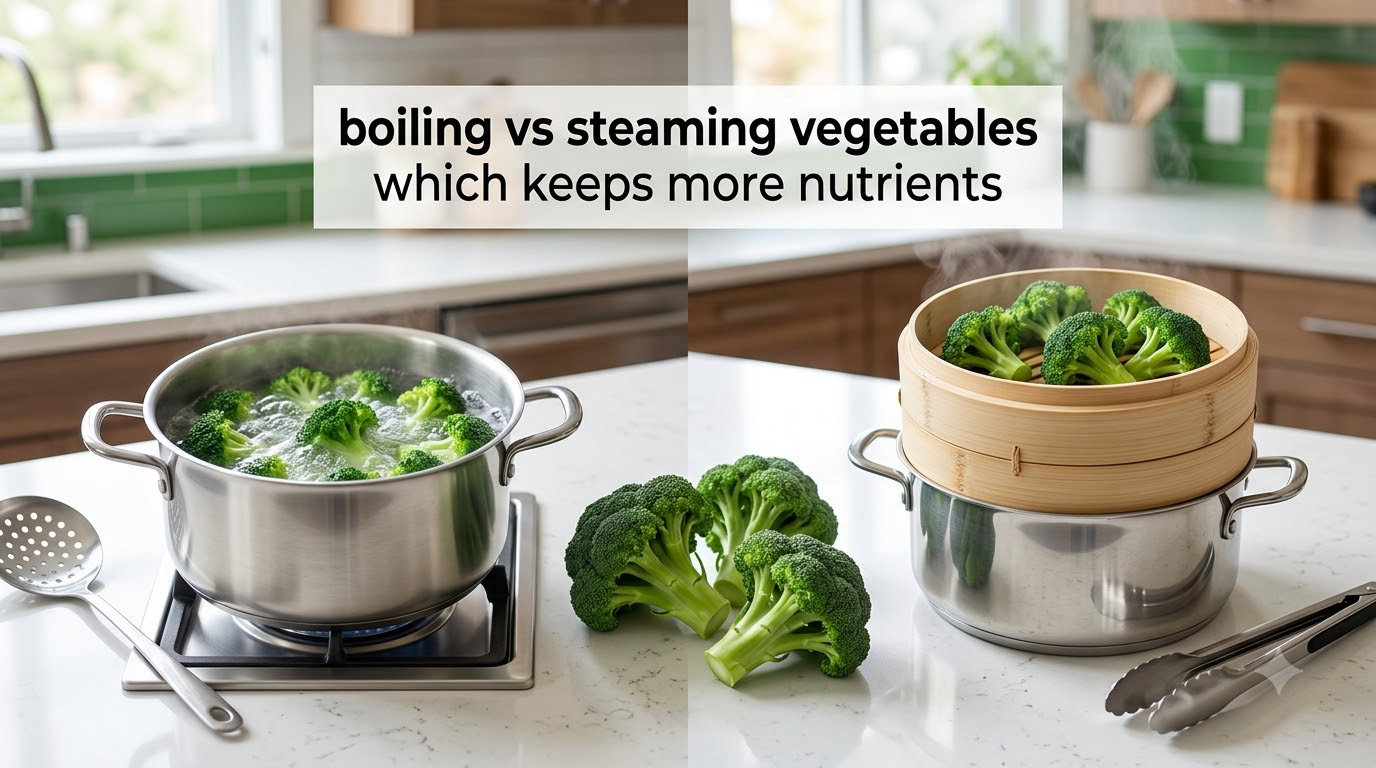
Steaming preserves more nutrients than boiling in most vegetables. Steaming keeps vegetables above the cooking water, preventing water-soluble vitamins like vitamin C and B vitamins from leaching out. Studies show steaming retains up to 90% of vitamin C, while boiling can lose 40-55%.
But the answer isn’t always that simple. Some vegetables actually benefit from boiling, and the best method depends on what you’re cooking and which nutrients matter most to you.
In this guide, I’ll break down exactly how boiling vs steaming vegetables affects nutrient retention, share specific numbers from peer-reviewed research, and give you practical tips to get the most nutrition from every meal.
Table of Contents
Why Steaming Keeps More Nutrients in Vegetables
Steaming works by surrounding vegetables with hot vapor without submerging them in water. This is the key difference that makes it superior for most nutrient preservation.
When vegetables sit in boiling water, their cell walls break down and release nutrients directly into the surrounding liquid. Water-soluble vitamins – particularly vitamin C, thiamine (B1), riboflavin (B2), and folate – dissolve readily in water and escape the vegetable tissue.
Steaming avoids this entirely. The vegetables never touch the water, so those water-soluble nutrients stay locked inside. Heat still causes some loss (cooking always does), but the absence of direct water contact makes a dramatic difference.
Research from a 2026 study published in Heliyon found that steaming broccoli retained significantly more glucosinolates – the cancer-fighting compounds that make cruciferous vegetables so valuable – compared to boiling. Steaming preserved roughly 70-80% of these compounds, while boiling retained only 40-55%.
Beyond nutrients, steaming also preserves the natural color, texture, and flavor of vegetables better. That bright green broccoli or vibrant orange carrot you see after steaming? That’s a visual indicator that fewer nutrients have been destroyed.
Why Boiling Causes More Nutrient Loss
Boiling submerges vegetables in water at 212°F (100°C). The combination of high heat and full water contact creates the worst conditions for water-soluble vitamin retention.
Here’s what happens at the molecular level: as vegetables heat up, their cell walls rupture. The water-soluble vitamins inside those cells dissolve into the cooking water. If you drain that water (which most people do), you’re literally pouring nutrients down the drain.
The degree of loss depends on several factors:
- Cooking time: The longer vegetables boil, the more nutrients escape. Even an extra 5 minutes can increase vitamin C loss by 10-15%.
- Water volume: More water means more room for nutrients to dissolve into. A large pot of water causes greater losses than a small one.
- Cut size: Smaller pieces have more surface area exposed to water, accelerating nutrient leaching. This is why whole potatoes retain more vitamins than cubed ones.
- Temperature: Higher temperatures accelerate both breakdown and leaching.
Studies show that boiling can destroy 40-55% of vitamin C in vegetables, compared to just 9-15% loss from steaming. For folate, boiling can cause up to 70% loss, while steaming typically preserves 80-90%.
That said, boiling isn’t always bad – and the cooking water you throw away might be more nutritious than you think.
Nutrient Retention Comparison: Steaming vs Boiling
The table below shows typical nutrient retention percentages based on published research. These numbers vary by vegetable type, cooking time, and cut size, but they give you a reliable comparison.
| Nutrient | Steaming Retention | Boiling Retention | Winner |
|---|---|---|---|
| Vitamin C | 85-91% | 45-60% | Steaming |
| Thiamine (B1) | 85-90% | 55-70% | Steaming |
| Riboflavin (B2) | 88-95% | 70-80% | Steaming |
| Folate | 80-90% | 30-50% | Steaming |
| Beta-carotene | 85-90% | 80-90% | Tie* |
| Glucosinolates | 70-80% | 40-55% | Steaming |
| Flavonoids | 80-90% | 50-65% | Steaming |
| Minerals (K, Mg) | 90-95% | 60-75% | Steaming |
*Beta-carotene is fat-soluble, so boiling can actually increase bioavailability in some vegetables like carrots when paired with a small amount of oil.
Steaming wins in almost every category, but you’ll notice the gap varies significantly by nutrient type. Fat-soluble vitamins (A, D, E, K) and carotenoids are much more resilient to both methods than water-soluble vitamins.
When Boiling Is Actually Better
Here’s the nuance that most “steaming is always better” articles miss: certain vegetables and certain nutrients actually benefit from boiling.
Carrots and beta-carotene: Boiling carrots breaks down their tough cell walls more thoroughly than steaming, releasing more beta-carotene. Since beta-carotene is fat-soluble, it doesn’t leach into the water the way vitamin C does. One study found that boiled carrots had 15% more bioavailable beta-carotene than steamed ones.
Tomatoes and lycopene: Boiling tomatoes significantly increases their lycopene content. The heat breaks down cell walls and converts trans-lycopene to cis-lycopene, which your body absorbs more easily. This is why cooked tomato sauce has more bioavailable lycopene than raw tomatoes.
Spinach and minerals: Boiling spinach can actually increase the availability of calcium and iron. The heat reduces oxalates – compounds that block mineral absorption – making the nutrients more accessible to your body.
When you’re saving the cooking water: If you’re making soup, stock, or sauce with the cooking liquid, boiling becomes much more nutritious. Those leached vitamins end up in the broth, and you consume them together. This is a traditional practice in many cuisines worldwide.
Steaming Times for Common Vegetables
Getting the timing right is crucial for both nutrition and taste. Under-steamed vegetables are tough and hard to digest. Over-steamed ones lose more nutrients and become mushy.
Here are tested steaming times for perfect results:
| Vegetable | Preparation | Steaming Time |
|---|---|---|
| Broccoli | Florets (1-2 inches) | 4-5 minutes |
| Cauliflower | Florets (1-2 inches) | 5-6 minutes |
| Carrots | Sliced 1/4 inch | 6-8 minutes |
| Green beans | Whole, trimmed | 5-6 minutes |
| Asparagus | Spears, ends trimmed | 3-5 minutes |
| Spinach | Whole leaves | 2-3 minutes |
| Kale | Leaves, stems removed | 3-4 minutes |
| Brussels sprouts | Halved | 6-8 minutes |
| Zucchini | Sliced 1/2 inch | 4-5 minutes |
| Potatoes | Cubed 1 inch | 12-15 minutes |
The fork test: Insert a fork into the thickest part of the vegetable. It should slide in easily with slight resistance. If it slides in with no resistance, you’ve over-steamed. If the fork meets significant resistance, give it another minute or two.
Home cooks on forums like Reddit’s r/EatCheapAndHealthy confirm that you can steam broccoli, carrots, and green beans together in one basket – just add the carrots first since they take longer, then add broccoli and green beans halfway through.
How to Steam Vegetables Properly
You don’t need fancy equipment to steam vegetables effectively. Here are three methods, from simplest to most specialized:
Method 1: Steamer Basket (Recommended)
- Add 1-2 inches of water to a pot – the water shouldn’t touch the basket bottom.
- Place the steamer basket inside, add vegetables in a single layer.
- Bring water to a boil, then reduce to a steady simmer.
- Cover with a tight-fitting lid and steam for the recommended time.
- Check doneness with a fork, then remove immediately to prevent overcooking.
Method 2: Colander Setup
If you don’t have a steamer basket, place a heat-safe colander over a pot of simmering water. Cover with a large plate or pot lid. This works well for larger batches.
Method 3: Microwave Steaming
Place vegetables in a microwave-safe bowl with 2-3 tablespoons of water. Cover with a microwave-safe plate or plastic wrap (leave a small vent). Microwave on high for 3-5 minutes, checking halfway through.
7 Tips to Minimize Nutrient Loss When Cooking Vegetables
Whether you choose to boil, steam, or use another cooking method, these strategies will help you retain maximum nutrition:
1. Use minimal water when boiling. If you must boil, use just enough water to cover the vegetables. Less water means less room for nutrients to dissolve into.
2. Save your cooking water. That nutrient-rich water is perfect for soups, stews, sauces, or even watering your garden plants. Forum users on r/ScientificNutrition recommend this as the easiest way to recapture lost vitamins.
3. Cook for the shortest time possible. Start checking vegetables 1-2 minutes before the recommended time. Slightly al dente vegetables retain more nutrients than soft ones.
4. Cut vegetables into larger pieces. Smaller cuts mean more surface area for nutrients to escape. When practical, steam or boil vegetables whole or in large chunks.
5. Don’t peel when possible. Many nutrients concentrate just below the skin. Scrubbing vegetables thoroughly lets you keep that nutrient-rich outer layer.
6. Add a small amount of healthy fat. For fat-soluble vitamins (A, D, E, K) and carotenoids, pairing vegetables with olive oil, butter, or avocado improves absorption significantly.
7. Use the cooking water in your meal. If boiling, serve the vegetables with some of the cooking liquid as a sauce. The leached nutrients return to your plate.
How Other Cooking Methods Compare
Steaming and boiling aren’t your only options. Here’s how other popular methods stack up for nutrient retention:
Microwaving: Surprisingly effective for nutrient retention. The short cooking time and minimal water usage mean microwaved vegetables often retain 80-95% of water-soluble vitamins. Research from Healthline shows microwaving is comparable to steaming for most nutrients.
Roasting: Great for flavor, but the high heat (400-450°F) can destroy some heat-sensitive vitamins like vitamin C. However, roasting with a little oil enhances carotenoid absorption and creates delicious caramelization.
Sautéing and stir-frying: Quick cooking with moderate heat and a small amount of oil. These methods preserve nutrients well because of the short cooking time, and the oil helps absorb fat-soluble vitamins.
Pressure cooking: Faster than boiling with less water exposure, but the high temperature can affect some heat-sensitive nutrients. Retention is generally between steaming and boiling.
For maximum nutrient retention across all vegetable types, steaming remains the gold standard. But the best cooking method is the one you’ll actually use consistently.
Frequently Asked Questions
Is it healthier to steam or boil veggies?
Steaming is healthier for most vegetables because it retains more water-soluble vitamins like vitamin C and B vitamins. Steaming preserves 85-91% of vitamin C compared to 45-60% with boiling. However, boiling can be better for certain vegetables like carrots and tomatoes, where it increases the bioavailability of beta-carotene and lycopene.
Which vitamins are destroyed by boiling?
Boiling primarily destroys water-soluble vitamins, especially vitamin C (40-55% loss), folate (up to 70% loss), and B vitamins like thiamine and riboflavin (20-40% loss). Fat-soluble vitamins (A, D, E, K) are more resistant to boiling. Minerals like potassium and magnesium also leach into cooking water during boiling.
Does steaming vegetables remove fiber?
No, steaming does not remove fiber. Fiber is not water-soluble, so it stays in the vegetable regardless of cooking method. In fact, steaming can make fiber easier to digest by softening the vegetable’s cell walls, which is beneficial for people with digestive issues like IBS.
How long should I steam vegetables for maximum nutrition?
Most vegetables need 3-8 minutes of steaming. Quick-cooking vegetables like spinach (2-3 minutes), asparagus (3-5 minutes), and broccoli (4-5 minutes) retain the most nutrients when steamed briefly. Check doneness with a fork – vegetables should be tender but still have slight resistance.
Is steaming vegetables better than microwaving?
Steaming and microwaving are comparable for nutrient retention. Both methods use minimal water and short cooking times. Microwaving can actually be slightly better for some vegetables because the cooking time is shorter. The key is avoiding overcooking with either method.
Do vegetables retain nutrients after boiling?
Yes, boiled vegetables retain many nutrients, especially fat-soluble vitamins and minerals. The main losses are water-soluble vitamins that dissolve into the cooking water. You can recover these nutrients by saving the cooking water for soups or sauces. Boiled vegetables still provide significant nutritional value.
What are the 5 disadvantages of steaming vegetables?
The main disadvantages of steaming are: 1) It takes slightly longer than boiling for some vegetables. 2) It requires a steamer basket or makeshift setup. 3) It can be harder to cook large batches evenly. 4) Some people find steamed vegetables bland without added seasoning. 5) Certain nutrients like beta-carotene in carrots are less bioavailable when steamed compared to boiled.
Conclusion
When it comes to boiling vs steaming vegetables which keeps more nutrients, steaming is the clear winner for most vegetables and most nutrients. It preserves 85-91% of vitamin C compared to boiling’s 45-60%, retains more B vitamins and glucosinolates, and keeps vegetables looking and tasting better.
But nutrition isn’t black and white. Boiling has legitimate advantages for carrots, tomatoes, and spinach. The cooking water you usually discard contains valuable nutrients. And the best cooking method is ultimately the one that gets you eating more vegetables consistently.
For maximum nutrition, steam most of your vegetables, save cooking water when you boil, and pair your veggies with a small amount of healthy fat. Your body will absorb more of the good stuff either way.