
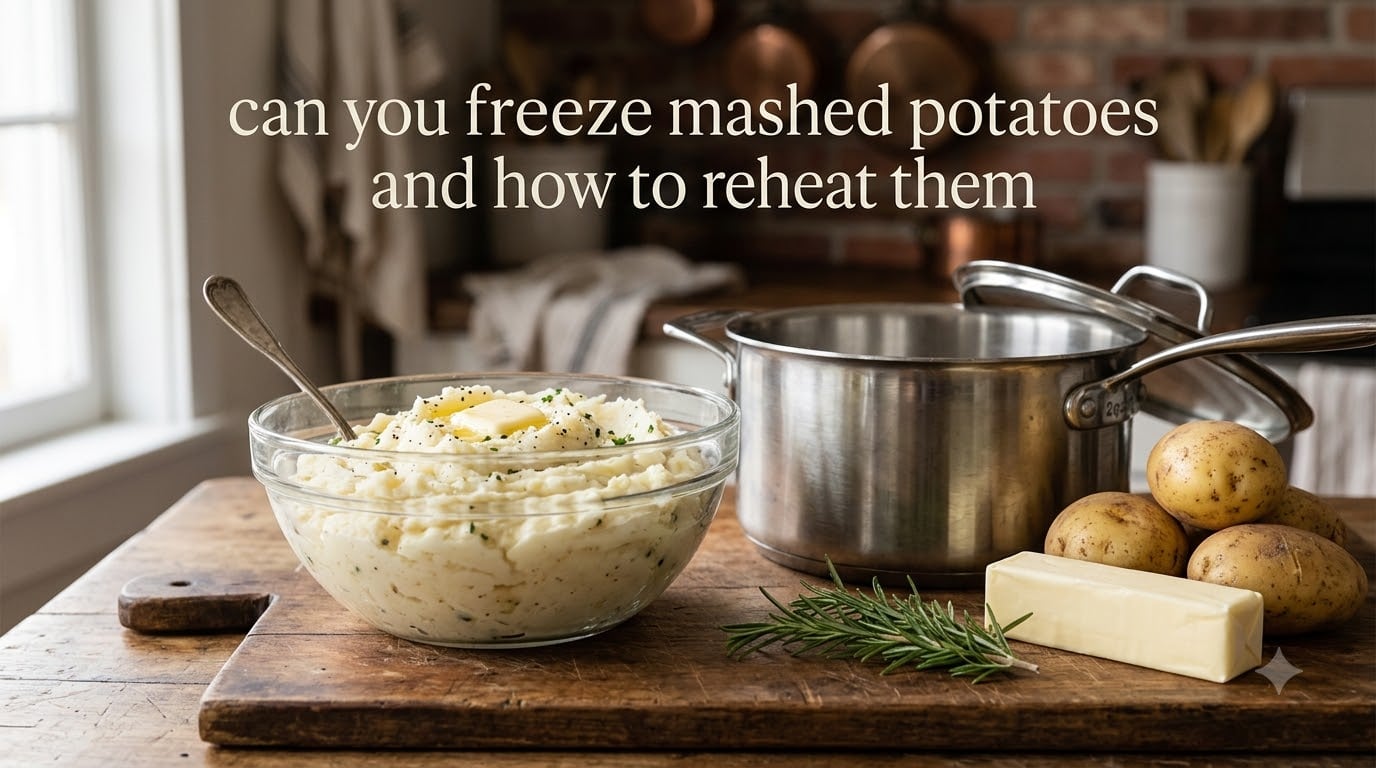
Yes, you can freeze mashed potatoes — and they reheat beautifully when you coat them with plenty of butter and cream before freezing. The trick is cooling them completely, storing them in airtight containers, and reheating them low and slow. Get this right, and frozen mashed potatoes taste just as creamy as the day you made them.
If you’ve ever wondered whether you can freeze mashed potatoes for Thanksgiving, Christmas, or just a busy weeknight, this guide walks you through the whole process. I’ll cover portioning, batch freezing, the best containers to use, four reliable reheating methods, and how to fix watery or grainy texture if it shows up. You’ll also get a make-ahead holiday timeline, a science note on why ice crystals form, and a dedicated section on freezing mashed sweet potatoes.
Table of Contents
Can You Freeze Mashed Potatoes? Yes — Here’s How
You can absolutely freeze mashed potatoes. They keep well for up to one month in a standard freezer and up to a year in a deep freeze, as long as you store them in airtight packaging. The two things that matter most are the fat content and how airtight you make the seal.
Mashed potatoes made with plenty of butter, whole milk, heavy cream, sour cream, or cream cheese freeze best because the fat coats the starch granules and protects them from ice-crystal damage. Lean versions made only with broth or non-dairy milk tend to turn watery and grainy once thawed. If your recipe is light on dairy, plan to stir in extra butter and cream when you reheat instead of before freezing.
Here’s what makes a batch freezer-friendly:
- At least 4 tablespoons of butter per 2 pounds of potatoes
- Whole milk or heavy cream, not skim
- A flat surface so they freeze quickly and evenly
- An airtight container with as little headspace as possible
- A label with the date so you use them within the safe storage window
Why Butter and Cream Matter When Freezing Mashed Potatoes
When potatoes freeze, the water inside them turns into ice crystals. Tiny crystals are fine — they melt back into the mash when you reheat it. Large crystals rupture the starch cells and release free water, which is what causes that watery, separated puddle on top of reheated mash.
Fat is the protective layer. Butter and cream wrap the starch granules so ice crystals form slowly and stay small. They also keep the mash from sticking together in one solid lump, which is why a buttery batch scoops and reheats like fresh while a broth-only batch turns into a stiff brick.
This is also why you should avoid over-mixing after reheating. Aggressive stirring breaks the protective starch network and releases more water. Stir gently, in small circles, only until creamy.
Tip: If you know you want to freeze a batch, double the butter in the original recipe. The extra fat pays off in the texture three weeks later.
How to Freeze Mashed Potatoes in Single Portions
Single-portion scoops are perfect for weeknight dinners and small families. Each scoop thaws and reheats in roughly the same time, so you never end up with hot outsides and cold centers.
- Cool the mashed potatoes completely in the refrigerator — at least 2 hours, or overnight.
- Line a rimmed baking sheet with parchment paper or wax paper.
- Use a large cookie scoop (about ½ cup) to portion the mash onto the sheet, leaving space between each scoop.
- Flash-freeze the scoops for 1 to 2 hours, until they are solid to the touch.
- Transfer the frozen scoops into a labeled freezer bag, press out the air, and seal.
- Return the bag to the freezer and use within 1 month for best quality.
This method is also ideal for camping trips. Pack the frozen scoops in a well-insulated cooler and they double as ice packs while gradually thawing. By the time you reach the campsite, they’re ready to finish warming in a pot over the fire.
How to Freeze Mashed Potatoes in Family-Size Batches
If you’re cooking for a crowd or want one big container to pull out on the holiday, the batch method works just as well. It saves freezer space and lets you reheat everything at once.
- Let the mash cool completely in the pot, then transfer to a large bowl so it chills faster in the fridge.
- Spoon the cold mash into a freezer-safe zip-top bag, an aluminum foil pan, or a glass baking dish. Leave about 1 inch of headspace for expansion.
- If using a bag, press it flat so the mash forms an even layer — flat bags thaw faster and stack neatly.
- Press a small square of parchment paper directly onto the surface of the mash before sealing. This prevents that waxy, discolored film that forms on top during long freezer storage.
- Squeeze out as much air as possible, seal, label with the date, and freeze.
- Use within 1 month for best quality; up to 3 months is acceptable in a deep freeze.
For very long storage — six months or more — wrap the sealed bag or dish in a second layer of plastic wrap. The extra wrap keeps out freezer odors and locks out the air that causes freezer burn.
Best Containers for Freezing Mashed Potatoes
Not all containers behave the same in the freezer. The right pick depends on how long you’re storing, how you’re reheating, and whether you want to freeze flat or in a serving dish.
| Container | Best For | Storage Time | Notes |
|---|---|---|---|
| Zip-top freezer bags (flat) | Single portions or family-size batches | 1 to 3 months | Press flat for fast thawing; stack to save space |
| Airtight plastic containers | Mid-size batches | 1 to 2 months | Leave 1 inch of headspace for expansion |
| Vacuum-sealed bags | Long-term storage (3 to 12 months) | 3 to 12 months | Best protection against freezer burn |
| Aluminum foil pans with lids | Casserole-style reheating straight from freezer | 1 to 2 months | Goes from freezer to oven with no extra dish |
| Glass baking dishes (oven-safe) | Same-day freezer-to-oven reheating | 1 to 2 months | Avoid sudden temperature changes to prevent cracking |
Glass containers freeze fine, but always let them warm slightly on the counter before putting them into a hot oven. A frozen glass dish hitting 350°F heat can shatter from thermal shock.
How Long Do Mashed Potatoes Last in the Freezer?
Mashed potatoes stay at their best quality for 1 month in a standard freezer and up to 3 months in a deep freeze. They remain safe to eat beyond that as long as the seal held and the freezer stayed at 0°F or below — but the texture slowly declines as freezer burn creeps in.
For the fridge, follow USDA guidance: cooked potatoes last 3 to 4 days when stored in a sealed container at 40°F or below. If you’re batch-cooking on Sunday and want them ready for Wednesday dinner, the fridge is the easier choice. If your horizon is weeks or months, the freezer is your friend.
Tip: Always label every bag or container with the date. A freezer full of mystery containers is the fastest path to food waste.
How to Reheat Frozen Mashed Potatoes
There are four reliable methods. Pick the one that fits your time and the dish you’re serving.
Stovetop Method (Best for Small Batches)
- Place the frozen mash in a heavy-bottomed saucepan over low heat.
- Add 1 to 2 tablespoons of butter and a splash of cream or milk.
- Cover and warm for 8 to 12 minutes, stirring gently every few minutes.
- Once heated through, whip briefly with a fork to restore the fluffy texture.
Oven Method (Best for Family-Size Batches)
- Preheat the oven to 350°F.
- Transfer the frozen mash to an oven-safe dish and dot the top with 2 tablespoons of butter.
- Pour ¼ cup of warm cream or milk around the edges.
- Cover tightly with foil and bake for 30 to 40 minutes, stirring once halfway through.
- Remove the foil for the final 5 minutes if you want a slightly crisp top.
Microwave Method (Best for Single Portions)
- Place one or two scoops in a microwave-safe bowl.
- Add a small pat of butter and a teaspoon of milk per scoop.
- Cover loosely with a damp paper towel to keep steam in.
- Microwave at 50% power for 4 to 5 minutes, stirring once at the halfway point.
- Stir gently and serve immediately.
Slow Cooker Method (Best for Holiday Holding)
- Place the frozen block of mash in the slow cooker.
- Add ½ cup of warm cream and 3 tablespoons of butter on top.
- Cover and cook on LOW for 2 to 4 hours, stirring once an hour.
- Switch to the WARM setting if you need to hold the mash for serving later.
The slow cooker is my favorite method for Thanksgiving. I freeze the mash a week ahead, drop the frozen block into the crock the morning of, and forget about it until the timer goes off.
How to Fix Watery or Grainy Mashed Potatoes After Reheating
If your reheated mash looks watery on top, don’t panic — it’s almost always fixable. The water is from ice crystals that melted faster than the mash could absorb them back.
Here are the moves that work:
- Stir in a few tablespoons of soft butter or cream cheese to re-emulsify the liquid.
- Add a splash of warm cream and stir gently in one direction.
- For really loose batches, spoon the mash into a fine-mesh strainer over a pot for a few minutes to drain off the water, then reheat with fresh butter.
- Spread the mash in a thin layer in a hot skillet for a minute or two — the dry heat drives off excess moisture.
If the mash is grainy instead of watery, that’s a sign of over-stirring or over-heating. Stop the cooking, fold in a tablespoon of cold butter, and let it rest for a minute. The fat will smooth out the texture without further agitation.
Can You Freeze Mashed Sweet Potatoes?
Yes, mashed sweet potatoes freeze just as well as regular mashed potatoes. The same rules apply — cool completely, portion into airtight containers, label with the date, and use within 1 to 3 months.
Sweet potatoes have a higher natural sugar content than russets, which means they can develop a slightly grainy texture after thawing. To prevent this, mix in 2 tablespoons of butter and 2 tablespoons of cream per pound of sweet potatoes before freezing. The fat coats the sugars and keeps the texture smooth.
For casseroles with brown sugar or marshmallow topping, freeze the mash plain and add the topping after reheating. Marshmallows don’t survive the freezer well, and brown sugar topping can weep when thawed.
Tip: Sweet potatoes also freeze well in muffin tins — one tablespoon per cup makes perfect single-serving portions for quick weeknight sides.
Frequently Asked Questions
Do mashed potatoes taste good after freezing?
Yes, mashed potatoes taste good after freezing when you coat them with plenty of butter and cream before freezing. The fat protects the starch granules from ice-crystal damage, which preserves the creamy texture. Plain broth-based versions turn watery and lose flavor, so always enrich the batch before freezing.
Do mashed potatoes reheat well from frozen?
Mashed potatoes reheat well from frozen as long as you use low, slow heat and add a splash of cream or milk. Stovetop and slow cooker methods work best for texture; the microwave works for speed. Avoid high heat, which causes uneven warming and watery separation.
What is the best way to freeze leftover mashed potatoes?
The best way to freeze leftover mashed potatoes is to scoop them onto a parchment-lined baking sheet, flash-freeze until solid, then transfer to a labeled freezer bag with the air pressed out. This method keeps portions separate so you can pull out exactly what you need without thawing the whole batch.
How long can you freeze mashed potatoes?
You can freeze mashed potatoes for up to 1 month in a standard freezer and up to 3 months in a deep freeze while keeping the best quality. They remain safe to eat longer than that if the seal held and the freezer stayed at 0°F, but the texture slowly declines as freezer burn creeps in.
Can you freeze mashed potatoes made with milk?
Yes, you can freeze mashed potatoes made with milk. Whole milk and heavy cream freeze better than skim milk because the higher fat content protects the starch and keeps the mash creamy. Stir in extra butter if your recipe is light on dairy to improve the post-thaw texture.
Can you freeze mashed potatoes in plastic containers?
Yes, you can freeze mashed potatoes in plastic containers as long as they are airtight and freezer-safe. Leave about 1 inch of headspace at the top for expansion, press the lid on firmly, and label the container with the date before placing it in the freezer.
Final Thoughts: Make Mashed Potatoes the Stress-Free Side
Freezing mashed potatoes turns the most last-minute dish on the holiday table into the easiest one. With a little fat, an airtight container, and a slow reheat, you can have creamy mash ready hours before guests arrive — and you’ll never again scramble for a stovetop burner the night before Thanksgiving.
Here’s the make-ahead timeline I use every holiday season:
- 1 month ahead: Freeze mashed potatoes in single portions for maximum flexibility.
- 1 week ahead: Freeze a family-size batch in a foil pan for the big day.
- 2 days ahead: Move the frozen batch to the fridge to thaw safely.
- Thanksgiving morning: Drop the thawed mash into the slow cooker on LOW with cream and butter.
- Serving time: Stir gently, taste, and adjust the salt.
Once you’ve done it once, you won’t go back to mashing potatoes while the turkey rests. The freezer does the work, the slow cooker finishes the job, and you get to enjoy the meal with everyone else.