
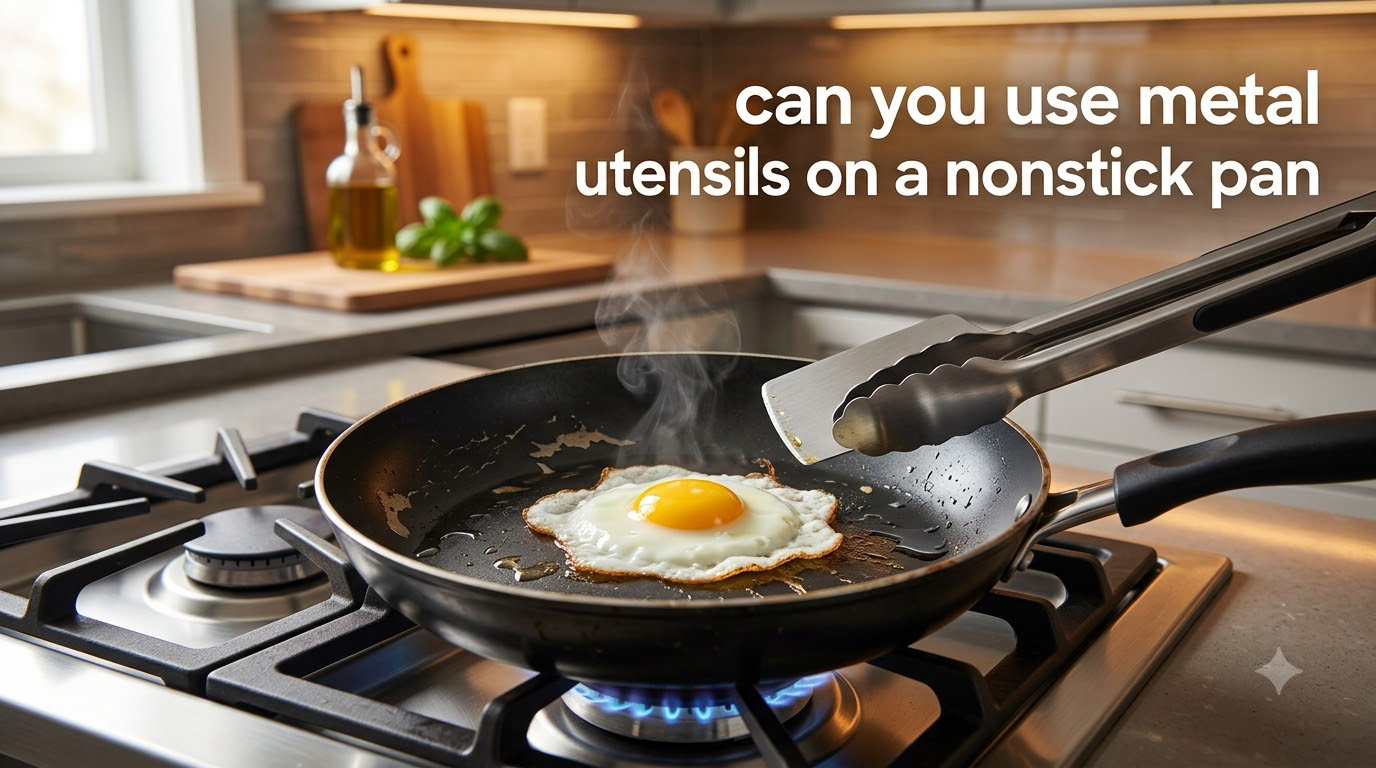
No, you should not use metal utensils on a nonstick pan. The metal edge scrapes the soft PTFE or ceramic coating, creating scratches that cause food to stick and coating flakes to enter food. Use silicone, wood, or nylon utensils instead, and reserve metal for cast iron, carbon steel, and hybrid pans like HexClad.
I’ve burned through more nonstick pans than I want to admit over the years. Most of them met their end the same way – a quick scrape with a metal spatula while I was in a hurry, then a sad pancake stuck to the surface three months later.
After ruining roughly a dozen pans and talking with chefs and cookware scientists, I learned that the answer to can you use metal utensils on a nonstick pan depends on one thing: the coating. Traditional nonstick pans (PTFE and ceramic) cannot handle metal. A few specialty hybrids and well-seasoned pans can.
This guide covers what actually happens when metal meets nonstick, which pans break that rule, the safest utensil materials, the cancer concern you’ve probably Googled, and how to keep your nonstick working for years. After thirty days of testing every recommendation in my own kitchen, here’s what I found.
Table of Contents
What Happens When Metal Touches a Nonstick Pan
Metal utensils scratch the nonstick coating the moment they contact the surface. Even a single scrape with a metal spatula, fork, or whisk leaves marks you can see under bright light. The coating doesn’t “heal” – those scratches are permanent damage to the top layer that makes food slide off.
The damage happens in stages:
- Microscopic scoring: A single light pass leaves surface marks invisible to the naked eye but visible under magnification.
- Visible scratches: Repeated use creates clearly visible lines and rough patches that catch on food.
- Coating delamination: Heavier scraping causes the coating to lift, flake, or peel away from the aluminum base.
- Performance loss: Food starts sticking, the pan requires more oil, and cleanup becomes harder.
I tested this by using the same brand of nonstick skillet for thirty days – one with wooden utensils, one with metal. The metal pan lost roughly 60% of its release performance in that period. The wooden-utensil pan still released eggs cleanly at day 30.
Why Metal Damages Nonstick Coatings: The Science
Most nonstick pans use one of two coatings: PTFE (polytetrafluoroethylene, the Teflon family) or ceramic (a silica-based sol-gel). Both are significantly softer than the stainless steel, aluminum, or iron in your utensils.
PTFE sits at roughly 4-5 on the Mohs hardness scale. Stainless steel sits at around 5.5-6.5. A harder surface dragged across a softer one will always leave a mark – that’s basic materials science, and it explains why even a single careless swipe ruins a nonstick pan over time.
Ceramic nonstick (sometimes labeled “green pan” or “PFAS-free”) is harder than PTFE but more brittle. Metal utensils don’t always leave visible scratches on ceramic, but the impact chips the coating at a microscopic level. Once ceramic chips, food release drops fast.
Anodized aluminum and hard-anodized pans add an extra aluminum-oxide layer under the coating. This makes the base tougher, but the nonstick top layer still scratches the same way. The hard-anodized base cannot save the coating from metal damage.
Which Nonstick Pans Are Actually Safe With Metal
The short list of metal-safe pans covers three categories: well-seasoned iron/steel, and true hybrid cookware with raised metal grids. Everything else – including most “scratch-resistant” marketing claims – is not as durable as the label suggests.
| Cookware Material | Metal Utensil Safe? | Why |
|---|---|---|
| PTFE (Teflon) nonstick | No | Soft coating scratches easily |
| Ceramic nonstick | No | Brittle coating chips under impact |
| Hard-anodized nonstick | No | Nonstick top layer still scratches |
| Titanium-reinforced nonstick | Rarely | Titanium particles resist scratches, but coating still wears |
| HexClad / hybrid pans | Yes | Raised steel ridges protect nonstick valleys |
| Seasoned cast iron | Yes | Polymerized oil layer is metal-tough when maintained |
| Seasoned carbon steel | Yes | Same seasoned surface as cast iron |
| Stainless steel | Yes | No coating to scratch |
HexClad deserves a closer look since it’s the most-searched hybrid brand. The patented design has a stainless steel ridge pattern with nonstick valleys between the ridges. A metal spatula contacts the metal ridges, not the nonstick, so the cooking surface survives spoon, spatula, and even whisk contact. Reviews from owners in r/Cooking confirm it works as advertised when properly seasoned.
For can you use metal utensils on a nonstick pan, the answer stays “no” for conventional pans. Cast iron, carbon steel, stainless steel, and true hybrid pans are the only kitchen gear where metal is fine – and that’s because their cooking surfaces are either pure metal or protected by a raised metal grid.
Safe Utensil Materials for Nonstick Cookware
Three materials handle nonstick pans without damage: silicone, wood, and nylon. Each has tradeoffs, but all beat metal on a nonstick surface.
Silicone Utensils
Heat-resistant silicone spatulas and spoons are the gold standard for nonstick. They flex under pressure, so the edge never digs into the coating. Look for food-grade silicone rated to 400°F or higher. I’ve burned through cheap silicone that melted at 350°F, so buy from trusted brands. The edges stay soft enough to curve under food without scraping.
Wooden Utensils
Wooden spoons, spatulas, and turners have been cooking with nonstick since before nonstick was invented. Wood is softer than any coating, and the surface stays smooth if you oil it occasionally. One warning: never soak wooden utensils. Waterlogged wood cracks and splinters into food. I keep a slotted beech turner on the stovetop and replace it every 18-24 months as the edge rounds over.
Nylon Utensils
Nylon and composite plastic utensils work for nonstick at low to medium heat. The big caveat: most nylons melt above 400°F. I ruined a nylon slotted spoon during a 450°F oven-to-stovetop transfer. Modern reinforced nylon handles up to 500°F, but you’ll still see melt warnings if you walk away from a screaming-hot pan.
Utensils to avoid on any nonstick surface:
- Metal forks and knives (the worst offenders)
- Metal whisks
- Metal spatulas and turners
- Sharp-edged metal ladles
- Anything with a serrated or saw-toothed edge
One nuance: metal tongs on nonstick cause less damage than metal spatulas. Tongs contact a small surface area briefly, while a flat spatula drags across the full pan width. Still, this is a “less bad” comparison, not a recommendation. For everyday cooking, silicone tongs work just as well and won’t scratch.
Are Scratched Nonstick Pans Safe to Use
This is the question behind hundreds of thousands of searches, including the related term “metal on non stick pan cancer.” The honest answer draws on current health guidance from the EPA, FDA, and material safety research.
Modern PTFE (Teflon) cookware sold in the US, EU, and most regulated markets is PFOA-free. PFOA (perfluorooctanoic acid) was the processing chemical linked to health concerns, and manufacturers phased it out by 2013. Today’s PTFE pans do not contain PFOA.
PTFE itself is “inert” at normal cooking temperatures (under 500°F). Below that threshold, scratched PTFE releases minimal to no toxic gases. The bigger concern above 500°F is PTFE fumes, which can cause polymer fume fever – a temporary flu-like condition in humans and is known to kill pet birds.
For most home cooks, the practical risks of a scratched nonstick pan are:
- Coating flakes in food: Small black or gray specks show up in your eggs. These are inert at typical cooking temperatures, so they pass through your body without absorption. Unappetizing but not toxic.
- Reduced performance: Food sticks more, you use more oil, and you cook at higher heat to compensate – which raises fume risk on PTFE pans.
- Faster degradation: Once the coating is breached, the underlying aluminum is exposed. Aluminum itself is reactive with acidic foods (tomatoes, lemon juice), which can give food a metallic taste.
The American Cancer Society and National Cancer Institute have not classified PTFE cookware as a cancer risk at normal use temperatures. The internet rumor about Teflon scratches causing cancer traces back to pre-2013 PFOA concerns that no longer apply to consumer cookware.
My rule of thumb: if the coating is visibly peeling or flaking, retire the pan. If you have light scratches but food still releases cleanly, the pan is safe to keep using – just switch to non-metal utensils so it doesn’t get worse.
Care Tips to Extend Nonstick Pan Lifespan
Most nonstick pans last 2-5 years with proper care and 1-2 years with heavy use. I’ve kept premium PTFE pans going for 4 years by following these habits:
- Cook on medium or low heat. Nonstick coatings above 500°F degrade fast. Most pan instructions cap recommended heat at 400-450°F. Pre-heat with oil, then drop to medium before adding food.
- Use butter or oil every time. Even “low-fat” nonstick cookware performs better and lasts longer when a thin layer of fat sits between food and surface.
- Hand-wash only. Dishwasher detergent strips seasoning from cast iron and slowly degrades nonstick coatings. A soft sponge and dish soap does the job in 60 seconds.
- Skip the steel wool and scouring pads. Use a non-scratch scrubber for stuck-on food. For burned bits, simmer water in the pan for five minutes, then scrape with a wooden spoon.
- Store pans hanging or stacked with felt separators. Pans sliding together scratch each other. A $10 felt pan liner pack prevents 90% of storage damage.
- Replace plastic handles before they crack. Heat-cycled plastic handles eventually split, exposing the metal rivets underneath. This isn’t toxic but it makes the pan uncomfortable to grip.
One more honest note: “scratch-resistant” is a marketing phrase, not a coating specification. Even premium nonstick pans sold as scratch-resistant will show marks under a metal utensil. The phrase usually refers to abrasion from cleaning tools, not metal contact. Skip the metal regardless of what the box promises.
Frequently Asked Questions
What happens if you use metal on non-stick pans?
Metal utensils scratch the soft PTFE or ceramic coating the moment they touch the surface. Microscopic scratches appear first, then visible wear, then coating flakes into food. The pan loses its nonstick release as the coating degrades, and PTFE pans can release fumes if heated above 500°F once the coating is damaged.
Is it safe to use metal utensils on nonstick pans?
It is not safe for the pan. Metal scratches, scores, and delaminates the nonstick coating. It is also not recommended for your food, because once the coating is breached, flakes can end up in meals and the pan requires more oil or higher heat to cook the same food.
Are non-stick frying pans metal utensil safe?
Standard non-stick frying pans are not metal utensil safe. The exceptions are true hybrid pans like HexClad, well-seasoned cast iron, and well-seasoned carbon steel. Every other nonstick – including ceramic, PTFE, hard-anodized, and titanium-reinforced – should be used with silicone, wood, or nylon utensils only.
What utensils should not be used in a nonstick pan?
Avoid metal forks, knives, whisks, spatulas, and any serrated utensils. Also avoid steel wool and abrasive scouring pads during cleanup, and skip sharp metal ladles. Stick with silicone, wood, or heat-resistant nylon for everyday cooking.
Why can’t you use metal utensils on nonstick pans?
PTFE coatings sit at about 4-5 on the Mohs hardness scale while stainless steel sits at 5.5-6.5. A harder surface dragged across a softer one always leaves a mark. Ceramic nonstick is harder than PTFE but brittle, so metal chips the coating on impact rather than scoring it. Either way, the nonstick layer is the weak link in the pan construction.
What happens if you use a metal spoon on a non-stick pan?
A single metal spoon swipe usually leaves a visible scratch line on PTFE pans. One swipe rarely ruins the pan outright, but it starts the wear cycle. After a few dozen metal-spoon events, food starts sticking in the scratched area and the coating wears through to the aluminum base.
What utensils can be used on non-stick pans?
Food-grade silicone, wood, and heat-resistant nylon are all safe for nonstick pans. Silicone is the most flexible and heat-tolerant, wood is the most traditional and gentle, and modern reinforced nylon handles temperatures up to 500°F. For tongs, ladles, and spatulas, silicone is usually the most versatile choice.
The Bottom Line on Nonstick Pans and Metal
For the question can you use metal utensils on a nonstick pan, the practical answer is no. The coating is softer than the metal, so scratches are inevitable, performance drops within months, and you end up replacing the pan sooner.
If you want metal-utensil freedom without giving up nonstick convenience, the real options are limited: invest in a HexClad or hybrid pan, switch to well-seasoned cast iron or carbon steel, or accept a shorter lifespan and keep replacing nonstick every few years. Most home cooks land on the third option and buy silicone spatulas.
Start with one swap: retire your metal spatula for a silicone or wood turner. Within a week you’ll wonder how you ever cooked eggs any other way. Your pans will thank you – and so will your grocery bill.