
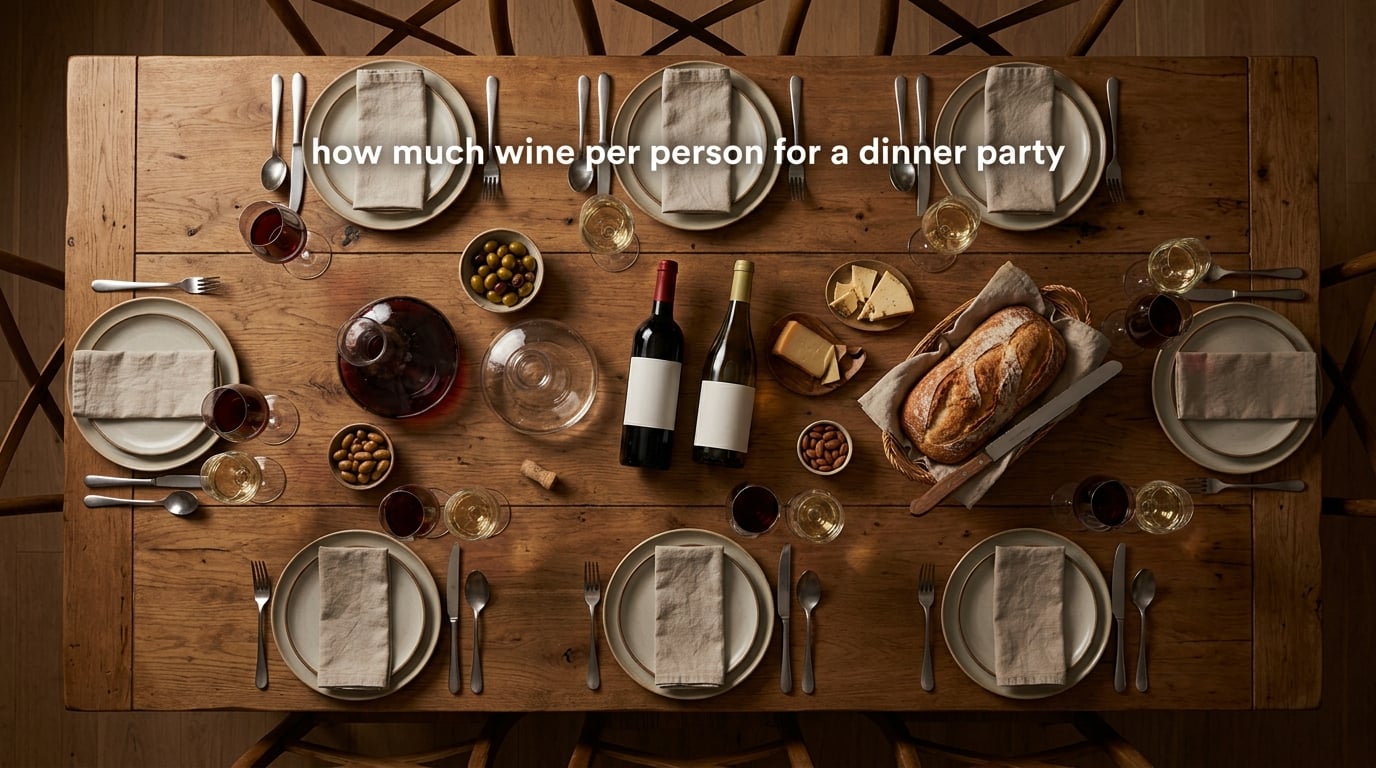
How much wine per person for a dinner party? After hosting wine-led dinners for years and tallying every empty bottle, our team sticks with one clean rule: plan for half a bottle of wine per person for a typical 3-hour dinner, or one full bottle per guest if you’re hosting a wine-heavy crowd that lingers past dessert.
That single answer gets you 90% of the way there. The remaining 10% is the math behind it, the variables that nudge the count up or down, and the copy-paste table so you stop guessing. I’ll cover all three below.
Table of Contents
How Much Wine Per Person: The Quick-Answer Rule
The short answer: half a bottle of wine per person (about 2.5 to 3 glasses) for a standard 3 to 4-hour dinner party. Double that to one full bottle per guest if you’re pouring generously, serving big pours, or hosting a wine-loving crowd that stays late.
That rule works because a 750 ml bottle yields five 5-ounce glasses — and most dinner-party guests drink two or three glasses across an evening. Multiply forward and you land at roughly half a bottle each.
If you want to skip the details and just see the numbers, jump straight to the Bottles Needed by Guest Count table below. If you want to understand why those numbers work, the next two sections break it down.
The Math: How Many Glasses Are in a Bottle of Wine?
A standard wine bottle holds 750 ml, which is about 25.4 fluid ounces. Divide that by a 5-ounce pour and you get five glasses per bottle. That’s the textbook answer — and it’s accurate if your bartender is using a measured pour.
Here’s what the math looks like in practice:
- 750 ml bottle = 25.4 oz
- 5 oz standard pour = 5 glasses per bottle
- 6 oz generous pour = about 4 glasses per bottle
- 4 oz light pour = about 6 glasses per bottle
Most home hosts pour closer to 6 oz without realizing it. A Reddit user on r/Hosting put it perfectly: “I don’t believe five ounces is a glass of wine. I think it’s a joke.” If you’re pouring heavy, plan on 4 glasses per bottle instead of 5, and add one extra bottle per 8 guests as a buffer.
For a quick sanity check on ABV: most table wine sits between 12% and 14.5% alcohol by volume, which is why a 5-ounce serving is the legal “standard drink” in the US.
Bottles Needed by Guest Count (Quick-Reference Table)
This is the table I wish someone had handed me before my first big dinner. Use it as a starting point, then add or subtract bottles based on the variables in the next section.
| Guest Count | Half-Bottle Rule (Standard Dinner) | Full-Bottle Rule (Generous Pouring) | Red / White Split (50/50 Default) |
|---|---|---|---|
| 4 guests | 2 bottles | 4 bottles | 1 red, 1 white |
| 6 guests | 3 bottles | 6 bottles | 2 red, 1 white |
| 8 guests | 4 bottles | 8 bottles | 2 red, 2 white |
| 10 guests | 5 bottles | 10 bottles | 3 red, 2 white |
| 12 guests | 6 bottles | 12 bottles | 3 red, 3 white |
| 20 guests | 10 bottles | 20 bottles | 5 red, 5 white |
| 30 guests | 15 bottles | 30 bottles | 8 red, 7 white |
| 50 guests | 25 bottles | 50 bottles | 13 red, 12 white |
Quick math shortcut: number of guests × 2.5 ÷ 5 = bottles under the half-bottle rule. So 8 guests × 2.5 ÷ 5 = 4 bottles. Easy to do in your head at the wine shop.
Add a buffer: if the dinner matters — a holiday, an anniversary, an in-law introduction — buy one extra bottle of each color beyond the table. Running out at 10 p.m. with hungry relatives still talking is the kind of mistake you only make once.
Variables That Change the Answer
The half-bottle rule is a starting point, not gospel. Five variables push the count up or down, and most dinners have at least two in play.
Party Length
A 2-hour dinner with one main course drinks less than a 4-hour dinner with appetizers, a main, and dessert. Our team uses this baseline: 1 glass of wine per guest per hour. So an 8-person, 3-hour dinner works out to 24 glasses, or 5 bottles at the 5-oz pour.
Welcome Drink or Aperitif
If you’re serving a sparkling wine or cocktail on arrival, add 1 glass per guest on top of your dinner count. That’s roughly 2 extra bottles for every 10 guests.
Heavy Pour or Heavy Drinkers
If your group skews wine-enthusiast or you’re pouring generously, drop your “glasses per bottle” assumption from 5 to 4. The same 8 guests now need 6 bottles instead of 4. Bon Appétit’s long-standing house rule for dinner parties is 1 bottle per guest minimum, conservative — and that holds up even for casual weeknight gatherings.
Full Bar or Beer Available
When you’re also pouring beer, hard seltzer, or a signature cocktail, wine consumption drops by roughly a third. Most hosts find that 60% wine / 40% beer is a workable split when both are available.
Non-Drinkers and Under-21 Guests
Subtract one bottle for every 4 to 5 confirmed non-drinkers in the group. Don’t skip this — couples routinely disagree on quantity (a classic r/Hosting thread: “Husband says 10 bottles, wife says 6 for 8 guests”), and a quick headcount of who actually drinks settles it.
Red vs. White Wine Split and Champagne Toast Math
If you’re serving both red and white, the safe default is a 50/50 split. Adjust by season and menu: lean 60% white for summer and seafood-heavy menus, lean 60% red for winter and red-meat menus. A blush or rosé fills the gap if you’re unsure what guests prefer.
Champagne or Sparkling Toast
For a toast, plan on half a glass per guest. A 750 ml bottle pours roughly 12 half-glasses when you’re filling flutes halfway. So:
- 8 guests = 1 bottle of bubbly for the toast
- 20 guests = 2 bottles
- 50 guests = 4 to 5 bottles
If the sparkling wine is also being served as the welcome drink, double those counts. You can also substitute a large-format bottle (a magnum holds 1.5 L) for 30+ guest toasts to reduce the bottle count you’re juggling.
When Wine Isn’t the Only Drink: Beer and Liquor Ratios
If you’re offering a full bar — wine plus beer plus a cocktail or two — wine consumption drops. A working ratio from the pros at Kiepersol’s party calculator: 50% wine, 30% beer, 20% mixed drinks or spirits.
For a 20-guest party with a full bar, that’s roughly 6 to 8 bottles of wine, 30 to 40 bottles of beer (or equivalent cans), and 4 to 5 bottles of liquor for cocktails. The exact mix depends on your crowd — a wine-curious book club will skew higher on wine than a casual backyard barbecue.
How Much Wine to Bring as a Guest (Not the Host)
If you’re the one being invited, the etiquette is simpler: bring one bottle of wine per person you’re bringing with you (including yourself). So a couple attending a dinner party for 8 brings 2 bottles — one to be served with dinner and one as a thank-you gift for the host. If you know the menu, match the wine to the main course: white for fish and poultry, red for red meat and heartier fare.
When in doubt, bring a bottle you’d be happy to drink yourself and a second that suits a different course. Hosts always appreciate the variety, and it covers the moment when a guest only drinks red and the table is full of whites.
Storage and Serving Tips Before the Party
A few quick tips so the wine you bought actually tastes good:
- Chill whites and rosés for 2 to 3 hours before serving (target 45 to 50 °F). Twenty minutes in an ice bath works in a pinch.
- Light reds like Pinot Noir benefit from 15 to 20 minutes out of the fridge before pouring.
- Full-bodied reds like Cabernet Sauvignon are best at cellar temperature, around 60 to 65 °F.
- Decant young reds (under 5 years old) for 20 to 30 minutes before serving to let them open up.
- Leftover wine keeps 3 to 5 days re-corked in the fridge — pull it out for cooking, or seal it with a vacuum stopper to stretch it a day longer.
Frequently Asked Questions
How much wine per person for a dinner party?
Plan for half a bottle of wine per person (about 2.5 to 3 glasses) for a standard 3 to 4-hour dinner. Double that to a full bottle per guest if you’re pouring generously or hosting wine enthusiasts who stay late. Add 1 extra bottle per 8 guests as a buffer bottle.
Is 10 bottles of wine enough for 20 people?
Yes, 10 bottles is the textbook answer for 20 guests under the half-bottle rule (20 guests × 2.5 glasses ÷ 5 glasses per bottle = 10 bottles). If you’re pouring generously, planning a toast, or expecting heavy drinkers, stretch to 12 to 14 bottles instead. Always keep one extra bottle per color on hand as a buffer.
How many bottles of wine for a 50 person party?
Plan for 25 bottles under the half-bottle rule (50 × 2.5 ÷ 5) or up to 50 bottles if pouring generously with a full wine-focused evening. Split 13 red and 12 white as a default. Add 4 to 5 bottles of sparkling wine if you’re doing a champagne toast. For a 4-hour party with a full bar available, drop to roughly 18 to 20 bottles of wine.
How much wine should I bring to a dinner party as a guest?
Bring one bottle of wine per person in your party, including yourself. A couple attending a dinner party for 8 brings 2 bottles — one to share during dinner and one as a host gift. If you know the menu, match the wine to the main course: white for fish and poultry, red for red meat.
What is the 20/20 rule for wine?
The 20/20 rule is a hosting etiquette rule, not a wine-quantity rule. It means arrive no more than 20 minutes before the stated time and stay no less than 20 minutes after the last toast. It does not relate to how much wine to pour per person, so use the half-bottle-per-guest rule for quantities instead.
What is the 20 minute wine rule?
The 20-minute wine rule refers to decanting: let a young red wine sit in a decanter or be poured into glasses 20 to 30 minutes before serving. This aerates the wine and softens tannins. It is a serving rule, not a quantity rule, and does not change how many bottles you should buy.
What is the 30/30 rule for wine?
The 30/30 rule is a food-and-wine pairing timing guideline: sip your wine roughly 30 seconds after each bite and finish the glass about 30 minutes after the course is served. It helps you taste wine and food together rather than separately. Like the 20-minute rule, it does not affect how many bottles to purchase.
Final Pour: A Quick Checklist
Here’s the recap before you head to the wine shop:
- Default rule: half a bottle per guest (about 2.5 to 3 glasses)
- Generous pour: 1 full bottle per guest
- Add 1 bottle per 10 guests for a champagne toast
- Default split: 50/50 red and white, adjusted by season and menu
- Add a buffer bottle per color for any dinner that matters
Now you know how much wine per person for a dinner party without second-guessing the cart at the wine shop. Pull up the table, do the quick math, and add a buffer bottle for the moment a guest wants “just one more glass.”