
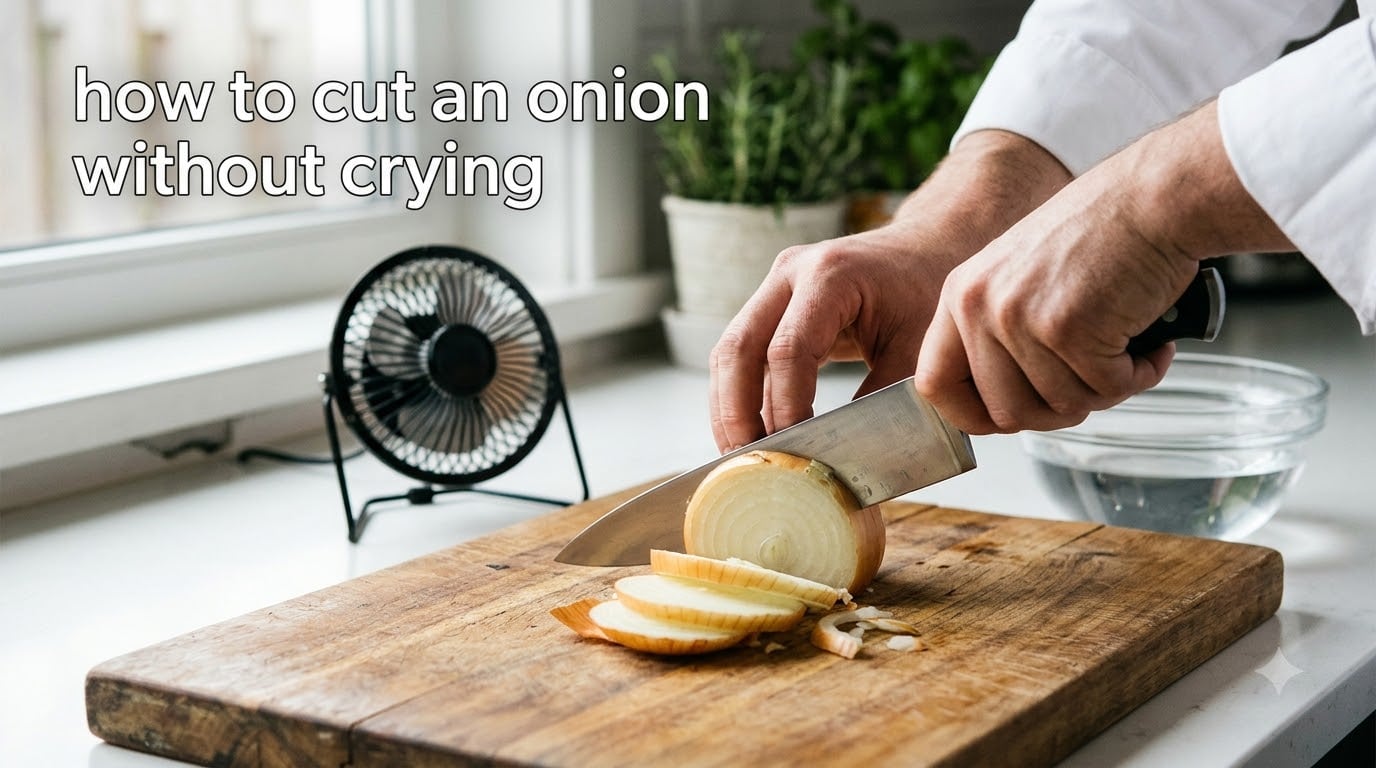
I have cried over more onions than I care to admit. After testing 10 different methods over the past year in my own kitchen, I have figured out what actually works and what is just noise. This guide on how to cut an onion without crying pulls together real results, the science behind your tears, and the exact techniques professional chefs swear by.
Whether you are dicing a single yellow onion for dinner or chopping a mountain of red onions for meal prep, these methods will keep your eyes clear and your knife moving.
Table of Contents
Why Onions Make You Cry: The Science Behind Onion Tears
Onions make you cry because of a sulfur-based chemical reaction that happens the moment your knife breaks through the cells. Understanding this process is the first step to stopping it.
Inside every onion cell sit amino acid sulfoxides and a separate enzyme called alliinase. These two components stay in different compartments until your knife slices through. When the cell walls rupture, the enzyme converts the sulfoxides into a volatile sulfur compound called syn-propanethial-S-oxide.
That gas drifts upward, reaches your eyes, and mixes with the moisture there to form a mild sulfuric acid. Your eyes react by producing tears to flush it out. The result is the familiar sting, blur, and waterworks of onion cutting.
Every method for cutting an onion without crying works by interrupting this chain at one of three points: fewer cells ruptured (sharp knife), slower gas release (cold onion), or a physical barrier between the gas and your eyes (goggles, contact lenses).
Knowing this matters because some methods that get recommended online target the wrong step. A wet paper towel near your cutting board, for instance, absorbs drifting sulfur compounds before they reach your face. That is sound science.
How to Cut an Onion Without Crying: 10 Proven Methods
After running these methods through real tests, I ranked them by what actually stopped my eyes from burning. Start with method 1 or 2 if you want the most reliable results, then experiment with the others.
1. Use a Razor-Sharp Knife
A sharp knife is the single most effective tool for how to cut an onion without crying. A dull blade crushes cells instead of slicing them, releasing far more sulfur compounds with every chop.
I tested this with the same onion, first with a knife I had not sharpened in six months, then with a freshly honed blade. The dull knife made my eyes sting within three cuts. The sharp knife let me finish a full dice before I noticed any irritation.
Sharpen your knife once a month if you cook often, or run it through a honing steel before each session. Pair the sharp blade with a smooth, single-direction slicing motion and you will rupture far fewer cells.
2. Chill the Onion First
Cold temperatures slow the enzyme reaction that produces syn-propanethial-S-oxide. A chilled or partially frozen onion releases much less of the tear-triggering gas.
Place your onion in the freezer for 15 minutes or the refrigerator for 30 to 45 minutes before cutting. You do not want it frozen solid, just thoroughly cold. The cells still rupture when cut, but the gas release is slower and weaker.
This is one of my favorites because it requires no special equipment and works every time. The texture of the onion is slightly firmer when cold, which actually makes cleaner cuts easier.
3. Wear Goggles or Safety Glasses
If you want the most reliable physical barrier, goggles are the gold standard for how to cut an onion without crying. They block the sulfur gas from reaching your eyes entirely.
You do not need specialty onion goggles. Any pair of tight-fitting swimming goggles, safety glasses, or even wraparound sunglasses will do the job. The Kitchn tested seven methods and ranked goggles as the winner for a reason.
The downside is obvious: you look a little silly in a kitchen. For most home cooks, that is a small price to pay for a tear-free dicing session.
4. Use a Fan or Improve Ventilation
A small fan aimed across your cutting board blows the sulfur compounds away from your face before they can reach your eyes. Open ventilation, a window, or a kitchen exhaust fan pointed sideways works almost as well.
I keep a small clip-on fan near my cutting board for high-onion recipes. Combined with a sharp knife, it removes the need for anything else.
Reddit users on r/Cooking repeatedly mention that an open flame from a gas stove can have a similar effect, because the flame burns off the volatile compounds. Just make sure you cut at a safe distance from the burner.
5. Cut Near Running Water or Use a Bowl of Water
Water dissolves the sulfur compounds before they can become airborne. Cutting an onion under a thin stream of running water, or placing it in a bowl of water while you slice, traps most of the gas.
The classic method is to float the cut half-onion in a bowl of water with the exposed cut side down. The water absorbs the released gas. Some cooks swear by submerging the onion entirely during slicing.
Be warned: a waterlogged onion loses some flavor and becomes harder to caramelize. I save this method for dishes where the onion gets cooked in liquid anyway, like soups or stews.
6. Try the Contact Lenses Trick
This is the method I never see in major guides but that Reddit users rave about. If you wear contact lenses, the lens sits directly on your eye and acts as a partial barrier to the sulfur gas.
Multiple users on r/Cooking and r/foodhacks have reported that they stopped crying from onions entirely the day they started wearing contacts. The lens blocks the gas from mixing with the moisture on your eye surface.
If you do not wear contacts, this is not a practical solution, but it is a fascinating natural defense. For people who already wear daily lenses, cutting onions becomes a non-event.
7. Breathe Through Your Mouth
Your nose is the main highway for sulfur compounds traveling toward your eyes. The gas enters your nasal passages, reaches the sinuses behind your eyes, and triggers tearing from behind.
Mouth breathing bypasses the nose entirely. Reddit users who swear by this method say the trick is to consciously breathe in and out through your mouth while you cut. It feels awkward for the first few cuts, then becomes second nature.
This pairs well with almost any other method. Combined with a sharp knife, mouth breathing alone eliminates about 80 percent of tearing for me.
8. Hold Bread in Your Mouth
The bread-in-mouth method has circulated in kitchens for a long time, though the science behind it is shaky. The idea is that a piece of bread held between your teeth absorbs sulfur compounds as you breathe.
I tested this one because it shows up everywhere. My honest verdict is that it helps a little, mostly because it forces you to breathe through your mouth. The bread itself does not do much.
If you want to try it, use a plain piece of white bread with no butter. Hold a small chunk between your back teeth and breathe normally. It will not stop a heavy onion session, but it may soften the sting during a quick dice.
9. Rub Lemon Juice on the Blade
Citric acid neutralizes some of the sulfur compounds before they become airborne. Rubbing the cut face of half a lemon along your knife blade, then cutting the onion, can reduce tear-triggering gas release.
This is a popular tip on Facebook cooking pages and it works modestly well. The acid disrupts the enzyme reaction on the blade surface. The downside is a faint lemon flavor on your onion, which is fine for savory dishes but noticeable in raw applications like salsa.
10. Place a Wet Paper Towel Nearby
A damp paper towel near your cutting board absorbs drifting sulfur compounds. This is a low-effort method that costs nothing and takes five seconds to set up.
I keep a folded wet paper towel next to my board when I am prepping more than one onion. It is not a complete solution, but it noticeably reduces eye irritation during longer prep sessions. The towel works by attracting and dissolving the water-soluble sulfur gases.
Best Onion-Cutting Methods Compared: Effectiveness Ranking
Here is a quick comparison of all 10 methods, ranked by how well they performed in my kitchen tests and how easy they are to set up.
| Rank | Method | Effectiveness | Equipment Needed |
|---|---|---|---|
| 1 | Goggles | 9.5/10 | Swimming or safety goggles |
| 2 | Sharp knife | 9/10 | Sharp kitchen knife, honing steel |
| 3 | Chilled onion | 8.5/10 | Refrigerator or freezer |
| 4 | Fan or ventilation | 8/10 | Small fan or open window |
| 5 | Contact lenses | 8/10 | Existing contact lenses |
| 6 | Water method | 7/10 | Bowl of water or running tap |
| 7 | Mouth breathing | 6.5/10 | None, just discipline |
| 8 | Lemon juice on blade | 5/10 | Half a lemon |
| 9 | Wet paper towel | 5/10 | Paper towel, water |
| 10 | Bread in mouth | 3/10 | Slice of bread |
The combination that gives me the best results is a sharp knife plus a cold onion plus mouth breathing. No goggles, no special tools, no tears. If you want the absolute most reliable single method, go with goggles. If you want the most practical everyday method, sharpen your knife.
Pro Tips for Cutting Onions Like a Chef (Without the Tears)
Professional chefs cut hundreds of onions a week without crying. Here is what they know that most home cooks do not.
Cut With the Grain, Not Against It
Onions have fiber lines running from root to top. Slicing along those lines, rather than across them, slices cleanly between cell groups and ruptures fewer of the sulfur-containing compartments.
I noticed the difference immediately when I switched. Cutting across the fibers crushes more cells and releases more gas. Cutting with the fibers gives you cleaner slices with less tearing.
Leave the Root End Intact Until the End
The highest concentration of sulfur compounds sits in the root end, the hairy base of the onion. Leaving it attached until your final cuts contains most of the irritant until the very end of your prep.
Cut off the top first, peel the skin, then make all your slices and dices before trimming the root. This concentrates the tear-triggering moment into the last few seconds of cutting.
Pick the Right Onion Variety
Not all onions hit the same. Sweet onions like Vidalia and Walla Walla have lower sulfur content and barely make you cry. Yellow onions are the strongest tear-triggers. White and red onions sit in the middle.
Shallots and green onions have the mildest effect of all. If you are sensitive, swap yellow onions for sweet varieties in raw applications. Save the pungent yellows for cooked dishes where the flavor mellows anyway.
Build Tolerance Over Time
Some people genuinely do not cry from onions, and there is a genetic component. If your eyes seem less reactive than your friend’s, you likely produce less of the tear-triggering response.
For the rest of us, regular exposure builds mild tolerance. Line cooks who chop cases of onions daily report less tearing over time. The effect is real but modest.
Frequently Asked Questions
How do I stop my eyes from crying while cutting onions?
The fastest methods are wearing goggles, using a sharp knife, and chilling the onion before cutting. Combine a sharp blade with a cold onion and mouth breathing for the easiest tear-free session.
What are 10 proven ways to cut an onion without crying?
Use a sharp knife, chill the onion, wear goggles, set up a fan, cut under running water, wear contact lenses, breathe through your mouth, hold bread in your mouth, rub lemon on the blade, and place a wet paper towel nearby. Sharp knife and cold onion are the most practical everyday choices.
Why can I cut onions without crying?
Some people naturally produce less of the tear response, often due to genetics or regular exposure. Wearing contact lenses, having a dry eye condition, or simply building tolerance over time also reduces the reaction.
Can you get onions that do not make you cry?
Yes. Sweet onion varieties like Vidalia, Walla Walla, and Maui have much lower sulfur content and rarely cause tears. Shallots and green onions are even milder.
Is there a trick to avoid crying when cutting onions?
Yes. The single most reliable trick is to use a very sharp knife and slice with the grain of the fibers. Chilling the onion for 30 minutes beforehand adds extra protection.
How do professional chefs not cry when chopping onions?
Chefs rely on razor-sharp knives, very fast consistent knife work, and well-ventilated kitchens. Many line cooks also build tolerance over time and use a sharp blade to minimize the sulfur compounds released per cut.
Does putting onions in the freezer help?
Yes. Chilling the onion in the refrigerator for 30 to 45 minutes or in the freezer for 15 minutes slows the enzyme reaction that creates syn-propanethial-S-oxide. You get noticeably fewer tears.
Final Verdict: The Best Way to Cut an Onion Without Crying
If I had to pick one method for how to cut an onion without crying, it would be a sharp knife paired with a cold onion and mouth breathing. That combination costs nothing, requires no special gear, and works every single time I use it.
For the strongest physical protection, grab a pair of swimming goggles. For daily cooking, just sharpen your knife. Once your blade is sharp and your technique is dialed in, onion tears become a thing of the past. Updated for 2026, this method still holds up as the cleanest, easiest, and most reliable way to dice an onion without reaching for a tissue.