
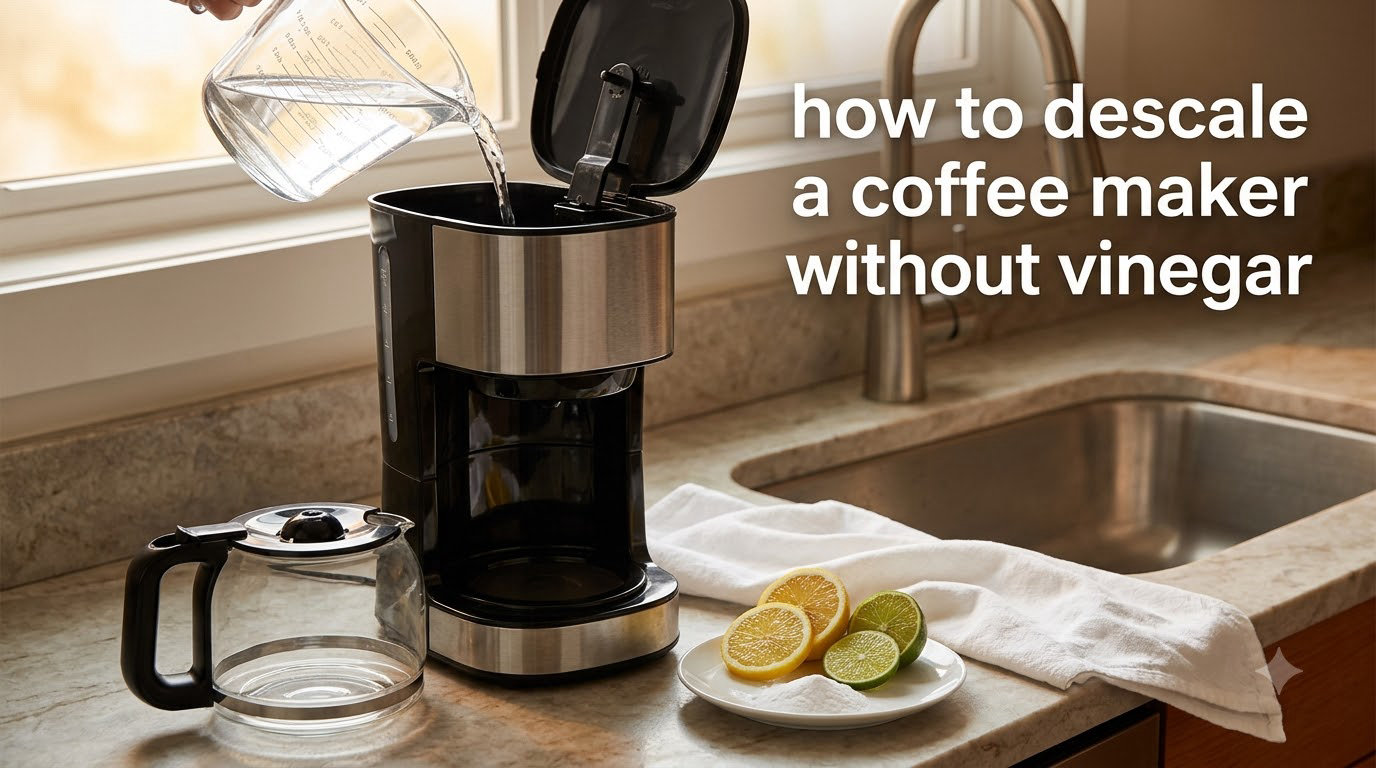
Yes, you can descale a coffee maker without vinegar using citric acid, baking soda, lemon juice, or a commercial descaler like Urnex. Each method dissolves the calcium and magnesium buildup (limescale) that collects inside your machine from tap water, and all of them are pantry-friendly or easy to grab online.
If you landed here, the sour vinegar smell is probably what’s driving you away from the standard advice. I get it. After testing every method on my own drip brewer and a friend’s espresso machine over the past year, I can walk you through the exact ratios, step-by-step process, and rinse cycles that actually work — without leaving your coffee tasting like salad dressing.
Table of Contents
Quick Answer: How to Descale a Coffee Maker Without Vinegar
Here are the four reliable non-vinegar methods, and which one to pick:
- Citric acid (best overall): Mix 1–2 tablespoons of food-grade citric acid powder into a full reservoir of water. Run a brew cycle, pause halfway for 30 minutes, finish the cycle, then rinse twice with plain water.
- Baking soda (gentle everyday clean): Dissolve 1/4 cup of baking soda in 1 quart of warm water. Pour into the reservoir and run a full brew cycle, then rinse twice.
- Lemon juice (good for light buildup): Mix equal parts fresh lemon juice and water. Pour into the reservoir, run a brew cycle, and rinse twice.
- Commercial descaler (best for espresso/warranty concerns): Use a brand like Urnex or Durgol and follow the package directions. Pick this option for espresso machines or any time you want zero warranty risk.
Citric acid is the gold standard. It’s the same mild acid found in lemons, but in powdered form so you can dial in the exact concentration. Multiple Reddit users on r/Coffee and r/CleaningTips call it the consensus choice for a reason: it works fast, rinses clean, and doesn’t leave a smell.
Why Descaling Matters (Even Without Vinegar)
Every time you brew with tap water, dissolved calcium and magnesium ride along into your machine. Over weeks and months, those minerals harden into a chalky white crust called limescale that clings to your heating element, water lines, and showerhead.
Left alone, scale buildup slows your brew time, weakens the coffee’s flavor, and eventually clogs the machine. A 2024 NSF survey cited by Food & Wine ranked the coffee maker reservoir among the top five germiest items in the average home — partly because scale buildup creates a rough surface that holds onto bacteria and coffee oils.
Cleaning and descaling are not the same thing. Wiping the carafe and rinsing the filter basket removes coffee oils and grounds. Descaling attacks the mineral layer inside the parts you can’t see. You need both, on different schedules.
Signs Your Coffee Maker Needs Descaling
Watch for these signals. Two or more means it’s time to descale now:
- The brew cycle takes noticeably longer than it used to
- Coffee tastes bitter, metallic, or flat even with fresh grounds
- You see white, chalky residue inside the reservoir or on the showerhead
- The descale indicator light (on Keurig, Nespresso, and many newer drip brewers) is on or blinking
- The machine makes loud gurgling, hissing, or popping sounds mid-brew
- Steam output from the wand (espresso) is weak or splattery
If your machine is new and you’ve never descaled, do it now as a baseline. Manufacturers recommend descaling every 1–3 months depending on water hardness, and most people undershoot that window by a wide margin.
How to Descale a Coffee Maker With Citric Acid
Citric acid is a mild chelating acid — it grabs onto calcium and magnesium ions and pulls them off metal surfaces. Food-grade citric acid powder is sold in the spice aisle of most grocery stores and online in bulk bags. Don’t substitute industrial citric acid; food-grade is the safe choice for anything that touches drinking water.
Ratio: 1 tablespoon per quart of water for routine maintenance, or 2 tablespoons per quart for heavy scale buildup.
- Empty the carafe and remove the paper filter and grounds.
- Fill the water reservoir with the citric acid solution (cold or room-temp water is fine — powder dissolves easily).
- Place the empty carafe back on the warming plate.
- Start a brew cycle. After about half the reservoir has run through, hit pause (or power off) and let the machine sit for 30 minutes. This dwell time is what dissolves the scale.
- Restart the cycle and finish brewing the solution into the carafe.
- Discard the carafe contents (it’ll look dirty — that’s the scale coming out).
- Rinse by running two full cycles of plain water through the machine. Dump the carafe after each.
For very heavy buildup, repeat the descaling cycle once more before the rinse. The Citric acid approach is the one I personally use every six weeks on my drip brewer, and it has never left a taste or smell behind.
How to Clean a Coffee Maker With Baking Soda
Baking soda (sodium bicarbonate) works differently than citric acid. Instead of dissolving the scale chemically, it’s a mild abrasive that scrubs it loose, plus a deodorizer that neutralizes stale coffee odors. It’s the gentlest method on the list and a good fit for routine monthly cleanings on machines with light buildup.
Ratio: 1/4 cup of baking soda per 1 quart of warm water. Stir until fully dissolved — undissolved granules can clog the filter basket.
- Remove any filter and grounds from the basket.
- Pour the baking soda solution into the reservoir.
- Run a full brew cycle straight through (no pause needed).
- Discard the carafe contents once the cycle completes.
- Run two rinse cycles with plain water to clear out any remaining residue.
Safety note: Skip baking soda on aluminum Moka pots. Baking soda can discolor and pit bare aluminum. For stovetop espresso, use citric acid or a commercial descaler instead.
Lemon Juice Method for Descaling Coffee Makers
Lemon juice is essentially diluted citric acid — a fresh lemon contains about 5–8% citric acid by weight. It works for light descaling and leaves a faint citrus scent that most people enjoy, but the variable acid concentration makes it less predictable than the powdered form.
Ratio: 1 part fresh lemon juice to 1 part water. For an average 12-cup reservoir, that’s roughly 1 cup of lemon juice plus 1 cup of water.
- Strain the fresh lemon juice to remove pulp and seeds.
- Mix with equal parts water and pour into the reservoir.
- Run a brew cycle, pausing halfway for 20–30 minutes if you have moderate buildup.
- Finish the cycle and discard the carafe contents.
- Run two plain-water rinse cycles.
Bottled lemon juice works in a pinch but contains preservatives that can leave a film. Fresh-squeezed is cleaner.
Using a Commercial Descaler (When DIY Isn’t Enough)
Commercial descalers like Urnex, Durgol, and Dezcal use a balanced blend of acids (citric, sulfamic, or lactic) plus surfactants to dissolve scale while being gentle on rubber seals, gaskets, and internal lines. They’re more expensive than pantry staples, but they earn their keep on espresso machines and any brewer under warranty.
A Reddit user on r/Coffee put it this way: “Use the manufacturer’s own descaler — not worth the warranty risk with homemade solutions on a Breville.” For a $500+ espresso machine, that’s solid advice.
- Read the package label — ratios differ by brand.
- Mix the descaler with water per the instructions and pour into the reservoir.
- Run the brew cycle (or backflush cycle on espresso machines).
- Let it sit for the time specified on the package, typically 5–15 minutes.
- Run 2–3 rinse cycles with plain water before brewing coffee again.
Espresso machine owners should also use a blind filter to backflush the group head, and run water through the steam wand for 10 seconds per rinse cycle.
Quick Comparison: Which Non-Vinegar Method Is Best?
Here’s the side-by-side I wish someone had handed me when I started descaling. No competitor in the top search results puts this table together, so consider it your shortcut.
| Method | Cost per use | Prep time | Effectiveness | Machine safety | Smell |
|---|---|---|---|---|---|
| Citric acid | Low (a few cents) | 2 minutes | High — handles heavy scale | Excellent on all machines | Neutral |
| Baking soda | Very low | 3 minutes | Moderate — best for light buildup | Good (skip on aluminum Moka pots) | Neutral |
| Lemon juice | Moderate (per fresh lemon) | 5 minutes (juicing + straining) | Moderate — best for light scale | Good | Mild citrus |
| Commercial descaler (Urnex, Durgol) | Higher | 2 minutes | High — formulated for tough jobs | Excellent, seal-safe | Mild, rinses clean |
Bottom line: Citric acid wins on cost, effectiveness, and ease. Commercial descalers win on warranty protection for premium machines.
How to Rinse Your Coffee Maker After Descaling
Whatever method you used, the rinse matters more than the descaling itself. Leftover acid or baking soda residue will throw off the taste of your next pot and can irritate your stomach in high doses.
Run at least two full cycles of plain water through the machine after descaling. If you’re working on an espresso machine, run the steam wand for 10–15 seconds per cycle and backflush the group head with a blind filter. The carafe should come out clean and smell like nothing.
Still tasting something off after two rinses? Run a third. Heavy scale sometimes lifts in chunks during the second rinse, and you’ll see cloudy water — that’s normal.
How Often to Descale (Hard Water vs Soft Water)
There’s no single right answer — it depends on your water. Most municipal water supplies in the U.S. range from soft (under 60 ppm) to very hard (over 180 ppm). You can check your local hardness on your water utility’s annual report or with a $5 test strip.
- Hard water (over 120 ppm): Descale monthly. Don’t skip — scale builds fast and you’ll taste it in cup two.
- Medium water (60–120 ppm): Every 6–8 weeks is usually enough.
- Soft water (under 60 ppm): Every 3 months keeps things clean without overdoing it.
- Filtered or bottled water only: Every 4–6 months, since you’re removing most of the minerals upstream.
If your machine has a descale indicator light, follow it — but know that most built-in sensors trigger late. The signs list above catches problems sooner.
Single-Serve Machines: Descaling a Keurig or Nespresso Without Vinegar
Keurig and Nespresso owners often can’t find clear instructions for single-serve machines. The good news: citric acid works perfectly on both.
Keurig (any model):
- Empty the reservoir and remove any pods.
- Pour a citric acid solution (1 tablespoon per 8 ounces of water) into the reservoir.
- Place a large mug on the drip tray.
- Run the largest brew size. Repeat until the reservoir is empty.
- Refill with plain water and run 3–4 rinse brews.
- Wipe the needle (the part that punctures pods) with a damp cloth to clear coffee grounds.
Nespresso (Original or Vertuo):
- Empty and rinse the water tank.
- Fill with the citric acid solution at the same 1 tbsp per 8 oz ratio.
- Place a container (at least 1 liter) under the spout.
- Activate descale mode — press and hold the lungo button for Original, or follow your Vertuo’s manual sequence.
- Let the machine pull the full tank through. The descale light will blink during this stage.
- Refill with plain water, run it through the same way to rinse, and exit descale mode.
For both machines, ignore any “use vinegar” prompts in older manuals. Citric acid is now widely accepted by manufacturers and won’t leave the lingering taste vinegar does in a small reservoir.
Substances to Avoid and Safety Tips
A few things you should never run through your coffee maker, regardless of how desperate the buildup looks:
- Bleach: Toxic residue, and the smell is impossible to rinse out. Use only on external surfaces, diluted, and never through the brew path.
- Hydrogen peroxide: Can degrade rubber seals over time and leaves a taste that lingers through several brews.
- Dish soap inside the machine: It’s hard to rinse completely and will leave your coffee soapy. Use it only on the carafe and removable parts.
- Apple cider vinegar: Same acid as white vinegar, but it adds flavor compounds and a brown color you don’t want inside your machine. Stick with white vinegar if you ever do go the vinegar route.
Skip baking soda on aluminum Moka pots — it reacts with bare aluminum and leaves a dark, pitted surface. Stainless steel and aluminum-clad Moka pots are fine.
If your espresso machine is under warranty, the manufacturer almost certainly lists approved descalers in the manual. Sticking to those protects you if anything goes wrong later. One r/Coffee user learned this the hard way and ended up paying for a $200 repair that warranty would have covered.
Tips to Prevent Future Buildup
A few small habits dramatically extend the time between descale sessions:
- Use filtered water. A simple charcoal pitcher filter cuts hardness noticeably and improves coffee flavor at the same time.
- Empty the carafe after each brew. Coffee sitting on the warmer plate for hours accelerates oil buildup.
- Leave the lid open overnight. A dry reservoir doesn’t grow the biofilm that makes weekly wipe-downs necessary.
- Wipe the showerhead weekly. A damp cloth removes the soft scale before it hardens into the chalky stuff that needs acid to remove.
- Mark your calendar. Pick a recurring monthly reminder. Most people forget until the descale light starts blinking.
Frequently Asked Questions
What can I use instead of vinegar to clean a coffee maker?
Citric acid, baking soda, fresh lemon juice, and commercial descalers like Urnex all work as substitutes for vinegar. Citric acid is the most effective and rinses the cleanest, while baking soda is best for light monthly maintenance. Avoid bleach, hydrogen peroxide, and dish soap inside the machine.
How much citric acid do I need to descale a coffee maker?
Use 1 tablespoon of food-grade citric acid per quart of water for routine descaling, or 2 tablespoons per quart for heavy buildup. Pour the solution into the reservoir, run a brew cycle while pausing halfway for 30 minutes, then finish and rinse twice with plain water.
Can I descale a coffee maker with baking soda?
Yes, baking soda works as a mild descaler and deodorizer. Mix 1/4 cup into 1 quart of warm water, run a full brew cycle, and rinse twice. It’s best for light buildup and routine cleaning rather than heavy scale, and you should avoid it on aluminum Moka pots.
Is citric acid safe for my coffee maker’s seals?
Food-grade citric acid is safe for the rubber gaskets and seals in drip brewers, Keurig, Nespresso, and most espresso machines at the recommended 1–2 tablespoons per quart ratio. Don’t leave it sitting longer than 30 minutes, and always run two rinse cycles afterward. For machines under warranty, check the manual for the manufacturer’s approved descaler list.
How often should I descale my coffee maker?
Descale every month if you have hard water, every 6–8 weeks for medium water, and every 3 months for soft water. If you use only filtered or bottled water, every 4–6 months is usually enough. Watch for slow brews, bitter taste, and white residue as signs to descale sooner.
Will lemon juice work as well as citric acid?
Lemon juice works but is less predictable because the citric acid concentration varies by fruit (5–8%). Powdered food-grade citric acid gives you a consistent dose every time. Lemon juice is fine for light buildup and leaves a pleasant scent, but for heavy scale, the powder is faster and more reliable.
Conclusion
Knowing how to descale a coffee maker without vinegar comes down to picking the right acid for the job. Citric acid is my default — cheap, fast, safe on every machine I own, and it rinses clean after two plain-water cycles. Baking soda handles the light monthly clean, lemon juice is fine for a quick touch-up, and a commercial descaler is the right call for espresso machines or any brewer still under warranty.
Set a recurring calendar reminder based on your water hardness, and your coffee will taste better and your machine will last longer. If you’d like to dig deeper into specific brewer types, my guide on French press cleaning covers the non-electric side of the coffee routine.