
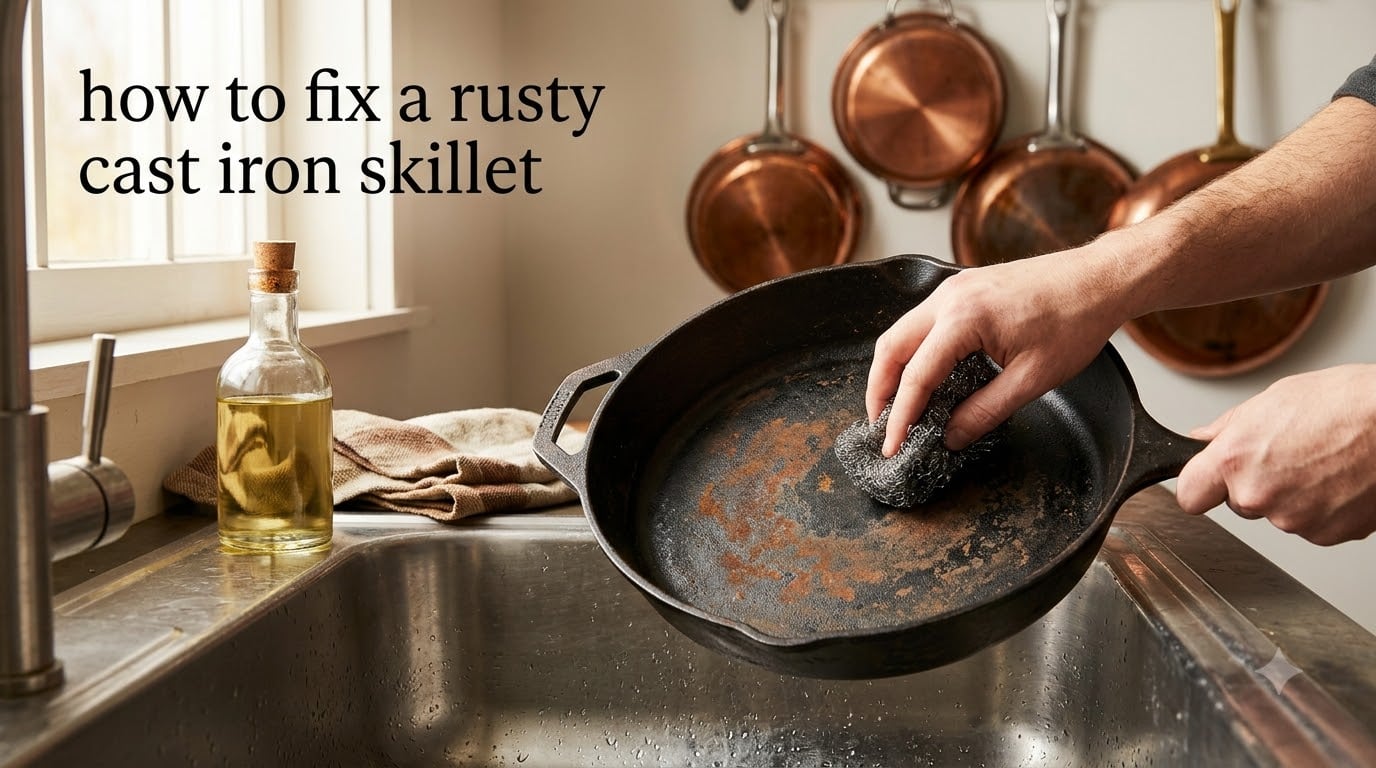
A rusty cast iron skillet is not ruined. You can fix a rusty cast iron skillet at home by scrubbing off the rust, drying the pan completely, and baking on a fresh thin coat of oil that hardens into a new protective seasoning. Most pans come back to cooking condition within an afternoon.
I’ve restored garage-sale pans, family heirlooms, and pans rescued from damp storage cabinets using the same basic process. In this guide, I’ll walk you through the why behind rust, the supplies you’ll need, a safety check before you start, the step-by-step restoration, a light-versus-heavy rust decision tree, re-seasoning details, troubleshooting, and how to keep the rust from coming back.
Table of Contents
Why Cast Iron Skillets Rust (and What Seasoning Actually Does)
Cast iron rusts when bare iron meets oxygen and moisture. The reddish-brown flaky coating is iron oxide, and it forms fast if you store the pan wet, leave it in a damp cabinet, or run it through a dishwasher. The good news is the iron itself is not damaged — rust is a surface problem.
Seasoning is a thin layer of polymerized oil baked onto the pan. When oil heats past its smoke point in the oven, it bonds to the iron and hardens into a slick, plastic-like film. That film does two jobs: it gives you a non-stick surface, and it seals the iron away from moisture so rust cannot form.
So restoring a rusty skillet is really two jobs in one. First, you remove the rust and any failed seasoning. Second, you lay down a fresh seasoning layer to protect the bare iron. Skip either step and the rust usually returns within weeks.
What You’ll Need to Fix a Rusty Cast Iron Skillet
Gather these before you start. Most are already in a kitchen or garage.
Steel wool, a stiff-bristle brush, or coarse kosher salt for scrubbing
Dish soap (a small amount is fine on bare iron)
Distilled white vinegar for heavier rust (50/50 with water)
Baking soda as a gentler alternative
Clean rags or paper towels
A lint-free cloth for oiling
High-smoke-point oil (see oil guide below)
Oven, sheet pan, and aluminum foil
Safety Check: Should You Actually Restore This Pan?
Not every rusty pan deserves the effort. Run through these checks before you scrub.
The Knock Test for Cracks
Hold the pan up and tap the body with the knuckle of your other hand. A sound pan rings like a bell with a clear, sustained tone. A cracked pan produces a dull thud or a rattling buzz. If you hear a thud, stop — no amount of re-seasoning will fix a structural crack, and the pan can shatter under heat.
Warping and Severe Pitting
Set the pan on a flat glass surface and press the rim. A warped pan rocks or wobbles. Warping is not repairable; the pan will never sit evenly on a burner again. Heavy pitting (deep craters you can feel with a fingernail) is also a sign the pan has been heavily damaged, though light pitting is fine to restore.
Lead Concerns on Very Old Pans
Vintage pans made before the 1970s occasionally carry lead residue on the cooking surface, especially if they spent years in a garage. If the pan is genuinely antique and you plan to cook in it, a $10 lead swab test from a hardware store is worth the peace of mind. Restoring the seasoning does not remove lead.
When to Retire a Pan
Retire the pan if it fails the knock test, wobbles on a flat surface, or has cracks you can see with the naked eye. Also retire pans with hairline fractures near the handle. A new Lodge 12-inch skillet costs less than the time you’ll spend on a hopeless restore.
How to Fix a Rusty Cast Iron Skillet: 5 Steps
This is the core process. Each step is short — most of the time goes into waiting for the oven.
Step 1: Scrub the Rust Off
For light surface rust, scrub the pan with steel wool, a stiff brush, or a paste of coarse kosher salt and a little oil. The salt acts as a gentle abrasive and lifts rust without scratching the iron badly. Work in circles and rinse often so you can see your progress.
For heavier rust, see the light-versus-heavy section below — you may want a vinegar soak first.
Step 2: Wash and Dry Thoroughly
Wash the scrubbed pan with warm water and a small amount of dish soap. Yes, modern dish soap is fine on bare iron — the old “never use soap” rule came from lye-heavy formulas that stripped seasoning. Rinse and towel dry, then place the pan on a burner over low heat for 2 to 3 minutes to drive off every trace of moisture. Any leftover water will flash-rust the pan in hours.
Step 3: Apply a Thin Coat of Oil
Put a few drops of high-smoke-point oil on a lint-free cloth and rub a sheer film across the entire pan — inside, outside, handle, and bottom. Then wipe it again with a clean part of the cloth until the pan looks almost dry. Too much oil is the #1 cause of sticky, gummy seasoning. If you see any pooling, wipe it off.
Step 4: Bake Upside Down for One Hour
Set the oven to 450-500°F (232-260°C). Place a sheet pan on the lower rack to catch any drips. Put the skillet upside down on the middle rack so oil does not pool in the cooking surface. Bake for one hour. The heat polymerizes the oil into a hard, dark seasoning layer bonded to the iron.
Step 5: Cool in the Oven
Turn the oven off and let the pan cool inside for at least an hour. Rapid temperature changes can warp cast iron, especially thinner pans. Once cool, your pan is ready to use — or repeat the oil-and-bake cycle two more times for a stronger initial seasoning.
Vinegar timing warning: if you use a vinegar soak for heavy rust, never exceed 1 to 4 hours. Vinegar is dilute acetic acid and will start etching the iron itself if you leave it longer. After a 4-hour soak you may notice a grey, roughened surface — that is pitting, and it cannot be undone.
Light Rust vs Heavy Rust: Which Method to Use
The right method depends on how bad the rust is. Use this quick decision tree.
| Rust Level | What It Looks Like | Best Method | Time Required |
|---|---|---|---|
| Light surface rust | Orange or reddish dust, no pitting, comes off under a fingernail | Scrub with steel wool or coarse kosher salt and oil | 15 to 30 minutes |
| Moderate rust | Visible orange patches, light pitting, stubborn spots | 50/50 vinegar-water soak for 1 to 2 hours, then scrub | 2 to 3 hours including soak |
| Heavy rust | Thick, scaly coating, deep pitting, rough to the touch | Vinegar soak (max 4 hours), scrub, then repeat 2 to 3 cycles | Half a day |
| Severe rust with failed seasoning | Rust over sticky or flaking old seasoning | Strip first with lye or self-cleaning oven cycle, then restore from scratch | Full day or two |
If you are not sure, start with the gentlest method (salt scrub) and escalate only if needed.
Re-Seasoning Your Cast Iron Skillet the Right Way
Re-seasoning is what turns a clean, dry pan into a non-stick cooking surface. Once you understand the chemistry, every step makes sense.
What Polymerization Means
Polymerization is the chemical reaction that turns liquid oil into a hard, plastic-like film when it hits high heat. The oil does not dry — it chemically changes. That is why you need a high-smoke-point oil: lower-smoke oils break down and turn sticky before they polymerize cleanly.
Best Oils and Oils to Avoid
| Oil | Smoke Point | Verdict |
|---|---|---|
| Avocado oil (refined) | 520°F / 270°C | Best choice — clean polymerize, very durable |
| Grapeseed oil | 420°F / 216°C | Excellent choice — clean finish, popular with chefs |
| Canola oil | 400°F / 204°C | Good choice — affordable and widely available |
| Vegetable oil | 400°F / 204°C | Fine choice — similar to canola |
| Lard or bacon grease | 370°F / 188°C | Traditional choice — works well, harder to apply evenly |
| Flax seed oil | 225°F / 107°C | Avoid for oven seasoning — looks great at first but flakes within months |
| Butter or extra virgin olive oil | 350 to 375°F / 177 to 191°C | Avoid — smoke point too low, leaves sticky residue |
How Many Rounds of Seasoning
For a brand-new seasoning layer, run the oil-and-bake cycle three times before you cook. Each layer is thin, and three passes build up a deep, dark, durable finish that resists rust and releases food cleanly. After that, one quick re-seasoning after heavy cleaning is plenty.
Temperature and Timing
450°F for one hour is the standard. Higher temperatures (up to 500°F) build seasoning faster but risk smoking out your kitchen if oil is uneven. Lower temperatures (400°F) work but take more cycles to build the same depth.
Maintenance and Prevention: How to Stop Rust From Coming Back
The fastest way to ruin a freshly restored pan is to treat it like a regular non-stick skillet. Cast iron needs a tiny bit of care after every use, and the routine takes about 60 seconds.
Never put a cast iron pan in the dishwasher. The detergent strips seasoning and the long wet cycle causes flash rust.
Hand-wash with warm water and a soft sponge right after cooking. Skip the soap unless the pan is truly grimy.
Dry the pan on the burner over low heat for 2 to 3 minutes after every wash.
Rub a few drops of oil on the warm pan with a paper towel. Store it in a dry cabinet.
Cook with the pan often. Regular use builds seasoning faster than any oven routine.
If you live in a humid climate, store the pan with the lid off and a paper towel inside to absorb moisture. If you stack pans, put a paper towel or cloth between them so air circulates.
Frequently Asked Questions
Can rusty cast iron be restored?
Yes. Rusty cast iron can almost always be restored at home by scrubbing off the rust, drying the pan thoroughly, and baking on a new layer of seasoning. The iron itself is not damaged by surface rust — only the protective seasoning layer is compromised. With a few hours of work, a rusty skillet can cook like new.
Can you remove rust from a cast iron skillet?
You can remove rust from a cast iron skillet using steel wool, a stiff brush, or coarse kosher salt as an abrasive scrub. For heavier rust, a 50/50 vinegar-and-water soak for one to four hours dissolves the rust quickly. After scrubbing, wash the pan with mild dish soap, dry it on the stove, and apply a thin coat of high-smoke-point oil before baking it in the oven to re-season.
Is it okay to cook in a rusted cast-iron pan?
Cooking in a rusted cast iron pan is technically not dangerous in small amounts — rust is iron oxide, and trace amounts are not toxic. However, the rust will flake into your food, the pan will not be non-stick, and the rust will spread if you do not restore the seasoning. The standard practice is to scrub off the rust and re-season before cooking with the pan again.
What is the best rust remover for cast iron?
The best rust remover for cast iron depends on how heavy the rust is. For light rust, mechanical scrubbing with steel wool or coarse kosher salt is the safest method. For moderate to heavy rust, a 50/50 white vinegar and water soak for one to four hours works fast. Baking soda paste is a gentler alternative for very light rust. Avoid prolonged vinegar soaks over four hours and avoid harsh acids like Naval Jelly, which can damage the iron.
How can I remove heavy rust from my cast iron skillet?
To remove heavy rust from a cast iron skillet, soak the pan in a 50/50 white vinegar and water solution for one to four hours. Do not exceed four hours or the vinegar will etch the iron. After soaking, scrub aggressively with steel wool or a wire brush, rinse, wash with dish soap, and dry the pan on the stove over low heat. Repeat the soak and scrub cycle two to three times for very heavy rust. Once clean, re-season with three rounds of thin oil baked at 450°F for one hour each.
Can a rusty cast iron skillet be saved?
A rusty cast iron skillet can be saved in almost every case as long as the pan passes the knock test for cracks and is not warped. Surface rust and even moderate pitting are fully reversible through scrubbing and re-seasoning. Cracks, structural fractures, and severe warping mean the pan should be retired, not restored.
Will Dawn dish soap get rid of rust?
Dawn dish soap will not get rid of rust on its own. Dish soap is a degreaser — it cleans oil and food, but it does not dissolve iron oxide. To remove rust you need mechanical scrubbing (steel wool, salt, brush) or a chemical reaction (vinegar soak). Use dish soap as a follow-up to scrub the pan clean after the rust is removed.
How can I restore a rusty cast iron skillet?
You can restore a rusty cast iron skillet in five steps: scrub the rust off with steel wool or coarse salt, wash the pan with mild dish soap and dry it on the stove, apply a thin coat of high-smoke-point oil and wipe off excess, bake the pan upside down at 450°F for one hour, and let it cool in the oven. Repeat the oil and bake cycle two more times for a strong initial seasoning. The whole process takes an afternoon.
Conclusion
You can fix a rusty cast iron skillet at home with steel wool or a vinegar soak, a thin coat of oil, and an hour in the oven. The chemistry is simple: remove the rust, dry the iron, and bake on a new polymerized oil layer. With three rounds of seasoning and a 60-second post-cooking routine, the pan will outlast the next decade of weeknight dinners.
Grab your rusty skillet, run the knock test, and start with the gentlest scrub. By dinner time, you’ll be cooking on a pan that looks better than the day it was made.