
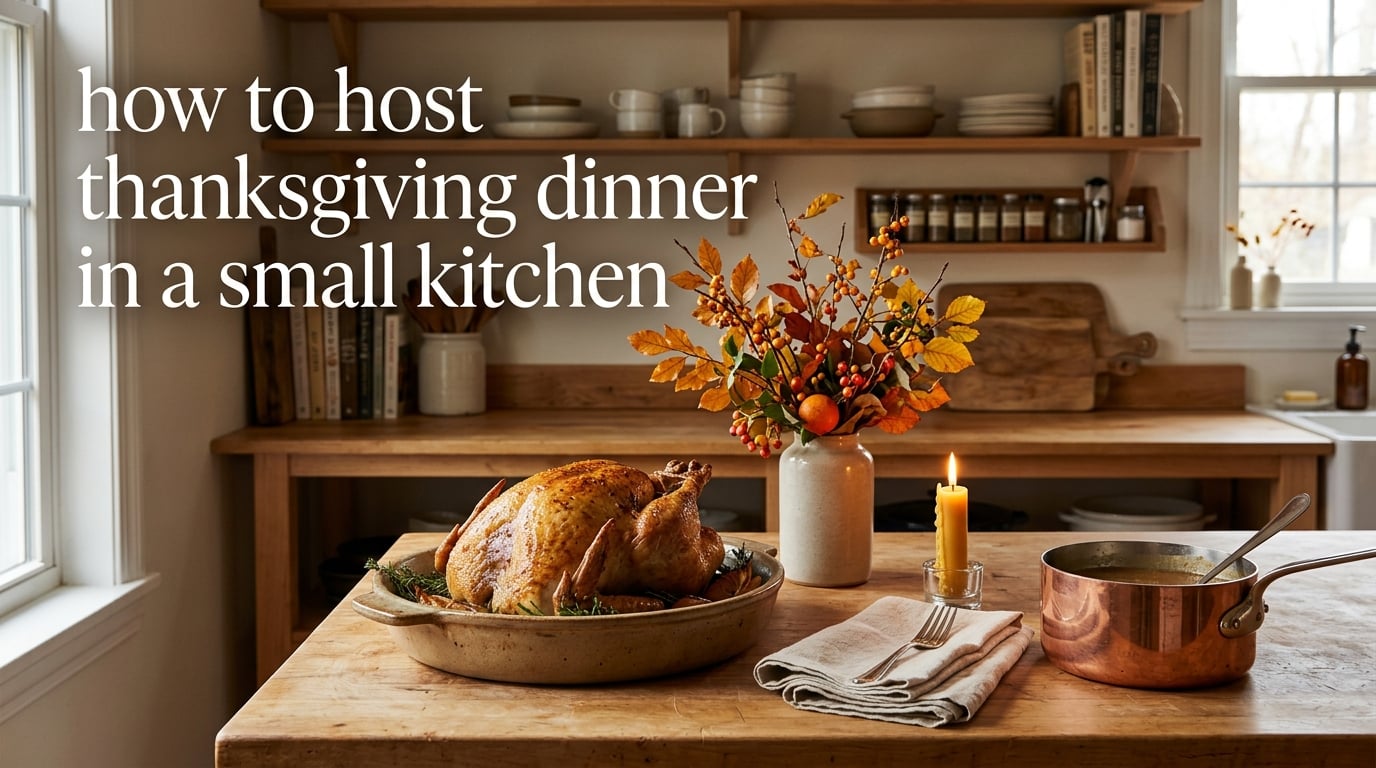
Learning how to host Thanksgiving dinner in a small kitchen starts with one mindset shift: the tiny space is your creative advantage, not your limitation. Thousands of Americans host Thanksgiving in apartments, condos, and homes under 400 square feet every year. Many of them end up calmer than their cousins cooking in a sprawling farmhouse kitchen. The trick is planning ahead, scaling the menu to fit one oven, and letting the gathering spill beyond the dining table. By the end of this guide, you will have a complete playbook: a two-week prep timeline, a make-ahead menu, a seating strategy for crowds your table cannot hold, and a day-of cooking workflow that keeps your counters clear. Let’s make this your best Thanksgiving yet.
Table of Contents
Why a Small Kitchen Is Actually an Advantage for Thanksgiving Dinner
Hosting Thanksgiving in a small kitchen is not something to apologize for. It is something to lean into. A tight space forces the kind of focus that produces a better meal: fewer dishes on the menu, sharper timing, less waste, and far more time at the table with people you love. In a tiny apartment, you cannot wander from a giant prep island to a six-burner stove. You stand, chop, and stir in one rhythm. That rhythm is the heart of great holiday cooking.
I have hosted Thanksgiving in a 195-square-foot studio, a galley kitchen in a duplex, and now a narrow condo with a single oven. Every single year, the meal turned out better because the space forced me to plan harder. Quality over quantity is not just a slogan here. It is the natural byproduct of cooking in a small kitchen. So before you borrow, rent, or rearrange anything, settle this in your head: you have enough room. You have enough stove. You have enough oven. You just need a strategy.
10 Quick Tips for Hosting Thanksgiving in a Small Kitchen
Before we get into the long game, here is the cheat sheet. These ten tips cover the most common small-kitchen Thanksgiving mistakes. Read them once, then keep scrolling for the detailed playbook.
- Make 70 percent of your dishes the day before or earlier.
- Cook the smallest turkey or alternative main your guest count actually needs.
- Use a buffet-style serving setup on a sideboard or folding table.
- Move appetizers and drinks out of the kitchen entirely.
- Join two folding tables end-to-end instead of squeezing around one small table.
- Stage dirty pans in a bus tub under the table, not on your counter.
- Freeze pie crusts, gravy, and cranberry sauce up to two weeks ahead.
- Run the dishwasher between courses, not after dinner is over.
- Set up the drink station in the living room to keep traffic out of the kitchen.
- Borrow what you do not own, especially chairs, platters, and roasting pans.
Your Pre-Thanksgiving Planning Timeline: Two Weeks, One Week, and Day Before
A clear Thanksgiving planning timeline is the single biggest difference between a relaxed holiday and a frazzled one. Start two weeks out so your fridge, freezer, and pantry all have time to organize themselves around the meal. Here is the exact schedule our team uses when hosting Thanksgiving in a small kitchen.
Two Weeks Before Thanksgiving
The two-week window is for freezer work and equipment hunting. Make and freeze pie crusts (par-baked or fully baked), stock, and any cranberry components. Bake and freeze extra bread for stuffing if you have room. Sit down with a notebook and write three lists: your final menu, your cooking list (in the order you will cook it), and your non-cooking list (rentals, borrowed items, drinks, ice, flowers). Equipment is the silent killer of small-kitchen holidays. Track down the roasting pan, the second oven thermometer, the extra folding table, and the chairs. Borrow them now, while your friends still remember the request.
One Week Before Thanksgiving
This week is for fridge management and the bones of your make-ahead dishes. Defrost and re-freeze the turkey breast if you went that route. Make and refrigerate cranberry sauce, pumpkin pie filling (without baking), and your stuffing base (without eggs). Make the mashed potato base and freeze in flat zip bags so they stack like books in your freezer. Clean the oven. Empty the fridge of anything expired, half-finished, or mysterious. You need every shelf for the days ahead.
The Day Before Thanksgiving
Cook the sides that reheat well. Bake the pies. Make the gravy and store it in a wide, shallow container so it cools fast. Set the table, polish the glasses, and arrange your buffet station. Most importantly: set out everything you will need for the morning in a single box by the front door. Spices, oils, foil, timers, towels. This stops the “where is the cumin?” panic before it starts.
What to Make Ahead for Thanksgiving (and What to Cook Day-Of)
A make-ahead Thanksgiving menu is not about cheating. It is the only sane way to host a meal in a small kitchen. If you try to cook everything on Thursday, your oven will be overloaded and your counters will be buried. Here is the dish-by-dish breakdown.
Make These Up to Two Weeks Ahead
Stock, gravy base, pie crusts, and cranberry sauce all freeze beautifully. Make pie crusts into disks, double-wrap in plastic, and freeze flat. Cranberry sauce keeps in the fridge for two weeks and gets better as it sits. Gravy freezes in ice cube trays, then gets transferred to a bag so you only reheat what you need.
Make These 1 to 3 Days Before
Mashed potatoes (freeze flat in bags, drop into boiling water to reheat), green bean casserole components, stuffing base (mix the bread, herbs, and aromatics, refrigerate, then bake on Thursday), and most desserts. Pumpkin pie can be baked two days ahead and stored covered at room temperature.
Cook These Day-Of
The turkey (or alternative main), any roasted vegetables you want crisp, and the final assembly of casseroles. Everything else should be ready to slide into the oven during the turkey’s resting window. That resting window is the secret weapon of small-kitchen Thanksgiving cooking. When the turkey comes out, the oven is free and hot. Slide in two sheet pans of vegetables and reheat the sides. It is the cleanest, calmest workflow you can build.
How to Maximize Space in a Small Kitchen for Thanksgiving
Maximizing counter and storage space is half the battle. The other half is choosing tools that earn their place. Start by clearing the counters the night before and moving everything you do not need out of the kitchen entirely. Store your everyday mugs, blender, and toaster on the dining table for the week. Yes, really. Your counters become prep surfaces, not storage.
Staging and Storage Tricks
An over-the-sink cutting board adds nearly two square feet of workspace without taking any. A rolling kitchen cart parked next to the stove gives you a place to land hot pans and active prep. Nesting bowls are the single best small-kitchen investment you can make. Half-sheet pans (the rimmed kind) hold more food than casserole dishes and stack in the oven. A good kitchen timer with multiple channels keeps you from opening the oven to check on everything.
Fridge and Freezer Staging
For the days before Thanksgiving, dedicate one shelf of your fridge to “reheat only.” Anything that goes in there is already cooked and just needs warming. The freezer becomes your overflow pantry. Flat zip bags stack like books, label them with a Sharpie, and you can fit a shocking amount of food in a small freezer if you lay things flat.
Buffet-Style Serving and Non-Traditional Setups for Small Spaces
Buffet-style service is the single best way to host a crowd in a small home. It frees you from trying to fit every side dish on the dining table, it lets guests serve themselves in their own rhythm, and it keeps traffic flowing. You do not need a built-in sideboard. A folding table along the wall, draped with a tablecloth and lined with borrowed platters, looks just as elegant.
Set up two stations: one for food and one for drinks. The drink station should live in the living room, not the kitchen, so guests are not constantly squeezing past you while you cook. A pitcher of cocktails, a bucket of sparkling water, and a few bottles of wine on a side table with a stack of glasses works perfectly. The appetizer station follows the same logic. A charcuterie board and a bowl of olives in the living room absorbs the first 45 minutes of guest arrival, which is when you need your kitchen most.
How to Seat More Guests Than Your Table Holds
If your dining table seats four and you have eight people coming, do not panic. You have three good options, and none of them involve squeezing extra chairs around a wobbling table.
- Join two folding tables end-to-end and drape a single tablecloth over the seam.
- Set up a second smaller table in the living room or on the deck for kids or overflow adults.
- Bring in floor cushions, poufs, or a coffee table for a casual Friendsgiving-style seating cluster.
Borrowing chairs is more common than renting, but rental companies exist in most cities for folding chairs, linens, and even tables if you want a true sit-down dinner for 12 in a kitchen that fits four. Apartment Therapy’s piece on hosting 23 people in 300 square feet is proof: with a buffet, a coffee table, and a few cushions, you can seat a crowd anywhere. Let people float between the kitchen island, the couch, and a folding chair pulled up to the table. The informality is the charm.
Day-Of Cooking Workflow: A Schedule That Fits One Oven
Cooking a full Thanksgiving meal with one oven is the puzzle everyone with a small kitchen faces. The solution is sequential, not parallel. Here is the workflow our team uses when hosting Thanksgiving dinner in a small kitchen with a single oven and a four-burner stove.
Morning: take the turkey out an hour before it goes in. Preheat the oven. Prep all the ingredients for the sides in bowls so they are ready to slide in the moment the turkey comes out to rest. Midday: turkey goes in. Rest the turkey for 45 minutes to an hour. During that rest, the oven is empty and screaming hot. This is when you bake two sheet pans of vegetables at once, reheat the mashed potatoes in a covered dish on the lower rack, and warm the stuffing casserole on the upper rack. Pull everything out together, pour the gravy into a warm boat, and call everyone to the table. The whole cooking window is roughly three to four hours of active work, with another two hours of waiting.
Clean As You Go, or You Will Drown
Cleaning as you go is the difference between a fun Thanksgiving and a miserable one. Keep a bus tub on the floor. Load the dishwasher between courses. Wipe the counters every time you walk past them. In a small kitchen, a single dirty bowl on the counter costs you two square feet of usable space. In a big kitchen, it costs you nothing. The small kitchen is your friend here. It demands discipline, and that discipline is what frees you to enjoy the meal.
Frequently Asked Questions
What not to forget when hosting Thanksgiving?
The most forgotten Thanksgiving essentials are oven space planning, a written cooking schedule, and a place to stage dirty pans. Make a menu list, a cooking list, and a non-cooking list at least one week ahead. Borrow any chairs, platters, or roasting pans you do not own. Set up the drink and appetizer stations outside the kitchen. Most importantly, do 70 percent of your cooking in the two days before Thanksgiving so the actual day is just the turkey and final reheats.
What are some creative ideas for hosting Thanksgiving?
Try a Friendsgiving-style potluck where each guest brings a side or dessert, a brunch-style Thanksgiving served at 11 a.m. to free up the afternoon, or a plated tasting menu with smaller portions of each classic. Move the gathering outdoors with a fire pit and blankets if weather allows. Use a sideboard or folding table for buffet service so guests are not stuck in formal seats. Embrace alternative mains like turkey breast, Cornish hens, or a roast chicken to free up oven space.
How do you seat 20 for Thanksgiving dinner?
Join two or three folding tables end-to-end and cover with a single long tablecloth. Add a second smaller table in the living room for overflow guests, or use floor cushions and poufs for a casual Friendsgiving seating cluster. Borrow chairs from neighbors and friends a week in advance. Rent folding chairs and linens from a party rental company if you want a formal look. Serve buffet-style so guests can sit anywhere and rotate in and out of the dining area.
What are some tips for hosting a party in a small space?
Set up appetizer and drink stations outside the main gathering area to prevent bottlenecks. Use folding furniture you can store away the rest of the year. Borrow instead of buying items you only need once. Keep traffic flow in mind: guests should be able to move between food, drinks, and seating without crossing the cooking zone. Run the dishwasher between courses, not at the end. Most importantly, embrace the small space as part of the charm rather than apologizing for it.
What are some Thanksgiving meal ideas for a small group?
For a small group of 2 to 4 people, scale the menu down to a turkey breast instead of a whole bird, two sides instead of five, and a single dessert. Sheet-pan vegetables save oven space. Crockpot mashed potatoes free up a burner. A small chicken or Cornish hens work beautifully as an alternative main and cook in under an hour. Skip the formal appetizer course and put out a simple cheese board while you finish cooking. Quality over quantity always wins at small gatherings.
What are some unconventional Thanksgiving menu ideas?
Swap the whole turkey for a glazed ham, a roasted whole fish, or individual Cornish hens. Replace stuffing with a wild rice pilaf or a savory bread pudding. Try a vegetarian main like a stuffed pumpkin or a mushroom Wellington. Serve the meal family-style at the table instead of plated, or do a build-your-own-bowl bar with all the sides arranged buffet-style. Thanksgiving is about gratitude and gathering, not about rigid tradition.
What is the easiest Thanksgiving dinner I can make?
The easiest Thanksgiving dinner for a small kitchen is a turkey breast (or store-bought rotisserie chicken), two sheet-pan vegetables, crockpot mashed potatoes, make-ahead gravy, a simple green salad, and a no-bake pie. Almost every component can be prepared the day before. The day-of work is just reheating sides and carving the main. A smaller, simpler menu done well beats a stressful ambitious one every time.
What are some alternative Thanksgiving dinner ideas?
Try turkey breast instead of a whole bird for smaller gatherings, Cornish hens for an elegant plated look, a glazed spiral ham as a totally different centerpiece, or a vegetarian main like stuffed acorn squash. For sides, swap mashed potatoes for whipped cauliflower, traditional stuffing for a sourdough panzanella, and pumpkin pie for a maple cheesecake. The goal is to keep the gratitude and the gathering while fitting the menu to your space, your oven, and your guest count.
Final Thoughts on Hosting Thanksgiving Dinner in a Small Kitchen
Hosting Thanksgiving dinner in a small kitchen is not the compromise it looks like from the outside. It is the opportunity to do less, do it better, and be present for the meal instead of buried in it. You will plan more, stress less, and end up with a table full of people who remember the conversation, not the chaos. Pick two or three make-ahead dishes to try this week. Borrow one folding table. Set up the drink station in the living room. Then trust the plan. Your small kitchen Thanksgiving is going to be the one your guests talk about for years, not because it was flawless, but because it felt warm, generous, and deeply lived-in.