
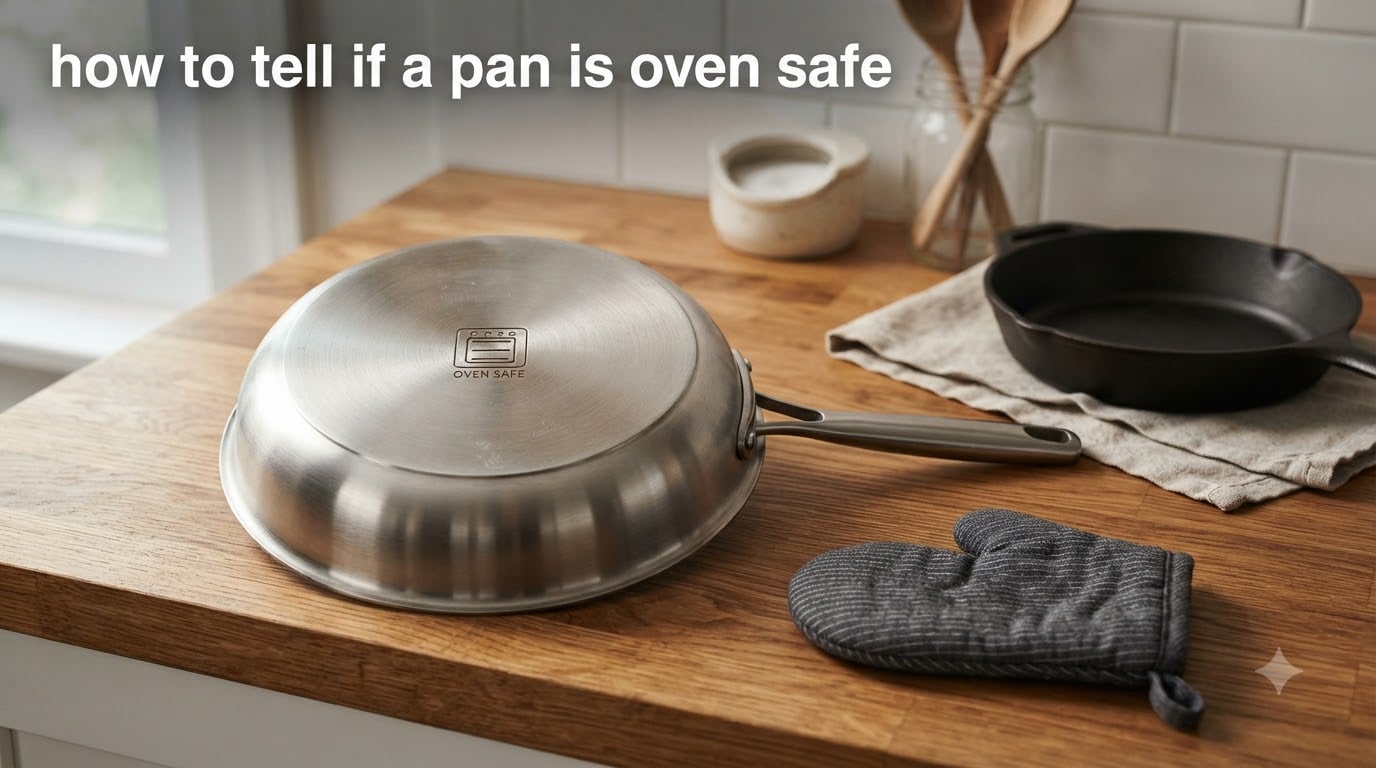
An oven-safe pan is one whose body, handles, and lid can all withstand oven temperatures (typically 350°F to 800°F+) without warping, melting, or releasing fumes. The fastest way to tell if a pan is oven safe is to flip it over and inspect the bottom of the base for an oven icon (a small square with horizontal rack lines), the words “Oven Safe,” or a specific temperature stamp such as “Oven Safe to 450°F.” If you only see a coil or loop symbol, that is induction-safe, which is not the same thing.
In this guide, I will walk you through exactly how to read those markings, decode the temperature stamps, and spot the warning signs on handles and lids. We pulled in research from Made In, Circulon, and Ideluxe, plus community threads from Reddit and Stack Exchange where home cooks keep running into the same problems.
Table of Contents
The 30-Second Check: How to Tell If a Pan Is Oven Safe
If you only have 30 seconds, run through this numbered checklist before putting any pan in a hot oven.
- Flip the pan upside down and look at the bottom of the base.
- Look for an oven icon (a small square with horizontal rack lines) or the words “Oven Safe.”
- Find a max-temperature stamp, if present (for example, “Oven Safe to 450°F”).
- Check the handle material. Metal handles are almost always oven-safe; plastic, wood, and low-grade rubber handles are not.
- Check the lid. A tempered glass or metal lid is fine; a plastic knob lowers the lid’s max temperature dramatically.
- If your recipe needs a higher temperature than the stamp allows, do not push the limit.
That is the entire workflow our team uses before any recipe calls for a stovetop-to-oven move. If a pan fails any single check, treat it as not oven-safe.
How to Read the Oven-Safe Symbol on the Bottom of a Pan
The oven-safe symbol is a small square containing three or four horizontal lines that look like a tiny oven rack. It is usually stamped, etched, or printed in light ink on the underside of the pan, near the brand logo and country of origin.
Three things to look for, in order of how often they appear:
- Oven icon: the small square with rack lines. This means the manufacturer has rated the pan for oven use, often with a specific max temperature nearby.
- Words: “Oven Safe,” “Oven Proof,” or “Oven-Safe to XXX°F” printed or engraved on the bottom.
- Temperature stamp: a single number with the degree symbol (for example, “450°F” or “260°C”). This is the max the pan can handle.
The symbol people most commonly confuse with the oven-safe icon is the induction-safe symbol, which is a flat coil or loop of wire. Induction-ready does not mean oven-safe. A pan can be induction-safe and still have a silicone handle that melts at 400°F, so always confirm the oven rating separately.
Oven-Safe Materials and Maximum Temperatures
Different materials tolerate different heat levels. Here is the cheat sheet we reference most often in our kitchen.
| Material | Typical Max Oven Temp | Notes |
|---|---|---|
| Cast iron | 500°F to 600°F+ | Can handle broiler; enameled version slightly lower |
| Carbon steel | 600°F to 1200°F | Often the highest-heat option; oven and broiler safe |
| Stainless steel (clad) | 500°F to 800°F | Cladded pans outperform disc-bottom pans |
| Hard-anodized aluminum | 400°F to 500°F | Check stamp; some lines are lower |
| Non-stick (PTFE/Teflon) | 350°F to 500°F | Older T-fal and similar lines cap at 350°F |
| Ceramic-coated | 400°F to 600°F | Coating can degrade faster than metal underneath |
| Enameled cast iron | 450°F to 500°F | Check lid knob material separately |
For most home cooking, 450°F covers the recipe, but if you plan to broil or sear-then-roast above 500°F, switch to cast iron, carbon steel, or clad stainless. Non-stick pans and most ceramic-coated pans should not see a broiler.
Stainless Steel Oven Safety
Yes, you can put a stainless steel pan in a 400°F oven, as long as the handle and any lid are also rated for that temperature. Quality cladded stainless pans from All-Clad, Made In, and Tramontina are typically rated to 500°F or 600°F, and sometimes higher. Bare disc-bottom pans (a thin steel plate welded to an aluminum core) can separate at very high heat, so keep them at 450°F or below.
Non-Stick Pan Oven Safety Limits
You can put a non-stick pan in the oven at 400°F only if the manufacturer’s stamp says it is rated for that temperature. Many non-stick pans cap out at 350°F, and going above that can break down the PTFE coating and release fumes. Older T-fal models, in particular, are commonly limited to 350°F. When in doubt, stay at or below 400°F for any modern non-stick pan and never put one under the broiler.
How to Check if Your Pan Handle Is Oven-Safe
The handle is the part most likely to fail in the oven. Even an all-metal pan can become unsafe if its handle is screwed on with plastic fittings or wrapped in low-melt silicone.
Identify what your handle is made of before you trust it:
- Solid metal (cast iron, carbon steel, stainless): almost always oven-safe to the pan’s max rating. The classic French-style skillet with a single long metal handle is the gold standard here.
- Riveted stainless or cast iron: the rivets are stainless steel, so they stay put. The handle itself is metal, so the pan is oven-safe.
- Bakelite (thermosetting plastic): a hard, glossy black or brown plastic that survives roughly 350°F to 400°F. Older pans often have these. Tap-test: a Bakelite handle feels dense, looks slightly glossy, and does not flex.
- Silicone overmold (silicone wrapped around a metal core): usually rated to about 400°F. Circulon’s silicone handles fall in this category.
- Plastic, wood, or low-grade rubber: not oven-safe. These melt, char, or crack well below 350°F.
Even with a “stay-cool handle” claim, always use an oven mitt. Stay-cool handles are designed to be comfortable on the stovetop, not safe to grab barehanded out of a 400°F oven. A Reddit thread on r/Cooking puts it bluntly: “All solid metal pans can go in the oven. Those without a plastic handle. Pans with silicone handles are usually oven-safe too.”
Does the Lid Have a Different Temperature Rating?
Yes, and this is the most common surprise for home cooks. The pan body might be rated to 500°F, but the lid often caps out lower because of its knob or glass type.
- Tempered glass lid: usually oven-safe to about 350°F to 400°F. Borosilicate glass versions push higher, around 450°F.
- Metal lid (stainless or aluminum): typically matches the pan’s rating.
- Lid with a plastic knob: limited to roughly 350°F to 400°F, regardless of what the glass can handle. This is the single most common hidden limit on a cookware set.
If your recipe needs the lid on at 450°F or higher, you have two options. Remove the lid entirely, or swap the plastic knob for an aftermarket stainless steel knob. Most lid knobs are held on by a single screw, so the swap takes about two minutes with a Phillips head screwdriver.
Pans and Materials to Avoid Putting in the Oven
Some pans and materials should never go in the oven, no matter how hot your recipe runs.
- Pans with plastic or wooden handles: melt, char, or catch fire well below 350°F.
- Pans with low-grade rubber grips: same risk as plastic handles.
- Most pure ceramic pans (unglazed): can crack from thermal shock. Glazed ceramic baking dishes are oven-safe; stovetop ceramic pans are often not.
- Plastic-bodied pans of any kind: even at 300°F, plastic will warp.
- Glass lids with plastic knobs above 400°F: the knob fails before the glass does.
- Non-stick pans under the broiler: the direct top-down heat destroys the coating and creates fumes.
If you have inherited a set, are buying secondhand, or have a pan with worn-off markings, the rules of thumb above still apply. Solid metal construction with a metal or Bakelite handle is almost always oven-safe.
What to Do When Your Pan Has No Markings
This is the question that comes up most often on Reddit’s r/Cooking and on Stack Exchange: the pan has no stamp, no icon, no paperwork. Here is the decision tree we use at Rotonde when a guest pan shows up at the pass.
- Confirm it is fully metal. A magnet will stick to cast iron, carbon steel, and most stainless. If it does not stick, it may be aluminum, which is still oven-safe but cannot be used on induction.
- Inspect every handle, knob, and grip. Any plastic, wood, or rubber component is your weak link. Treat the pan as not oven-safe until that component is removed or replaced.
- Check the lid for the same telltales. A tempered glass lid with a metal knob is usually fine to 400°F; a plastic knob forces the lid out at 350°F.
- If everything is metal or Bakelite, you can default to 400°F as a safe working limit. Push above that only after confirming the manufacturer’s rating.
- Look up the brand and model. Tramontina, T-fal, Gotham Steel, Sabichi, All-Clad, and Made In all publish spec sheets on their websites. A quick search for “[brand] [model] oven safe” almost always turns up the answer.
- If you still cannot find a rating, do not push the pan past 400°F. That is the threshold below which virtually every all-metal pan is safe.
If the symbol has worn off, you can use a fine-tipped paint pen to rewrite the max temperature directly on the handle. Painter’s tape works as a quick cheat sheet too: write the max temp on the tape and stick it to the handle or lid knob.
Practical Tips for Safe Oven Use
Even when the pan is rated for oven use, how you handle it matters. These are the rules our cooks follow every service.
- Avoid thermal shock. Do not move a hot pan onto a cold or wet surface, and do not put a cold glass or ceramic pan into a hot oven. The temperature change can crack glass or warp metal. Let pans come to room temperature before washing, and let glass pans warm up gradually.
- Watch the oil smoke point. When cooking above 300°F in the oven, use oils with high smoke points: avocado oil (~520°F), refined peanut oil (~450°F), or refined coconut oil (~400°F). Extra-virgin olive oil smokes around 375°F and will leave your kitchen smelling bitter.
- Broiler is a different game. Most non-stick pans and most glass lids are not broiler-safe. The broiler is essentially upside-down direct heat at 500°F to 550°F from a few inches away. Cast iron, carbon steel, and clad stainless are the pans that handle it.
- Always use mitts. Even metal handles get hot. A “stay-cool” handle claim is about stovetop comfort, not oven safety. The handle will be hot at 400°F.
- Let pans cool before washing. Quenching a hot cast iron or carbon steel pan in cold water can warp it. For glass and ceramic lids, thermal shock can shatter them outright.
A good rule of thumb from the Ideluxe team, and one we agree with: if the recipe temperature is above the pan’s max stamp, lower the oven by 25°F and add a few minutes to the cook time. Your roast will not notice the difference, and your pan will last years longer.
Frequently Asked Questions
What pans cannot go in the oven?
Any pan with a plastic, wooden, or low-grade rubber handle or knob should not go in the oven. Plastic-bodied pans, glass lids with plastic knobs above 400°F, and most non-stick pans are also not safe under the broiler. Pure unglazed ceramic pans can crack from thermal shock and should stay on the counter.
What is the symbol on a pan for oven-safe?
The oven-safe symbol is a small square with three or four horizontal lines that look like a tiny oven rack. It is usually stamped or printed on the underside of the pan. You may also see the words u0022Oven Safeu0022 or a specific temperature stamp such as u0022Oven Safe to 450°F.u0022 Do not confuse it with the induction-safe symbol, which is a flat coil or loop.
Can I put a stainless steel pan in a 400 degree oven?
Yes. Quality cladded stainless steel pans from brands like All-Clad, Tramontina, and Made In are typically rated to 500°F or 600°F, so a 400°F oven is well within their range. Just confirm that the handle and any lid are also rated for 400°F, since plastic or wooden components will fail before the pan body does.
What if I don’t have an oven-safe skillet?
If you do not have a clearly oven-safe skillet, use a metal baking dish or a Dutch oven instead. Cast iron, carbon steel, and clad stainless skillets are the most common oven-safe options. If you only have a non-stick or plastic-handled pan, transfer the food to a metal baking dish or sheet pan before finishing in the oven.
How do I know if my pan handle is oven safe?
Identify what the handle is made of. Solid metal handles (cast iron, carbon steel, stainless) are almost always oven-safe. Bakelite (a hard, glossy plastic) is usually rated to 350-400°F. Silicone-overmold handles typically handle 400°F. Plastic, wood, or low-grade rubber handles are not oven-safe and will melt or char well below 350°F.
Can you put a nonstick pan in the oven at 400 degrees?
Only if the pan is rated for it. Many non-stick pans, especially older T-fal models, are capped at 350°F. Modern PTFE-coated pans from brands like Circulon or All-Clad often allow 400°F to 500°F, but always check the stamp on the bottom. Never put a non-stick pan under the broiler, regardless of its oven rating.
Final Verdict on Oven-Safe Pans
Knowing how to tell if a pan is oven safe comes down to three checks: read the bottom for the oven icon or temperature stamp, inspect the handle for non-metal components, and inspect the lid the same way. If everything is metal or Bakelite, you can default to a 400°F working limit. If you need higher heat or broiler use, switch to cast iron, carbon steel, or clad stainless.
Before your next stovetop-to-oven recipe, take 30 seconds to flip each pan and confirm the rating. A little inspection now saves you from melted handles, degraded coatings, and a trip to the cookware store. For more on the stovetop-to-oven technique, our team at Rotonde has plenty of recipes that walk you through it step by step.