
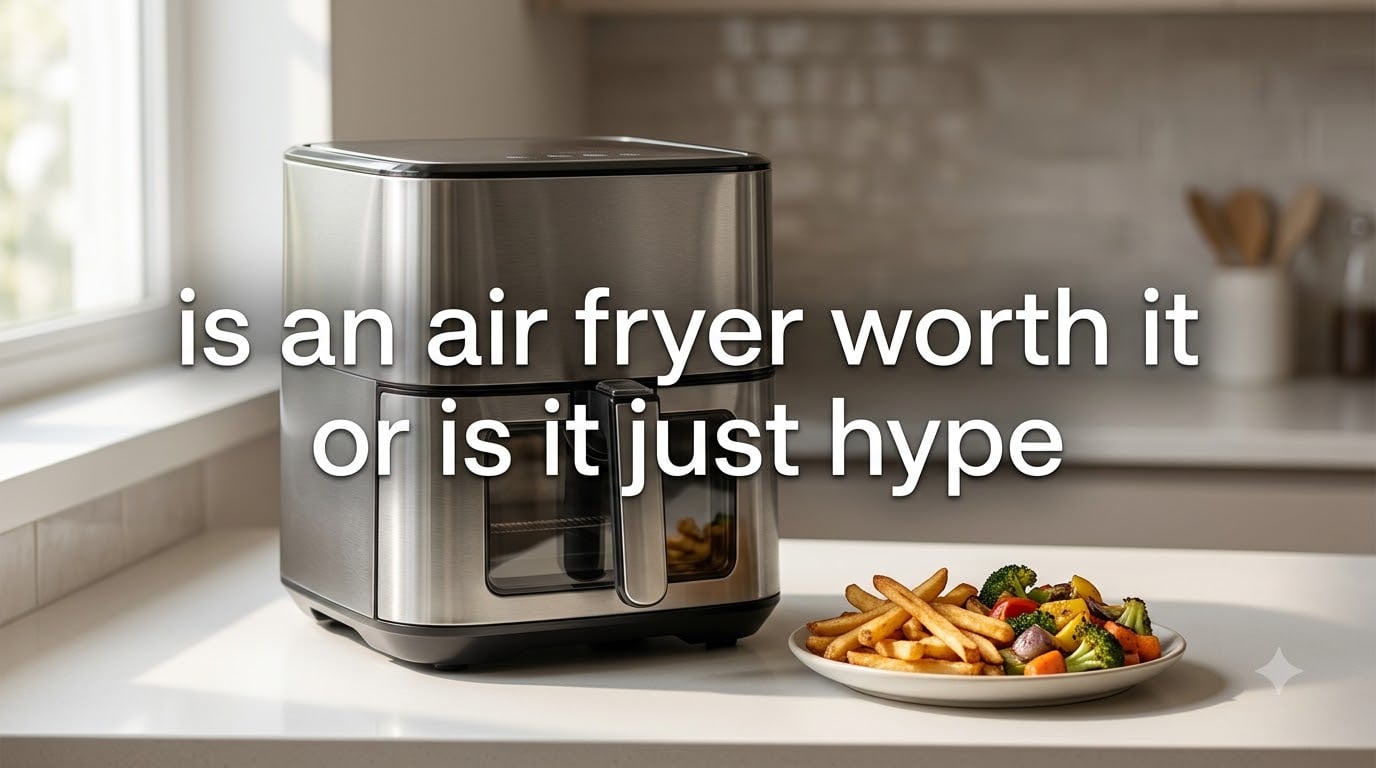
I spent six months testing an air fryer before writing this. I cooked frozen dumplings, salmon, Brussels sprouts, and a frankly questionable attempt at churros. By the end, my oven sat mostly untouched on weekday nights. So when someone asks me is an air fryer worth it or just hype, I have a real answer, not a marketing one.
Here’s the honest truth: air fryers are genuinely useful for the right person and a countertop-hogging gimmick for everyone else. There is no universal verdict. Whether one belongs in your kitchen depends on how you cook, how much space you have, and how often you reach for convenience over tradition.
In this guide, I’ll walk through what an air fryer actually does, the real pros and cons (including the ones advertisers skip), what doctors and Reddit users say, and a clear checklist for deciding if you should buy one in 2026.
Table of Contents
What Is an Air Fryer, Really?
An air fryer is a small countertop appliance that cooks food by circulating very hot air around it at high speed. It is not a fryer in the traditional sense. There is no oil bath, no submerged food, no deep-frying happening.
It is, mechanically speaking, a compact convection oven. A heating element at the top warms the air, and a powerful fan pushes that hot air around the food in a perforated basket. The fast-moving hot air removes moisture from the food’s surface and triggers the Maillard reaction, the same browning that gives roasted, baked, and fried food its flavor and crisp.
Two main styles exist. Basket-style air fryers look like a small rice cooker with a pull-out drawer. Toaster-oven-style air fryers have a front door, a rack, and often multiple cooking functions. Basket models tend to be cheaper and simpler. Oven-style models usually hold more food and can bake, toast, and broil.
How Air Fryers Work (In Plain English)
Most air fryers run between 1,500 and 1,800 watts and reach temperatures from about 180°F to 400°F. A heating coil glows red, and a fan above it blasts air down and around the food. Because the air moves fast and the basket is small, the heat hits the food evenly on all sides.
That fast, even heat is the whole trick. It is the same principle as a convection oven, just smaller and more focused. Convection cooking in general transfers heat faster than a conventional oven because moving air transfers energy more efficiently than still air.
The result is a brown, crispy outside with a tender inside, often in half the time a conventional oven would take.
The Real Pros of Air Fryers
Air fryers earned their popularity for good reasons. Here is what they actually deliver.
Speed: An air fryer typically preheats in under 3 minutes and cooks most foods in 10 to 15 minutes. A conventional oven takes 10 to 15 minutes just to preheat. For weeknight meals, that difference matters.
Less oil: You can cook most foods with a teaspoon of oil or none at all. Frozen fries that traditionally absorb a cup of oil during deep-frying come out of an air fryer with a fraction of that. For people trying to cut calories, this is the single biggest practical benefit.
Easy cleanup: Most baskets and trays are non-stick and dishwasher safe. There is no oil to dispose of, no splattered stovetop, and no greasy hood to scrub.
Energy efficiency: An air fryer uses roughly half the energy of a full-size oven for the same task, because it heats a smaller volume. If you replace four oven sessions a week with air fryer sessions, the savings on your electricity bill are noticeable over a year.
Cooler kitchen: Air fryers do not heat your entire kitchen the way a 350°F oven does in July. For apartments without central air, this is more than a nicety.
Great for small batches: Cooking for one or two? An air fryer is genuinely faster and more efficient than firing up an oven for a single chicken breast or a small portion of vegetables.
The Honest Cons and Drawbacks
Now for the part most reviews skip. Air fryers have real limitations.
Counter space: Even a 2-quart basket model takes up real estate on your countertop. Larger models can approach the size of a small microwave. Reddit threads in r/Cooking and r/AirFryers are full of people who gave theirs away because it never left the counter.
Small capacity: Most basket air fryers hold 2 to 5 quarts, which feeds one to three people. Cooking for a family of four or five usually means cooking in batches, which defeats the time-saving point.
Texture limitations: Air fryers cannot replicate wet-battered food. Tempura, beer-battered fish, and corn dogs simply do not work, because the batter drips through the basket before it can set. You also cannot deep-fry anything that needs to float in oil.
Food can dry out: Lean proteins like chicken breast and white fish can overcook quickly. Without enough oil, lean meats turn rubbery fast. The fix is brushing on a thin oil layer, but it is an extra step people forget.
Coating concerns: Many baskets use PTFE-based non-stick coatings (Teflon-style). At normal cooking temperatures these are stable, but if you routinely run the appliance above 400°F or preheat it empty for extended periods, the coating can degrade. Ceramic-coated baskets avoid this issue.
Noise: The fan is loud. Not jet-engine loud, but noticeably louder than a microwave. If your kitchen opens to a living room, this matters.
Fire risk with cheap models: Several recall notices have hit budget air fryers over the past three years due to overheating and electrical faults. The Reddit thread “Why is everyone getting rid of air fryers?” often traces back to a single cheap model that caught smoke.
Health Considerations: What the Evidence Says
The most-searched follow-up question to “is an air fryer worth it” is whether air fryers are healthy. The honest answer is nuanced.
Oil reduction is real: Studies comparing deep-fried versus air-fried foods consistently show air-fried versions contain 70 to 80 percent less fat. For people whose main concern is calorie reduction from cooking oil, the air fryer wins.
Acrylamide is a real concern: Acrylamide forms when starchy foods (potatoes, bread, crackers) are cooked at high temperatures above 250°F. Both ovens and air fryers can produce it. Air fryers do not eliminate acrylamide; they just cook for shorter times, which can reduce levels. Soaking potatoes in water for 30 minutes before air-frying reduces acrylamide further.
What doctors say: The American Heart Association has noted that cooking methods requiring less oil can support heart health goals. Registered dietitians on r/Frugal and r/Cooking consistently say air fryers are a tool, not a magic fix. They help with oil reduction but do not make French fries a health food.
Coating safety: PTFE coatings are considered safe below 500°F by the FDA and most regulatory bodies. Ceramic and stainless steel baskets are the safest option if you want zero coating concerns.
Advanced Glycation End Products (AGEs): Some research suggests high-heat, dry cooking methods, including air frying, can produce more AGEs than gentler methods like steaming. The research is still emerging and the increase is modest compared to actual deep frying.
Who Should Get an Air Fryer
Air fryers earn their counter space for these specific users.
Singles and couples: If you cook for one or two people, the basket capacity matches your portion sizes. You will use it often.
People who cook frozen food regularly: Frozen fries, chicken nuggets, taquitos, and spring rolls come out noticeably better in an air fryer than in an oven. If frozen food is a weekly staple, an air fryer is a clear win.
Apartment dwellers: Without a garage or outdoor space for grilling, an air fryer gives you a fast, low-smoke way to get crispy textures without heating your whole apartment.
Vegetarians and vegans: Roasted vegetables, tofu, chickpeas, and plant-based proteins come out excellent. Reddit’s vegan and vegetarian communities are some of the most enthusiastic air fryer users.
Older adults: Anyone uncomfortable handling hot oil benefits from the safety of an air fryer. There is no pot of boiling oil to manage.
Busy parents: Reheating leftovers for kids in an air fryer beats a soggy microwave every time.
Who Should Skip the Air Fryer
The hype bothers people for a reason. An air fryer is not for everyone.
If you already love your oven: If you roast, bake, and broil happily and your oven works well, an air fryer is redundant. It will collect dust within a month.
If you cook for four or more people daily: Batch cooking in a small basket takes longer than just using an oven. The math does not work for large families.
If your kitchen has zero storage: A 2-quart air fryer still needs a cupboard or shelf when not in use. If it will live on your counter permanently next to a coffee maker and toaster, the visual clutter adds up.
If you love wet-battered foods: Tempura, beer batter, and fritters need real oil. No air fryer substitutes for a deep fryer here.
If you tend to buy gadgets and abandon them: Be honest. If your Instant Pot sits in a cabinet, your air fryer will too. Wait until you commit to changing how you cook.
Air Fryer vs Oven: An Honest Side-by-Side
This comparison comes up constantly. Here is the practical breakdown.
- Preheat time: Air fryer 2-3 minutes, oven 10-15 minutes. Air fryer wins.
- Energy per use: Air fryer roughly 0.4 kWh for 20 minutes, oven roughly 1.0-1.5 kWh for the same. Air fryer wins.
- Capacity: Air fryer 2-5 quarts typically, oven full sheet pan. Oven wins for families.
- Crisp on frozen foods: Air fryer wins by a wide margin.
- Roasting a whole chicken: Oven wins. Most air fryers cannot fit one.
- Baking: Oven wins. Toaster-oven-style air fryers can handle small bakes.
- Heat in kitchen: Air fryer wins.
- Wet batter: Oven cannot do this either; only deep fryer wins.
The air fryer is a complement, not a replacement, for most households.
Common Myths About Air Fryers Debunked
Myth 1: Air fryers fry food with no oil. Mostly true but misleading. A teaspoon of oil on vegetables or a light spray on fries produces dramatically better results. Zero oil gives you dry food.
Myth 2: Air-fried food is always healthy. False. Air-fried French fries are still French fries. The cooking method is healthier, but portion size and ingredients still matter.
Myth 3: Air fryers replace ovens entirely. False for most people. They replace many small cooking tasks but not roasting a whole bird, baking a cake, or feeding a crowd.
Myth 4: Air fryers cook food from the inside out. False. They cook from the outside in, exactly like every other dry-heat method.
Myth 5: All air fryers are the same. False. Cheap models have unreliable thermostats and weak fans. Build quality varies dramatically.
Frequently Asked Questions
Why is everyone getting rid of air fryers?
Most people who get rid of their air fryer do so for one of three reasons: the unit took up too much counter space and got used less than expected, they bought a cheap model that failed within a year, or they realized their oven handled most of their cooking fine. A few Reddit users report fire-safety concerns with specific recalled models, which is worth checking before buying.
What is the downside of an air fryer?
The main downsides are limited capacity for family-sized meals, permanent counter space required for most models, inability to cook wet-battered foods, drying out of lean proteins if overcooked, and the noise of the fan. Non-stick coatings using PTFE are stable at normal cooking temperatures but may concern buyers who want to avoid them entirely.
Is an air fryer overhyped?
For people who cook for one or two, frequently heat frozen food, and want fast weeknight meals, an air fryer delivers real value and is not overhyped. For larger households, people who already enjoy oven cooking, or anyone with limited storage, the hype oversells what the appliance actually does. The marketing tends to position air fryers as replacements for ovens, which they are not for most cooks.
What do doctors say about air fryers?
Most dietitians and physicians view air fryers as a useful tool for reducing oil intake, which supports heart health and weight management goals. They do not consider air fryers a magic solution; the underlying food still matters. Doctors also note that high-heat cooking produces some acrylamide in starchy foods, though air fryers generally produce less than deep fryers due to shorter cook times.
Are air fryers really worth getting?
Yes for singles, couples, and anyone who cooks frozen food or reheats leftovers frequently. No for large families, people with tiny kitchens and no storage, or anyone who already loves roasting in a conventional oven. The honest answer depends entirely on your household size, cooking habits, and available counter space.
Is there anything unhealthy about air fryers?
Air fryers themselves are safe kitchen appliances. The cooking method produces some acrylamide in starchy foods, similar to but generally less than deep frying. Non-stick coatings using PTFE are considered safe by the FDA below 500°F, and air fryers normally operate below 400°F. Choosing a ceramic-coated or stainless steel basket eliminates this concern entirely for cautious buyers.
Final Verdict: Is an Air Fryer Worth It or Just Hype?
An air fryer is worth it if you cook for one or two people, use your oven mainly for small frozen or reheated meals, and have counter space to spare. It is hype if you already roast happily, cook for a family, or have a kitchen with no storage.
The appliance is not a replacement for an oven, a deep fryer, or good cooking. It is a fast, energy-efficient tool for specific tasks. If those tasks match your real weeknight habits, the air fryer earns its place. If not, save the counter space for something you will actually use.
My honest recommendation: borrow one for a week before buying. Most stores have generous return windows. Cook the five meals you would actually make at home. If you reach for it four nights out of seven, keep it. If it sits there looking decorative, you have your answer.